Push to End Crypto Staking Double Taxation Gains Momentum in Washington

bitcoinistОпубликовано 2025-12-23Обновлено 2025-12-23

Введение

As crypto staking becomes more widespread, U.S. lawmakers are pushing for clearer tax rules to avoid double taxation and simplify compliance. A bipartisan group of 18 House representatives has urged the IRS to update its guidance, arguing that taxing staking rewards only upon sale—rather than at receipt—would better reflect actual economic gains and reduce administrative burdens. They warn that current policies may discourage staking, which is crucial for blockchain security. Additionally, the newly introduced Digital Asset PARITY Act proposes a de minimis exemption for small stablecoin transactions and defers income recognition from staking for up to five years. These efforts reflect a growing consensus in Congress for more coherent crypto tax policies ahead of key 2026 tax changes.

As crypto staking shifts from a niche activity to a mainstream practice, long-standing gaps in U.S. tax policy are coming under closer scrutiny in Washington, with lawmakers warning that unclear and inconsistent rules could discourage participation in blockchain networks and complicate compliance for millions of investors.

Related Reading: Bitcoin Long-Term Holders Stay Resilient, But Profits Haven’t Fully Arrived – Here’s What To Know

With the 2026 tax year nearing, 18 bipartisan House lawmakers have urged the Internal Revenue Service to review staking tax guidance, arguing it results in double taxation, creating administrative burdens and failing to reflect actual economic gains, especially during volatile markets.

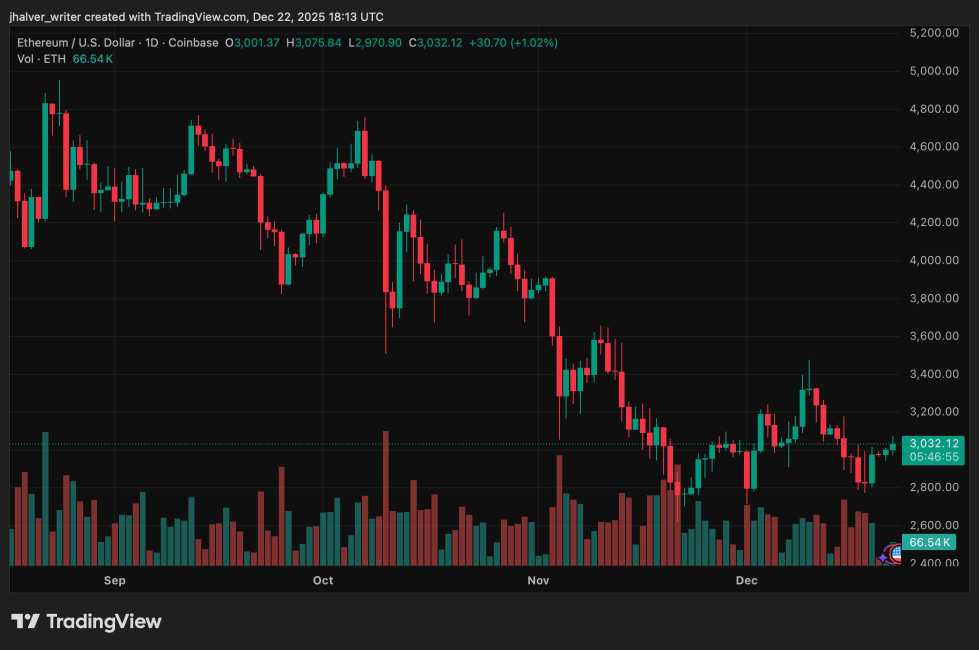
ETH's price trends to the downside on the daily chart. Source: ETHUSD on Tradingview

Lawmakers Press IRS Ahead of 2026

In a letter led by Representative Mike Carey, lawmakers asked whether any administrative barriers stand in the way of updating staking guidance before the end of the year. They argue that taxing rewards only at the point of sale would better capture actual economic gain while reducing reporting complexity.

The group also warned that current rules may discourage staking participation, which plays a critical role in securing proof-of-stake blockchains and maintaining network resilience.

The timing is deliberate. Several tax provisions are set to expire in 2026, and lawmakers want clarity on staking before broader tax debates take precedence. They also noted that prolonged uncertainty could invite unfavorable court rulings that lock in interpretations through precedent rather than policy.

The PARITY Act and Broader Crypto Tax Reform

Alongside the IRS letter, Representatives Steven Horsford and Max Miller have introduced a discussion draft known as the Digital Asset PARITY Act.

The proposal takes a wider view of crypto taxation, including a de minimis exemption for regulated stablecoin payments used in everyday transactions. Small gains or losses from these payments would generally not be taxed, mirroring existing treatment for low-value foreign currency exchanges.

For staking and mining, the PARITY Act stops short of eliminating immediate taxation but proposes allowing taxpayers to defer income recognition for up to five years.

Supporters say this could provide interim relief while lawmakers work toward permanent clarity. The bill also extends wash-sale rules and certain securities tax provisions to actively traded digital assets, aiming to curb abuse without expanding loopholes.

What Comes Next for Crypto Investors

Together, these efforts signal growing consensus in Congress that crypto taxation needs refinement rather than piecemeal fixes. While no changes are guaranteed, the push to address staking double taxation reflects a shift toward more technical, outcome-focused policymaking.

Related Reading: XRP ETFs Attract Global Pension Funds And Insurers, Canary CEO Reveals

For investors and network participants, the next year could determine whether staking remains burdened by uncertainty or moves toward a clearer, more predictable tax framework.

Cover image from ChatGPT, ETHUSD chart from Tradingview

Связанные с этим вопросы

QWhat is the main issue with current U.S. tax policy regarding crypto staking that lawmakers are addressing?

AThe main issue is that current tax rules result in double taxation, create administrative burdens, and fail to reflect actual economic gains, especially during volatile markets.

QHow many bipartisan House lawmakers have urged the IRS to review staking tax guidance ahead of the 2026 tax year?

A18 bipartisan House lawmakers have urged the IRS to review staking tax guidance.

QWhat specific change in taxation timing do lawmakers propose to better capture actual economic gain from staking rewards?

ALawmakers propose taxing staking rewards only at the point of sale, rather than immediately, to better capture actual economic gain and reduce reporting complexity.

QWhat is the name of the proposed draft legislation that addresses broader crypto taxation, including a de minimis exemption for stablecoin payments?

AThe proposed draft legislation is called the Digital Asset PARITY Act.

QHow does the PARITY Act propose to handle income recognition for staking and mining rewards?

AThe PARITY Act proposes allowing taxpayers to defer income recognition from staking and mining rewards for up to five years, providing interim relief while seeking permanent clarity.

Похожее

Retail Ecology Dwindles, ZKsync Bets on Bank Pilots for a Breakthrough

Amidst declining retail activity, ZKsync is pivoting to target institutional banking as its primary growth strategy. The article explores this shift, contrasting it with the competitive "survival of the fittest" narrative by highlighting a cooperative model inspired by naturalist Peter Kropotkin. ZKsync is developing infrastructure like its private, permissioned Prividium suite for banks (e.g., Deutsche Bank's use case via Memento), enabling private transactions with public verifiability via zero-knowledge proofs. This appeals to institutions needing privacy, compliance, and Ethereum-based settlement security, unlike fully private chains (e.g., JPMorgan's Kinaxis) or consortium models (e.g., R3 Corda). However, this strategic focus has coincided with a steep decline in its public DeFi ecosystem, evidenced by plunging TVL and the departure of major protocols like Aave due to low fees. The network's future now hinges on banking adoption, with upcoming pilots like the Cari Network involving regional banks holding over $600 billion in deposits. A significant challenge is balancing this institutional focus with ZKsync's decentralized governance. Banks must operate on a network where rules and fees (denominated in the volatile ZK token) can be changed via community vote, and where a Security Council holds emergency control—a stark contrast to the predictable, contract-bound environments of traditional finance. The coming 18 months will test whether ZKsync can successfully onboard traditional banks onto a dynamically governed public chain or if institutions will ultimately revert to proprietary solutions.

Foresight News36 мин. назад

Retail Ecology Dwindles, ZKsync Bets on Bank Pilots for a Breakthrough

Foresight News36 мин. назад

The Recursive AI Anthropic Warned About: Tian Yuandong's New Company Has Just Taken the "First Step"

Anthropic recently highlighted the rapid progress toward "recursive self-improvement," where AI systems autonomously design and train their successors. In response, Recursive Superintelligence, a new company co-founded by former Meta researcher Tian Yuan Dong, has publicly demonstrated its first step toward automating AI research. The company released a system designed to autonomously execute the full AI research cycle: generating ideas, implementing code, running experiments, and learning from results. It validated this approach by achieving state-of-the-art results on three diverse benchmarks: 1. **NanoChat Autoresearch:** Optimizing a small language model's validation loss under a fixed 5-minute GPU budget, improving upon the community's best result. 2. **NanoGPT Speedrun:** Reducing the time to train a GPT model to a specific loss on 8 H100 GPUs from 79.7 seconds to 77.5 seconds, beating a highly optimized, human-driven community effort. 3. **SOL-ExecBench:** Improving the overall score on NVIDIA's suite of 235 GPU kernel optimization tasks by 18%, closing the gap to the hardware limit. The system discovered novel optimizations in this highly specialized domain without direct human expertise. Recursive's system operates as a general framework, capable of parallel exploration and cross-task knowledge transfer while incorporating safeguards against reward hacking. The company, backed by $650M in funding and a star-studded team including Richard Socher and Alexey Dosovitskiy, aims to create AI that recursively enhances its own research capabilities. This development represents an early but concrete move toward a new paradigm where AI accelerates its own advancement. It occurs alongside Anthropic's warnings about the need for industry coordination and potential pauses when recursive self-improvement thresholds are reached, highlighting the dual trajectory of rapid technical progress and growing calls for careful stewardship.

marsbit43 мин. назад

The Recursive AI Anthropic Warned About: Tian Yuandong's New Company Has Just Taken the "First Step"

marsbit43 мин. назад

The Gold Buy-on-the-Dip Guide: Watch Interest Rates, Not Just War

"Gold Buying Guide: Focus on Interest Rates, Not Just War" Four months ago, gold buyers likely didn't anticipate buying at a peak that even a war couldn't sustain. After hitting a record high of $5,596 on January 29, gold entered a bear market just 91 days later, its fastest decline since 2008. A key trigger was the Fed's hawkish shift, highlighting that monetary policy, not geopolitics, is the primary driver. The article argues that the traditional "buy gold in turmoil" script has changed. While the US-Iran conflict initially boosted prices, the sustained rally in oil prices heightened inflation fears, forcing central banks to maintain or consider tighter policy. Since gold yields no interest, higher rates increase its opportunity cost, eroding its appeal. This dynamic was evident when gold fell sharply on May 18 despite positive peace talks, as lower oil prices eased inflation and thus rate hike pressures. The recent sell-off is also part of a broader market deleveraging. Correlations between gold, Nasdaq, and Bitcoin spiked as leveraged investors sold liquid assets to cover losses, creating a synchronized downturn. Historically, gold bottoms align with policy shifts, not conflict resolutions. The 2008 and 2022 bear markets ended with shifts to extreme easing and peak inflation expectations, respectively. For potential buyers, the author suggests monitoring three signals: 1) Peak interest rate hike expectations, 2) Reopening of the Strait of Hormuz (to ease oil/inflation pressure), and 3) A return to net inflows for Gold ETFs, indicating the end of forced selling. While predicting the exact bottom is impossible, the author's personal strategy involves scaling into a position across price levels like $4000, $3700, and $3500, committing no more than 30% of the intended total allocation initially, and adding the remainder only if key signals emerge. The core conclusion: In turbulent times, watching interest rates is more crucial than watching wars.

marsbit50 мин. назад

The Gold Buy-on-the-Dip Guide: Watch Interest Rates, Not Just War

marsbit50 мин. назад

Recent On-Chain Review: No Clear Narrative Under U.S. Stock Market Pressure, Just Hype

This article analyzes the current state of the Solana meme coin and community token ecosystem, highlighting a market caught between two dominant forces: attention-based PvP and a gradual return to community-centric projects. The first part explores the "Attention PvP" dynamic, where success is driven by celebrity endorsements, viral events, and speed. Examples include $JOTCHUA, which surged after its meme creator's social media activity, and $WORLDCUP, which outperformed a similar Base chain project ($PITCH) largely due to influencer support. The recent "pump.fun GO" feature, allowing bounty tasks for token promotion, is critiqued for fostering sensationalist and often negative stunts—like people getting token tickers tattooed on their bodies for rewards—reminiscent of old internet shock content. In contrast, the article points to a resurgence of organic, community-driven tokens that survive market volatility through strong holder bases and shared ideology, not just hype. Influencer Ansem is cited, arguing that durable meme coins rely on communities willing to endure losses and promote their core message daily. Examples given are older tokens like $neet (anti-work ethos), $troll, $buttcoin, and $triplet, which have maintained relative price stability. A prime example of this community-build model is the new project $KINS, the token for the browser-based MMORPG Kintara. Its success stems not from advanced graphics but from consistently delivering updates, fostering player trust, and creating genuine engagement (e.g., in-game economies, events, property auctions). It has attracted a growing player base and even notable KOLs as participants, demonstrating that sustainable growth can come from building trust rather than orchestrating pumps. The article concludes by questioning whether the market is ultimately a game of mutual trust or mutual deception, expressing hope that such reflection might lead to a healthier ecosystem.

marsbit50 мин. назад

Recent On-Chain Review: No Clear Narrative Under U.S. Stock Market Pressure, Just Hype

marsbit50 мин. назад

Торговля

Спот
Фьючерсы

Популярные статьи

Как купить PUSH

Добро пожаловать на HTX.com! Мы сделали приобретение Push Protocol (PUSH) простым и удобным. Следуйте нашему пошаговому руководству и отправляйтесь в свое крипто-путешествие.Шаг 1: Создайте аккаунт на HTXИспользуйте свой адрес электронной почты или номер телефона, чтобы зарегистрироваться и бесплатно создать аккаунт на HTX. Пройдите удобную регистрацию и откройте для себя весь функционал.Создать аккаунтШаг 2: Перейдите в Купить криптовалюту и выберите свой способ оплатыКредитная/Дебетовая Карта: Используйте свою карту Visa или Mastercard для мгновенной покупки Push Protocol (PUSH).Баланс: Используйте средства с баланса вашего аккаунта HTX для простой торговли.Третьи Лица: Мы добавили популярные способы оплаты, такие как Google Pay и Apple Pay, для повышения удобства.P2P: Торгуйте напрямую с другими пользователями на HTX.Внебиржевая Торговля (OTC): Мы предлагаем индивидуальные услуги и конкурентоспособные обменные курсы для трейдеров.Шаг 3: Хранение Push Protocol (PUSH)После приобретения вами Push Protocol (PUSH) храните их в своем аккаунте на HTX. В качестве альтернативы вы можете отправить их куда-либо с помощью перевода в блокчейне или использовать для торговли с другими криптовалютами.Шаг 4: Торговля Push Protocol (PUSH)С легкостью торгуйте Push Protocol (PUSH) на спотовом рынке HTX. Просто зайдите в свой аккаунт, выберите торговую пару, совершайте сделки и следите за ними в режиме реального времени. Мы предлагаем удобный интерфейс как для начинающих, так и для опытных трейдеров.

861 просмотров всегоОпубликовано 2024.03.29Обновлено 2026.06.02

Как купить PUSH

Обсуждения

Добро пожаловать в Сообщество HTX. Здесь вы сможете быть в курсе последних новостей о развитии платформы и получить доступ к профессиональной аналитической информации о рынке. Мнения пользователей о цене на PUSH (PUSH) представлены ниже.

活动图片