‘Ownership must be tracked at creation’ – Can Camp Network solve it?

ambcryptoОпубликовано 2026-03-23Обновлено 2026-03-23

Введение

Camp Network, a blockchain startup, proposes using crypto to address challenges in entertainment finance and digital ownership, particularly as AI accelerates content creation. It replaces traditional intermediaries with "on-chain vaults" for programmable ownership and automated revenue distribution, allowing communities to fund projects and share in IP success. The system emphasizes "proof of provenance" to track ownership at creation, ensuring proper attribution and royalties. While the model has attracted investment and industry interest, adoption remains cautious, with executives seeking solutions to real inefficiencies like rights tracking and payment delays rather than added complexity.

Camp Network, a blockchain startup focused on artificial intelligence [AI] and intellectual property [IP], is pitching crypto as a fix for growing problems in entertainment finance and digital ownership.

The pitch comes as AI speeds up content creation, while funding and rights systems lag.

Creators often face unclear ownership and complex financing. Camp Network’s approach, using blockchain-based “on-chain vaults”, tries to replace intermediaries with programmable ownership and automated revenue flows.

Funding without middlemen

In an interview with AltcoinDesk, Co-Founder Nirav Murthy said entertainment financing remains slow and controlled by a few players. Creators often give up equity and pay high legal costs to secure funding.

Camp’s model allows communities to fund projects directly. Fans can share in the upside of the IP they support. A recent example included a $200,000 vault used for film post-production and marketing.

Murthy said this model builds stronger audiences. Supporters become more engaged when they have economic exposure.

Tokenizing entertainment flows collapses the distance between creators, capital, and audiences.

The company said 53 global music festivals have joined the network, including Clockenflap and S2O Festival.

Industry response remains cautious. In an interview with IBM, a New York City-based record label said,

Royalty payments are often three to six months delayed. What happens if a song blows up and when the stats come in, not everyone was credited? At that point, changing the metadata is a pain and often swept under the rug.

Executives are open to blockchain only if it solves real inefficiencies such as cross-border payments, rights tracking and revenue distribution, rather than adding complexity.

AI exposes cracks in ownership

The pressure comes from AI’s rapid growth. Content is being created faster than ownership systems can track.

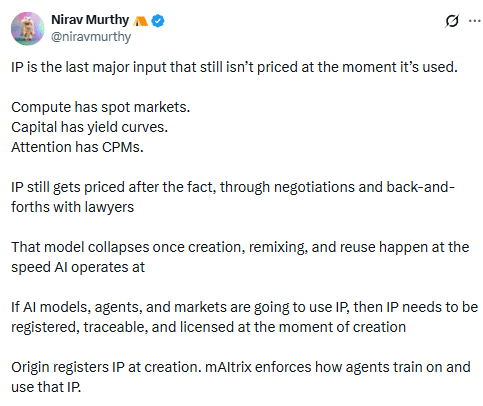
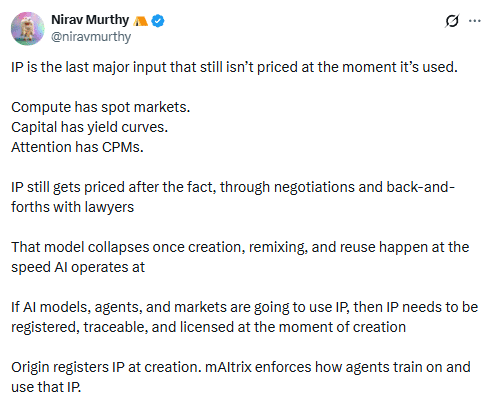
IP still gets priced after the fact... that model collapses once creation happens at AI speed.

Murthy said ownership must be tracked at the moment of creation. Delays can leave creators without payment or control.

Source: Nirav Murthy/X

Camp Network’s system focuses on “proof of provenance,” which records who created content and how it is used. The goal is to allow creators to license work and receive royalties automatically.

The company describes this as building an “Autonomous IP Layer” for AI systems, where data used to train models is traceable and permissioned.

That approach aligns with broader industry concerns. According to a16z Crypto’s State of Crypto 2025 report, AI and blockchain are increasingly converging, with crypto infrastructure evolving into a core layer of the digital economy.

Capital flows into IP blockchains

Investors have backed this approach.

Camp Network has raised about $30 million across funding rounds. That includes a $25 million Series A led by 1kx and Blockchain Capital.

Murthy has also pointed to broader changes in the market, including how creators and platforms are reacting to AI.

If you’re a startup trying to train a voice model or a video model... you can’t do it anymore

At the same time, legal pressure is rising. Creators and publishers have filed lawsuits over AI training on copyrighted material.

Anyways, adoption remains uneven. Institutional investors still dominate early participation in tokenized assets. As AI creates more content, ownership may become harder to define.


Final Summary

  • Creators still face slow financing, high legal costs, and loss of equity under traditional systems.
  • Camp’s “on-chain vaults” enable direct funding from communities, allowing fans to share in IP revenue.

Связанные с этим вопросы

QWhat problem does Camp Network aim to solve in the entertainment and AI industries?

ACamp Network aims to solve problems related to unclear ownership, complex financing, and delayed royalty payments in entertainment and AI-driven content creation by using blockchain technology to provide programmable ownership and automated revenue flows.

QHow does Camp Network's 'on-chain vaults' model work for funding creative projects?

ACamp Network's 'on-chain vaults' allow communities to fund projects directly, enabling fans to share in the financial upside of the intellectual property they support. This model replaces intermediaries and reduces legal costs while building stronger audience engagement through economic exposure.

QWhy is tracking ownership at the moment of creation particularly important in the age of AI?

ATracking ownership at creation is crucial because AI accelerates content generation beyond the capacity of traditional ownership systems. Delays in establishing ownership can leave creators without payment or control, especially when content goes viral or is used in training AI models without proper attribution.

QWhat is Camp Network's approach to ensuring proof of provenance for digital content?

ACamp Network focuses on 'proof of provenance,' which records who created content and how it is used. This system allows creators to license their work and receive royalties automatically, ensuring traceable and permissioned use of data, particularly in AI training.

QHow much funding has Camp Network raised, and which firms led their Series A round?

ACamp Network has raised about $30 million across funding rounds, including a $25 million Series A led by 1kx and Blockchain Capital.

Похожее

Why Not Short Even When Bearish? Munger Did the Math on a 'Losing Trade'

Why Not Short Even When Bearish? Charlie Munger's Calculated "Loss-Making Account" Many traders, drawn to speculative tools like futures contracts, often face repeated failures. As the article notes, unless one is a genius, such instruments should be avoided for long-term profit-seeking. Similarly, the practice of short selling is viewed with caution. The author firmly states a policy of not shorting, even when bearish, preferring to simply wait. The core reason? Successful short selling requires exceptionally difficult conditions to profit. Legendary investors Warren Buffett and Charlie Munger have themselves reflected on painful short-selling experiences. Munger highlights two critical flaws in the mathematical logic of shorting: 1. Asymmetrical Risk/Reward: A long position has a maximum loss of 100% but unlimited upside. A short position caps profit at 100% (if a stock falls to zero) but carries theoretically unlimited loss potential. 2. The "Promoter" Problem: Fraudulent or struggling companies can prolong their decline. As Munger said, "You can run out of money before the promoter runs out of ideas," meaning short sellers may be forced to cover positions at a loss before the company's true fate unfolds. The article cites Stanley Druckenmiller, a famed hedge fund manager. He once shorted 12 companies that all eventually went bankrupt. However, intense market rallies forced him to cover his positions within three weeks, resulting in massive losses—$200 million of his capital plus an additional $600 million. He concluded he likely never made money shorting in his career. His experience perfectly illustrates Munger's points: facing unlimited losses and being wiped out before being proven right. The conclusion is clear: for most investors, complex instruments like short selling and derivatives are not viable paths to stable, long-term gains. Self-reflection is advised before repeatedly wasting time and capital on such speculative strategies.

marsbit17 мин. назад

Why Not Short Even When Bearish? Munger Did the Math on a 'Losing Trade'

marsbit17 мин. назад

For Hedging, Buy Gold and Oil; For Explosive Growth, Buy AI; Bitcoin, the 'Outdated' Asset, Enters a Bear Market

Bitcoin’s price has recently fallen sharply, hitting a two-month low near $66,000, with Ethereum also dropping to a three-month low. While surface explanations point to ETF outflows, geopolitical tensions, and corporate selling, a deeper issue is emerging: Bitcoin is losing a crucial asset competition. For years, Bitcoin thrived in a low-rate environment where investors sought alternatives amid inflation fears and dissatisfaction with traditional options. Now, the market landscape has shifted, leaving Bitcoin stuck in an "awkward middle ground," facing challenges on three fronts: 1. **As an inflation hedge, gold is winning.** Investors worried about persistent inflation are turning to tangible assets like gold, energy stocks, and commodity producers, which offer more direct pricing power and physical backing. 2. **For growth exposure, AI is winning.** Those seeking high growth now favor AI-related companies with actual revenues and profits, an area where Bitcoin's lack of cash flow puts it at a disadvantage. 3. **Within crypto, infrastructure and stablecoins are winning.** Even investors wanting crypto exposure have alternatives like exchanges, stablecoin issuers, and tokenization firms, whose performance is directly tied to real-world adoption and offers clearer operational leverage. The recent market reaction to inflation warnings highlights this shift. Instead of boosting Bitcoin as "digital gold," such news now drives flows toward traditional inflation-sensitive assets. Therefore, recent events like ETF outflows and corporate selling are seen not as causes, but as symptoms of this new reality. Capital has more compelling options, and investors are becoming more selective. The emerging bear case for Bitcoin is no longer about it being a fraud or failed technology, but rather that **scarcity alone is no longer enough**. It is no longer seen as the best hedge, the best growth asset, or the only crypto play.

marsbit33 мин. назад

For Hedging, Buy Gold and Oil; For Explosive Growth, Buy AI; Bitcoin, the 'Outdated' Asset, Enters a Bear Market

marsbit33 мин. назад

SaaS Battle Royale: The Survivors Who Win All Share One Common Trait

**Summary** The AI revolution has triggered a "SaaS apocalypse," forcing a brutal market shakeout. The key dividing line is the pricing model. Companies like Snowflake and Datadog, which charge based on consumption (e.g., data processed or compute used), are thriving. AI workloads actively *generate* more demand for their services, fueling growth. Datadog's accelerating revenue is a prime example. Microsoft and Palantir, as platform/ecosystem players, also benefit by acting as essential channels for AI deployment. In contrast, traditional SaaS firms built on per-seat or per-task licensing (e.g., Intuit, Adobe) face direct pressure, as AI threatens to automate the very human tasks their software supports. Companies like Salesforce, a per-seat giant, are caught in the middle. While showing strong AI monetization (e.g., its Agentforce platform) and experimenting with consumption-based "Flex Credits," its stock remains under pressure, illustrating that the market rewards *completed* transitions, not just the intent. The recent Microsoft Build conference underscored key trends: AI is evolving from an assistant to an autonomous "agent," and platform providers like Microsoft are consolidating their control. The market's recovery is highly selective, focused on identifying which companies are "fed by AI" versus "eaten by AI." Future focus will be on the diffusion of this recovery to transforming companies and the real-world adoption data of AI agents like Microsoft Copilot.

marsbit50 мин. назад

SaaS Battle Royale: The Survivors Who Win All Share One Common Trait

marsbit50 мин. назад

Торговля

Спот
Фьючерсы

Популярные статьи

Как купить CAMP

Добро пожаловать на HTX.com! Мы сделали приобретение Camp Network (CAMP) простым и удобным. Следуйте нашему пошаговому руководству и отправляйтесь в свое крипто-путешествие.Шаг 1: Создайте аккаунт на HTXИспользуйте свой адрес электронной почты или номер телефона, чтобы зарегистрироваться и бесплатно создать аккаунт на HTX. Пройдите удобную регистрацию и откройте для себя весь функционал.Создать аккаунтШаг 2: Перейдите в Купить криптовалюту и выберите свой способ оплатыКредитная/Дебетовая Карта: Используйте свою карту Visa или Mastercard для мгновенной покупки Camp Network (CAMP).Баланс: Используйте средства с баланса вашего аккаунта HTX для простой торговли.Третьи Лица: Мы добавили популярные способы оплаты, такие как Google Pay и Apple Pay, для повышения удобства.P2P: Торгуйте напрямую с другими пользователями на HTX.Внебиржевая Торговля (OTC): Мы предлагаем индивидуальные услуги и конкурентоспособные обменные курсы для трейдеров.Шаг 3: Хранение Camp Network (CAMP)После приобретения вами Camp Network (CAMP) храните их в своем аккаунте на HTX. В качестве альтернативы вы можете отправить их куда-либо с помощью перевода в блокчейне или использовать для торговли с другими криптовалютами.Шаг 4: Торговля Camp Network (CAMP)С легкостью торгуйте Camp Network (CAMP) на спотовом рынке HTX. Просто зайдите в свой аккаунт, выберите торговую пару, совершайте сделки и следите за ними в режиме реального времени. Мы предлагаем удобный интерфейс как для начинающих, так и для опытных трейдеров.

502 просмотров всегоОпубликовано 2025.08.27Обновлено 2026.06.02

Как купить CAMP

Обсуждения

Добро пожаловать в Сообщество HTX. Здесь вы сможете быть в курсе последних новостей о развитии платформы и получить доступ к профессиональной аналитической информации о рынке. Мнения пользователей о цене на CAMP (CAMP) представлены ниже.

活动图片