Japan’s Largest Banks Eye FY2026 Stablecoin Rollout Amid Regulatory Push

bitcoinistОпубликовано 2026-06-11Обновлено 2026-06-11

Введение

Japan's three largest banks—MUFG Bank, Sumitomo Mitsui Banking Corp., and Mizuho Bank—are advancing plans to launch a jointly-issued yen-pegged stablecoin by the end of fiscal year 2026 (March 31, 2027). They have established a voluntary council to develop the operational framework, governance, and issuance infrastructure for the token, which will be issued under a trust agreement. The move aligns with Japan's regulatory push to expand its yen-based digital asset market, following 2022 amendments to the Payment Services Act that restrict stablecoin issuance to licensed entities like banks and trust companies. The banks, which began exploring this initiative in late 2025, aim to support a wide range of use cases and are considering future collaborations with other financial institutions. This development occurs alongside other yen-stablecoin launches and recent political proposals to promote such tokens for settlement in Asia.

As Japanese financial authorities push to expand the yen-based digital asset market, three megabanks have advanced their joint stablecoin plans by establishing a council to develop the framework for issuing the token this fiscal year.

Megabanks Advance Joint Stablecoin Plans

The three largest Japanese banks, Mitsubishi UFJ Financial Group (MUFG) Bank, Sumitomo Mitsui Banking Corp., and Mizuho Bank, are preparing to launch their jointly issued stablecoin by the end of the 2026 fiscal year (FY2026).

In a Wednesday statement, the megabanks revealed their plan to conduct commercial transactions during FY2026 using a stablecoin issued under a trust agreement, where the three banks will serve as joint settlors and a trust bank or similar entity will act as trustee.

The banks announced they have signed a memorandum of understanding (MoU) to form a joint voluntary council to review operational frameworks, governance, and related issues to support the token’s practical implementation.

“The Council will serve as a framework for examining the potential development of an issuance infrastructure related to the Subject Stablecoin, as well as the design of systems, schemes, and governance structures,” the statement read.

The three banks will also accelerate their efforts to support the potential use of these tokens across a wide range of use cases, aiming to launch live transactions of the joint stablecoin before March 31, 2027, when the current fiscal year ends. In addition, the council will also consider collaborations with financial institutions and other relevant stakeholders that may join the project in the future.

Notably, the megabanks, which serve over 300,000 companies combined, began exploring the launch of a joint stablecoin in late 2025, with initial reports suggesting plans to debut the token within FY2025.

In November, the banks announced a pilot project under the Financial Services Agency’s (FSA) Payment Innovation Project. The pilot used the infrastructure of Tokyo-based fintech company Progmat and aimed to gather “practical knowledge” on the joint issuance of a stablecoin and advanced cross-border payments.

Japan’s Regulatory Push For Yen-Backed Tokens

In 2022, Japanese authorities amended the Payment Services Act to establish a legal framework for stablecoins. Under the new regime, only licensed money transfer companies, trust companies, and banks are allowed to issue yen-denominated tokens.

Tokyo fintech company JPYC launched the first yen-pegged token, JPYC, in October, backed by yen reserves, including bank deposits and government bonds. Earlier this year, SBI Holdings partnered with Startale Group for JPYSC, a trust bank-backed yen stablecoin for institutional and cross-border use cases.

Last week, Japan’s Liberal Democratic Party (LDP) called for the creation of rules for crypto exchange-traded funds (ETFs) and the promotion of yen-denominated stablecoins in the region in a new proposal to the government.

Junichi Kanda, a lawmaker on the ruling party’s panel, affirmed that the LDP pushed the government to boost the use of yen stablecoins in the region. “We urged the government to take steps to promote ​yen stablecoins for settlement in Asia in the future,” he stated.

The lawmaker also said that Japan could promote yen-based tokens and blockchain innovation next year, when the country hosts the Asian Development Bank’s annual meeting.

Meanwhile, the FSA recently expanded the Cabinet Office Ordinance to recognize certain trust-type stablecoins issued by foreign trust banks and similar entities as electronic payment instruments under the Payment Services Act.

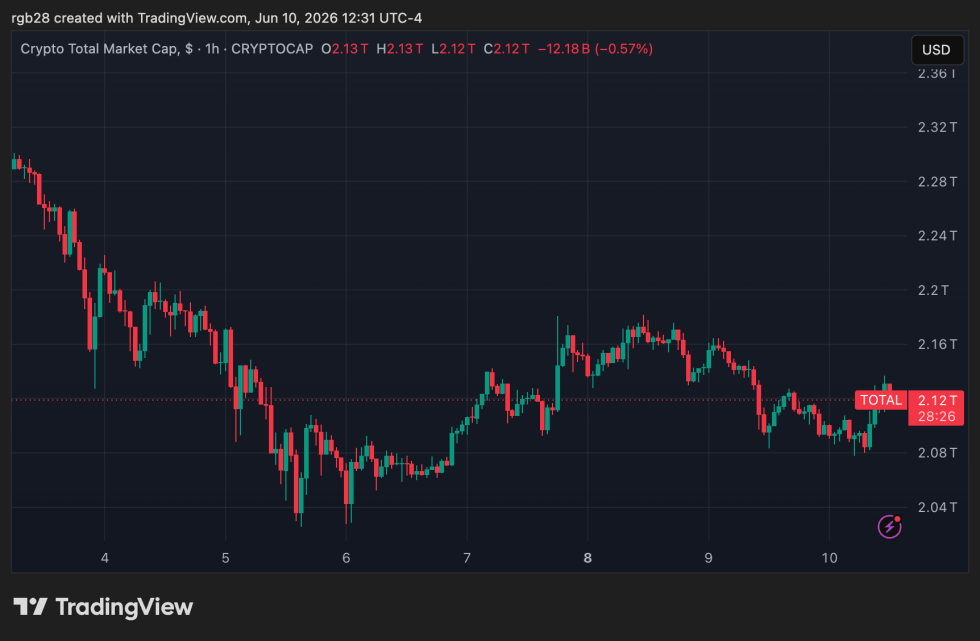
The total crypto market capitalization is at $2.12 trillion in the one-week chart. Source: TOTAL on TradingView

Связанные с этим вопросы

QWhat is the target fiscal year for Japan's three megabanks to roll out their jointly issued stablecoin?

AThe target fiscal year is FY2026, aiming for launch before March 31, 2027.

QWhich three Japanese megabanks are collaborating on the joint stablecoin project?

AThe three banks are Mitsubishi UFJ Financial Group (MUFG) Bank, Sumitomo Mitsui Banking Corp., and Mizuho Bank.

QWhat recent regulatory change in Japan created a legal framework for stablecoin issuance?

AIn 2022, Japanese authorities amended the Payment Services Act to establish a legal framework, allowing only licensed money transfer companies, trust companies, and banks to issue yen-denominated stablecoins.

QWhat is the purpose of the voluntary council formed by the three megabanks?

AThe council's purpose is to examine the development of an issuance infrastructure, as well as the design of systems, schemes, and governance structures to support the practical implementation of their joint stablecoin.

QHow does Japan's ruling Liberal Democratic Party (LDP) intend to promote yen stablecoins according to the article?

AThe LDP, through a lawmaker on its panel, urged the government to promote yen stablecoins for settlement in Asia, potentially leveraging events like next year's Asian Development Bank annual meeting which Japan will host.

Похожее

The Largest IPO in History Ignites Heated Debate: Is SpaceX Worth $1.77 Trillion?

SpaceX's potential IPO is priced at $135 per share, aiming to raise $75 billion and valuing the company at approximately $1.77 trillion, which would make it the largest IPO in history. This valuation has sparked intense debate among investors. Bullish analysts, including major underwriters Goldman Sachs and Morgan Stanley, argue the valuation is justified by SpaceX's long-term potential. They see it not just as a rocket company but as a future leader in space infrastructure, with key growth drivers being Starlink satellite internet, low-cost rocket launches, and future AI-related ventures. They project revenues reaching hundreds of billions to trillions of dollars by 2030-2040. ARK Invest's model suggests a 2030 enterprise value could reach $2.5 trillion. Bearish analysts from independent research firms like Morningstar, PitchBook, and New Constructs contend the IPO price is excessively high, already pricing in unrealistic future growth. Using DCF and sum-of-the-parts models, they estimate fair value between $780 billion and $1.7 trillion, significantly below the IPO target. They highlight risks such as the speculative nature of AI projections, over-dependence on Elon Musk, high growth expectations, and corporate governance concerns. Trefis set a target price of just $79 per share. While both sides acknowledge SpaceX's unique position in commercial space, the core disagreement centers on whether the $135 share price offers a reasonable margin of safety or is overly optimistic. Despite the valuation controversy, reported strong demand for the IPO indicates significant market interest.

marsbit43 мин. назад

The Largest IPO in History Ignites Heated Debate: Is SpaceX Worth $1.77 Trillion?

marsbit43 мин. назад

After the Passage of the GENIUS Act and the CLARITY Act, What Is the Correct Architecture for On-Chain Yield?

The article discusses the evolution of on-chain credit, distinguishing three markets: overcollateralized crypto lending, unsecured lending (largely unsuccessful), and asset-backed credit (ABC). ABC, backed by identifiable real-world collateral with legal recourse, is identified as the fastest-growing category and the only one credibly addressing adverse selection—the core problem in credit where the riskiest borrowers self-select. Current growth in on-chain Real World Assets (RWAs), particularly tokenized private credit funds (e.g., Maple Finance, Centrifuge), is substantial but often merely "wraps" existing fund structures, inheriting their risks rather than solving adverse selection at the protocol level. The regulatory landscape is a key driver, with the US GENIUS Act (prohibiting stablecoin issuers from paying yield) and the proposed CLARITY Act (closing loopholes on indirect yield) set to redefine permissible yield-bearing products. This makes vaults (like ERC-4626) the critical architecture—they become the primary compliant vehicle for delivering yield, functioning as issuance, disclosure, distribution, and recovery mechanisms. The author's thesis is that the correct post-GENIUS/CLARITY architecture involves building ABC solutions where credit assessment, structure, and recovery are encoded directly into the smart contract vault layer, moving beyond mere tokenized fund wrappers to solve adverse selection fundamentally and ensure regulatory compliance.

Foresight News1 ч. назад

After the Passage of the GENIUS Act and the CLARITY Act, What Is the Correct Architecture for On-Chain Yield?

Foresight News1 ч. назад

TechFlow Intelligence Bureau: Anthropic's New Model Fable Sparks Controversy by Restricting Biosafety Research, US CPI Soars to 4.2%, a Three-Year High

**Summary of TechFlow Intelligence Report:** The newsletter covers several key tech and finance developments. In AI, Anthropic's new Fable model faced backlash for secretly limiting biomedical research capabilities and enforcing a 30-day data retention policy, prompting the company to promise more transparent adjustments. In a related story, Anthropic's founder revealed his departure from OpenAI was due to dishonesty from Sam Altman, not safety concerns. Meanwhile, OpenAI is considering significant price cuts to compete with Anthropic, potentially sparking a price war. In crypto/Web3, BlackRock filed a new amendment for a yield-generating Bitcoin ETF, while Bank of America's CEO warned that stablecoin yields could drain trillions from traditional banks. U.S. Senator Cynthia Lummis advocated for the U.S. to officially accumulate Bitcoin reserves. In hardware, Nvidia released the DiffusionGemma-2-6B image model optimized for efficient inference, and AMD promoted its unified memory architecture to challenge Nvidia's dominance. TSMC's CFO hinted at possible price increases due to soaring AI chip demand. A major legal ruling in Germany held Google legally responsible for inaccurate information generated by its AI Overviews feature. Google Chrome also moved to fully block ad-blocker workarounds like uBlock Origin. Macroeconomic headlines included U.S. CPI rising to 4.2% (a 3-year high) and Iran's complete closure of the Strait of Hormuz, raising oil price and inflation fears. South Korean markets saw continued volatility with massive foreign capital outflow. Other notable stories: Microsoft expanded its Copilot AI assistant "Mico" globally; a study found r/wallstreetbets users' stock picks outperformed Wall Street; a fully autonomous drone killed a human soldier for the first time, raising AI ethics concerns; and a Chinese hospital used brain-computer interface technology to help a blind person "see." The overarching theme connects debates over AI boundaries and responsibility (Anthropic's restrictions, Google's liability, lethal autonomous drones) with real-world economic and geopolitical turmoil (inflation, Strait of Hormuz closure, market instability), highlighting the tense interplay between technological advancement and global chaos.

marsbit1 ч. назад

TechFlow Intelligence Bureau: Anthropic's New Model Fable Sparks Controversy by Restricting Biosafety Research, US CPI Soars to 4.2%, a Three-Year High

marsbit1 ч. назад

Alibaba's Yet Another New Business Division: What Signal Does It Send?

Alibaba has established a new "Token Foundry" business unit, merging its Tongyi large model division and Future Life Lab. Led directly by Group CEO Wu Yongming, this marks the company's third significant AI organizational reshuffle in 2026, following the creation of the Alibaba Token Hub (ATH) and a Group Technology Committee. The move signals a strategic shift from consolidating AI resources to accelerating productization and commercialization. The "Token Foundry" name reflects Alibaba's ambition to become a foundational supplier in the AI era, focusing on model development and commercial application. Key teams, including those behind the high-performing HappyHorse video generation model, have been integrated into the new unit. Concurrently, Zhou Jingren, architect of the Qwen model series, has been appointed Group Chief Scientist to lead a new AI Future Research Institute, focusing on long-term technological breakthroughs like Agent capabilities. This restructuring creates a clear four-layer AI architecture within Alibaba: the research institute for frontier exploration, Token Foundry for core models and commercialization, MaaS for platform services, and business units like Qianwen (C端) and Wukong (B端) for end-user applications. The adjustments align with a global trend among tech giants like Google and Microsoft to centralize AI leadership under the CEO and deeply integrate research with business units. The urgency is driven by a narrowing competitive window. Alibaba has announced its AI business is now entering a commercialization phase, with AI-related revenue seeing triple-digit growth for eleven consecutive quarters. The company faces intense competition in the MaaS (Model-as-a-Service) sector from rivals like ByteDance and Tencent. The Token Foundry initiative represents Alibaba's effort to streamline execution and enhance competitiveness in this critical, fast-evolving landscape.

marsbit2 ч. назад

Alibaba's Yet Another New Business Division: What Signal Does It Send?

marsbit2 ч. назад

From Return to Resignation: Chen Hang's 437 Days at DingTalk

The 437-Day Return and Departure of Chen Hang at DingTalk This article chronicles the 437-day period from March 31, 2025, to June 11, 2026, when Chen Hang (also known as "No Move") returned as CEO of DingTalk, the enterprise communication platform he originally founded, only to later step down. Chen Hang, the creator of DingTalk in 2015, was brought back by Alibaba in 2025 after the company acquired his subsequent startup, HHO. His return was driven by Alibaba's renewed focus on AI and DingTalk's strategic role as its key to-B AI application. However, his aggressive management style, marked by strict work policies like mandatory clock-ins and extended hours, quickly caused internal friction and was criticized as being at odds with Alibaba's culture. Despite the internal turmoil, Chen Hang drove significant product launches. In August 2025, he unveiled "AI DingTalk 1.0," featuring new products like the AI-native entry point "DingTalk ONE." By March 2026, he announced "Wukong," touted as the world's first enterprise-grade AI-native work platform, representing a fundamental rebuild of DingTalk's architecture. The turning point came in early June 2026. A detailed internal post criticizing DingTalk's work culture went viral, followed by a public critique from a former executive. This prompted an unprecedented public rebuke from the Alibaba Partners Committee, which stated such management was not aligned with company values. One day later, on June 11, Alibaba announced Chen Hang's departure. He was succeeded by Chen Yusen, a 32-year-old technical expert known for founding cybersecurity firm Changting Technology. While Chen Hang's tenure laid the technical foundation for DingTalk's AI transformation with "Wukong," his leadership style ultimately led to his replacement as the company seeks a new direction under younger leadership.

marsbit2 ч. назад

From Return to Resignation: Chen Hang's 437 Days at DingTalk

marsbit2 ч. назад

Торговля

Спот
Фьючерсы

Популярные статьи

Как купить PUSH

Добро пожаловать на HTX.com! Мы сделали приобретение Push Protocol (PUSH) простым и удобным. Следуйте нашему пошаговому руководству и отправляйтесь в свое крипто-путешествие.Шаг 1: Создайте аккаунт на HTXИспользуйте свой адрес электронной почты или номер телефона, чтобы зарегистрироваться и бесплатно создать аккаунт на HTX. Пройдите удобную регистрацию и откройте для себя весь функционал.Создать аккаунтШаг 2: Перейдите в Купить криптовалюту и выберите свой способ оплатыКредитная/Дебетовая Карта: Используйте свою карту Visa или Mastercard для мгновенной покупки Push Protocol (PUSH).Баланс: Используйте средства с баланса вашего аккаунта HTX для простой торговли.Третьи Лица: Мы добавили популярные способы оплаты, такие как Google Pay и Apple Pay, для повышения удобства.P2P: Торгуйте напрямую с другими пользователями на HTX.Внебиржевая Торговля (OTC): Мы предлагаем индивидуальные услуги и конкурентоспособные обменные курсы для трейдеров.Шаг 3: Хранение Push Protocol (PUSH)После приобретения вами Push Protocol (PUSH) храните их в своем аккаунте на HTX. В качестве альтернативы вы можете отправить их куда-либо с помощью перевода в блокчейне или использовать для торговли с другими криптовалютами.Шаг 4: Торговля Push Protocol (PUSH)С легкостью торгуйте Push Protocol (PUSH) на спотовом рынке HTX. Просто зайдите в свой аккаунт, выберите торговую пару, совершайте сделки и следите за ними в режиме реального времени. Мы предлагаем удобный интерфейс как для начинающих, так и для опытных трейдеров.

861 просмотров всегоОпубликовано 2024.03.29Обновлено 2026.06.02

Как купить PUSH

Обсуждения

Добро пожаловать в Сообщество HTX. Здесь вы сможете быть в курсе последних новостей о развитии платформы и получить доступ к профессиональной аналитической информации о рынке. Мнения пользователей о цене на PUSH (PUSH) представлены ниже.

活动图片