Is Ethereum cheaper in the U.S? Demand is starting to fade and…

ambcryptoОпубликовано 2026-03-25Обновлено 2026-03-25

Введение

Ethereum's current stability may be misleading, as underlying demand, particularly from U.S. investors, is weakening. The Coinbase Premium Index remains negative, indicating ETH is trading cheaper on Coinbase compared to Binance due to lower buying pressure or increased selling in the U.S. This persistent discount exists even during brief price recoveries, suggesting weak sentiment among American investors. While large players (whales) remain active with consistently high average order sizes dominating spot activity, retail participation is notably absent. This one-sided market structure, reliant on whales without broader retail support, lacks staying power and makes any price upside fragile. Technically, Ethereum is holding above $2,100 but appears shaky. The RSI is neutral, while the MACD is flat, signaling a loss of momentum in its recent push. Derivatives data align with this caution: Open Interest has declined from earlier highs, indicating traders are stepping back, and Funding Rates, while positive, show a lack of aggressive long positioning.

Ethereum [ETH] may not be as strong as it seems right now. While the price might look momentarily steady, there’s more to this than what meets the eye.

Large players have continued to stay active, but will this pace hold without retail support?

Not enough demand for Ethereum

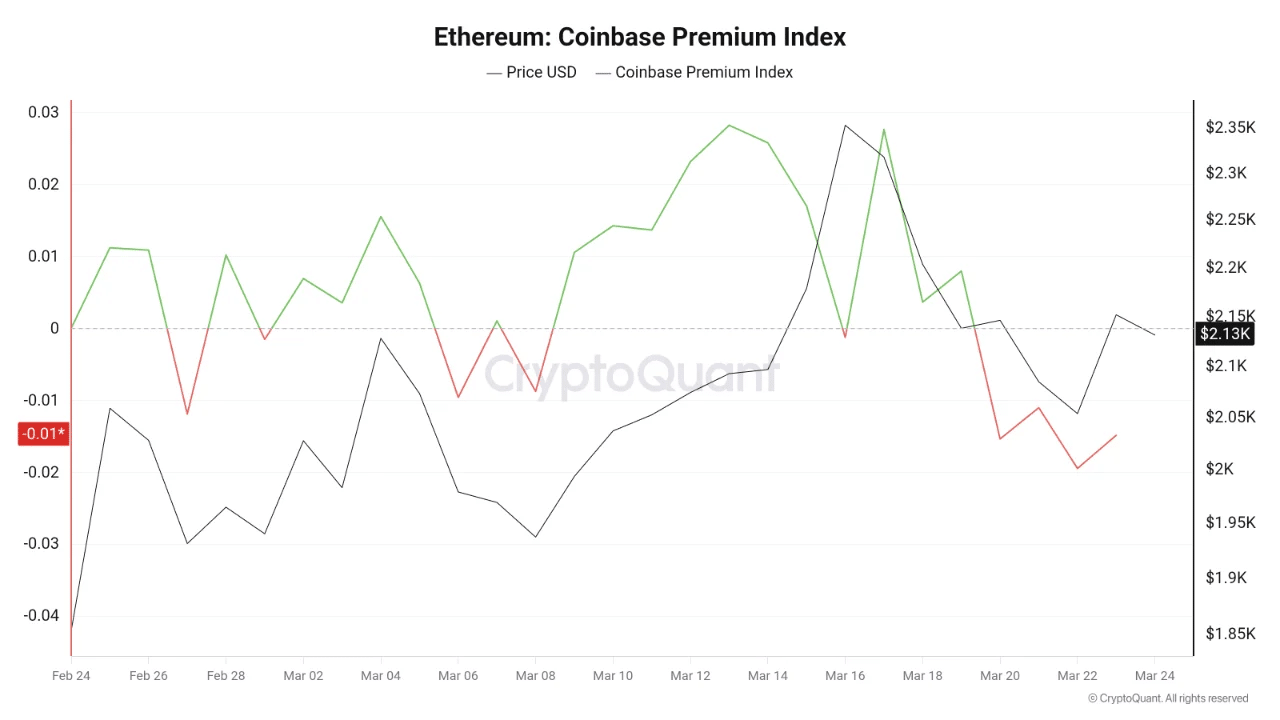
According to a recent report, Ethereum faces weaker demand from U.S investors, even with global activity. The Coinbase Premium Index, which compares ETH prices on Coinbase and Binance, was negative with a value of around -0.0149 at press time.

Source: Cryptoquant

Put simply, this means Ethereum [ETH] might be trading cheaper on Coinbase, than on Binance. That means lower buying pressure or a hike in selling in the U.S.

Here, what’s interesting is that this gap has persisted even during a recovery. No matter how brief it may be. A move back towards neutral or positive levels, however, would prove improved sentiment and stronger support from U.S investors.

The whales are here, but retail is not

Things get clear when looking at order flow. While U.S demand has been weak, large players have been active in the market.

In fact, CryptoQuant data highlighted consistently elevated average order sizes. So, whale-sized trades have been dominating Ethereum’s spot activity.

Source: Ethereum

What’s missing, however, is retail participation. There’s little indication of smaller order flows picking up alongside these larger trades. The market structure has been pretty one-sided.

Such setups may lack staying power.

Steady, but not quite powerful

Source: TradingView

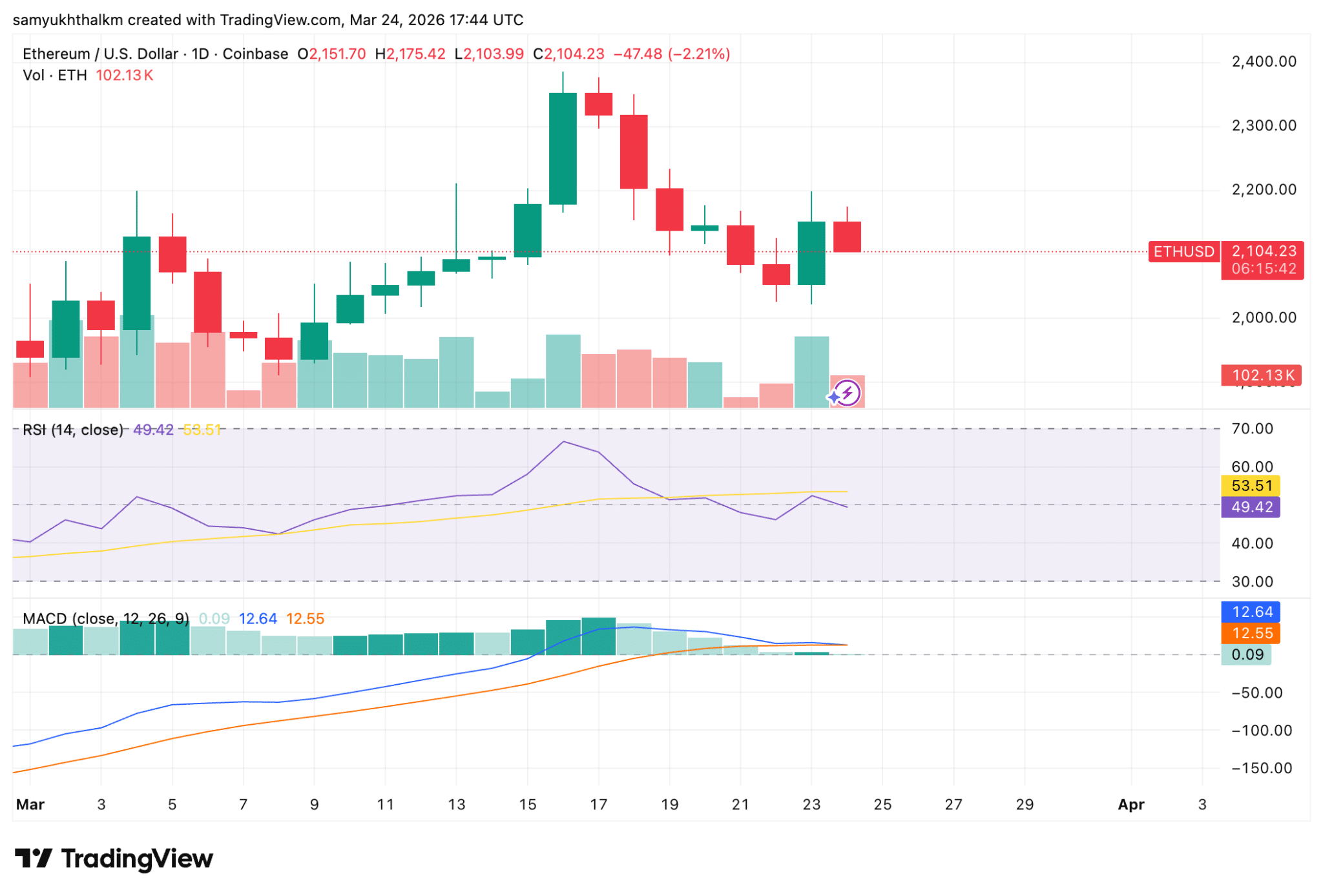
On the daily chart, Ethereum [ETH] held on above the $2,100-zone. However, it looked shaky at best. Especially since while the RSI was at neutral levels, the MACD was flat. Put simply, its recent push has been losing strength.

Source: Coinalyze

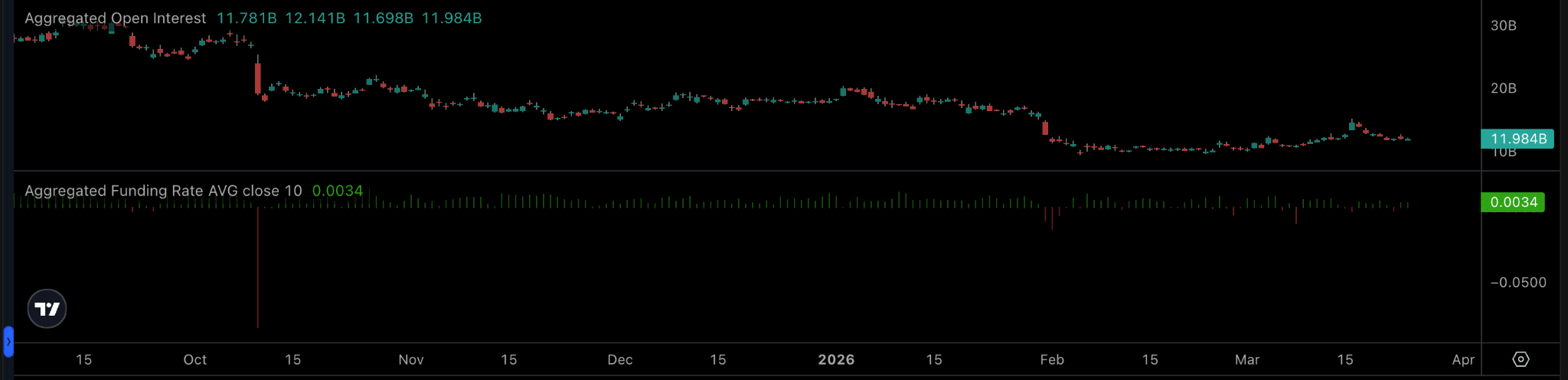
Derivatives numbers appeared to be of a similar vein too. Open Interest fell lower from earlier highs – A sign that traders may be stepping back.

At the same time, Funding Rates suggested longs were still dominant… but not aggressively so.


Final Summary

  • Ethereum doesn’t have much U.S demand.
  • Whale activity has been dominant, but lack of retail support makes any upside fragile.

Связанные с этим вопросы

QWhat does the negative Coinbase Premium Index indicate about Ethereum demand in the U.S.?

AThe negative Coinbase Premium Index indicates that Ethereum is trading cheaper on Coinbase compared to Binance, suggesting lower buying pressure or increased selling activity from U.S. investors.

QHow has whale activity contrasted with retail participation in Ethereum's market?

AWhale activity has been consistently elevated with large order sizes dominating spot trades, but retail participation remains weak with no significant increase in smaller order flows.

QWhat technical indicators suggest Ethereum's recent price push is losing strength?

AThe RSI is at neutral levels and the MACD is flat, indicating that Ethereum's recent upward momentum is weakening despite holding above the $2,100 zone.

QWhat does the decline in Open Interest and neutral Funding Rates imply for Ethereum's derivatives market?

AThe decline in Open Interest suggests traders are stepping back, while neutral Funding Rates indicate longs are dominant but not aggressive, reflecting cautious sentiment.

QWhy might Ethereum's current market structure lack staying power according to the article?

AThe market structure lacks staying power because it relies heavily on whale activity without broader retail support, making any potential upside fragile and unsustainable.

Похожее

RWA First Stock's Major Acquisition: Why Buy a 'Traditional' Mortgage Company?

On June 10th, Figure Technology Solutions (Nasdaq: FIGR), a blockchain-native capital markets firm, announced a $717 million acquisition of Kiavi, a leading non-bank lender for residential real estate investors. The deal involves Figure acquiring Kiavi's technology and operations for approximately $538 million, while forming a joint venture with alternative asset manager Sixth Street to purchase Kiavi's existing loan portfolio. Sixth Street also provided a $3 billion forward purchase commitment. This acquisition marks a strategic shift for Figure, known as the "RWA (Real World Asset) first stock," allowing it to expand significantly into the larger market of first-lien mortgages. Kiavi specializes in non-qualified mortgage (Non-QM) loans, such as short-term fix-and-flip (RTL) and rental property (DSCR) loans—a segment traditionally underserved by major banks. The move is expected to increase Figure's first-lien loan origination to over $7 billion annually, aiming for these to constitute about 40% of its business by 2027. Both companies leverage AI for underwriting: Kiavi uses proprietary models to value renovated properties and automate document processing, dominating the fix-and-flip lending space. Figure plans to integrate these assets onto its blockchain platform, Provenance, using its new 'Adaptor' product to standardize and tokenize the loans for institutional investors on its Democratized Prime marketplace. While the integration poses challenges—including merging different asset types, interest rate sensitivity of Kiavi's loans, and post-IPO execution risks—Figure projects the deal to be accretive to earnings with a cash payback period under four years. The transaction is seen as a major step in scaling blockchain-based capital markets, moving RWA tokenization from concept validation toward large-scale operation.

Foresight News22 мин. назад

RWA First Stock's Major Acquisition: Why Buy a 'Traditional' Mortgage Company?

Foresight News22 мин. назад

Trend in US Stocks: A Post Triggers a 930-Point Rebound, Tonight Belongs to SpaceX

On Thursday (June 11, U.S. Eastern Time), Wall Street staged a textbook V-shaped reversal. The Dow Jones surged 929.97 points (+1.86%) to close above 50,000, while the Nasdaq and S&P 500 rose 2.54% and 1.75%, respectively. The rally occurred despite the hottest PPI report in years, with May data showing a 6.5% year-on-year surge, the highest since 2022. The market ignored the inflation data, focusing instead on reports that former President Trump called off a planned strike on Iran, hinting at a potential multi-party peace agreement draft. This sparked a sharp drop in oil prices, fueling hopes that inflation may have peaked. Sector rotations were stark: previously battered AI hardware and cyclical stocks led the gains, while defensive sectors that hit record highs the prior day were sold off. Chip stocks like Micron and Intel saw sharp rebounds. In contrast, software giant Oracle plunged nearly 10% despite beating earnings, with concerns over cloud revenue and cash flow. Adobe also fell after hours despite raising guidance, as its CFO announced departure. The rally's sustainability is questioned, driven largely by social media posts about unconfirmed geopolitical developments. Inflation risks remain, with pipeline pressures still high. Meanwhile, the market's risk appetite faces a major test with SpaceX's historic IPO. Priced at $135 per share, it aims to raise ~$75 billion with a $1.75 trillion valuation, becoming the largest U.S. IPO ever. It will join the Nasdaq 100 in 15 days, triggering massive index fund buying. However, critics cite extreme valuation (88x sales) and market liquidity concerns.

marsbit46 мин. назад

Trend in US Stocks: A Post Triggers a 930-Point Rebound, Tonight Belongs to SpaceX

marsbit46 мин. назад

The Trillion-Dollar Valuation Test: Are the Three Super IPOs a Tech Stock Frenzy or a Crypto Market Nightmare?

Trillion-Dollar Valuation Test: Are the Three Mega IPOs a Tech Stock Frenzy or a Crypto Market Nightmare? The capital market in 2026 is witnessing a highly anticipated wave of tech IPOs, centered on SpaceX, OpenAI, and Anthropic. Collectively valued at over $3.5 trillion, their potential listing represents one of the largest such waves in recent years. This raises concerns about market liquidity, valuation bubbles, and potential capital outflows from other assets like crypto. SpaceX's valuation narrative has shifted from rocket launches to becoming a global infrastructure play via its Starlink satellite network, which now drives most revenue. Despite ongoing losses, investors focus on its long-term growth potential. OpenAI and Anthropic represent the core productivity engines of generative AI. Their public listings would offer the first direct investment opportunity in large foundation model companies, potentially triggering a repricing within the AI sector. Market fears of a massive "capital drain" from these IPOs are likely overstated. Historical precedents like Alibaba and Saudi Aramco show that mega-listings primarily cause capital reallocation, not destruction, within the vast equities market. Systemic risk is rarely triggered by IPOs alone. For stock markets, short-term volatility and sector repricing are expected, especially for AI concept stocks. Long-term, these listings could reinforce the tech sector's importance. For crypto, direct competition for speculative capital exists, particularly affecting AI-themed tokens. However, crypto's trajectory remains more tied to its own cycles, macro liquidity, and Bitcoin ETF flows rather than a single IPO event. The real risk lies not in the listings themselves but in the sky-high growth expectations embedded in these valuations. If future revenue, profitability, or commercialization progress disappoints, significant valuation resets could follow, impacting high-growth tech stocks. Ultimately, the market's direction hinges on macroeconomic conditions and whether these companies can deliver on their ambitious promises.

链捕手1 ч. назад

The Trillion-Dollar Valuation Test: Are the Three Super IPOs a Tech Stock Frenzy or a Crypto Market Nightmare?

链捕手1 ч. назад

Trillion-Dollar Valuation Test: Are the Three Super IPOs a Tech Stock Frenzy or a Crypto Market Nightmare?

Title: Trillion-Dollar Valuations at Stake: Super IPOs of SpaceX, OpenAI, Anthropic – Tech Boom or Crypto Nightmare? TL;DR: A wave of mega-tech IPOs is approaching, featuring SpaceX (targeting a $1.75 trillion valuation), OpenAI (~$852B), and Anthropic (~$965B), with a combined potential valuation exceeding $3.5 trillion. This tests the market's pricing of innovation and sparks debate on liquidity impact. * **SpaceX**'s valuation is now driven more by its Starlink global communications infrastructure than its core rocket business. * **OpenAI & Anthropic** offer the first major public investment opportunities in foundational AI models, potentially repricing the entire AI sector. * Concerns about a market-wide "liquidity drain" are likely overblown; history shows large IPOs mainly cause fund reallocation, not disappearance, and rarely trigger systemic risk. * Crypto markets, especially some AI-themed tokens, may face short-term fund competition, but their long-term trajectory depends more on macro liquidity, regulation, and Bitcoin cycles. * The real risk lies not in the IPOs themselves, but in whether these companies can justify their sky-high valuations with future revenue growth and profitability. Unmet expectations could lead to significant repricing pressure. Ultimately, these IPOs represent a massive market pricing of next-gen tech infrastructure, not a prelude to a market crash. The broader market direction will be determined by macro conditions, corporate earnings, and risk appetite.

marsbit1 ч. назад

Trillion-Dollar Valuation Test: Are the Three Super IPOs a Tech Stock Frenzy or a Crypto Market Nightmare?

marsbit1 ч. назад

Торговля

Спот
Фьючерсы

Популярные статьи

Manyu: восходящая мем-звезда на Ethereum, готовая открыть новую эру культуры Shiba

Manyu - это мемтокен на Ethereum, который приносит децентрализованную культурную и развлекательную ценность через вирусное влияние в соцсетях и вовлечённость сообщества.

2.0k просмотров всегоОпубликовано 2025.11.27Обновлено 2025.11.27

Manyu: восходящая мем-звезда на Ethereum, готовая открыть новую эру культуры Shiba

Неделя обучения по популярным токенам 14: Glamsterdam — самое ожидаемое обновление Ethereum в 2026 году

Ordinals/Runes по-прежнему стимулируют доходы от комиссий за блоки и активность разработчиков, рассматриваются как отправная точка «нативной эмиссии активов» в сети.

1.5k просмотров всегоОпубликовано 2026.04.29Обновлено 2026.04.29

Неделя обучения по популярным токенам 14: Glamsterdam — самое ожидаемое обновление Ethereum в 2026 году

Обсуждения

Добро пожаловать в Сообщество HTX. Здесь вы сможете быть в курсе последних новостей о развитии платформы и получить доступ к профессиональной аналитической информации о рынке. Мнения пользователей о цене на ETH (ETH) представлены ниже.

活动图片