ING Germany Integrates Bitwise and VanEck ETPs as LiquidChain Unifies Cross-Chain Liquidity

bitcoinistОпубликовано 2026-02-03Обновлено 2026-02-03

Введение

ING Germany, serving over 9 million customers, has integrated crypto ETPs from Bitwise and VanEck into its retail banking platform, allowing users direct access to Bitcoin and Ethereum through their banking app. This move signals a major shift toward mainstream crypto adoption in Europe’s largest economy. However, the underlying blockchain infrastructure remains fragmented, isolating liquidity across chains like Bitcoin, Ethereum, and Solana. LiquidChain ($LIQUID) aims to solve this fragmentation with a Layer 3 protocol that unifies liquidity and enables seamless cross-chain transactions. The project has raised over $500K in its presale and offers high staking rewards, targeting the growing need for interconnected DeFi infrastructure as institutional interest increases.

The barrier between traditional finance and digital assets in Europe’s largest economy isn’t just crumbling, it’s gone.

ING Germany, catering to over 9M customers, quietly integrated crypto ETPs (Exchange Traded Products) and ETNs (Exchange Traded Notes) into its retail banking interface. The partners? Asset management heavyweights Bitwise and VanEck.

This collaboration is more than a vendor agreement; it’s a merging of DNA. Bitwise brings the deep-rooted crypto native expertise and research-heavy approach, while VanEck provides the institutional pedigree of a firm that has pioneered ETFs for nearly 70 years.

Together with ING, they’ve created a ‘regulated wrapper’ that satisfies the stringent compliance demands of the German BaFin while offering investors the precise price tracking they expect from high-tier financial instruments.

This matters. Not just for the immediate volume, but for the signal it blasts to risk departments globally. When a conservative institution like ING opens crypto rails to German retail savers, the asset class graduates from ‘speculative fringe’ to ‘portfolio standard.’

Users can now access Bitcoin and Ethereum directly through their banking app. No external exchanges, no friction. Just access.

But there’s a catch. While giants like ING solve the financial exposure problem, the underlying tech is still a mess. It’s fragmented. A user holding a Solana ETP has zero interaction with Ethereum; liquidity is trapped in silos.

As institutional capital pours in, the race is on to build a backend that actually connects Bitcoin, Ethereum, and Solana. That’s the precise gap LiquidChain ($LIQUID) aims to fill.

LiquidChain ($LIQUID) Ends Asset Isolation With Unified L3 Architecture

Right now, DeFi looks a lot like the pre-Internet era of local intranets: disconnected islands of value. To move capital from Ethereum to Solana, you’re forced to navigate complex bridges, wrap assets (risky business), and juggle multiple gas tokens.

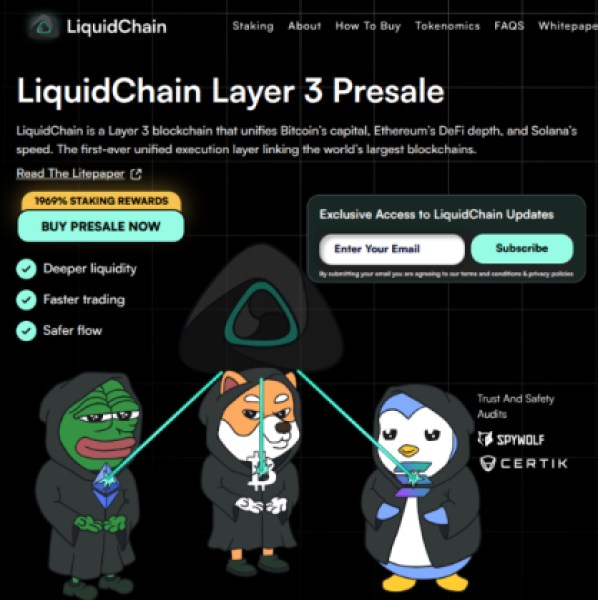
LiquidChain fixes this. It positions itself as a Layer 3 (L3) protocol that fuses liquidity from Bitcoin, Ethereum, and Solana into one execution environment. An L3 is a highly specialized, application-specific blockchain built on top of a Layer 2 to provide hyper-scalability, lower gas fees, and custom environments for specific use cases like gaming or high-frequency trading.

Source: LiquidChain

For developers, it’s a ‘Deploy-Once’ setup. Instead of rewriting code for the Ethereum Virtual Machine (EVM) and then doing it all over again for Solana’s Virtual Machine (SVM), they launch on LiquidChain L3 once. That app then accesses liquidity across all connected chains naturally. For the end-user? It’s seamless.

A transaction can source liquidity from a Uniswap pool on Ethereum and settle on Solana without the user ever touching a bridge.

It solves the primary bottleneck preventing true institutional adoption: fragmentation. The protocol’s ‘Cross-Chain VM’ acts as a translation layer for the industry’s three largest ecosystems, allowing verifiable settlement across networks.

BUY LIQUIDCHAIN ($LIQUID) HERE.

Why Smart Money Is Watching Cross-Chain Aggregation Protocols

Banks integrating crypto products signal ubiquity, sure. But it also highlights how limited the current infrastructure really is. Institutions need deep liquidity to execute large orders without slippage. Right now? That liquidity is shattered across dozens of Layer 1 and Layer 2 chains.

This sets the stage for aggregation layers. LiquidChain ($LIQUID) isn’t just a bridge; it’s a unification layer. By enabling Liquidity Staking and using $LIQUID as transaction fuel, the protocol captures value from the velocity of money moving between chains.

The project’s already raised over $500K, and tokens are priced at $0.0135. As it’s early in the presale, staking rewards are also high, currently sitting at 1968%. But this is dynamic and subject to change.

History shows the market rewards infrastructure that simplifies UX. Arbitrum and Optimism thrived by making Ethereum cheaper. LiquidChain targets the next evolution: making the multi-chain world invisible.

For investors looking beyond major caps like $BTC, projects solving this ‘liquidity fracture’ represent a sector with serious potential as the cycle matures.

VISIT THE OFFICIAL LIQUIDCHAIN ($LIQUID) PRESALE SITE.

This article is for informational purposes only and does not constitute financial or investment advice. Cryptocurrencies are volatile assets; always conduct your own research before making investment decisions.

Связанные с этим вопросы

QWhat major step has ING Germany taken regarding digital assets for its retail customers?

AING Germany has integrated crypto Exchange Traded Products (ETPs) and Exchange Traded Notes (ETNs) from Bitwise and VanEck into its retail banking interface, allowing its over 9 million customers to access Bitcoin and Ethereum directly through their banking app.

QWhat is the primary problem that LiquidChain ($LIQUID) aims to solve in the current DeFi landscape?

ALiquidChain aims to solve the problem of fragmented liquidity and asset isolation between different blockchains, such as Bitcoin, Ethereum, and Solana, by providing a unified Layer 3 (L3) protocol that fuses liquidity from these chains into a single execution environment.

QHow does LiquidChain's L3 architecture benefit developers building decentralized applications?

ALiquidChain's L3 architecture offers a 'Deploy-Once' setup, allowing developers to launch their application on the protocol once and have it natively access liquidity across all connected chains without needing to rewrite code for different virtual machines like the EVM and SVM.

QWhat is the significance of ING's integration of crypto ETPs for the broader perception of cryptocurrency?

AING's integration signals a major shift in perception, moving the cryptocurrency asset class from a 'speculative fringe' to a 'portfolio standard' for conservative institutions and their retail customers, demonstrating increased legitimacy and acceptance within traditional finance.

QWhat are some key features or mechanisms that LiquidChain uses to capture value and facilitate cross-chain transactions?

ALiquidChain uses its 'Cross-Chain VM' as a translation layer for settlement, enables Liquidity Staking, and uses its native $LIQUID token as transaction fuel, capturing value from the velocity of money moving between different blockchains.

Похожее

The Post-Plunge Panorama: Institutions Cry 'Buy the Dip' as Traders Turn to U.S. Stocks

Amidst a significant market correction, Bitcoin (BTC) briefly fell below the $60,000 mark to around $59,130 on June 6th. While it later rebounded to near $63,000, breaking the key psychological level severely impacted market confidence, with the current sentiment index indicating "extreme fear." Altcoins followed the broader downturn. Market participants offer mixed views on whether this is a buying opportunity. On the bullish side, analysts from Glassnode and Strive Asset Management point to Bitcoin touching its 200-week moving average—a historically reliable buy signal—and suggest a higher-probability bottom zone between $46k and $54k. Standard Chartered's digital assets head believes the bottom is "almost in," anticipating large-scale buybacks. Analysts Darkfost and trader Killa also see current levels as a generational or long-term accumulation opportunity, citing deeply oversold technical models. Conversely, NYDIG's research highlights capital rotation from crypto into outperforming AI stocks as a headwind, noting the current ~53% drawdown is milder than historical cycles. Polymarket prediction data shows a 72% probability of BTC falling below $55k, though odds for a drop below $35k-$40k are seen as lower. Notably, some traders, like Eugene Ng, have pivoted away, citing more attractive opportunities in equities and unresolved systemic risks (referencing a major entity's BTC sales), and are avoiding attempts to "catch a falling knife." In summary, while several institutional voices and on-chain metrics suggest a nearing bottom and a strategic buying zone, significant near-term downside risk remains acknowledged. The market exhibits a clear divide between those seeing a historic entry point and those withdrawing to wait for clearer signals or better risk/reward ratios.

Foresight News12 мин. назад

The Post-Plunge Panorama: Institutions Cry 'Buy the Dip' as Traders Turn to U.S. Stocks

Foresight News12 мин. назад

Торговля

Спот
Фьючерсы

Популярные статьи

Как купить S

Добро пожаловать на HTX.com! Мы сделали приобретение Sonic (S) простым и удобным. Следуйте нашему пошаговому руководству и отправляйтесь в свое крипто-путешествие.Шаг 1: Создайте аккаунт на HTXИспользуйте свой адрес электронной почты или номер телефона, чтобы зарегистрироваться и бесплатно создать аккаунт на HTX. Пройдите удобную регистрацию и откройте для себя весь функционал.Создать аккаунтШаг 2: Перейдите в Купить криптовалюту и выберите свой способ оплатыКредитная/Дебетовая Карта: Используйте свою карту Visa или Mastercard для мгновенной покупки Sonic (S).Баланс: Используйте средства с баланса вашего аккаунта HTX для простой торговли.Третьи Лица: Мы добавили популярные способы оплаты, такие как Google Pay и Apple Pay, для повышения удобства.P2P: Торгуйте напрямую с другими пользователями на HTX.Внебиржевая Торговля (OTC): Мы предлагаем индивидуальные услуги и конкурентоспособные обменные курсы для трейдеров.Шаг 3: Хранение Sonic (S)После приобретения вами Sonic (S) храните их в своем аккаунте на HTX. В качестве альтернативы вы можете отправить их куда-либо с помощью перевода в блокчейне или использовать для торговли с другими криптовалютами.Шаг 4: Торговля Sonic (S)С легкостью торгуйте Sonic (S) на спотовом рынке HTX. Просто зайдите в свой аккаунт, выберите торговую пару, совершайте сделки и следите за ними в режиме реального времени. Мы предлагаем удобный интерфейс как для начинающих, так и для опытных трейдеров.

1.4k просмотров всегоОпубликовано 2025.01.15Обновлено 2026.06.02

Как купить S

Sonic: Обновления под руководством Андре Кронье – новая звезда Layer-1 на фоне спада рынка

Он решает проблемы масштабируемости, совместимости между блокчейнами и стимулов для разработчиков с помощью технологических инноваций.

2.3k просмотров всегоОпубликовано 2025.04.09Обновлено 2025.04.09

Sonic: Обновления под руководством Андре Кронье – новая звезда Layer-1 на фоне спада рынка

HTX Learn: Пройдите обучение по "Sonic" и разделите 1000 USDT

HTX Learn — ваш проводник в мир перспективных проектов, и мы запускаем специальное мероприятие "Учитесь и Зарабатывайте", посвящённое этим проектам. Наше новое направление .

1.8k просмотров всегоОпубликовано 2025.04.10Обновлено 2025.04.10

HTX Learn: Пройдите обучение по "Sonic" и разделите 1000 USDT

Обсуждения

Добро пожаловать в Сообщество HTX. Здесь вы сможете быть в курсе последних новостей о развитии платформы и получить доступ к профессиональной аналитической информации о рынке. Мнения пользователей о цене на S (S) представлены ниже.

活动图片