How to Systematically Track High-Win-Rate Addresses on Polymarket?

marsbitОпубликовано 2026-03-02Обновлено 2026-03-02

Введение

This article explores methods to systematically identify and track high-success-rate addresses on Polymarket, a blockchain-based prediction market where all transactions are publicly recorded on-chain. It highlights that while data is transparent, the key challenge lies in extracting meaningful signals from vast datasets to detect addresses with potential informational advantages. The piece outlines common characteristics of such addresses: new wallets making large, concentrated bets; specialization in specific verticals; abnormal changes in position size; and exceptionally precise timing, repeatedly entering positions hours before major news breaks. A three-step systematic approach is recommended: First, filter addresses based on sustained profitability (e.g., 30-day positive returns, >55% win rate) using leaderboards like Polymarket Analytics. Second, analyze their holdings in specific event markets, focusing on addresses that are consistently among the top holders before full market pricing. Third, scrutinize their on-chain behavior: entry timing relative to news, position-building patterns (e.g., rapid, concentrated entries), holding periods, and trading focus. Advanced strategies include monitoring exit behavior (e.g., large, unexplained sell-offs), conducting wallet clustering analysis to find linked addresses, tracking unusual volume spikes in low-liquidity markets, and cross-referencing on-chain activity with external real-world data for validation. The goal is to ...

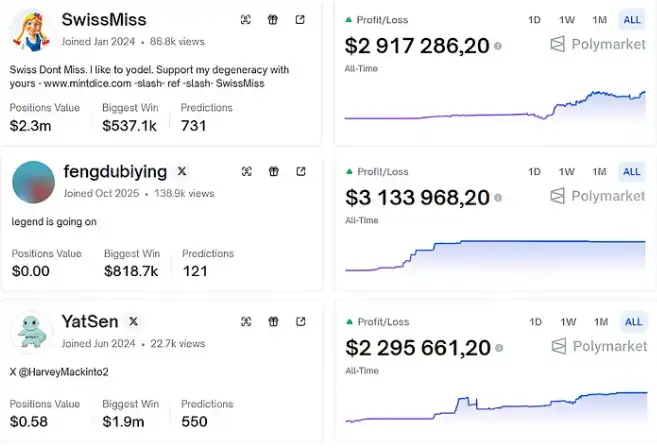
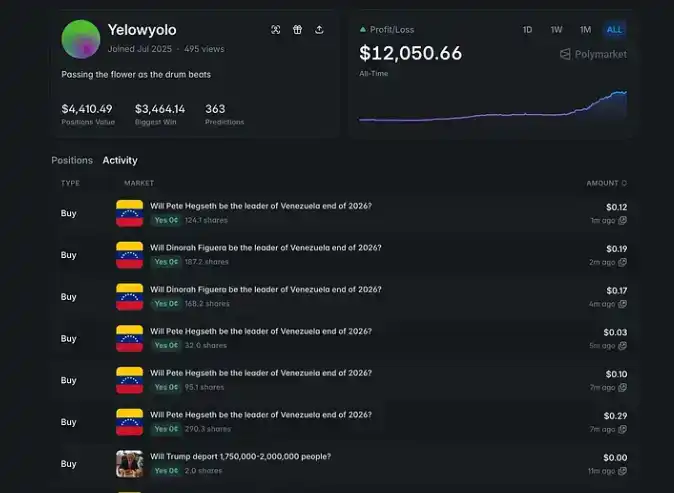
An address on Polymarket turned $35,000 into $442,000, achieving a 12.6x return. Notably, the position was established hours before a major market movement, and the trades were largely settled before the news spread to mainstream channels. This is not an isolated incident. Before the news of the "Venezuela Raid" political event became public, three addresses made moves in advance and collectively profited $630,000 from the same event.

If such trading occurred in traditional financial markets, one might easily think of information asymmetry. However, in prediction markets, all fund flows and position changes are recorded on the public blockchain; there are no hidden accounts or private transactions.

Being public does not mean there is no gap. The key is not whether you can see the trades, but whether you can discern the truly informative signals from the massive amount of data.

Every Trade on Polymarket is Public Data

Many prediction market participants still view Polymarket as a traditional betting platform: watch the odds, pick a direction, and bet on the outcome. But Polymarket's underlying structure is completely different from DraftKings or ordinary sports betting. All transactions occur on-chain; fund flows, position sizes, and entry/exit timings are all publicly viewable. The operational paths of the most accurate and timely addresses are not post-hoc speculation but real-time on-chain records.

Polymarket's API is also open. Transaction records, market data, and historical trades can be directly called by anyone; there is no permission barrier.

Therefore, the gap is not about who can see the data, but about who can extract meaning from it. On-chain information is public, but what is truly valuable is the ability to identify wallets worth tracking continuously and to recognize behavioral changes before prices fully reflect them.

What Characteristics Do True "Informed Addresses" Typically Have?

It is important to emphasize that not all profitable wallets imply insider information. Some traders have solid research capabilities, while others rely on quantitative models and algorithmic advantages. However, when profitability is repeatedly coupled with specific behavioral patterns, one can observe structural features that distinguish them from mere "luck."

· Type 1: New Addresses Combined with Unusually Large Bets

A wallet created just days ago, with very few transactions, suddenly invests a large amount of capital in a low-liquidity niche market. This behavior is uncommon. Especially in the absence of public catalysts, large, concentrated positions often carry stronger informational significance.

· Type 2: Highly Vertical Trading Focus

Some addresses do not operate across markets but focus long-term on a specific niche, maintaining a stable and significant win rate in that area. They do not diversify across crypto prices, elections, sports, etc., but concentrate their firepower on a single theme, with more decisive position decisions.

· Type 3: Abnormal Changes in Position Size

When an address that has been betting with medium size for a long time suddenly significantly increases its position size in a particular market, this behavior often indicates a change in the strength of conviction. Position size itself is an attitude; a sudden change in scale usually reflects an upgrade in information or belief.

· Type 4: Overly Precise Timing

Occasional early positioning can be attributed to coincidence, but if an address repeatedly completes its positions hours before major news announcements, with highly consistent direction, this temporal lead is difficult to explain simply as luck. Once is random; repeated occurrences are more likely to reflect an information advantage.

How to Systematically Screen for Potential "Information-Advantaged Addresses"

· Step 1: Analyze Performance on Polymarket Leaderboards

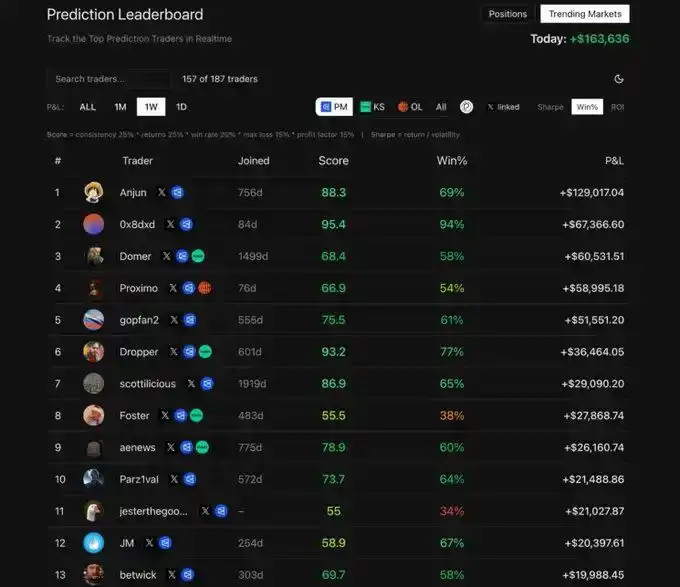
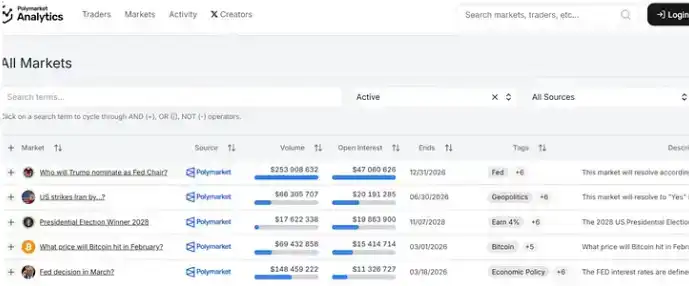
Start with the leaderboard on Polymarket Analytics (link: https://polymarketanalytics.com/traders), sorted by 30-day P&L, using recent stable profitability as the first filter. Focus on wallet addresses with an overall positive return over 30 consecutive days, a win rate above 55%, and total profit significantly higher than total loss. Also, confirm that their trading is concentrated in markets with real liquidity, not low-volume prediction events with little participation.

The goal at this stage is not to directly judge whether they have an information advantage, but to build a watchlist of addresses with sustained profitability. A consistent profit record is the foundation for subsequent behavioral analysis.

· Step 2: Analyze Position Structure in Specific Events

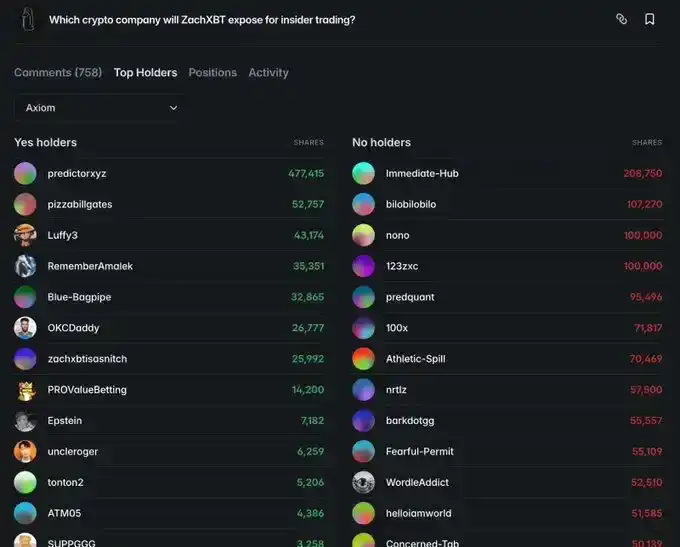
After the initial screening, drill down into specific trading events. Enter active prediction markets and check the Top Holders list for that event. Polymarket publicly displays the addresses with the largest current positions; these large positions often represent stronger conviction.

The key is not whether an address hits a single large bet, but whether its behavior is persistent. If a wallet repeatedly appears in the top holder lists for multiple significant events, and these positions were established before the market was fully priced, this repetition itself constitutes a signal.

Hitting once might be chance, but repeatedly making large, early-stage positions with consistent direction and validated outcomes often indicates a judgment system with a stable advantage.

· Step 3: Analyze Trading Behavior and Position Timing

After identifying candidate addresses, further analyze their on-chain transaction history, focusing on entry timing, position structure, and holding rhythm.

First, observe the entry time. If the purchase occurs hours before the official news release and repeats multiple times, the timing advantage itself becomes an important variable; entering after media reports is more likely to be just information following.

Second, analyze the method of position building. Mature traders typically build positions in batches and add gradually, while wallets with strong information judgment often complete concentrated layouts quickly within a short time window because their opportunity is limited.

Furthermore, pay attention to the holding period. Some high-quality addresses choose to exit during the middle of the trend发酵, rather than waiting for the tail end of extreme volatility, indicating their goal is to capture the main trend rather than marginal profits.

Finally, observe their trading scope. Addresses that are highly vertical and long-term focused on a single niche are more likely to form stable information advantages; addresses that frequently operate across sectors are more likely to rely on market sentiment rather than specific domain judgment.

Advanced Address Tracking Strategies

After mastering the basic screening methods, what truly makes the difference is the further dissection of the details of fund behavior.

First, focus on exit behavior, not just entry timing. Addresses with information advantages often not only position early but also actively reduce positions before potential negative news emerges. When a large address with a long, stable holding history suddenly significantly reduces its position without obvious catalysts, the informational content of this action is often higher than the initial buy. Especially when the reduction reaches a significant proportion, this change itself is a signal.

Second, perform wallet clustering analysis using on-chain data. Connections between addresses are not completely untraceable. Identical funding sources, similar Gas usage patterns, and transactions occurring consecutively within a very short time may reveal relationships between addresses. Many seemingly "new" accounts can often be traced back to a long-active old address through 2 or 3 fund transfers. Tracking along the fund flow path helps identify new potential high-quality accounts before the market notices.

Additionally, pay attention to abnormal volume changes in niche markets. If a market with usually small daily trading volume suddenly experiences a large influx of funds without public news, this structural increase in volume often means some participants have acted early. Analyzing the specific addresses driving the volume change can help build a new watchlist.

Finally, cross-validate on-chain behavior with external public information. The so-called "Pizza Index" once inferred potential military action from abnormal order volumes at pizzerias near the Pentagon. Similarly, flight tracking data, social media activity of key figures, adjustments to public calendars, and other information can provide corroboration or counter-verification for on-chain position behavior. The linkage between on-chain capital flows and real-world signals can often strengthen the reliability of judgment.

Связанные с этим вопросы

QWhat are the key characteristics of potentially high-performing addresses on Polymarket?

AKey characteristics include: 1) New addresses making unusually large bets, 2) High specialization in a narrow trading domain, 3) Abnormal changes in position size indicating conviction shifts, and 4) Exceptionally precise timing of trades before major news breaks.

QHow can one systematically identify addresses with potential information advantages on Polymarket?

AA systematic approach involves: 1) Analyzing the Polymarket Analytics leaderboard for consistently profitable addresses, 2) Examining specific event holders lists for large, early positions, and 3) Conducting deep analysis of transaction timing, position structure, and holding patterns.

QWhy is transaction timing particularly important when analyzing Polymarket addresses?

ATransaction timing is crucial because addresses that consistently establish positions hours before major news becomes public, rather than after media coverage begins, demonstrate a potential information advantage that cannot be easily explained by luck alone.

QWhat advanced strategies can be used for tracking high-performance addresses beyond basic screening?

AAdvanced strategies include: analyzing exit behaviors and sudden position reductions, conducting wallet clustering through on-chain data analysis, monitoring unusual volume spikes in niche markets, and cross-referencing on-chain activity with external real-world signals.

QHow does Polymarket's structure differ from traditional betting platforms in terms of data transparency?

AUnlike traditional platforms, all Polymarket transactions occur on-chain, making fund flows, position sizes, and entry/exit timestamps publicly visible and accessible through open APIs, creating a transparent environment where performance is verifiable through public blockchain data.

Похожее

GitHub, Transfixed by AI

On the night of February 9th, GitHub suffered a major outage caused by a simple configuration change—reducing a cache refresh interval from 12 to 2 hours—that triggered a cascade of failures. This was not an isolated event, but part of a broader pattern. In early 2026, GitHub experienced at least 8 major incidents, failing to meet its promised 99.9% availability. These outages stemmed from structural issues: explosive growth in load, tight service coupling, and insufficient protection against abnormal traffic. This unprecedented load is driven by AI Agents. In 2025, GitHub handled ~1 billion commits. By 2026, weekly commits reached 275 million, projecting to ~14 billion for the year—a 14x increase. AI tools like Claude Code now contribute 4.5% of all public repository commits, with weekly submissions surging 25x in just three months. AI-generated pull requests jumped from 4 million to 17 million per month in half a year. Unlike human developers, AI Agents work continuously, generating commits at a scale that overwhelms infrastructure designed for human rhythms. The surge also shattered GitHub's business model. Copilot's flat-rate pricing, based on assisting human developers, became unsustainable as Agentic AI sessions consumed resources worth hundreds of dollars for a few dollars in fees. In response, GitHub imposed usage limits and, by June 1st, shifted to a pay-per-use "AI Credits" system. Facing this new reality, GitHub realized a 10x scaling plan was insufficient. It announced a need to *redesign* its architecture for 30x current scale—decoupling services, adding fault isolation, and improving change management to prevent cascading failures. Other platforms like Stripe and AWS are facing similar challenges with AI Agents. Fundamentally, GitHub is transitioning from a human collaboration platform to an "exhaust pipe" for automated AI workflows. Its detailed post-mortem reports aim to maintain trust during this turbulent rebuild. The February outage was not just a technical glitch, but a signal of the software industry's entry into a new, AI-driven era.

marsbit20 мин. назад

GitHub, Transfixed by AI

marsbit20 мин. назад

Both Suffer Massive Losses Exceeding $90 Billion, Which Is in Greater Peril: Strategy or Bitmine?

Facing massive paper losses exceeding $90 billion each amidst a sharp market downturn, "Digital Asset Treasury" (DAT) giants Strategy and Bitmine find themselves in a precarious position, but with different underlying risks. Strategy, heavily invested in Bitcoin (BTC), faces significant financial strain. Its strategy relies heavily on debt, including convertible notes and preferred stock (STRC) requiring substantial dividend payments. With its cash reserves dwindling and BTC offering no staking yield for cash flow, Strategy's high leverage makes it vulnerable. A continued price decline could force asset sales to meet obligations, potentially creating a negative feedback loop. Its market value has already fallen sharply. In contrast, Bitmine, an Ethereum (ETH) holder, appears on firmer financial ground. It primarily funds its purchases through equity offerings (like ATM programs), avoiding debt pressure. It also generates income by staking a large portion of its ETH holdings. While not immune to market drops and shareholder dilution concerns, Bitmine maintains more flexibility, recently announcing a new preferred share offering to raise further capital. The core divergence lies in their financing: Bitmine uses equity (investor money), while Strategy uses debt (borrowed money). Consequently, Bitmine currently faces less immediate liquidity pressure than Strategy, which must navigate the dual challenge of servicing debt/dividends and a declining core asset (BTC) price.

marsbit27 мин. назад

Both Suffer Massive Losses Exceeding $90 Billion, Which Is in Greater Peril: Strategy or Bitmine?

marsbit27 мин. назад

Where the AI Bubble Really Is: Which Layer of Players Are Naked

AI Bubble: Where It Really Is and Who's Swimming Naked This analysis dissects the AI industry not as a single entity but as a five-layer pyramid, arguing that bubbles are concentrated in specific tiers, not uniformly distributed. **Key Distinction from the 2000 Dot-com Bubble:** Unlike 2000, where companies had stock prices before revenue, today's leading AI players have massive, contract-backed revenue driving their valuations. Core infrastructure demand is real, with every GPU running at full capacity for paying customers. **The Five-Layer Pyramid & Bubble Assessment:** * **L0 (Fab/Manufacturing) & Top L4 (Leading AI Apps): NO BUBBLE.** Companies like TSMC, NVIDIA, major cloud providers (Microsoft, Google, Meta, Amazon), and top AI labs have real revenues and orders. Supply is tightly constrained by TSMC's disciplined capacity control and physical limits like power/land for data centers, preventing a supply glut. * **L1 (Memory): BATTLEGROUND.** Sky-high HBM margins could signal a new structural cycle or a classic "boom before bust." The oligopoly of three major players may enforce supply discipline, making this a high-stakes bet. * **L2 (Interconnect/Optical Modules): BUBBLE TERRITORY.** Companies like Lumentum and AAOI have seen stock surges (4-10x) far outpacing revenue growth. This hardware segment has lower physical barriers to expansion than fabs, allowing speculation. It mirrors the 2000 bubble's epicenter—optics. * **L3 (Infrastructure/"GPU Landlords"): VULNERABLE.** GPU leasing companies profit from the current compute shortage but own no long-term moat. Their business model relies on a temporary bottleneck that will ease as big tech expands and new tech (e.g., potential space-based data centers) emerges. * **L4 Long Tail (VC-backed Startups): STRONG BUBBLE SIGNALS.** VC funding concentration in AI is twice that of the 1999 peak. Many startups with little revenue use the valuation logic of successful giants to justify their own, creating high risk of a "valuation crunch" when funding dries up. **Critical Risks to Monitor:** 1. **GPU Depreciation & Accounting:** Companies extending the assumed useful life of GPUs artificially boost profits. The true economic life depends on future generational leaps from NVIDIA. 2. **"GPU Credit" & Off-Balance-Sheet Leverage:** Emerging structures where shell companies borrow to buy GPUs and lease them out (with chipmakers sometimes investing) move debt off major balance sheets. This echoes the "vendor financing" of 2000 and the securitization risks of 2008, though currently small-scale. 3. **TSMC Abandoning Caution:** If the primary supply bottleneck (TSMC's conservative capacity planning) breaks, runaway supply could trigger a bust. 4. **Algorithmic Efficiency Breakthrough:** A major leap in software efficiency could drastically reduce the need for raw compute hardware, undermining the investment thesis. **Conclusion:** The AI boom is expensive and has frothy areas, but its core is underpinned by real demand and physical supply constraints. The bubble risk is layered: most present in optical components, GPU leasing, and the long-tail startup ecosystem, while the foundational chip manufacturing and leading application layers remain relatively solid—for now.

marsbit40 мин. назад

Where the AI Bubble Really Is: Which Layer of Players Are Naked

marsbit40 мин. назад

Торговля

Спот
Фьючерсы

Популярные статьи

Как купить WIN

Добро пожаловать на HTX.com! Мы сделали приобретение WINkLink (WIN) простым и удобным. Следуйте нашему пошаговому руководству и отправляйтесь в свое крипто-путешествие.Шаг 1: Создайте аккаунт на HTXИспользуйте свой адрес электронной почты или номер телефона, чтобы зарегистрироваться и бесплатно создать аккаунт на HTX. Пройдите удобную регистрацию и откройте для себя весь функционал.Создать аккаунтШаг 2: Перейдите в Купить криптовалюту и выберите свой способ оплатыКредитная/Дебетовая Карта: Используйте свою карту Visa или Mastercard для мгновенной покупки WINkLink (WIN).Баланс: Используйте средства с баланса вашего аккаунта HTX для простой торговли.Третьи Лица: Мы добавили популярные способы оплаты, такие как Google Pay и Apple Pay, для повышения удобства.P2P: Торгуйте напрямую с другими пользователями на HTX.Внебиржевая Торговля (OTC): Мы предлагаем индивидуальные услуги и конкурентоспособные обменные курсы для трейдеров.Шаг 3: Хранение WINkLink (WIN)После приобретения вами WINkLink (WIN) храните их в своем аккаунте на HTX. В качестве альтернативы вы можете отправить их куда-либо с помощью перевода в блокчейне или использовать для торговли с другими криптовалютами.Шаг 4: Торговля WINkLink (WIN)С легкостью торгуйте WINkLink (WIN) на спотовом рынке HTX. Просто зайдите в свой аккаунт, выберите торговую пару, совершайте сделки и следите за ними в режиме реального времени. Мы предлагаем удобный интерфейс как для начинающих, так и для опытных трейдеров.

636 просмотров всегоОпубликовано 2024.04.17Обновлено 2026.06.02

Как купить WIN

Обсуждения

Добро пожаловать в Сообщество HTX. Здесь вы сможете быть в курсе последних новостей о развитии платформы и получить доступ к профессиональной аналитической информации о рынке. Мнения пользователей о цене на WIN (WIN) представлены ниже.

活动图片