Here’s How The Largest XRP Treasury Company Has Fared In 2025

bitcoinistОпубликовано 2025-12-25Обновлено 2025-12-25

Введение

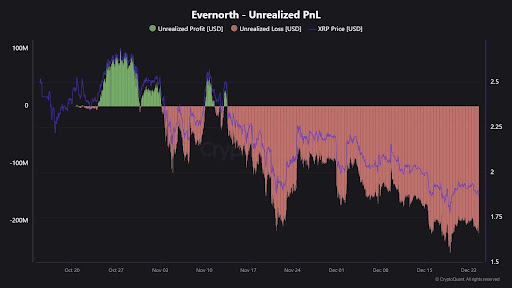
Evernorth's large-scale XRP treasury experiment in 2025 has resulted in significant paper losses, testing institutional crypto strategies. The company accumulated 388.7 million XRP, reaching a peak value of $947 million with a $71 million gain. However, as XRP's price fell from $2.60 to around $1.80, the position dropped below its cost basis, resulting in an unrealized loss of approximately $220–225 million by late December. Despite the drawdown, Evernorth has not sold any assets. The case highlights concentration risks in single-asset crypto treasuries and the divergence between direct holdings and institutional ETF inflows, which continued despite the price decline. The outcome underscores the importance of endurance in long-term crypto investment strategies.

Evernorth’s decision to build one of the largest known XRP treasuries has become one of the most closely watched institutional crypto experiments of 2025. What began as a high-conviction accumulation strategy has since evolved into a stress test of timing, volatility management, and long-term positioning in a market that has repeatedly punished short-term optimism.

A High-Conviction XRP Treasury Meets Market Reality

Evernorth accumulated approximately 388.7 million XRP between late October and late December 2025, deploying capital aggressively as XRP traded in a strong uptrend. At its peak, the position was valued at roughly $947 million and briefly generated a gain of about $71 million. This early performance reinforced the thesis that institutional-scale XRP exposure could deliver meaningful upside if market momentum held.

However, that momentum did not persist. As XRP’s price slid from the $2.60 region toward the $1.80 range, Evernorth’s treasury position moved decisively below its aggregate cost basis. What was once a profitable allocation quickly turned into a substantial unrealized drawdown. By late December, the paper loss had expanded to roughly $220–225 million, according to on-chain and price-based estimates.

Importantly, this outcome was not driven by forced selling or liquidation. The losses remain unrealized, meaning Evernorth has not exited its position. Instead, the situation reflects a classic mark-to-market recalibration, where exposure size and price volatility intersect unfavorably. Moreover, a chart shared by market watcher JA_Maartun in relation to Evernorth’s treasury illustrates a clear progression, with early profit zones giving way to sustained loss territory as XRP’s price trend weakened over time.

Source: CryptoQuant

What Evernorth’s Performance Signals For Institutional Strategy

Beyond the headline loss figure, Evernorth’s 2025 performance highlights several structural realities about institutional crypto exposure. First, concentration risk is non-trivial. A treasury strategy centered on a single volatile asset amplifies sensitivity to short- and medium-term price swings, regardless of long-term conviction. Even disciplined accumulation can be undermined by unfavorable macro and market timing.

Second, Evernorth’s experience underscores the disconnect that can exist between price action and broader institutional interest. While the altcoin’s spot price declined, XRP-linked exchange-traded products reportedly continued to attract steady inflows, pushing total ETF-held XRP value to around $1.25 billion. This divergence suggests that some institutional participants are expressing exposure through structured vehicles rather than direct balance-sheet holdings, potentially mitigating volatility risk.

In practical terms, Evernorth’s XRP treasury has so far delivered a sobering outcome in 2025: large-scale exposure, significant paper losses, and heightened scrutiny. Yet, the case reframes how success and failure are measured in crypto treasury strategies. The current unrealized loss does not automatically invalidate the strategy, but it does reset expectations. The ability to withstand prolonged drawdowns without triggering exits will determine whether this treasury move is remembered as a misstep or a long-duration bet that simply endured early turbulence.

Price moves downward as bears dominate | Source: XRPUSDT on Tradingview.com

Связанные с этим вопросы

QWhat was the peak value of Evernorth's XRP treasury position in 2025, and what was the gain at that time?

AAt its peak, Evernorth's XRP position was valued at roughly $947 million and briefly generated a gain of about $71 million.

QWhat was the approximate size of the unrealized loss on Evernorth's XRP treasury by late December 2025?

ABy late December 2025, the paper loss on Evernorth's XRP treasury had expanded to roughly $220–225 million.

QAccording to the article, what is one key structural reality about institutional crypto exposure highlighted by Evernorth's performance?

AOne key structural reality is that concentration risk is non-trivial; a treasury strategy centered on a single volatile asset amplifies sensitivity to short- and medium-term price swings.

QDespite the declining spot price of XRP, what continued to happen with XRP-linked exchange-traded products (ETPs)?

ADespite the declining spot price, XRP-linked exchange-traded products reportedly continued to attract steady inflows, pushing total ETF-held XRP value to around $1.25 billion.

QWhat does the article suggest will determine whether Evernorth's treasury move is seen as a misstep or a long-term bet?

AThe ability to withstand prolonged drawdowns without triggering exits will determine whether this move is remembered as a misstep or a long-duration bet that endured early turbulence.

Похожее

After the Passage of the GENIUS Act and the CLARITY Act, What Is the Correct Architecture for On-Chain Yield?

The article discusses the evolution of on-chain credit, distinguishing three markets: overcollateralized crypto lending, unsecured lending (largely unsuccessful), and asset-backed credit (ABC). ABC, backed by identifiable real-world collateral with legal recourse, is identified as the fastest-growing category and the only one credibly addressing adverse selection—the core problem in credit where the riskiest borrowers self-select. Current growth in on-chain Real World Assets (RWAs), particularly tokenized private credit funds (e.g., Maple Finance, Centrifuge), is substantial but often merely "wraps" existing fund structures, inheriting their risks rather than solving adverse selection at the protocol level. The regulatory landscape is a key driver, with the US GENIUS Act (prohibiting stablecoin issuers from paying yield) and the proposed CLARITY Act (closing loopholes on indirect yield) set to redefine permissible yield-bearing products. This makes vaults (like ERC-4626) the critical architecture—they become the primary compliant vehicle for delivering yield, functioning as issuance, disclosure, distribution, and recovery mechanisms. The author's thesis is that the correct post-GENIUS/CLARITY architecture involves building ABC solutions where credit assessment, structure, and recovery are encoded directly into the smart contract vault layer, moving beyond mere tokenized fund wrappers to solve adverse selection fundamentally and ensure regulatory compliance.

Foresight News27 мин. назад

After the Passage of the GENIUS Act and the CLARITY Act, What Is the Correct Architecture for On-Chain Yield?

Foresight News27 мин. назад

TechFlow Intelligence Bureau: Anthropic's New Model Fable Sparks Controversy by Restricting Biosafety Research, US CPI Soars to 4.2%, a Three-Year High

**Summary of TechFlow Intelligence Report:** The newsletter covers several key tech and finance developments. In AI, Anthropic's new Fable model faced backlash for secretly limiting biomedical research capabilities and enforcing a 30-day data retention policy, prompting the company to promise more transparent adjustments. In a related story, Anthropic's founder revealed his departure from OpenAI was due to dishonesty from Sam Altman, not safety concerns. Meanwhile, OpenAI is considering significant price cuts to compete with Anthropic, potentially sparking a price war. In crypto/Web3, BlackRock filed a new amendment for a yield-generating Bitcoin ETF, while Bank of America's CEO warned that stablecoin yields could drain trillions from traditional banks. U.S. Senator Cynthia Lummis advocated for the U.S. to officially accumulate Bitcoin reserves. In hardware, Nvidia released the DiffusionGemma-2-6B image model optimized for efficient inference, and AMD promoted its unified memory architecture to challenge Nvidia's dominance. TSMC's CFO hinted at possible price increases due to soaring AI chip demand. A major legal ruling in Germany held Google legally responsible for inaccurate information generated by its AI Overviews feature. Google Chrome also moved to fully block ad-blocker workarounds like uBlock Origin. Macroeconomic headlines included U.S. CPI rising to 4.2% (a 3-year high) and Iran's complete closure of the Strait of Hormuz, raising oil price and inflation fears. South Korean markets saw continued volatility with massive foreign capital outflow. Other notable stories: Microsoft expanded its Copilot AI assistant "Mico" globally; a study found r/wallstreetbets users' stock picks outperformed Wall Street; a fully autonomous drone killed a human soldier for the first time, raising AI ethics concerns; and a Chinese hospital used brain-computer interface technology to help a blind person "see." The overarching theme connects debates over AI boundaries and responsibility (Anthropic's restrictions, Google's liability, lethal autonomous drones) with real-world economic and geopolitical turmoil (inflation, Strait of Hormuz closure, market instability), highlighting the tense interplay between technological advancement and global chaos.

marsbit40 мин. назад

TechFlow Intelligence Bureau: Anthropic's New Model Fable Sparks Controversy by Restricting Biosafety Research, US CPI Soars to 4.2%, a Three-Year High

marsbit40 мин. назад

Alibaba's Yet Another New Business Division: What Signal Does It Send?

Alibaba has established a new "Token Foundry" business unit, merging its Tongyi large model division and Future Life Lab. Led directly by Group CEO Wu Yongming, this marks the company's third significant AI organizational reshuffle in 2026, following the creation of the Alibaba Token Hub (ATH) and a Group Technology Committee. The move signals a strategic shift from consolidating AI resources to accelerating productization and commercialization. The "Token Foundry" name reflects Alibaba's ambition to become a foundational supplier in the AI era, focusing on model development and commercial application. Key teams, including those behind the high-performing HappyHorse video generation model, have been integrated into the new unit. Concurrently, Zhou Jingren, architect of the Qwen model series, has been appointed Group Chief Scientist to lead a new AI Future Research Institute, focusing on long-term technological breakthroughs like Agent capabilities. This restructuring creates a clear four-layer AI architecture within Alibaba: the research institute for frontier exploration, Token Foundry for core models and commercialization, MaaS for platform services, and business units like Qianwen (C端) and Wukong (B端) for end-user applications. The adjustments align with a global trend among tech giants like Google and Microsoft to centralize AI leadership under the CEO and deeply integrate research with business units. The urgency is driven by a narrowing competitive window. Alibaba has announced its AI business is now entering a commercialization phase, with AI-related revenue seeing triple-digit growth for eleven consecutive quarters. The company faces intense competition in the MaaS (Model-as-a-Service) sector from rivals like ByteDance and Tencent. The Token Foundry initiative represents Alibaba's effort to streamline execution and enhance competitiveness in this critical, fast-evolving landscape.

marsbit1 ч. назад

Alibaba's Yet Another New Business Division: What Signal Does It Send?

marsbit1 ч. назад

From Return to Resignation: Chen Hang's 437 Days at DingTalk

The 437-Day Return and Departure of Chen Hang at DingTalk This article chronicles the 437-day period from March 31, 2025, to June 11, 2026, when Chen Hang (also known as "No Move") returned as CEO of DingTalk, the enterprise communication platform he originally founded, only to later step down. Chen Hang, the creator of DingTalk in 2015, was brought back by Alibaba in 2025 after the company acquired his subsequent startup, HHO. His return was driven by Alibaba's renewed focus on AI and DingTalk's strategic role as its key to-B AI application. However, his aggressive management style, marked by strict work policies like mandatory clock-ins and extended hours, quickly caused internal friction and was criticized as being at odds with Alibaba's culture. Despite the internal turmoil, Chen Hang drove significant product launches. In August 2025, he unveiled "AI DingTalk 1.0," featuring new products like the AI-native entry point "DingTalk ONE." By March 2026, he announced "Wukong," touted as the world's first enterprise-grade AI-native work platform, representing a fundamental rebuild of DingTalk's architecture. The turning point came in early June 2026. A detailed internal post criticizing DingTalk's work culture went viral, followed by a public critique from a former executive. This prompted an unprecedented public rebuke from the Alibaba Partners Committee, which stated such management was not aligned with company values. One day later, on June 11, Alibaba announced Chen Hang's departure. He was succeeded by Chen Yusen, a 32-year-old technical expert known for founding cybersecurity firm Changting Technology. While Chen Hang's tenure laid the technical foundation for DingTalk's AI transformation with "Wukong," his leadership style ultimately led to his replacement as the company seeks a new direction under younger leadership.

marsbit1 ч. назад

From Return to Resignation: Chen Hang's 437 Days at DingTalk

marsbit1 ч. назад

Торговля

Спот
Фьючерсы

Популярные статьи

Как купить S

Добро пожаловать на HTX.com! Мы сделали приобретение Sonic (S) простым и удобным. Следуйте нашему пошаговому руководству и отправляйтесь в свое крипто-путешествие.Шаг 1: Создайте аккаунт на HTXИспользуйте свой адрес электронной почты или номер телефона, чтобы зарегистрироваться и бесплатно создать аккаунт на HTX. Пройдите удобную регистрацию и откройте для себя весь функционал.Создать аккаунтШаг 2: Перейдите в Купить криптовалюту и выберите свой способ оплатыКредитная/Дебетовая Карта: Используйте свою карту Visa или Mastercard для мгновенной покупки Sonic (S).Баланс: Используйте средства с баланса вашего аккаунта HTX для простой торговли.Третьи Лица: Мы добавили популярные способы оплаты, такие как Google Pay и Apple Pay, для повышения удобства.P2P: Торгуйте напрямую с другими пользователями на HTX.Внебиржевая Торговля (OTC): Мы предлагаем индивидуальные услуги и конкурентоспособные обменные курсы для трейдеров.Шаг 3: Хранение Sonic (S)После приобретения вами Sonic (S) храните их в своем аккаунте на HTX. В качестве альтернативы вы можете отправить их куда-либо с помощью перевода в блокчейне или использовать для торговли с другими криптовалютами.Шаг 4: Торговля Sonic (S)С легкостью торгуйте Sonic (S) на спотовом рынке HTX. Просто зайдите в свой аккаунт, выберите торговую пару, совершайте сделки и следите за ними в режиме реального времени. Мы предлагаем удобный интерфейс как для начинающих, так и для опытных трейдеров.

1.4k просмотров всегоОпубликовано 2025.01.15Обновлено 2026.06.02

Как купить S

Sonic: Обновления под руководством Андре Кронье – новая звезда Layer-1 на фоне спада рынка

Он решает проблемы масштабируемости, совместимости между блокчейнами и стимулов для разработчиков с помощью технологических инноваций.

2.3k просмотров всегоОпубликовано 2025.04.09Обновлено 2025.04.09

Sonic: Обновления под руководством Андре Кронье – новая звезда Layer-1 на фоне спада рынка

HTX Learn: Пройдите обучение по "Sonic" и разделите 1000 USDT

HTX Learn — ваш проводник в мир перспективных проектов, и мы запускаем специальное мероприятие "Учитесь и Зарабатывайте", посвящённое этим проектам. Наше новое направление .

1.8k просмотров всегоОпубликовано 2025.04.10Обновлено 2025.04.10

HTX Learn: Пройдите обучение по "Sonic" и разделите 1000 USDT

Обсуждения

Добро пожаловать в Сообщество HTX. Здесь вы сможете быть в курсе последних новостей о развитии платформы и получить доступ к профессиональной аналитической информации о рынке. Мнения пользователей о цене на S (S) представлены ниже.

活动图片