Gold and Silver Have Gone Crazy: Is Bitcoin 'Lagging Behind' or Building Momentum During Christmas Week?

比推Опубликовано 2025-12-23Обновлено 2025-12-23

Введение

During the Christmas week, global markets have seen a surge in safe-haven assets like gold and silver, which hit new all-time highs amid a weaker dollar and falling Treasury yields. In contrast, Bitcoin has remained stagnant, trading within a narrow range of $88,000–$89,000, failing to ride the macro tailwinds. The article questions whether Bitcoin is experiencing a "Santa Rally"—a seasonal uptrend often seen in traditional markets—or is instead consolidating for a potential move. Market analysts point to a cautious macro environment, with investors awaiting key U.S. economic data, including Q3 GDP and unemployment figures, to gauge the Federal Reserve’s policy direction. This uncertainty has led to risk-off sentiment, with capital flowing out of Bitcoin and Ethereum ETFs while seeing minor inflows into altcoins like XRP and Solana. Technically, Bitcoin is in a consolidation phase, with key resistance between $93,000–$95,000. A major $24 billion options expiration on Friday adds to near-term volatility, with bulls targeting $100,000 and bears defending $85,000. Analysts from CF Benchmarks and others describe the current behavior as digestion of prior gains rather than preparation for a new rally. Historical data shows mixed Christmas-week performance for Bitcoin, with an average gain of 7.9% since 2011. Overall, Bitcoin’s current stance reflects its perception as a risk asset amid broader market caution. The outcome depends less on seasonal trends and more on whether insti...

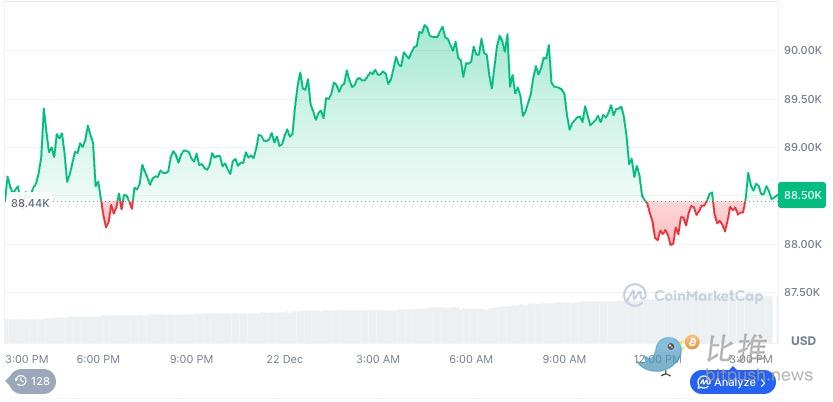
Entering Christmas week, the global market's initial answer did not belong to the crypto market. Against the backdrop of a weakening US dollar and falling US bond yields, risk-aversion sentiment quickly heated up. Gold and silver took the lead, with prices repeatedly刷新历史高位 (hitting new historical highs), becoming the most obvious destination for funds. In contrast, the crypto market appeared unusually quiet. Bitcoin did not take off with the macroeconomic tailwinds but remained stuck in the 88,000-89,000 fluctuation range, lacking the aggressive posture expected before the holiday.

It is precisely against this contrast that the question of "whether Bitcoin will usher in a Santa Rally" has once again become a topic of repeated discussion in the market. The so-called Santa Rally, originally a seasonal phenomenon in traditional financial markets, refers to a phased rise in risk assets around Christmas, driven by improved sentiment and changes in liquidity. But in the crypto market, this pattern has never been stable. Whether this year's Bitcoin is "lagging behind" amid rising risk-aversion sentiment or quietly building momentum within a high range still requires looking for answers in real price action and fund structures.

Fundamentals: Macro Environment Still in a "Wait-and-See" State, Funds Flowing Out of Risk Assets

Gabriel Selby, Research Head at CF Benchmarks, pointed out that before the Federal Reserve obtains data for several consecutive months that clearly points to sustained disinflation, market participants are unlikely to truly increase their配置 (allocation) to risk assets like Bitcoin. In his view, the current macro environment is still in a "waiting for verification" stage.

This cautious sentiment is closely related to investors' high attention to a series of upcoming US economic data. The Q3 GDP data will be released soon, with market expectations for an annualized growth rate of about 3.5%, slightly lower than Q2's 3.8%; meanwhile, indicators like the Consumer Confidence Index and weekly initial jobless claims will provide more clues about the labor market conditions. The outcomes of these data will directly affect the market's judgment on the Fed's policy path and further influence overall risk appetite.

From other macro conditions, a weakening US dollar and falling US bond yields do provide a theoretical tailwind for risk assets. But the actual choices of funds have given a completely different answer. Amid rising risk-aversion sentiment, funds clearly优先流向 (flowed preferentially to) traditional safe-haven assets like gold and silver.

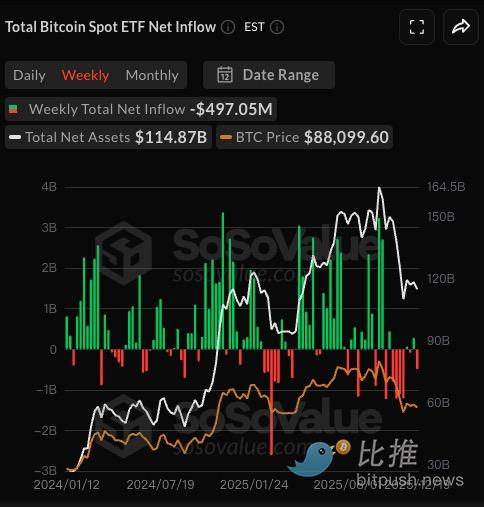
Fund flow data further confirms this. According to statistics from SoSoValue, a clear divergence recently appeared at the ETF level: Bitcoin ETFs recorded a net outflow of approximately $158.3 million, and Ethereum ETFs saw an outflow of about $76 million; in contrast, XRP and Solana ETFs recorded small inflows of about $13 million and $4 million respectively, showing that funds are also undergoing structural adjustments within the crypto market, rather than a overall回流 (return flow).

Looking at digital asset investment products more broadly, CoinShares pointed out in its latest weekly fund flow report that digital asset investment products collectively saw a net outflow of approximately $952 million last week, marking the first net redemption (outflow) after four consecutive weeks of inflows. CoinShares attributed this fund outflow partly to the regulatory uncertainty brought by the slowed progress of the US Clarity Act, causing institutional investors to倾向于 (tend towards) reducing risk exposure in the short term.

Technical Structure: More Like Digestion Than Launch

From a technical structure perspective, Bitcoin's current trend is not明显偏空 (obviously bearish), but it's also hard to call it strong. The 88,000 to 89,000 US dollar range has become the core fluctuation zone repeatedly tested in the short term, while the area above 93,000 to 95,000 US dollars constitutes a key resistance that the bulls must break through.

Several traders pointed out that if Bitcoin fails to effectively break through this resistance range during Christmas week, even if there is a short-term rebound, it is more likely to be seen as a technical repair rather than a trend reversal. Conversely, if the price continues to maintain a high横盘 (sideways movement), it means the market is waiting for new driving factors, rather than actively choosing a direction.

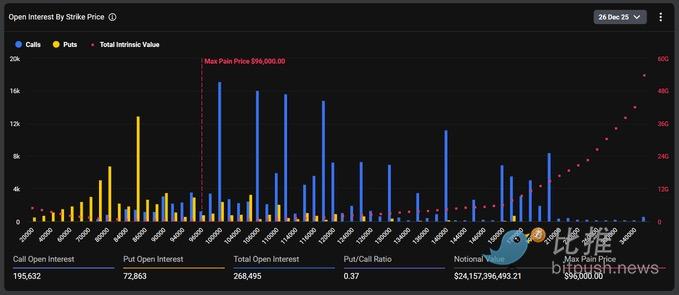
The structure of the derivatives market also partly explains why Bitcoin appears particularly restrained during Christmas week. This Friday, the Bitcoin market will witness the largest options expiration in history, with a total value of up to $24 billion. Currently, bulls and bears are engaged in fierce博弈 (game) around key price levels:

Bull camp: Betting that BTC will break through the 100,000 US dollar mark.

Bear camp: Defending the 85,000 US dollar关口 (level) with full force.

Key level: 96,000 US dollars is seen as the分水岭 (watershed) for this round's trend. Holding above here maintains the rebound momentum; otherwise, the market will continue to face pressure.

What Do Analysts Think?

Against the backdrop of Bitcoin's delayed breakout, analysts' judgments are generally cautious. Several market observers pointed out that this year's Christmas week is more like a "structure test" rather than a window for sentiment-driven one-sided行情 (market movement).

Gabriel Selby, Research Head at CF Benchmarks, stated bluntly in a recent interview that Bitcoin's current price action does not fit the characteristics of a typical Santa Rally. In his view, a real holiday rally is often accompanied by持续占优 (sustained dominance) of buying pressure and trend continuation, rather than反复拉锯 (repeated tug-of-war) within a high range. "What we are seeing now looks more like the market消化 (digesting) previous gains, rather than building momentum for the next rise." This judgment is also corroborated by the reality of持续偏低 (persistently low) trading volume.

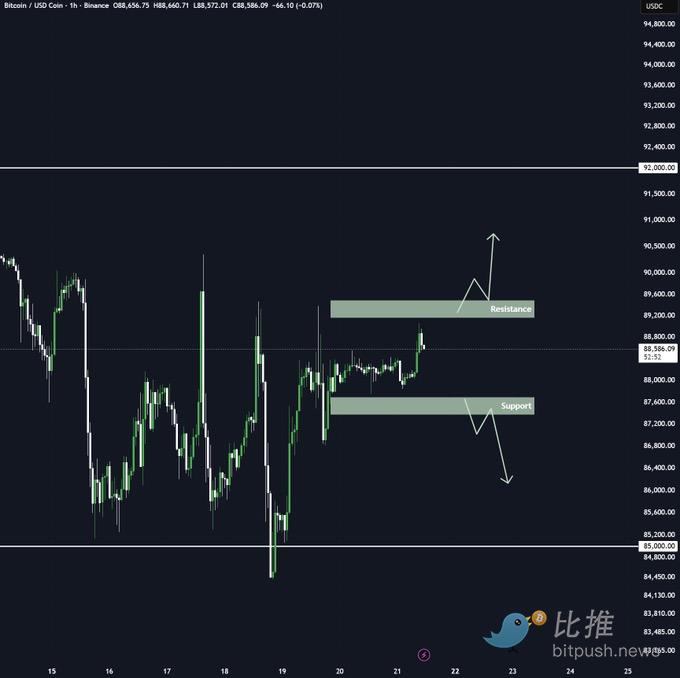
Crypto analyst DrBullZeus stated that BTC continues to fluctuate between the same support and resistance levels, with no clear breakout yet. Until a clear breakout occurs, the price will remain in a range-bound trend. Breaking above resistance would open the door to the 92,000 US dollar level, while breaking below support could lead to a price drop to the 85,000 US dollar region.

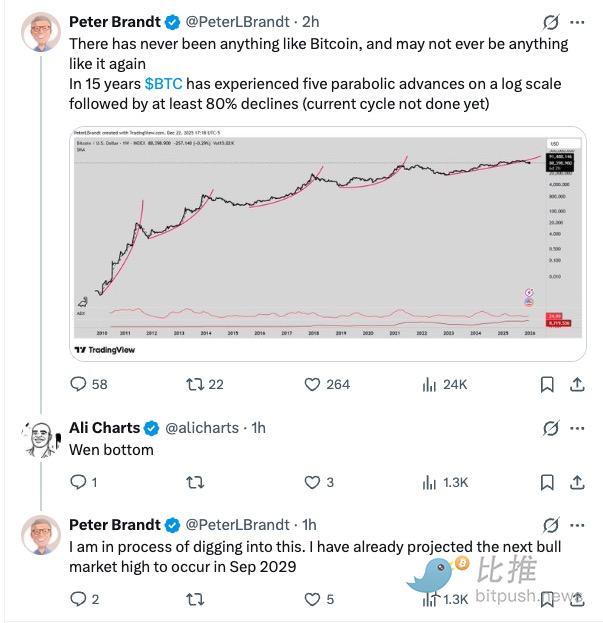
Legendary trader Peter Brandt最新复盘 (recently reviewed and pointed out) that Bitcoin has experienced 5 cycles of "parabolic growth followed by an 80% retracement" in 15 years, and the adjustment in this cycle has not yet bottomed out. Despite the冷酷 (harsh) short-term规律 (pattern), he predicted through cycle extrapolation that the next bull market peak will arrive in September 2029. Brandt emphasized that this asset's unprecedented attributes注定 (destine) it to move towards new highs through extreme洗盘 (shakeouts).

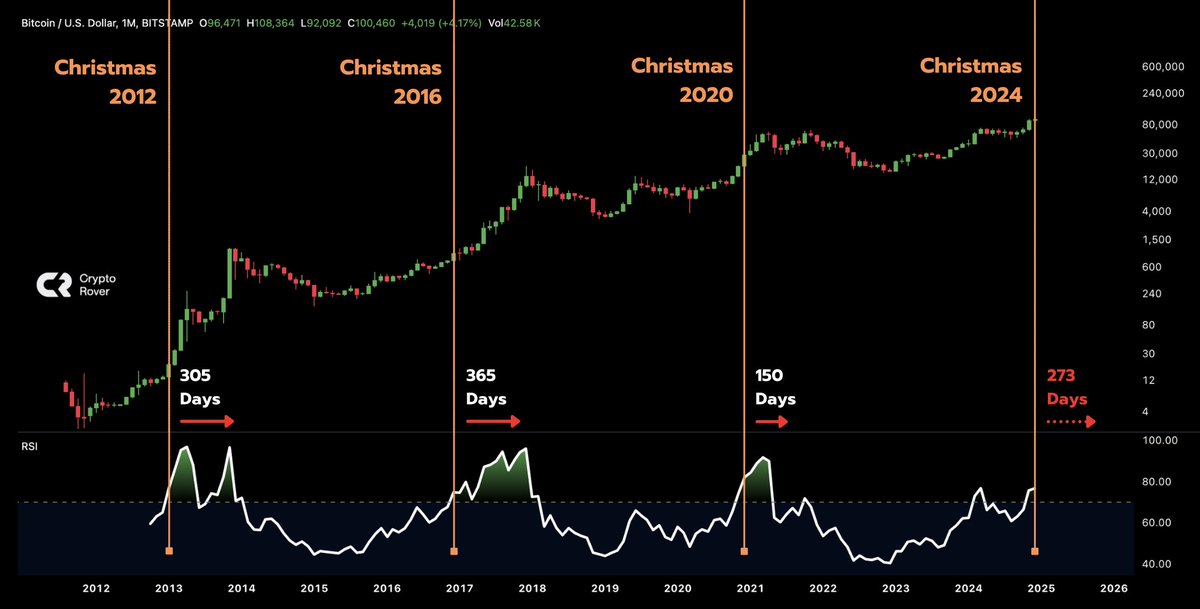
Bitcoin's "Santa Rally" has always been elusive. Looking back at history, there have been dazzling performances like surges of 33% and 46% during the holiday period in 2012 and 2016, but also平淡 (flat) or even declining years. Statistically, since 2011, Bitcoin's average gain during the Christmas period is about 7.9%.

However, judging from the current market structure, it seems difficult to reproduce a typical "Santa Claus rally" this year. The strength of gold and silver reflects more the集中释放 (concentrated release) of market risk-aversion sentiment; in contrast, Bitcoin's relative "calmness" once again highlights that it is still widely regarded as a risk asset in the current stage of global asset allocation.

Therefore, rather than simply attributing Bitcoin's current performance to "lagging behind," it is better to say that it is at a critical and微妙 (subtle) position: on the one hand, it lacks sufficient macroeconomic tailwinds to directly send it onto a new upward trajectory; on the other hand, there are no clear signals of a breakdown and weakness.

What truly determines whether Bitcoin can走出独立行情 (stage an independent rally) at the end of the year is not the "Christmas" time label, but whether market funds are willing to reinvest at the current high levels. Until this point is clearly confirmed,窄幅震荡 (narrow-range fluctuations) will likely remain the主旋律 (main theme) of this Christmas week.

Author: Bootly


Twitter:https://twitter.com/BitpushNewsCN

Bitpush TG Discussion Group:https://t.me/BitPushCommunity

Bitpush TG Subscription: https://t.me/bitpush

Original link:https://www.bitpush.news/articles/7597670

Связанные с этим вопросы

QWhy did gold and silver prices hit record highs during the Christmas week, while Bitcoin remained stagnant?

AGold and silver surged due to rising safe-haven demand amid a weaker US dollar and falling Treasury yields, while Bitcoin, perceived as a risk asset, did not benefit from the same macro tailwinds and showed subdued price action.

QWhat is the 'Santa Rally' in the context of financial markets, and how has Bitcoin historically performed during this period?

AThe 'Santa Rally' refers to a seasonal phenomenon in traditional financial markets where risk assets often experience a rally around Christmas due to improved sentiment and liquidity changes. Historically, Bitcoin's performance during this period has been inconsistent, with an average gain of about 7.9% since 2011, including significant rallies in some years and flat or negative performance in others.

QWhat key economic data were market participants monitoring that influenced risk appetite and Bitcoin's price action?

AMarket participants were closely watching US economic data, including Q3 GDP (expected around 3.5% annualized growth), consumer confidence indices, and weekly initial jobless claims, as these indicators would affect expectations for Federal Reserve policy and overall risk sentiment.

QHow did ETF flows reflect the sentiment towards Bitcoin and other cryptocurrencies during this period?

AETF flows showed a divergence: Bitcoin ETFs saw a net outflow of approximately $158.3 million, and Ethereum ETFs had outflows of about $76 million, while XRP and Solana ETFs recorded small inflows, indicating structural adjustments within the crypto market rather than broad-based capital回流.

QWhat is the significance of the $96,000 level for Bitcoin's price trend according to derivatives market activity?

AThe $96,000 level is seen as a critical分水岭 (watershed) in the derivatives market. If Bitcoin can sustain above this level, it could maintain upward momentum; otherwise, the price may continue to face downward pressure, especially with a large options expiration influencing market dynamics.

Похожее

South Korean Exchanges 'Battle' Regulators, Challenging the Boundaries of Enforcement and Legislation

South Korea's cryptocurrency industry is engaged in a rare, direct confrontation with regulators. The Financial Intelligence Unit (FIU), the primary anti-money laundering (AML) watchdog, has recently imposed heavy penalties on major exchanges like Upbit and Bithumb for alleged violations involving unregistered overseas VASPs and AML procedures. However, exchanges are now actively challenging these actions in court and through industry associations. In a significant shift, the Seoul Administrative Court ruled in favor of Upbit's operator, Dunamu, overturning part of an FIU-ordered business suspension. The court found the FIU's penalty criteria and justification insufficiently clear. Similarly, the court suspended the enforcement of a six-month business suspension against Bithumb pending a final ruling, citing potential irreversible harm to the exchange. Beyond legal battles, the industry is contesting proposed legislative amendments. The Digital Asset eXchange Alliance (DAXA) strongly opposes a draft rule that would mandate Suspicious Transaction Reports (STRs) for all crypto transfers over 10 million KRW (~$6,800). DAXA argues this "poison pill" clause violates legal principles and would overwhelm the STR system, increasing reports from 63,000 to an estimated 5.45 million annually for major exchanges, thereby crippling effective AML monitoring. This conflict highlights a structural tension in South Korea's crypto governance: comprehensive digital asset laws are still developing, while regulators rely heavily on AML enforcement. The industry's move from passive compliance to active legal and legislative challenges signifies a new phase, pressing for clearer rules and more proportionate enforcement. While short-term disputes may intensify, this clash could ultimately lead to a more mature and sustainable regulatory framework for South Korea's vibrant crypto market.

marsbit24 мин. назад

South Korean Exchanges 'Battle' Regulators, Challenging the Boundaries of Enforcement and Legislation

marsbit24 мин. назад

After 50x Storage Surge, Justin Sun Always Looks to the Next Decade

Sun Yuchen, known for his controversial stunts like a $30 million lunch with Warren Buffett (canceled due to a kidney stone) and eating a $6.2 million duct-taped banana, is often overshadowed by a significant fact: his decade-long track record of spotting major investment trends. In 2016, he famously advised young people to invest in Bitcoin, Nvidia, Tesla, and Tencent instead of buying property. A hypothetical $20,000 investment in Nvidia and Tesla from that list would now be worth over 50 million RMB. His latest major call was on November 6, 2025, predicting a "50x storage opportunity" tied to the AI boom, which materialized with Sandisk's stock surging nearly 50-fold by 2026. Looking ahead, Sun now focuses on the next frontier: Physical AI. He identifies four key areas: 1. **Embodied AI/Robotics**: He sees this reaching its "iPhone moment," with companies like UBTech and Galaxy General leading in commercialization. 2. **Drones**: Viewed as the first commercially viable form of Physical AI, revolutionizing sectors from warfare (e.g., AeroVironment's Switchblade) to logistics. 3. **Spatial Computing**: Beyond VR, it's about AI understanding physical space, a foundational technology for robotics and autonomous systems, exemplified by Apple's Vision Pro. 4. **Space Exploration**: After a 2025 suborbital flight with Blue Origin, Sun advocates for space as the ultimate frontier, discussing blockchain's potential role in space asset management and data transactions. His investment philosophy involves betting on entire, inevitable trends rather than single companies. For robotics, he sees Tesla (the body/manufacturer) and Nvidia (the brain/AI platform) as complementary plays. In defense drones, he highlights companies making tanks obsolete (AeroVironment) and those augmenting fighter jets (Kratos). For space, he participated in Blue Origin's flight and anticipates SpaceX's potential IPO to redefine the sector's valuation. Sun Yuchen's vision frames the next two decades not as a revolution in information flow (like the internet), but in the fundamental operation of the physical world through AI-powered robots, autonomous systems, and spatial intelligence, ultimately extending human and AI activity into space. While many still focus on conventional assets, he continues to look toward the next technological horizon.

marsbit1 ч. назад

After 50x Storage Surge, Justin Sun Always Looks to the Next Decade

marsbit1 ч. назад

The Billionaires Behind the Most Expensive Midterm Election in History

"The Most Expensive Midterm Elections and Their Billionaire Backers" This analysis details the unprecedented scale of spending in the 2026 midterm elections, highlighting the key billionaire donors shaping the political landscape. Jeff Yass, founder of Susquehanna International Group, has contributed over $81 million, ranking third among individual donors behind George Soros ($102.6M) and Elon Musk ($84.8M). Yass is a major donor to Trump's MAGA Inc. and supports school choice and various candidates. Overall, federal committees have raised over $4.7 billion this cycle, with political ad spending projected to reach $10.8 billion. Republican-aligned groups are significantly out-raising their Democratic counterparts. "Dark money" from undisclosed sources continues to grow. The core stakes involve control of Congress and policy direction for Trump's final term. Donors are also motivated by specific issues: Sergey Brin and Chris Larsen are funding opposition to a proposed California wealth tax and supporting crypto-friendly policies. Other top donors include OpenAI's Greg Brockman and his wife Anna ($50M total to MAGA Inc. and an AI-focused PAC), Richard Uihlein ($45.3M to conservative causes), venture capitalists Marc Andreessen and Ben Horowitz (each over $44M to crypto/AI PACs and MAGA Inc.), Miriam Adelson ($42.6M to GOP leadership PACs), Paul Singer ($33.9M), and Diane Hendricks ($25.8M to MAGA Inc.). The article notes that the peak fundraising period is still ahead, with major primaries approaching.

marsbit1 ч. назад

The Billionaires Behind the Most Expensive Midterm Election in History

marsbit1 ч. назад

The Largest IPO in History Is Approaching, Surpassing SpaceX, 28 Years of AI Self-Iteration, Countdown to Intelligence Explosion

"Anthropic Nears Trillion-Dollar IPO, Fueled by Explosive Growth and 2028 'Intelligence Explosion' Warning Anthropic is considering a deal valuing the AI company near $1 trillion, potentially leading to one of the largest IPOs ever and surpassing SpaceX. Its revenue has skyrocketed, with Annual Recurring Revenue (ARR) reaching $45 billion in May 2026—a 500% increase in just five months. This vertical growth curve is attributed to its key products, Claude Code and Cowork, dominating AI coding and enterprise collaboration. Beyond commercial success, co-founder Jack Clark issued a pivotal warning in an interview: there is a greater than 50% chance that by the end of 2028, AI systems will achieve recursive self-improvement—the ability to autonomously build a 'better version' of themselves, initiating an 'intelligence explosion.' This prophecy underpins the company's astronomical valuation, as the market prices in the potential for transformative and disruptive AI. Further signaling its ambition, Anthropic formed a $1.5 billion joint venture with Goldman Sachs and Blackstone, aiming to disrupt traditional consulting firms like McKinsey by deploying Claude AI for complex strategic work. This move tests AI's capacity to replace high-level cognitive labor, a precursor to its predicted autonomous evolution. The narrative presents a dual future: unprecedented economic opportunity alongside significant risks like economic restructuring and security threats. Anthropic's meteoric rise and Clark's 2028 prediction frame the coming years as a countdown to a potential technological singularity."

marsbit1 ч. назад

The Largest IPO in History Is Approaching, Surpassing SpaceX, 28 Years of AI Self-Iteration, Countdown to Intelligence Explosion

marsbit1 ч. назад

Торговля

Спот
Фьючерсы

Популярные статьи

Тест по Bitcoin Биткоина

HTX Learn: Изучите Bitcoin halving и Заработаете Токены USDT

3.0k просмотров всегоОпубликовано 2024.04.16Обновлено 2024.04.16

Тест по Bitcoin  Биткоина

Что такое $BITCOIN

ЦИФРОВОЕ ЗОЛОТО ($BITCOIN): Комплексный анализ Введение в ЦИФРОВОЕ ЗОЛОТО ($BITCOIN) ЦИФРОВОЕ ЗОЛОТО ($BITCOIN) — это проект на основе блокчейна, работающий в сети Solana, который стремится объединить характеристики традиционных драгоценных металлов с инновациями децентрализованных технологий. Хотя он носит имя Биткойн, часто называемого “цифровым золотом” из-за его восприятия как средства хранения ценности, ЦИФРОВОЕ ЗОЛОТО является отдельным токеном, предназначенным для создания уникальной экосистемы в ландшафте Web3. Его цель — позиционировать себя как жизнеспособный альтернативный цифровой актив, хотя детали его применения и функциональности все еще развиваются. Что такое ЦИФРОВОЕ ЗОЛОТО ($BITCOIN)? ЦИФРОВОЕ ЗОЛОТО ($BITCOIN) — это токен криптовалюты, специально разработанный для использования в блокчейне Solana. В отличие от Биткойна, который выполняет широко признанную роль хранения ценности, этот токен, похоже, сосредоточен на более широких приложениях и характеристиках. Примечательные аспекты включают: Инфраструктура блокчейна: Токен построен на блокчейне Solana, известном своей способностью обрабатывать высокоскоростные и недорогие транзакции. Динамика предложения: ЦИФРОВОЕ ЗОЛОТО имеет максимальное предложение, ограниченное 100 квадриллионами токенов (100P $BITCOIN), хотя детали о его обращающемся предложении в настоящее время не раскрыты. Утилита: Хотя точные функциональные возможности не описаны, есть указания на то, что токен может быть использован для различных приложений, потенциально связанных с децентрализованными приложениями (dApps) или стратегиями токенизации активов. Кто создатель ЦИФРОВОГО ЗОЛОТА ($BITCOIN)? На данный момент личность создателей и команды разработчиков, стоящих за ЦИФРОВЫМ ЗОЛОТОМ ($BITCOIN), остается неизвестной. Эта ситуация типична для многих инновационных проектов в области блокчейна, особенно тех, которые связаны с децентрализованными финансами и феноменом мем-криптовалют. Хотя такая анонимность может способствовать культуре, ориентированной на сообщество, она усиливает опасения по поводу управления и ответственности. Кто инвесторы ЦИФРОВОГО ЗОЛОТА ($BITCOIN)? Доступная информация указывает на то, что у ЦИФРОВОГО ЗОЛОТА ($BITCOIN) нет известных институциональных спонсоров или значительных венчурных капиталовложений. Проект, похоже, функционирует по модели пирингового взаимодействия, сосредоточенной на поддержке и принятии сообществом, а не на традиционных путях финансирования. Его активность и ликвидность в основном сосредоточены на децентрализованных биржах (DEX), таких как PumpSwap, а не на устоявшихся централизованных торговых платформах, что еще больше подчеркивает его подход, ориентированный на grassroots. Как работает ЦИФРОВОЕ ЗОЛОТО ($BITCOIN) Операционные механизмы ЦИФРОВОГО ЗОЛОТА ($BITCOIN) можно подробно описать на основе его дизайна блокчейна и характеристик сети: Механизм консенсуса: Используя уникальный механизм доказательства истории (PoH) Solana в сочетании с моделью доказательства доли (PoS), проект обеспечивает эффективную валидацию транзакций, что способствует высокой производительности сети. Токеномика: Хотя конкретные дефляционные механизмы не были подробно описаны, большое максимальное предложение токенов подразумевает, что оно может быть предназначено для микротранзакций или нишевых случаев использования, которые еще предстоит определить. Интероперабельность: Существует потенциал для интеграции с более широкой экосистемой Solana, включая различные платформы децентрализованных финансов (DeFi). Однако детали относительно конкретных интеграций остаются неуточненными. Хронология ключевых событий Вот хронология, которая подчеркивает значимые вехи, касающиеся ЦИФРОВОГО ЗОЛОТА ($BITCOIN): 2023: Первоначальное развертывание токена происходит в блокчейне Solana, отмеченное его адресом контракта. 2024: ЦИФРОВОЕ ЗОЛОТО приобретает видимость, когда оно становится доступным для торговли на децентрализованных биржах, таких как PumpSwap, позволяя пользователям обменивать его на SOL. 2025: Проект наблюдает спорадическую торговую активность и потенциальный интерес к инициативам, возглавляемым сообществом, хотя на данный момент не зафиксировано никаких значительных партнерств или технических достижений. Критический анализ Сильные стороны Масштабируемость: Основная инфраструктура Solana поддерживает высокие объемы транзакций, что может повысить полезность $BITCOIN в различных сценариях транзакций. Доступность: Потенциально низкая цена торговли за токен может привлечь розничных инвесторов, способствуя более широкому участию благодаря возможностям дробного владения. Риски Отсутствие прозрачности: Отсутствие публично известных спонсоров, разработчиков или процесса аудита может вызвать скептицизм относительно устойчивости и надежности проекта. Волатильность рынка: Торговая активность сильно зависит от спекулятивного поведения, что может привести к значительной волатильности цен и неопределенности для инвесторов. Заключение ЦИФРОВОЕ ЗОЛОТО ($BITCOIN) является интригующим, но неоднозначным проектом в быстро развивающейся экосистеме Solana. Хотя он пытается использовать нарратив “цифрового золота”, его отход от установленной роли Биткойна как средства хранения ценности подчеркивает необходимость более четкого различения его предполагаемой утилиты и структуры управления. Будущее принятие и усвоение, вероятно, будут зависеть от решения текущей непрозрачности и более четкого определения его операционных и экономических стратегий. Примечание: Этот отчет охватывает синтезированную информацию, доступную на октябрь 2023 года, и с тех пор могут произойти события.

99 просмотров всегоОпубликовано 2025.05.13Обновлено 2025.05.13

Что такое $BITCOIN

Fractal Bitcoin: масштабирование Биткоина с помощью рекурсивной системы

Fractal Bitcoin — масштабное Layer-1-решнение, созданное на базе кода Биткоина, позволяющего достигать бесконечного масштабирования с помощью рекурсивного подхода.

2.2k просмотров всегоОпубликовано 2025.06.30Обновлено 2025.06.30

Fractal Bitcoin: масштабирование Биткоина с помощью рекурсивной системы

Обсуждения

Добро пожаловать в Сообщество HTX. Здесь вы сможете быть в курсе последних новостей о развитии платформы и получить доступ к профессиональной аналитической информации о рынке. Мнения пользователей о цене на BTC (BTC) представлены ниже.

活动图片