From Safe Haven to Risk Basket: Why Gold, Silver, and BTC Are Becoming Increasingly Similar?

marsbitОпубликовано 2026-02-06Обновлено 2026-02-06

Введение

In January 2026, gold, silver, and Bitcoin experienced a synchronized sharp decline, challenging traditional asset classifications. The pricing of precious metals has shifted from physical demand to financialized markets, driven by the same macro factors—dollar liquidity, real interest rates, and risk appetite—that influence Bitcoin. Institutional investors and algorithmic trading systems now dominate marginal price movements, treating all three as "non-sovereign scarce assets" within the same risk basket. Silver, with its leverage and industrial role, acted as a volatility amplifier, while Bitcoin's decentralized narrative weakened due to institutionalization. Physical markets for gold and silver showed resilience with central bank buying and industrial demand, creating a two-tier structure: long-term support from physical buyers and short-term volatility from leveraged paper markets. The crypto ecosystem, including altcoins and DeFi, faces pressure as Bitcoin's value proposition aligns more with macro liquidity tools than decentralized ideals.

Author: Nikka / WolfDAO (X: @10xWolfdao)

In January 2026, gold, silver, and BTC plummeted simultaneously, breaking the classification of traditional safe-haven and speculative assets. The pricing power of precious metals has long shifted to financialized markets, driven by the same macro factors as BTC—such as dollar liquidity and real interest rates—and are bought and sold together by the same institutional funds. Silver, with its high leverage, acts as a volatility amplifier, and all three trigger leveraged liquidations at liquidity turning points. The paper market and physical market for precious metals are diverging, while BTC's decentralization narrative is being diluted by institutionalization, putting pressure on the crypto ecosystem.

Anomalous Synchronization

On January 30, 2026, gold plunged over 12% from its all-time high of $5,600 per ounce, marking its largest single-day drop in nearly 40 years. Silver fell even more sharply, dropping 27% in one day and another 6.7% the next day. Bitcoin fell below $75,000, touching the $70,000 range over the weekend, and as of this week, it has dropped below the $60,000 mark, with market panic intensifying.

In traditional understanding, this should not happen. Gold and silver are safe-haven assets—low volatility, risk-resistant, and wealth during crises. Bitcoin is a speculative asset—high volatility, high risk, and both loved and hated. They should fluctuate at different times, in different ways, and for different reasons.

But the real market is proving in the most direct way: this classification system has failed. At least in terms of pricing logic, precious metals and Bitcoin are being treated as the same type of asset.

The issue is not that gold and silver have "become unsafe" but that the forces determining their prices have fundamentally changed.

The Overlooked Shift

Let’s start with a key fact: The prices of gold and silver are no longer primarily determined by "safe-haven demand."

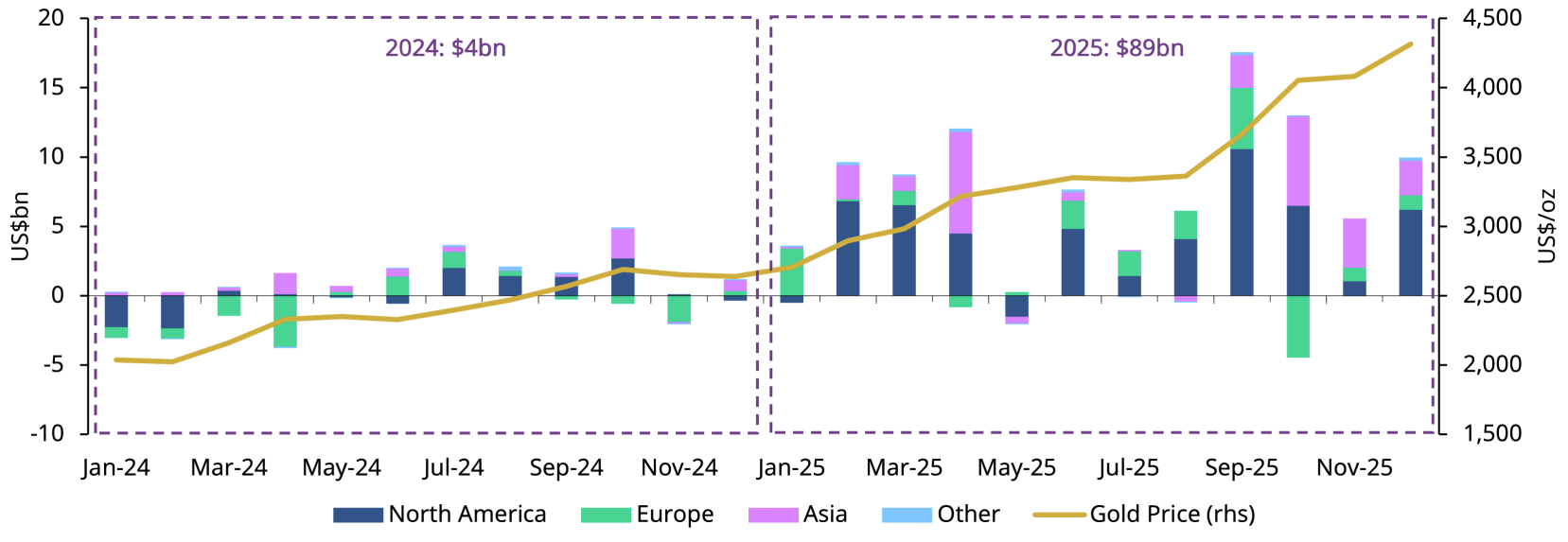
source: gold.org

In 2025, global gold ETF inflows hit a record $89 billion, doubling the assets under management to $559 billion. The proportion of gold in global financial assets has risen from its low in 2010 to 2.8% in the third quarter of 2025.

This 2.8% marks a profound structural shift: the pricing power of precious metals has shifted from physical demand to financialized markets.

Today, the marginal price fluctuations of gold and silver are driven by the same global macro funds: hedge funds, CTA strategies, systematic trend funds, and cross-market institutional accounts. These funds don’t care about "whether gold is a safe haven"; they only care about three variables:

  • Dollar liquidity
  • Real interest rates
  • The pace of risk appetite changes

JP Morgan research shows that changes in U.S. Treasury yields can explain about 70% of gold’s quarterly price fluctuations. This means gold pricing has become highly macro-driven and systematic. When you see gold price movements, they are no longer driven by India’s wedding season or Chinese retail investors’ buying enthusiasm but by Wall Street’s quantitative models and algorithmic trading systems.

The Same Button

This explains why gold, silver, and Bitcoin have recently fluctuated sharply at the same time.

They are all exposed to the same macro factor: violent swings in global liquidity expectations.

When the market bets on rate cuts, a weaker dollar, or diluted purchasing power, these three assets are bought simultaneously—not because they are "safe havens" but because, in quantitative models, they are all "non-sovereign scarce assets."

When inflation proves sticky, rate expectations rebound, the dollar strengthens, or risk models trigger deleveraging, they are sold off simultaneously—not because they are "high risk" but because they are in the same risk basket.

Price fluctuations are not due to "changes in asset attributes" but because the participants and trading methods driving pricing have become homogenized.

January 30 is the best proof. Trump nominated Kevin Warsh as Fed chair, which the market interpreted as a hawkish signal. The dollar rebounded, and immediately:

  • Gold fell from $5,600 to below $4,900
  • Silver plummeted from $120 to $75
  • Bitcoin slid from $88,000 to $81,000

Three assets, same moment, same direction, same violence. This is not a coincidence but direct evidence that they are priced by the same trading system.

Silver: The Amplifier Effect

Silver’s performance is particularly representative.

Compared to gold, silver has dual attributes as both a precious metal and an industrial metal, with higher leverage and more fragile liquidity. By the end of 2025, silver’s 30-day realized volatility surged above 50%, while Bitcoin’s compressed to the 40% range—a significant reversal.

Silver’s rapid rally and sharp decline were essentially due to concentrated inflows and outflows of macro long positions, not any structural change in fundamentals over the short term. In January 2026, the Chicago Mercantile Exchange raised silver futures margin requirements from historical lows to 15–16.5%, ending the era of low-cost "paper silver" speculation.

When prices fell, highly leveraged speculators couldn’t meet the new margin requirements and were forced to liquidate. This triggered cascading liquidations—prices fell further, and more positions were forcibly closed. This "margin trap" is identical to the 1980 move to crush the Hunt Brothers’ silver accumulation by raising margins.

This price action is almost identical to Bitcoin’s behavior near liquidity turning points.

The Truth of the Paradox

This also explains a seemingly contradictory phenomenon: safe-haven assets plummet when "risk arrives."

The reason is not that they have lost their safe-haven attributes but that when systemic risk rises to a certain level, the market prioritizes "cash" and "liquidity" over "long-term preservation logic."

When volatility spikes, liquidity often evaporates. Market makers narrow quote sizes, spreads widen, and price gaps appear. In such an environment, all highly financialized, quickly liquidatable assets with leveraged exposure are sold off simultaneously—whether they are called gold, silver, or Bitcoin.

As Saxo Bank’s Ole Hansen said: "Volatility reinforces itself." When prices fluctuate violently, market structure takes over everything. In this cycle, the "intrinsic attributes" of assets play almost no role.

A Tale of Two Markets

But this is not the whole truth.

While the paper market crashed, the physical market showed opposite signals. After silver’s plunge, physical silver premiums in Shanghai and Dubai soared to $20 above the Western spot price. Major silver miner Fresnillo has cut its 2026 production guidance to 42–46.5 million ounces. Industrial demand (solar, electric vehicles, semiconductors) remains strong.

This split reveals a key contradiction:

  • Paper market: Highly financialized, extremely volatile, driven by macro funds
  • Physical market: Supply-constrained, demand-supported, relatively stable

The same split exists in the gold market. In 2026, central banks are still expected to buy 750–950 tons of gold, marking the third consecutive year of purchases exceeding 1,000 tons. These "traditional" buyers—mainly emerging market central banks—buy gold for dedollarization, reserve diversification, and long-term value storage. They don’t engage in short-term trading, don’t use leverage, and aren’t forced to liquidate by margin calls.

This creates a two-tier structure:

  • Long-term floor: Central banks provide sustained buying, setting a price bottom
  • Short-term volatility: Institutional investors and algorithms dominate marginal pricing, creating extreme fluctuations

Narrative Collapse

A deeper issue: The narrative system long relied upon by the crypto market is collapsing.

The "decentralized safe haven" narrative is being diluted by institutionalization. When Bitcoin falls sharply over weekends with thin liquidity, it is largely due to leveraged trading and futures market liquidations—products of centralized finance. The fundamentalists who hold private keys and adhere to "not your keys, not your coins" have long been marginalized in pricing power.

This change affects not just Bitcoin but the entire crypto ecosystem.

Altcoins face greater pressure: If even Bitcoin has lost its unique value proposition and is grouped into the "macro liquidity trading tool" basket, where will altcoins with weaker narratives and more fragile fundamentals go? When institutions allocate crypto assets, will they choose the already "tamed" BTC or risk investing in Ethereum, Solana, or other public chains?

Ethereum fell 4% to $2,660 during the same period, underperforming Bitcoin. This hints at a brutal possibility: in macro risk models, funds will flow集中 to "the gold of the crypto market" (BTC) and abandon assets seen as "the silver or copper of the crypto market."

DeFi’s paradox: Decentralized finance was once seen as the most revolutionary innovation in crypto, promising lending, trading, and other services without relying on traditional financial intermediaries. But if the underlying assets (BTC, ETH) are entirely priced by traditional financial markets, how much "decentralization" do DeFi protocols really have left?

You can trade using decentralized protocols, but if price discovery happens on Wall Street trading desks, Chicago futures markets, and quantitative model servers, this decentralization is only superficial.

Связанные с этим вопросы

QWhy did gold, silver, and Bitcoin experience a synchronized sharp decline in January 2026, breaking traditional asset classifications?

AThey experienced a synchronized sharp decline because their pricing is now driven by the same macro factors—such as dollar liquidity, real interest rates, and risk appetite—and are traded by the same institutional funds using similar quantitative models and algorithmic systems, rather than their traditional roles as safe-haven or speculative assets.

QWhat key structural shift in the precious metals market has led to gold and silver being priced like financial assets rather than physical commodities?

AThe key structural shift is the financialization of the precious metals market, where pricing power has moved from physical demand to financial markets. Global gold ETF inflows reached a record $89 billion in 2025, and institutional investors like hedge funds and CTAs now drive marginal price movements based on macro factors, not physical supply and demand.

QHow does silver act as a 'volatility amplifier' compared to gold and Bitcoin in the current market structure?

ASilver acts as a volatility amplifier due to its high leverage, lower liquidity, and dual role as both a precious and industrial metal. Its leverage makes it more susceptible to margin calls and cascading liquidations during market stress, as seen when CME raised margin requirements in January 2026, triggering sharp price swings.

QWhat contradiction exists between the 'paper market' and the 'physical market' for assets like gold and silver?

AThe paper market is highly financialized, driven by macro funds and algorithms, leading to extreme volatility and leverage-induced price swings. In contrast, the physical market is supported by steady demand from banks and industrial users, with central banks buying gold for long-term reserve diversification, creating a stable price floor despite paper market turbulence.

QHow has the institutionalization of Bitcoin diluted its 'decentralized haven' narrative and impacted the broader ecosystem?

AInstitutionalization has diluted Bitcoin's decentralized narrative because its price is now heavily influenced by traditional financial mechanisms like futures markets, leverage trading, and macro liquidity factors. This shift marginalizes core 'not your keys, not your coins' holders and pressures the broader crypto ecosystem, as altcoins and DeFi protocols lose their unique value propositions when underlying asset pricing is dominated by Wall Street.

Похожее

DeepSeek No Longer Wants to Focus Only on Large Models

DeepSeek, a leading Chinese AI company, has released its new model series DeepSeek-V4, featuring two versions: the high-performance V4-Pro with 1.6 trillion parameters and the cost-efficient V4-Flash. Both support 1 million token context windows and use Mixture-of-Experts (MoE) architecture to improve efficiency. The company continues its strategy of offering competitive pricing, with input tokens priced as low as ¥0.2 per million tokens. A key revelation is DeepSeek’s explicit link between future price reductions and the mass availability of Huawei’s Ascend 950 AI chips in the second half of the year. This signals a strategic shift from relying solely on algorithmic and engineering optimizations to integrating domestic computing power into its core cost structure. DeepSeek has adapted its inference system to run efficiently on both NVIDIA GPUs and Huawei NPUs, potentially challenging NVIDIA's CUDA ecosystem dominance. Concurrently, DeepSeek is reportedly seeking significant external investment, with a pre-money valuation of around ¥300 billion. This move highlights growing pressures in scaling compute infrastructure, retaining top talent—amid recent departures of key researchers—and accelerating commercialization efforts. The company has also updated its consumer app with tiered model access, indicating a stronger product focus. The V4 release underscores that China's AI competition is evolving beyond pure model capability into a broader contest involving compute supply chains, engineering systems, financing, and talent strategy.

marsbit15 мин. назад

DeepSeek No Longer Wants to Focus Only on Large Models

marsbit15 мин. назад

Торговля

Спот
Фьючерсы

Популярные статьи

Тест по Bitcoin Биткоина

HTX Learn: Изучите Bitcoin halving и Заработаете Токены USDT

3.0k просмотров всегоОпубликовано 2024.04.16Обновлено 2024.04.16

Тест по Bitcoin  Биткоина

Что такое $BITCOIN

ЦИФРОВОЕ ЗОЛОТО ($BITCOIN): Комплексный анализ Введение в ЦИФРОВОЕ ЗОЛОТО ($BITCOIN) ЦИФРОВОЕ ЗОЛОТО ($BITCOIN) — это проект на основе блокчейна, работающий в сети Solana, который стремится объединить характеристики традиционных драгоценных металлов с инновациями децентрализованных технологий. Хотя он носит имя Биткойн, часто называемого “цифровым золотом” из-за его восприятия как средства хранения ценности, ЦИФРОВОЕ ЗОЛОТО является отдельным токеном, предназначенным для создания уникальной экосистемы в ландшафте Web3. Его цель — позиционировать себя как жизнеспособный альтернативный цифровой актив, хотя детали его применения и функциональности все еще развиваются. Что такое ЦИФРОВОЕ ЗОЛОТО ($BITCOIN)? ЦИФРОВОЕ ЗОЛОТО ($BITCOIN) — это токен криптовалюты, специально разработанный для использования в блокчейне Solana. В отличие от Биткойна, который выполняет широко признанную роль хранения ценности, этот токен, похоже, сосредоточен на более широких приложениях и характеристиках. Примечательные аспекты включают: Инфраструктура блокчейна: Токен построен на блокчейне Solana, известном своей способностью обрабатывать высокоскоростные и недорогие транзакции. Динамика предложения: ЦИФРОВОЕ ЗОЛОТО имеет максимальное предложение, ограниченное 100 квадриллионами токенов (100P $BITCOIN), хотя детали о его обращающемся предложении в настоящее время не раскрыты. Утилита: Хотя точные функциональные возможности не описаны, есть указания на то, что токен может быть использован для различных приложений, потенциально связанных с децентрализованными приложениями (dApps) или стратегиями токенизации активов. Кто создатель ЦИФРОВОГО ЗОЛОТА ($BITCOIN)? На данный момент личность создателей и команды разработчиков, стоящих за ЦИФРОВЫМ ЗОЛОТОМ ($BITCOIN), остается неизвестной. Эта ситуация типична для многих инновационных проектов в области блокчейна, особенно тех, которые связаны с децентрализованными финансами и феноменом мем-криптовалют. Хотя такая анонимность может способствовать культуре, ориентированной на сообщество, она усиливает опасения по поводу управления и ответственности. Кто инвесторы ЦИФРОВОГО ЗОЛОТА ($BITCOIN)? Доступная информация указывает на то, что у ЦИФРОВОГО ЗОЛОТА ($BITCOIN) нет известных институциональных спонсоров или значительных венчурных капиталовложений. Проект, похоже, функционирует по модели пирингового взаимодействия, сосредоточенной на поддержке и принятии сообществом, а не на традиционных путях финансирования. Его активность и ликвидность в основном сосредоточены на децентрализованных биржах (DEX), таких как PumpSwap, а не на устоявшихся централизованных торговых платформах, что еще больше подчеркивает его подход, ориентированный на grassroots. Как работает ЦИФРОВОЕ ЗОЛОТО ($BITCOIN) Операционные механизмы ЦИФРОВОГО ЗОЛОТА ($BITCOIN) можно подробно описать на основе его дизайна блокчейна и характеристик сети: Механизм консенсуса: Используя уникальный механизм доказательства истории (PoH) Solana в сочетании с моделью доказательства доли (PoS), проект обеспечивает эффективную валидацию транзакций, что способствует высокой производительности сети. Токеномика: Хотя конкретные дефляционные механизмы не были подробно описаны, большое максимальное предложение токенов подразумевает, что оно может быть предназначено для микротранзакций или нишевых случаев использования, которые еще предстоит определить. Интероперабельность: Существует потенциал для интеграции с более широкой экосистемой Solana, включая различные платформы децентрализованных финансов (DeFi). Однако детали относительно конкретных интеграций остаются неуточненными. Хронология ключевых событий Вот хронология, которая подчеркивает значимые вехи, касающиеся ЦИФРОВОГО ЗОЛОТА ($BITCOIN): 2023: Первоначальное развертывание токена происходит в блокчейне Solana, отмеченное его адресом контракта. 2024: ЦИФРОВОЕ ЗОЛОТО приобретает видимость, когда оно становится доступным для торговли на децентрализованных биржах, таких как PumpSwap, позволяя пользователям обменивать его на SOL. 2025: Проект наблюдает спорадическую торговую активность и потенциальный интерес к инициативам, возглавляемым сообществом, хотя на данный момент не зафиксировано никаких значительных партнерств или технических достижений. Критический анализ Сильные стороны Масштабируемость: Основная инфраструктура Solana поддерживает высокие объемы транзакций, что может повысить полезность $BITCOIN в различных сценариях транзакций. Доступность: Потенциально низкая цена торговли за токен может привлечь розничных инвесторов, способствуя более широкому участию благодаря возможностям дробного владения. Риски Отсутствие прозрачности: Отсутствие публично известных спонсоров, разработчиков или процесса аудита может вызвать скептицизм относительно устойчивости и надежности проекта. Волатильность рынка: Торговая активность сильно зависит от спекулятивного поведения, что может привести к значительной волатильности цен и неопределенности для инвесторов. Заключение ЦИФРОВОЕ ЗОЛОТО ($BITCOIN) является интригующим, но неоднозначным проектом в быстро развивающейся экосистеме Solana. Хотя он пытается использовать нарратив “цифрового золота”, его отход от установленной роли Биткойна как средства хранения ценности подчеркивает необходимость более четкого различения его предполагаемой утилиты и структуры управления. Будущее принятие и усвоение, вероятно, будут зависеть от решения текущей непрозрачности и более четкого определения его операционных и экономических стратегий. Примечание: Этот отчет охватывает синтезированную информацию, доступную на октябрь 2023 года, и с тех пор могут произойти события.

99 просмотров всегоОпубликовано 2025.05.13Обновлено 2025.05.13

Что такое $BITCOIN

Fractal Bitcoin: масштабирование Биткоина с помощью рекурсивной системы

Fractal Bitcoin — масштабное Layer-1-решнение, созданное на базе кода Биткоина, позволяющего достигать бесконечного масштабирования с помощью рекурсивного подхода.

2.2k просмотров всегоОпубликовано 2025.06.30Обновлено 2025.06.30

Fractal Bitcoin: масштабирование Биткоина с помощью рекурсивной системы

Обсуждения

Добро пожаловать в Сообщество HTX. Здесь вы сможете быть в курсе последних новостей о развитии платформы и получить доступ к профессиональной аналитической информации о рынке. Мнения пользователей о цене на BTC (BTC) представлены ниже.

活动图片