From Changing Rules to Betraying the Community: Trove, a Failed ICO Stress Test

比推Опубликовано 2026-01-21Обновлено 2026-01-21

Введение

The article analyzes two recent ICOs, Trove and Ranger, as case studies for the evolving state of initial coin offerings. Trove's ICO, which raised over $11.5 million, promised to build on the Hyperliquid ecosystem but abruptly pivoted to Solana after fundraising concluded. This retroactive change, coupled with questionable fund management and a lack of transparency, led to a 75% token price crash and a severe loss of investor trust. In contrast, Ranger’s ICO on the MetaDAO platform was structured with pre-defined, unchangeable rules. Its framework included vesting schedules, governance controls, and treasury restrictions that limited team discretion and aligned incentives with long-term performance. The piece concludes that while modern ICOs use more structure to mitigate risks, the fundamental issue remains trust. The Trove incident underscores that changing core plans post-fundraising is a breach of contributor trust and highlights the need for robust mechanisms to protect investors, suggesting a full refund and a new sale under revised terms would be the ideal corrective action.

Author: Prathik Desai

Original Title: The New ICO Test

Compiled and Edited by: BitpushNews


The new year kicked off with a series of major events. The rekindled tariff war between the United States and the European Union has once again brought uncertainty to the forefront. Following closely was a wave of high-volume liquidations in the crypto market within a week.

However, tariffs were not the only "discordant note" at the start of this year. Several Initial Coin Offering (ICO) events that occurred over the past week have given us ample reason to revisit this topic that the crypto community was once obsessed with nearly a decade ago.

Those who remember history might think that the crypto world has long moved beyond the ICO era of 2017. Although many aspects of ICOs have changed since then, the two ICO events last week still raised many key questions—some are old issues, while others are new.

Both the Trove and Ranger ICOs were oversubscribed, albeit without the frenzied aura of Telegram-style countdowns from 2017. However, the evolution of these events still serves as a reminder that the fairness of the community allocation process is crucial.

In today's article, I will delve into what the TROVE and RNGR issuance events tell us about how ICOs are evolving and the trust mechanisms for investors in the allocation process.

The Story Begins:

The more recent of the two, Trove's ICO, ran from January 8 to January 11, raising over $11.5 million upon conclusion. This exceeded the initial $2.5 million target by 4.5 times. The oversubscription clearly indicated investor support and belief in the project, which was positioned as a perpetual contract exchange.

Trove had promised to build on Hyperliquid, leveraging the ecosystem's perpetual contract infrastructure and community.

However, just days after raising funds and before the token generation event, Trove suddenly pivoted, announcing it would launch on Solana instead of the initially promised Hyperliquid. Participants who had invested based on trust in Hyperliquid instantly felt betrayed.

This pivot not only shook investor confidence but also caused widespread confusion. Chaos further escalated when another detail was dug up by investors: Trove stated it would retain approximately $9.4 million of the raised funds for the redesigned plan, refunding only the remaining few million. This undoubtedly raised another red flag.

Ultimately, Trove had to respond.

"We are not taking the money and running," it said in a statement on platform X.
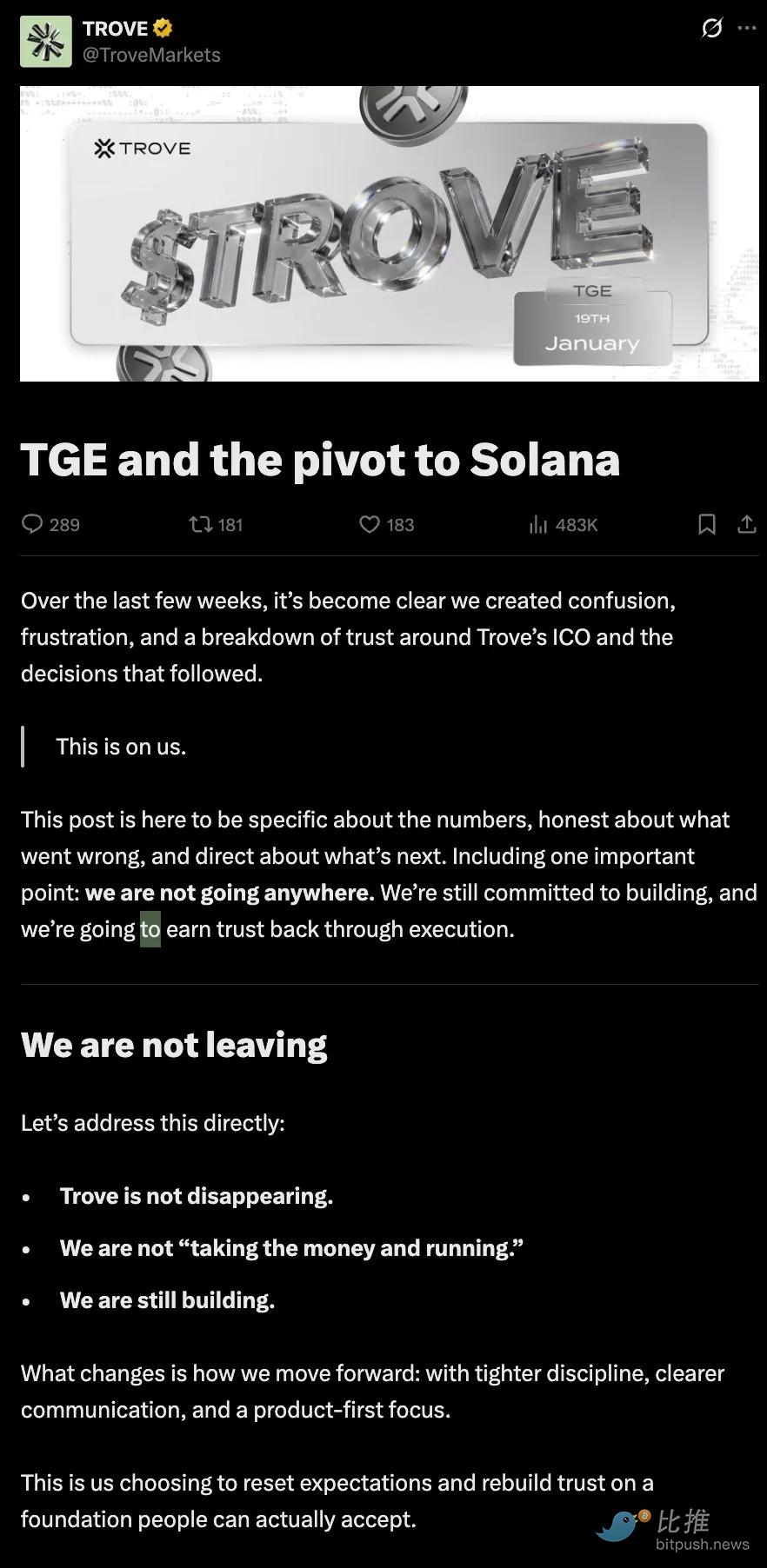
The team insisted that the project remained focused on building, albeit with a changed approach.

Even without making any assumptions, one thing is crystal clear: it is hard to imagine that they were not framed in an unfair, retroactive manner. The funds were initially committed based on one ecosystem, one technical path, and one set of implied risk profiles. The modified plan now requires them to accept another set of assumptions without reopening the participation terms.

It is like changing the rules for one player alone after a game has started.

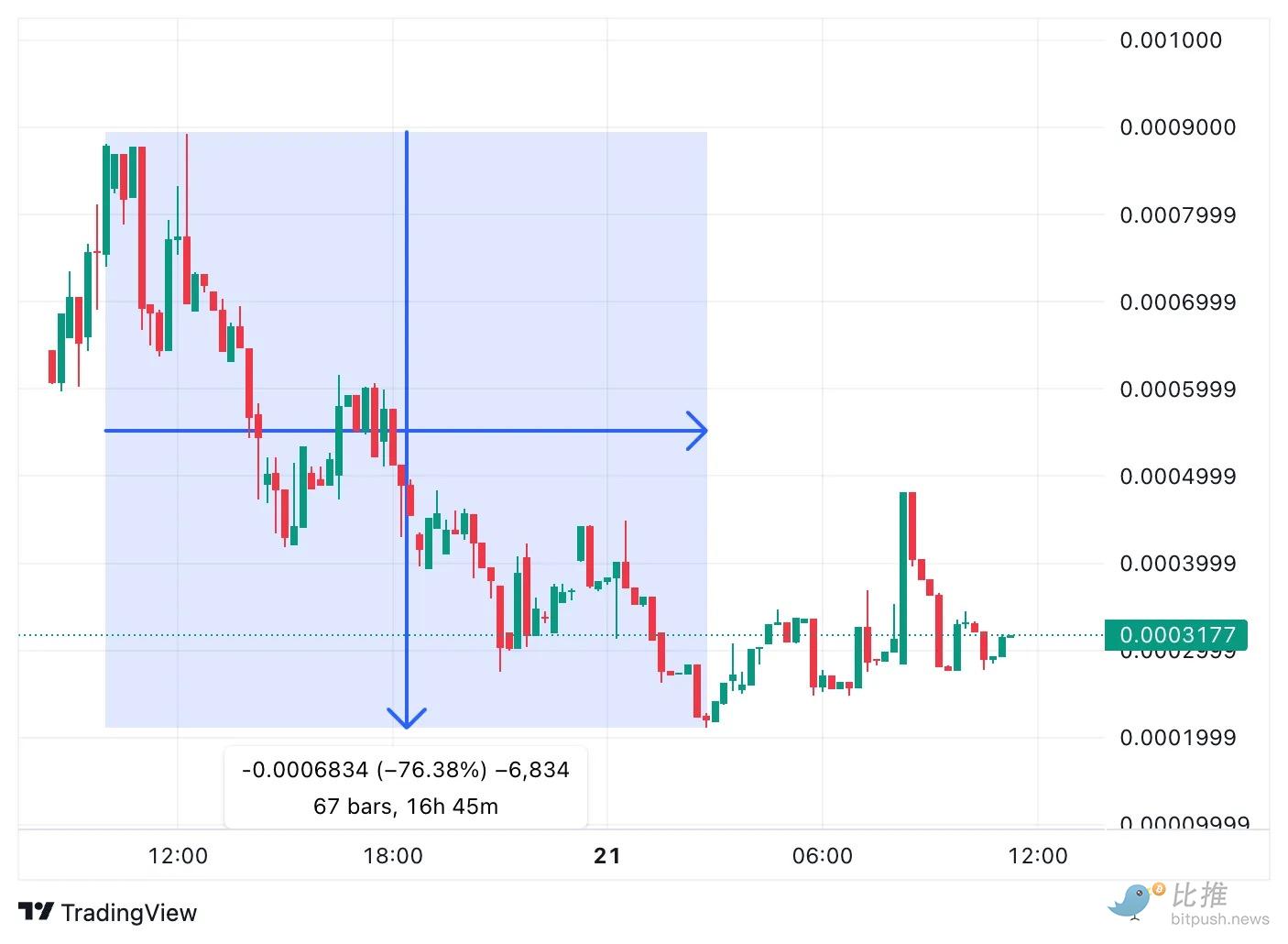
But by then, the damage was done, and the market voted with its feet, punishing this collapse of trust. The TROVE token plummeted over 75% within 24 hours of its listing, with its market capitalization expectations nearly zeroed out.
In the community, some moved beyond gut feelings and delved into on-chain fund movements. Crypto detective ZachXBT pointed out several suspicious transactions: approximately $45,000 in USDC from angel round funds eventually flowed into a prediction market platform and even to an address associated with a casino.
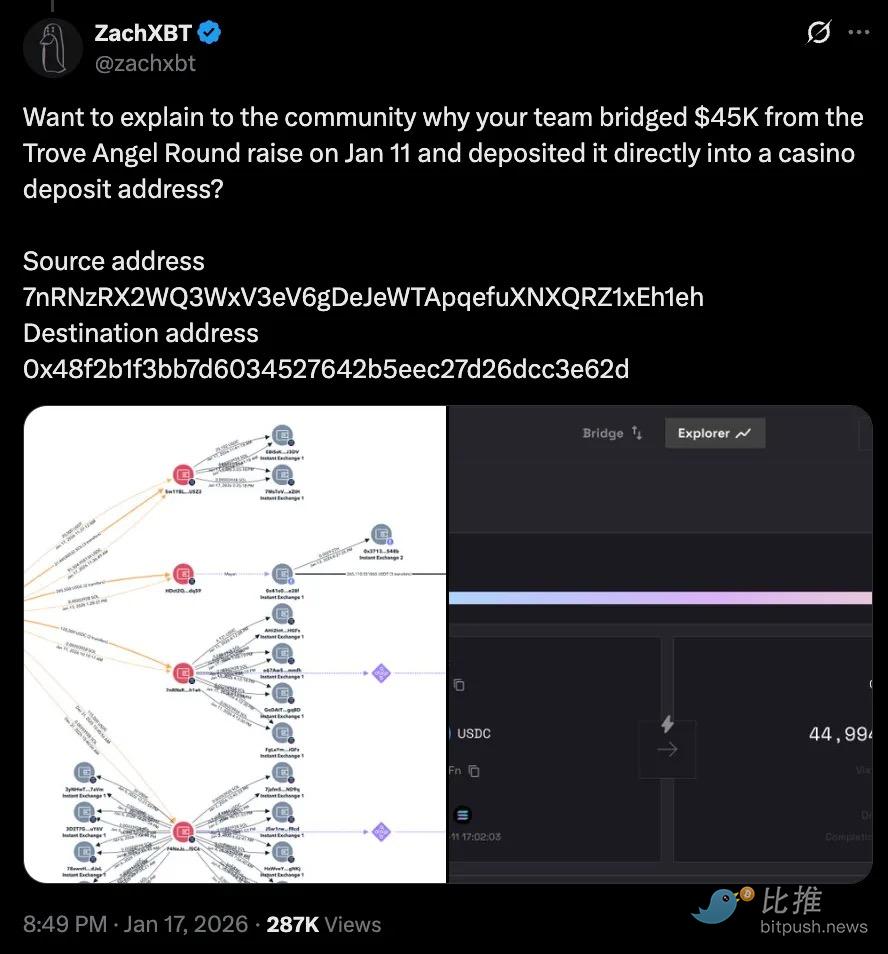
Whether this was a careless accounting error, poor fund management, or a genuine red flag remains debatable. Many users criticized the refund process, noting that only a few deserving refund recipients received their payments promptly.

Amid all this, Trove's statements failed to reassure investors who felt betrayed. Although it emphasized that the project would continue—a perpetual exchange on Solana—it did not adequately address the economic concerns arising from the pivot. It provided no detailed breakdown of the modified fund deployment and governance plan, nor did it offer more clarity on the refund roadmap.

Although there is no conclusive evidence linking this pivot to team misconduct, the incident shows that once trust in the fundraising process erodes, every data point is more likely to be viewed with suspicion.

What made this turmoil even more unstable was the way the team handled its discretion after the fundraising concluded.

Oversubscription effectively handed control of both capital and voice to the project team. Once the team changed direction, supporters had little recourse beyond selling on the secondary market or exerting public pressure.

To some extent, Trove's ICO still shares similarities with many projects from past cycles. Although the mechanisms are more standardized and the infrastructure more mature today, the core issue spanning both old and new cycles remains trust—investors still have to rely on the team's judgment rather than a clear set of rules as a backbone.

The Ranger ICO, conducted a few days earlier, provides an important contrast.

Ranger's token sale took place from January 6 to 10 on the MetaDAO platform, which requires teams to predefine key fundraising and allocation rules before the sale begins. Once started, these rules cannot be modified by the team.

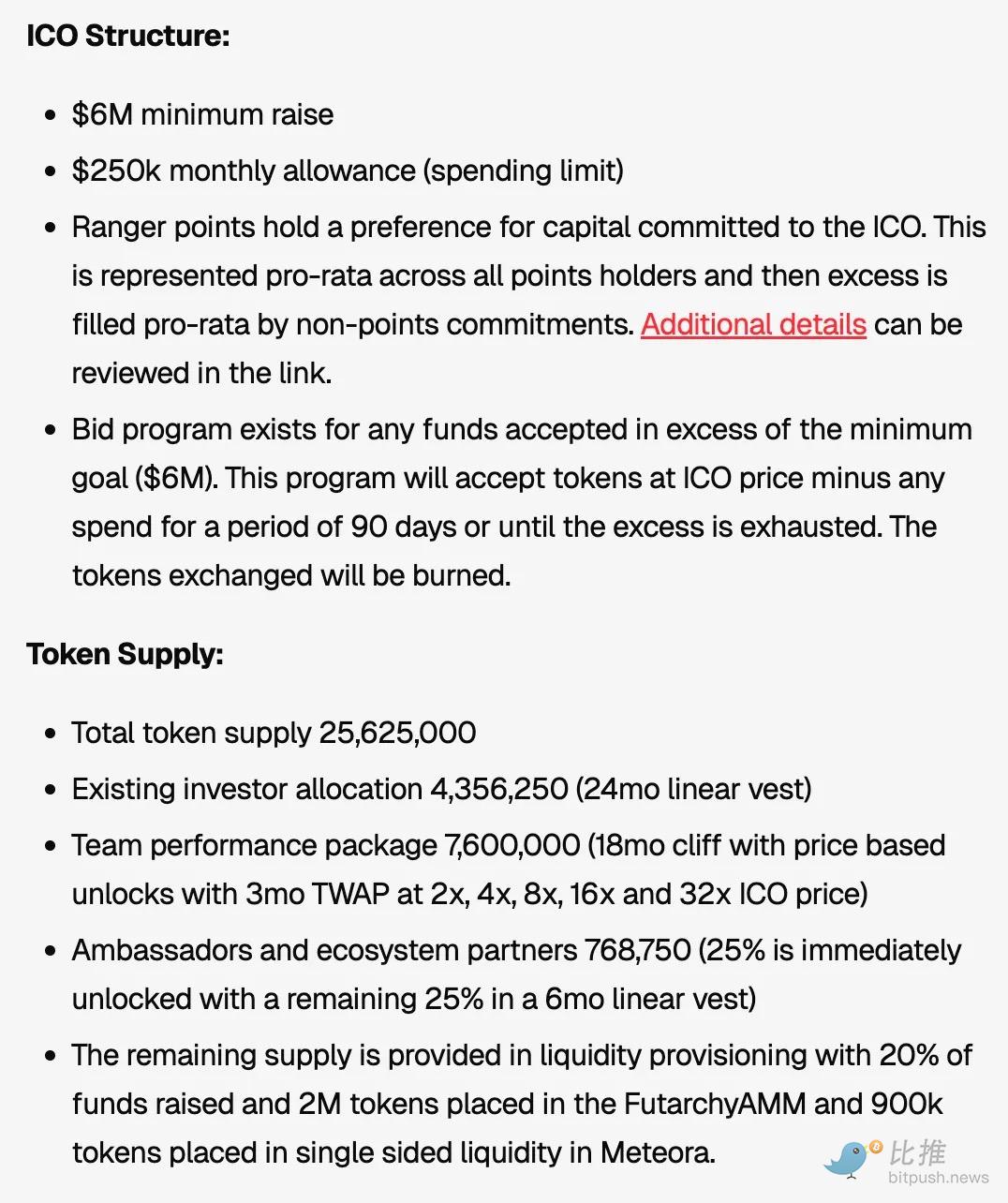
Ranger sought a minimum fundraising target of $6 million and sold approximately 39% of its total token supply through the public sale. Similar to Trove, its sale was oversubscribed. But MetaDAO's constraints meant the team had anticipated the possibility of oversubscription and made arrangements from the outset, unlike Trove's situation.

When the sale was oversubscribed, the proceeds were deposited into a treasury governed by token holders. MetaDAO's rules also restricted the team's access to the treasury to a fixed monthly allowance of $250,000.

Even the allocation structure was defined more clearly. Public sale participants received full liquidity at the token generation event, while presale investors faced a 24-month linear unlock period. The majority of tokens allocated to the team would only unlock upon reaching specific price milestones for the RNGR token. These milestones, such as reaching 2x, 4x, 8x, 16x, and 32x of the ICO price, would be measured using a three-month time-weighted average price, with at least an 18-month lock-up period before any unlocking occurs.

These measures show that the team embedded constraints into the fundraising structure itself, rather than expecting contributors to rely on post-fundraising discretion. Control over capital was partially ceded to governance rules, and any team gains were tied to long-term market performance, protecting contributors from the risk of a "rug pull" on launch day.
Nevertheless, concerns about fairness persist.

Like many modern ICOs, Ranger used a pro-rata allocation model to distribute tokens in its oversubscribed sale. In theory, this means everyone should receive tokens in proportion to their capital commitment. However, Blockworks Research pointed out that this model often favors participants who can over-commit capital. Smaller contributors typically receive disproportionately small allocations.
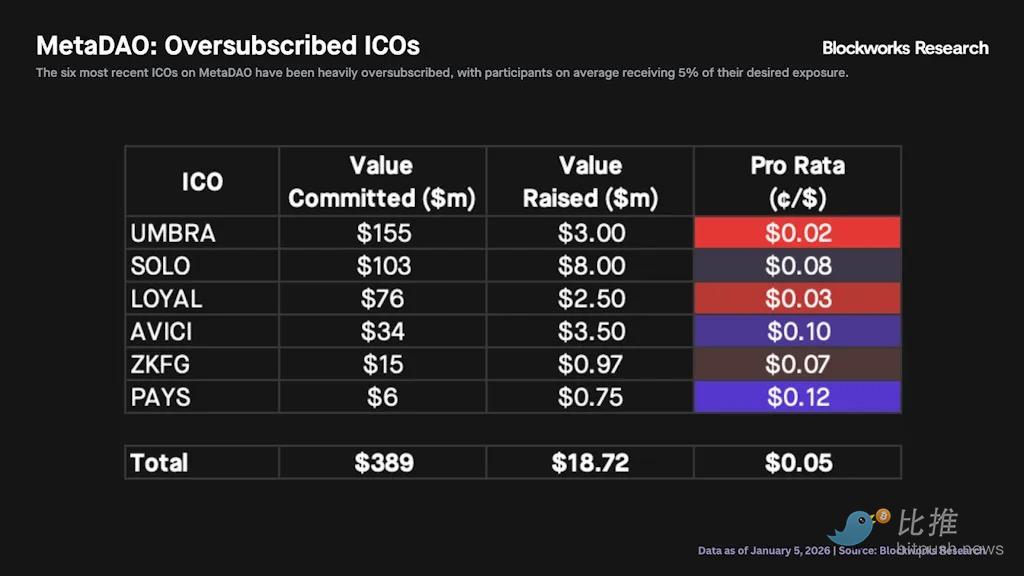
However, there is no simple solution to this problem.

Ranger attempted to address this by reserving separate token allocation pools specifically for users who had participated in the ecosystem before the public sale. While this practice alleviated some矛盾, it did not completely resolve a fundamental dilemma: how to balance allowing more people to obtain tokens with ensuring participants receive substantial shares.

Conclusion

The Trove and Ranger events show that nearly a decade after the initial explosion of ICOs, they are still subject to many constraints. The old ICO model heavily relied on Telegram announcements, narratives, and momentum.

The new model relies on structure—including unlock schedules, governance frameworks, treasury rules, and allocation formulas—to demonstrate restraint. These tools, often mandated by platforms like MetaDAO, help limit the discretionary power of launch teams. However, these tools can only reduce risks, not eliminate them entirely.

These events raise critical questions that every future ICO team needs to answer: "Who decides when a team can change plans?" "Who controls the funds after the fundraising is complete?" "What mechanisms do contributors have when expectations are not met?"

In any case, the issues that occurred in the Trove incident need to be corrected. Changing the chain on which a project launches cannot be a spur-of-the-moment decision. Here, the best way to remedy the damage is for Trove to treat its contributors properly. In this case, that might mean fully refunding the funds and re-conducting the sale under revised assumptions.

Although this is the most ideal path forward at the moment, it is not easy for Trove to actually achieve this. Funds may have already been deployed, operational costs may have been incurred, and partial refunds may have already been executed. Reversing course at this point could trigger multiple legal, procedural, and reputational complexities. But this is the price that must be paid to clean up the current mess.

How Trove chooses to proceed may set a precedent for ICOs in the year to come. Project launches now face a more cautious market environment—participants no longer equate oversubscription simply with consensus, nor do they confuse "being involved" with "being protected." Only a truly robust system can provide a fundraising experience that, while not foolproof, is trustworthy enough.


Twitter: https://twitter.com/BitpushNewsCN

Bitpush TG Discussion Group: https://t.me/BitPushCommunity

Bitpush TG Subscription: https://t.me/bitpush

Original link: https://www.bitpush.news/articles/7604888

Связанные с этим вопросы

QWhat was the main reason Trove's ICO caused a loss of investor trust?

ATrove abruptly changed its plan to launch on Solana instead of the originally promised Hyperliquid ecosystem after fundraising, without reopening participation terms or properly addressing economic concerns.

QHow did the market react to Trove's token after its launch?

AThe TROVE token plummeted over 75% within 24 hours of its launch, with its market capitalization expectations nearly collapsing to zero.

QWhat key difference in structure did Ranger's ICO have compared to Trove's?

ARanger's ICO used the MetaDAO platform, which enforced predefined fundraising and allocation rules that could not be modified by the team after the sale began, including governance-controlled treasury access and milestone-based token unlocks.

QWhat suspicious activity did crypto investigator ZachXBT uncover related to Trove's funds?

AZachXBT identified suspicious transactions where approximately $45,000 USDC from angel round funds flowed into a prediction market platform and even to a casino-linked address.

QWhat fundamental issue do modern ICOs still face despite improved infrastructure and mechanisms?

AModern ICOs still fundamentally rely on trust in the team's judgment rather than solely on clear, enforceable rules, and they struggle with balancing broad token distribution against meaningful allocations for participants.

Похожее

Индекс Sci-Tech Innovation 50 вырос на 10.73%: почему китайские акции показали «V-образный разворот»?

После нескольких дней снижения китайский фондовый рынок продемонстрировал сильный отскок. 21 июля основные индексы пережили V-образный разворот и резко выросли. Индекс STAR 50 подскочил на 10.73%, достигнув максимального однодневного роста за год. Шанхайский композитный индекс вырос на 1.79%, индекс Shenzhen Component — на 4.81%, а индекс ChiNext — на 7.05%. Объем сделок на трех биржах составил 2.97 трлн юаней. Более 3100 акций выросли в цене, свыше 100 достигли лимита роста. Ведущей силой восстановления стал сектор полупроводников, где активно росли акции компаний, занимающихся оборудованием, памятью, кремниевыми пластинами и HBM. Соответствующие тематические ETF также показали резкий рост. Сильный отскок рынка объясняется сочетанием трех факторов. Во-первых, на рынок вышли различные источники финансирования, включая "государственные фонды", страховые компании, а также выкуп акций компаниями и управляющими фондами. Это укрепило ликвидность и доверие инвесторов. Во-вторых, регуляторы, в частности председатель Комиссии по ценным бумагам Китая, заявили о приверженности поддержанию стабильности рынка. В-третьих, стабилизация и восстановление зарубежных рынков, особенно в Южной Корее, создали благоприятную внешнюю среду. Аналитики полагают, что наиболее паническая фаза для технологического сектора, вероятно, уже позади. Хотя краткосрочные колебания могут сохраниться, фундаментальные тренды, такие как спрос на вычисления для ИИ и импортозамещение в полупроводниковой отрасли, остаются неизменными. Среднесрочная динамика будет зависеть от новых отраслевых стимулов и подтверждения результатов компаний во время сезона отчетности.

marsbit5 мин. назад

Индекс Sci-Tech Innovation 50 вырос на 10.73%: почему китайские акции показали «V-образный разворот»?

marsbit5 мин. назад

Акции технологических компаний с импульсом показали крупнейший в истории рост за один день, но завершился ли обвал?

Технологические акции с высоким моментом (momentum stocks) в США продемонстрировали рекордно сильный однодневный рост во вторник, 21 июля. Индекс модности TMT Morgan Stanley вырос более чем на 12%, что стало самым большим суточным скачком в истории, превысив даже показатели периода пузыря доткомов в 2000 году. Ключевым драйвером выступили полупроводники: индекс Philadelphia Semiconductor Index подскочил на 4,6%. Этот резкий отскок произошел после трехдневного падения и кумулятивного снижения акций с моментом на 33%, которое стало одним из самых сильных со времен краха доткомов. Основной причиной роста стала "паническая скупка" (short squeeze), когда инвесторы, игравшие на понижение, были вынуждены закрывать свои позиции, создавая восходящую спираль. Однако внутренняя структура рынка остается слабой: объемы торгов были низкими, а в индексе S&P 500 количество падающих акций превышало количество растущих, что указывает на узкий, а не широкий характер восстановления. Мнения аналитиков разделились. Стратег BTIG Джонатан Крински предупреждает, что рост достиг ключевого уровня сопротивления, и рекомендует фиксировать прибыль, ожидая скорой остановки ралли. С другой стороны, аналитики Goldman Sachs и UBS считают, что распродажа активов с моментом подходит к концу, и видят возможность для постепенного увеличения позиций, особенно в акциях, связанных с ИИ. Дальнейшая динамика будет сильно зависеть от сезона корпоративных отчетов, ключевым событием которого станут результаты Alphabet (GOOGL) и ее ориентиры по капитальным затратам. Потенциальной угрозой для рынка акций остается рынок облигаций: доходности гособлигаций США растут, отчасти из-за роста цен на нефть, и их дальнейший рост может оказать давление на фондовый рынок. Таким образом, несмотря на впечатляющий однодневный рост, сохраняется значительная неопределенность относительно того, закончилась ли коррекция.

marsbit12 мин. назад

Акции технологических компаний с импульсом показали крупнейший в истории рост за один день, но завершился ли обвал?

marsbit12 мин. назад

Акции технологического импульса в США установили рекордный однодневный рост, но закончился ли обвал?

Акции технологических компаний с высоким импульсом («моментум») на рынке США показали рекордный рост во вторник, 21 июля. Индекс TMT-моментум Morgan Stanley вырос более чем на 12%, что стало самым большим однодневным скачком в истории. Причиной столь резкого роста стал эффект «сжатия коротких позиций» (short squeeze), когда продавцы, открывшие короткие позиции на фоне предыдущего падения импульсных акций на 33%, были вынуждены их закрывать, подпитывая восходящую динамику. Однако аналитики отмечают, что внутренняя структура рынка остается слабой: объемы торгов были низкими, а при общем росте индекса S&P 500 количество падающих акций превышало количество растущих. Это указывает на то, что восстановление затронуло лишь узкий круг наиболее популярных бумаг, таких как акции полупроводниковых компаний (индекс Philadelphia Semiconductor Index вырос на 4.6%). Стратеги разделились в оценках перспектив. BTIG советует сокращать позиции на росте, считая, что индекс импульсных акций уперся в ключевой уровень сопротивления. Напротив, Goldman Sachs и UBS полагают, что волна распродаж близка к завершению, и рекомендуют постепенно наращивать позиции. Ключевым фактором для определения устойчивости восстановления станут корпоративные отчеты. Особое внимание рынка приковано к отчету Alphabet (GOOGL) и новым прогнозам по капитальным затратам, которые дадут сигнал о перспективах инвестиций в ИИ. Одновременно фондовый оптимизм омрачается ростом доходности гособлигаций США и цен на нефть, что создает макроэкономические риски. Таким образом, несмотря на впечатляющий однодневный отскок, волатильность на рынке, вероятно, сохранится.

链捕手14 мин. назад

Акции технологического импульса в США установили рекордный однодневный рост, но закончился ли обвал?

链捕手14 мин. назад

Bitcoin подает 3 сигнала макро-дна — Но сможет ли BTC достичь $70 тыс.?

Рынок переходит от обсуждения локального дна к поиску макро-дна для биткоина. Аналитик Али Мартинес указывает на появление трех технических сигналов, исторически совпадавших с макро-низами циклов: месячный RSI около 43.65, осциллятор Чанде (CMO) на уровне -71 и цена рядом со скользящей средней за 50 месяцев. Эта комбинация наблюдалась в 2015, 2019 и 2022 годах, каждый раз предшествуя масштабным ралли. Несмотря на прорыв выше $66 000 и оптимистичные технические сигналы, ключевым испытанием остается ликвидность. Доминирование стейблкоинов растет, но их общая капитализация снизилась более чем на $10 млрд за месяц. Данные показывают отток стейблкоинов с бирж в течение 35 дней подряд при отсутствии значительного накопления биткоина на спотовом рынке. Таким образом, хотя техническая картина указывает на формирование макро-дна, для уверенного движения к $70 000 требуется приток свежей ликвидности, который пока отсутствует.

ambcrypto18 мин. назад

Bitcoin подает 3 сигнала макро-дна — Но сможет ли BTC достичь $70 тыс.?

ambcrypto18 мин. назад

Вечно вместе и снова порознь: Когда L1 становится собственным Rollup, что ждет Ethereum в финале?

Стремясь решить проблему масштабируемости, Ethereum изначально принял стратегию, где L1 выступает в качестве безопасного, но дорогого уровня расчетов, а Rollup на L2 предоставляют дешевое пространство для выполнения транзакций. Однако по мере того, как L1 сам развивает свои возможности (увеличение лимита газа, безсостоятельность, zkEVM), его пропускная способность значительно возрастает. Это ставит под вопрос уникальную ценность L2, основанную лишь на низкой стоимости транзакций. В ответ Ethereum пересматривает отношения между L1 и L2. L1 должен стать мощным, устойчивым глобальным хабом для расчетов, общего состояния и ликвидности. Роль L2 смещается от простого расширения к предоставлению дифференцированных функций, таких как оптимизация под конкретные приложения, конфиденциальность или гибкие модели управления, формируя спектр сред выполнения с разной степенью наследования безопасности Ethereum. Ключевой вызов фрагментированной многокомпонентной экосистемы — взаимодействие. Улучшение пользовательского опыта сосредоточено на нативной абстракции аккаунтов (например, EIP-7702) и межоперабельности. Цель — позволить Ethereum «снова ощущаться как единый блокчейн». Это включает в себя фреймворки интентов (intents), такие как Open Intents Framework, и протоколы межоперабельности (Ethereum Interop Layer), которые упрощают кросс-чейн взаимодействия. Сокращение времени финализации транзакций на L1 с минут до секунд также критически важно для эффективной работы мостов и приложений. Интригующая перспектива, выдвинутая исследователями, — это возможная конвергенция архитектур L1 и L2. С внедрением систем доказательств (например, zkEVM) на основном уровне, валидаторы L1 могут начать проверять состояние с помощью доказательств, а не повторного выполнения, что делает сам Ethereum в некотором роде «своим собственным Rollup». Одновременно концепция Native Rollup предполагает более тесную интеграцию проверки L2 в протокол L1. Это может привести к размытию четких границ между уровнями, превратив Ethereum в единую систему консенсуса с множеством специализированных сред выполнения (доменов), которые разделяют общую основу безопасности, ликвидность и надежную синхронизацию состояния. Таким образом, эволюция Ethereum движется от разделения выполнения для масштабирования к повторной интеграции разрозненных компонентов в единую, но разнородную экосистему. Итогом может стать не иерархия L1/L2, а сеть взаимосвязанных сред, которые вместе образуют целостный и мощный Ethereum.

链捕手29 мин. назад

Вечно вместе и снова порознь: Когда L1 становится собственным Rollup, что ждет Ethereum в финале?

链捕手29 мин. назад

Торговля

Спот
活动图片





