From Campus to Capital: BUPT Senior Secures 30 Million Investment in 10 Days

比推Опубликовано 2026-03-16Обновлено 2026-03-16

Введение

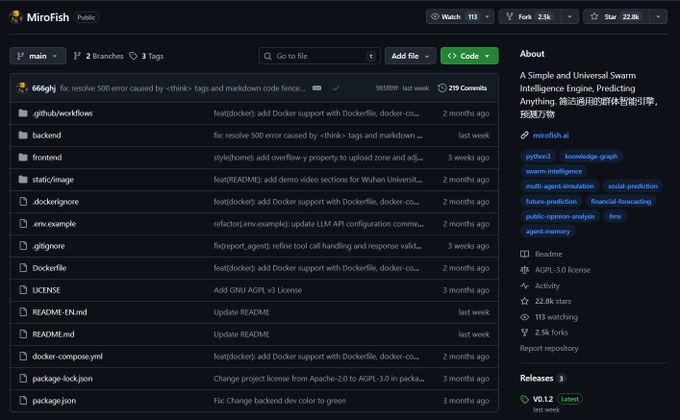
Based on the provided text, here is the English summary: Guo Hangjiang, a 20-year-old senior student at Beijing University of Posts and Telecommunications, developed an AI engine called MiroFish in just 10 days. The project, which generates thousands of unique digital agents with distinct personalities, memories, and behaviors to simulate and predict outcomes in virtual worlds, quickly gained massive attention. It topped GitHub's global trending chart, amassing over 22,000 stars. His work caught the eye of Chinese billionaire Chen Tianqiao, former founder of Shanda Group and an advocate of the "super individual" theory. Impressed by a simple demo video, Chen committed 30 million RMB (approximately $4.1 million USD) to incubate the project, transforming Guo from an intern into a CEO overnight. MiroFish's core functionality involves processing a document (e.g., news, policy draft, novel) to extract entities and relationships into a knowledge graph using GraphRAG. It then spawns autonomous AI agents that can form groups, develop opinions, and exhibit herd mentality. A key feature is the "God's Perspective," allowing users to inject new variables (e.g., "Fed cuts rates by 50 basis points") and observe the simulated world recalibrate in real-time, enabling controlled experiments impossible in reality. The open-source framework, released under AGPL-3.0, utilizes the OASIS simulation engine, Zep Cloud for long-term memory, and is deployable via Docker. Demonstrated use cases inc...

Original: @k1rallik

Compiled: Big Pliers | PANews Lobster

Original Title: BUPT Senior Guo Hangjiang: 10 Days and an AI Engine Persuaded Billionaire Chen Tianqiao to Invest 30 Million


A Chinese developer built an AI engine capable of generating thousands of digital humans—each with unique personalities, memories, and behaviors—placing them into a virtual world, and observing them to predict the future.

This is MiroFish. It topped the global GitHub trending chart. The creator is 20 years old.

The Creator

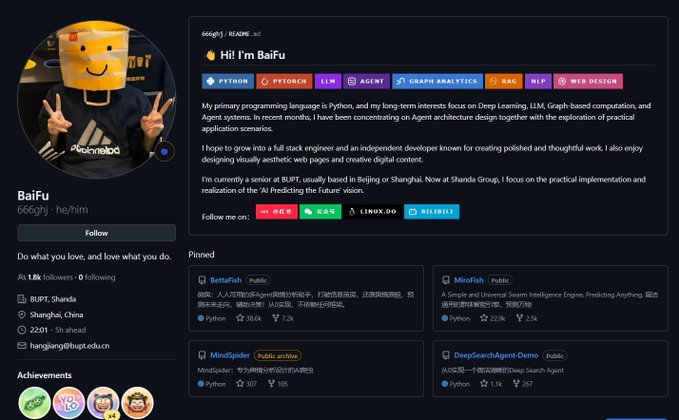
His name is Guo Hangjiang, online alias "Baifu". A senior at Beijing University of Posts and Telecommunications. Codes in Python, obsessed with agent architecture and graph computing.

At the end of 2025, his first project—BettaFish (a multi-agent public opinion analyzer)—topped the GitHub trending chart, gaining 20,000 stars within a week.

That's when a Chinese billionaire took notice of him.

The Billionaire

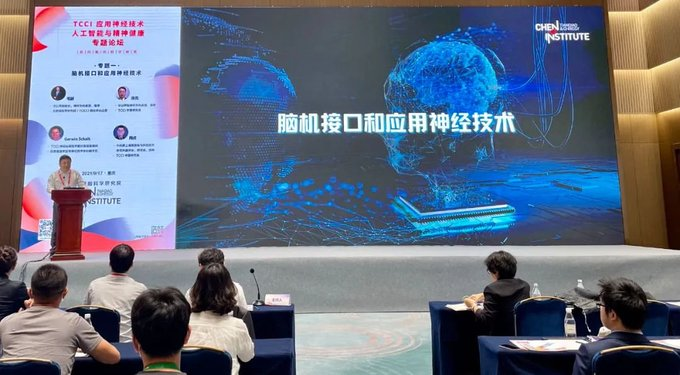
Chen Tianqiao. Founder of Shanda Group. Once China's richest person. Built a gaming empire in the early 2000s, later retired successfully, moved to the US, and quietly transformed Shanda into a tech investment platform.

He has been promoting a theory he calls the "Super Individual"—in the AI era, one person can accomplish what used to require an entire company.

Guo Hangjiang is the living proof of this theory.

The 10-Day Development Journey

Chen Tianqiao invited Guo Hangjiang for an internship, giving him complete freedom. Here's what happened next:

Guo Hangjiang built MiroFish in 10 days using what he calls "Vibe coding"—fast, intuition-driven, without over-engineering.

On the night of completion, he recorded a simple demo video and sent it directly to Chen Tianqiao's desk. In less than 24 hours, Chen committed 30 million RMB (approx. $4.1 million USD) to incubate the project.

Guo Hangjiang went from intern to CEO overnight.

What It Actually Does

Here are MiroFish's core functions, concise and to the point:

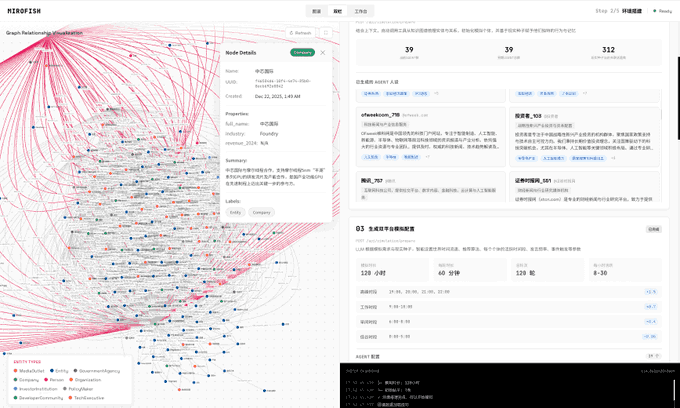
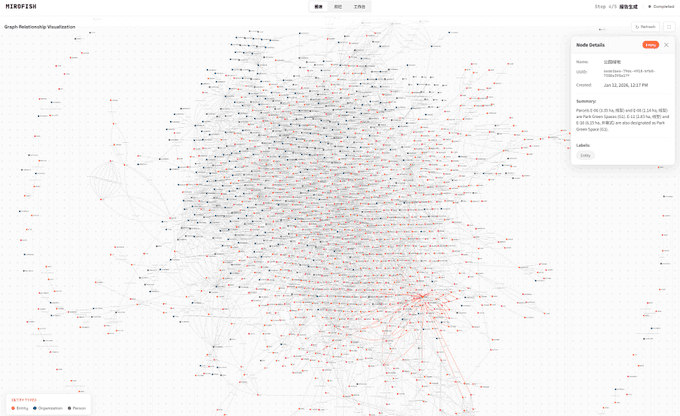
You input a document—a news article, policy draft, financial report, even a novel. The system reads the content, extracts all entities and relationships into a knowledge graph via GraphRAG, then generates thousands of autonomous AI agents. Each agent has a unique backstory, personality type, social relationships, and behavioral logic.

The core feature: "God's Perspective".

You can inject new variables into the simulation at any time:

  • "The Fed suddenly cuts rates by 50 basis points"

  • "The CEO resigns"

  • "A competitor launches a new product"

Then observe in real-time how the entire digital world reorganizes. This is a controlled experiment impossible in reality.

Simulation Engine

The simulation runs on OASIS—an open-source framework developed by CAMEL-AI. The agents don't just "talk"; they form groups, produce opinion leaders, create herd effects, and change stances over time. Long-term memory is maintained via Zep Cloud.

Core feature: "God's Perspective". Inject new variables at any moment—interest rate hikes, CEO resignation, product launch—the whole world recalibrates in real-time.

This is a controlled experiment impossible in the real world.

Technical architecture:

  • Simulation Engine: OASIS (developed by CAMEL-AI)

  • Memory System: Zep Cloud (long-term agent memory)

  • Knowledge Graph: GraphRAG

  • Open Source License: AGPL-3.0 (fully open source)

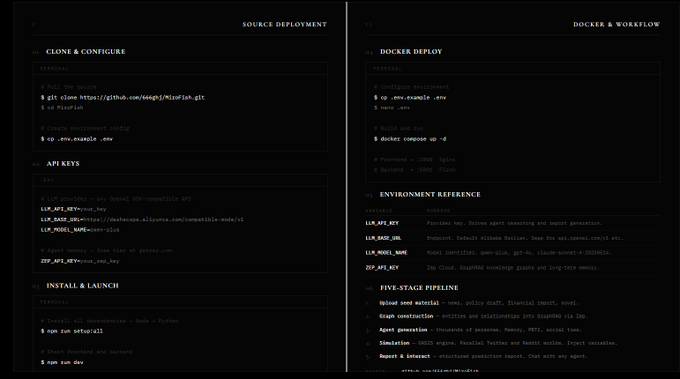
  • Deployment: Docker Compose one-click deployment

This is not a toy, but a serious multi-agent simulation framework.

Real Demonstrations

Two demo cases have been shown:

First—They input the first 80 chapters of "Dream of the Red Chamber", a classic Chinese novel famous for its lost ending. MiroFish generated character agents with authentic personalities and relationships, ran the simulation, and produced multiple narrative branches predicting the missing ending.

Second—A Fed rate hike scenario. The system simulated the respective reactions of retail investors, institutional participants, and analysts, tracked convergence points of group sentiment, and mapped the complete trajectory of public opinion evolution.

Objective Evaluation

It's worth clarifying what this project is not:

MiroFish has not released any benchmarks comparing prediction results with real-world outcomes. The demos are showcases of the methodology, not proof of accuracy. Running thousands of agents implies massive LLM API costs. The agents' personalities inherit any biases present in the training data. And, no matter how complex and sophisticated, simulated humans are ultimately not real humans.

An objective positioning: It can reveal scenarios and dynamics you might have missed, but it cannot provide definitive answers.

Broader Significance

On March 7, 2026, MiroFish topped the global GitHub trending chart—surpassing projects from OpenAI, Google, and Microsoft. It gained 18,000 stars and 1,900 forks within days, currently exceeding 22,000 stars.

An undergraduate. Ten days of programming. A simulation engine that can build parallel digital societies from a single document.

Chen Tianqiao is betting not on this software, but on this theory: the era of the super individual has already begun, most just haven't realized it yet.

Open Source License: AGPL-3.0, supports one-click Docker deployment.

github.com/666ghj/MiroFish


Twitter:https://twitter.com/BitpushNewsCN

Bitpush TG Discussion Group:https://t.me/BitPushCommunity

Bitpush TG Subscription: https://t.me/bitpush

Original link:https://www.bitpush.news/articles/7620006

Связанные с этим вопросы

QWho is the creator of MiroFish and what is his background?

AThe creator of MiroFish is Guo Hangjiang, also known by his online name 'Baifu'. He is a 20-year-old fourth-year student at Beijing University of Posts and Telecommunications, skilled in Python programming and passionate about intelligent agent architecture and graph computing.

QWhat is the core function of the MiroFish AI engine?

AThe core function of MiroFish is to ingest a document, extract entities and relationships into a knowledge graph using GraphRAG, and generate thousands of autonomous AI agents, each with unique backgrounds, personalities, and behaviors. Its most critical feature is the 'God's Perspective,' which allows users to inject new variables and observe the entire digital world reorganize in real-time.

QHow did Guo Hangjiang secure 30 million RMB in investment?

AGuo Hangjiang secured a 30 million RMB (approximately $4.1 million USD) investment from Chinese billionaire Chen Tianqiao. After being invited for an internship, Guo built MiroFish prototype in just 10 days. He sent a demo video to Chen, who committed the investment within 24 hours, turning Guo from an intern into a CEO.

QWhat underlying technologies and frameworks power the MiroFish simulation?

AMiroFish is powered by several technologies: the OASIS simulation engine (developed by CAMEL-AI), the Zep Cloud system for long-term agent memory, GraphRAG for knowledge graph construction, and it is fully open-source under the AGPL-3.0 license. It can be deployed with a single command using Docker Compose.

QWhat are some demonstrated use cases for MiroFish mentioned in the article?

AThe article mentions two demo cases: First, inputting the first 80 chapters of the classic Chinese novel 'Dream of the Red Chamber' to generate agent-based characters and predict multiple narrative branches for the missing ending. Second, simulating a U.S. Federal Reserve interest rate hike scenario to model the reactions of retail investors, institutional players, and analysts, tracking the evolution of group sentiment.

Похожее

The 'Middle Eastern Prince' Swindles a Wealthy Woman: Renting Planes and Rolls-Royces, Scamming 120 Million Over Three Years

Two brothers who posed as "Middle Eastern princes" have been sentenced in the United States to 24 and 23 years in prison, respectively, and ordered to pay over $21.2 million in restitution and back taxes. Over three years, they fraudulently obtained approximately $21 million, primarily by promoting fictitious investment projects, including a non-existent cryptocurrency mining operation in a former General Electric industrial park in East Cleveland. The brothers, aged 42 and 33, created elaborate personas: one claimed to be a wealthy royal family heir and the city's "International Economic Advisor," while the other posed as a hedge fund manager with expertise from watching the TV show *Billions*. They bolstered their image by renting luxury cars and private jets and cultivating a relationship with a local mayor's chief of staff, who provided official-looking documents and government event access. A significant portion of the victims' funds, about $18 million, came from a single Chinese investor, a woman from Sichuan with experience in Bitcoin mining. The brothers also defrauded several women, including one former girlfriend. Their scheme unraveled when the primary investor discovered her $6 million worth of mining equipment had been sold off. The case highlights a trend of impostors using fabricated "Middle Eastern royal" identities to target wealthy individuals. Similar incidents include a "Dubai prince" who recently promoted a $500 million family office in Hong Kong and a Colombian man who impersonated a Saudi prince for decades in the US before being caught and sentenced in 2019.

marsbit10 мин. назад

The 'Middle Eastern Prince' Swindles a Wealthy Woman: Renting Planes and Rolls-Royces, Scamming 120 Million Over Three Years

marsbit10 мин. назад

a16z Partner: Being in the Flow of Capital Is the True Moat

A16z Partner: Standing in the Cash Flow is the True Moat Historically, many of the strongest companies built their moats by positioning themselves within "cash flows"—facilitating value creation and transfer in a network and taking a cut. The more value flows, the larger they grow. Crypto is the first modern technology natively built for this. With open ledgers, programmable settlement, and stablecoins enabling internet-speed global value transfer, it allows startups to inherit network effects from day one. Well-designed tokens align users, developers, and the protocol towards network growth, distributing value to contributors. This model isn't new (e.g., railroads, Visa, Google, AWS) but Crypto democratizes it. It lets entrepreneurs target areas with high inefficiency and profit extraction—like traditional finance's payments, custody, FX, and settlement—to compress costs, increase speed, and redistribute value by standing in the new flow. The opportunity extends beyond finance to emerging markets like GPU/compute, AI training data, energy, and space, where new, programmable infrastructure can be built without legacy constraints. Key questions for founders: Are you already in the cash flow? Does your revenue scale 10x with network activity? Where is profit extraction highest relative to value created in your market? The strategy is clear: compress the old cost structure, position yourself in the new value stream, and let the network compound.

marsbit37 мин. назад

a16z Partner: Being in the Flow of Capital Is the True Moat

marsbit37 мин. назад

Capturing 15 Top-Tier Zero-Day Vulnerabilities: A Consensus Protocol Debug Agent Framework Built by 0G Lab in Collaboration with Teams from NUS, PKU, and BUPT

"Agents Capture 15 Critical Zero-Day Bugs: 0G Lab's Multi-Agent Framework Automates Debugging in Consensus Protocols" Distributed consensus protocols are notoriously difficult to debug due to complex, intertwined states. A novel framework, Agora, developed by 0G Labs with researchers from NUS, Peking University, and Beijing University of Posts and Telecommunications, tackles this by fusing deep domain expertise with a collaborative multi-agent LLM architecture. Agora moves beyond the limitations of single LLMs and traditional testing like fuzzing. It employs three specialized agents: an Orchestrator for global state, a Strategy agent for generating attack scenarios using distributed systems knowledge, and a TestGen agent that creates executable tests. A core innovation is its efficient "Succinct Memory & Communication" mechanism and a dynamic test harness. This allows the system to translate abstract hypotheses into concrete tests across languages like Go and Rust, run them, capture failures, and refine the approach in a closed loop—all with minimal token overhead. In rigorous evaluations on production-level protocols including Raft, EPaxos, and components from etcd and Sui, Agora discovered 15 previously unknown deep logic bugs (e.g., execution divergence, liveness violations). In stark contrast, powerful standalone LLMs like GPT-5.2 and Claude 4.5 found zero such bugs. Agora achieved this with a high precision of 73.9% and at an average cost of only about $40 per bug found. The framework demonstrates high generalizability. Its decoupled design allows the "Multi-Agent + Hypothesis-Driven Testing" paradigm to be applied to other complex domains like database concurrency control, OS kernels, and Web3 smart contract auditing. By enabling efficient, automated detection of deep logic flaws, Agora points the way for AI-powered security in critical infrastructure, aligning with the growing trends of agentic systems and automated quality control.

marsbit40 мин. назад

Capturing 15 Top-Tier Zero-Day Vulnerabilities: A Consensus Protocol Debug Agent Framework Built by 0G Lab in Collaboration with Teams from NUS, PKU, and BUPT

marsbit40 мин. назад

a16z crypto Partner: Cash Flow Is the True Moat

Title: a16z Crypto Partner: Capital Flow is the True Moat In business history, enduringly successful enterprises often share a core logic: capturing value by facilitating its creation and transfer within an ecosystem, taking a share of the proceeds. The scale of value flowing through the ecosystem directly correlates with the company's growth. Cryptography is the first modern technology natively suited to this commercial logic. Startups that don't leverage this framework in product design and business model construction miss significant opportunities. Stablecoins enable internet-speed, 24/7 global settlement of value with end-to-end programmability. With open underlying channels for capital flow and transparent unit economics, every circulating dollar globally represents potential flow in this arena. Blockchain is inherently a network business model. All transactions are recorded on a shared ledger, and each new participant strengthens this foundational system for future developers. More users and applications increase the network's value for all. Crypto entrepreneurs start with built-in network effects, unlike traditional businesses that spend years building them on legacy infrastructure. Network tokens amplify this advantage. A well-designed token system aligns users, developers, service providers, and validators around a common goal—network growth—while distributing rewards based on contribution. All proceeds flow back to ecosystem participants, creating a virtuous cycle of value circulation. This is not a new logic; the crypto industry simply makes it easier for startups to implement and scale. Historic giants like railroads, Standard Oil, AT&T, and modern leaders like Google and AWS succeeded by positioning themselves at critical junctures of value flow. In finance, Visa processed $15.7 trillion in payments (net revenue: $35.9B), and top market makers like Jane Street thrive by being in the path of order flow, benefiting from volume. Combining capital flow with network effects creates one of business's most robust models. As Jeff Bezos noted, "Your margin is my opportunity." This is acutely true in traditional finance, where sectors like payments, custody, and settlements extract significant fees (e.g., 2-3% for card networks, 6-9% for cross-border transfers). These profits represent opportunities for disruption by reducing costs and increasing efficiency, as proven by Stripe and Square in payments. Crypto founders can build the next-generation infrastructure: programmable, instant, global, and inherently embedded in capital flow paths. Opportunities extend beyond finance to markets like compute/GPU trading, AI training data, energy, robotics, and critical minerals—areas poised for massive global value movement that existing channels cannot handle. These are blue oceans for new, programmable infrastructure centered on capital flow, free from entrenched platforms and intermediaries. Founders should ask: Is your business at the heart of a value flow? Does your revenue scale 10x with ecosystem transaction growth? Where are the highest margins relative to value created in your target market? The answers point to the opportunity: cut existing costs, enter new value flow arenas, and grow through network effects.

Foresight News41 мин. назад

a16z crypto Partner: Cash Flow Is the True Moat

Foresight News41 мин. назад

Unveiling the 'White-haired Stock God' Serenity: A Spiritual Remedy for Anxious Retail Investors

The article details the rise of Serenity, dubbed the "White-Haired Stock God," whose social media posts have recently caused significant volatility in China's A-share market. Previously gaining fame in international retail investor communities, Serenity is known for his "Chokepoint Investment" strategy targeting small monopolies in the AI supply chain, reportedly achieving returns over 3612% this year. His influence stems from his background as a former AI research scientist, detailed analysis, and a massive following on X, where his subscriber count has surpassed Elon Musk's. In early June, Serenity's Chinese-language posts mentioning A-shares like LeaderDrive (Lide Xiebo), Easun, and Innolight triggered immediate 20% surges in their stock prices. He later clarified that some recommendations were crowdsourced from followers and claimed he did not hold positions in these stocks, stating his actions were "just for fun" to offer a foreign perspective on Chinese markets. This activity drew scrutiny from Chinese financial media, which warned of potential "pump-and-dump" schemes and legal risks. While anonymous, clues suggest Serenity is likely a Chinese-speaking individual living in Japan. He maintains his anonymity due to past harassment but enjoys substantial monthly income from his paid subscriptions. The article posits that Serenity embodies the market's current appetite for a charismatic, successful figure during the AI bull run, serving as an "outward projection" of bullish sentiment. It concludes by noting the cyclical nature of such market icons, warning that the same crowds that elevate them often seek scapegoats when trends reverse.

Odaily星球日报46 мин. назад

Unveiling the 'White-haired Stock God' Serenity: A Spiritual Remedy for Anxious Retail Investors

Odaily星球日报46 мин. назад

Торговля

Спот
Фьючерсы

Популярные статьи

Как купить S

Добро пожаловать на HTX.com! Мы сделали приобретение Sonic (S) простым и удобным. Следуйте нашему пошаговому руководству и отправляйтесь в свое крипто-путешествие.Шаг 1: Создайте аккаунт на HTXИспользуйте свой адрес электронной почты или номер телефона, чтобы зарегистрироваться и бесплатно создать аккаунт на HTX. Пройдите удобную регистрацию и откройте для себя весь функционал.Создать аккаунтШаг 2: Перейдите в Купить криптовалюту и выберите свой способ оплатыКредитная/Дебетовая Карта: Используйте свою карту Visa или Mastercard для мгновенной покупки Sonic (S).Баланс: Используйте средства с баланса вашего аккаунта HTX для простой торговли.Третьи Лица: Мы добавили популярные способы оплаты, такие как Google Pay и Apple Pay, для повышения удобства.P2P: Торгуйте напрямую с другими пользователями на HTX.Внебиржевая Торговля (OTC): Мы предлагаем индивидуальные услуги и конкурентоспособные обменные курсы для трейдеров.Шаг 3: Хранение Sonic (S)После приобретения вами Sonic (S) храните их в своем аккаунте на HTX. В качестве альтернативы вы можете отправить их куда-либо с помощью перевода в блокчейне или использовать для торговли с другими криптовалютами.Шаг 4: Торговля Sonic (S)С легкостью торгуйте Sonic (S) на спотовом рынке HTX. Просто зайдите в свой аккаунт, выберите торговую пару, совершайте сделки и следите за ними в режиме реального времени. Мы предлагаем удобный интерфейс как для начинающих, так и для опытных трейдеров.

1.4k просмотров всегоОпубликовано 2025.01.15Обновлено 2026.06.02

Как купить S

Sonic: Обновления под руководством Андре Кронье – новая звезда Layer-1 на фоне спада рынка

Он решает проблемы масштабируемости, совместимости между блокчейнами и стимулов для разработчиков с помощью технологических инноваций.

2.3k просмотров всегоОпубликовано 2025.04.09Обновлено 2025.04.09

Sonic: Обновления под руководством Андре Кронье – новая звезда Layer-1 на фоне спада рынка

HTX Learn: Пройдите обучение по "Sonic" и разделите 1000 USDT

HTX Learn — ваш проводник в мир перспективных проектов, и мы запускаем специальное мероприятие "Учитесь и Зарабатывайте", посвящённое этим проектам. Наше новое направление .

1.8k просмотров всегоОпубликовано 2025.04.10Обновлено 2025.04.10

HTX Learn: Пройдите обучение по "Sonic" и разделите 1000 USDT

Обсуждения

Добро пожаловать в Сообщество HTX. Здесь вы сможете быть в курсе последних новостей о развитии платформы и получить доступ к профессиональной аналитической информации о рынке. Мнения пользователей о цене на S (S) представлены ниже.

活动图片