Fortune Investigates Binance's Iran Fund Flow: $439 Million Chinese VIP Accounts Surface

marsbitОпубликовано 2026-03-14Обновлено 2026-03-14

Введение

Binance, the world's largest cryptocurrency exchange, is facing renewed scrutiny over its compliance practices following a Fortune investigation. The report reveals that a VIP account, registered under the name of a 79-year-old Chinese resident, transferred $439 million in Tether stablecoins to external wallets. These funds were subsequently moved to wallets linked to Iranian entities, including the Islamic Revolutionary Guard Corps. Despite Binance's $4.3 billion plea deal with the U.S. government in 2023, which it committed to strengthen its compliance programs, these massive transactions did not trigger immediate alerts. A second Chinese VIP account, held by a 38-year-old woman, transferred nearly $200 million to the same Iranian-linked network. Internal investigators found that both accounts were likely accessed from the same device, suggesting possible common control. The funds were funneled through a Hong Kong-based entity, Blessed Trust, which also handled back-office operations for Binance. The exchange has denied that internal investigators were fired for uncovering these activities, stating their departures were due to violations of data policies. The U.S. Department of Justice is reportedly investigating whether Iran used Binance to evade sanctions, though the exchange says it is unaware of any such probe. These findings have prompted a U.S. Senate investigation and raised serious questions about the effectiveness of Binance's compliance program.

Author: Fortune

Compiled by: Deep Tide TechFlow

Deep Tide Introduction: This article is compiled from Fortune's investigative report on March 12. Readers are reminded to note the following background:

Since February this year, Western media outlets including Fortune, The Wall Street Journal, and The New York Times have reported that Binance's internal investigators discovered over $1 billion in funds flowing to entities linked to Iran, and were subsequently fired.

Binance denied firing employees due to compliance whistleblowing, stating that the departures were due to violations of internal data protection policies. On March 11, Binance filed a defamation lawsuit against The Wall Street Journal, demanding a retraction of the related reports.

Concurrently, Binance won two civil lawsuits filed under the U.S. Anti-Terrorism Act—federal courts in the Southern District of New York and Alabama dismissed all claims from the plaintiffs. However, these cases were civil claims by victims' families, which belong to a different legal category than the sanctions compliance disputes discussed in this article.

This article was written by Fortune author Leo Schwartz, who for the first time disclosed specific details of two Chinese VIP accounts: an account under the name of a 79-year-old individual transferred out $439 million, and the two accounts were suspected of sharing the same device.

Binance's stance is: platform accounts did not directly trade with sanctioned entities; the suspicious activity was discovered by Binance itself and reported to law enforcement agencies; the involved accounts have been taken offline. Currently, the U.S. Department of Justice is investigating whether Iran used Binance to evade sanctions, but it is unclear whether Binance itself is the target of the investigation.

Below is the full compilation of the Fortune article:

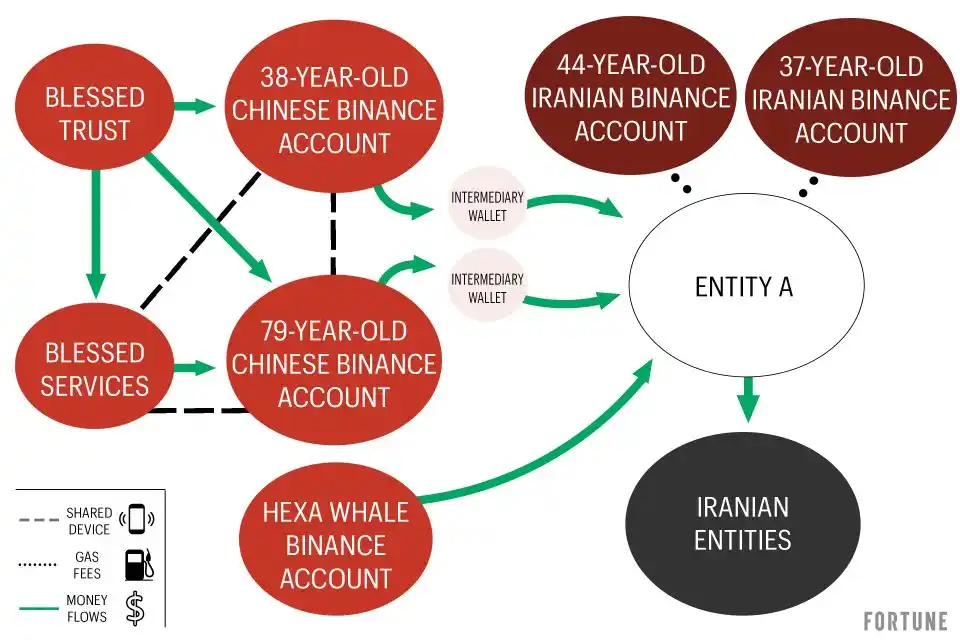
In early 2025, the embattled Iranian regime increasingly relied on cryptocurrency to circumvent economic sanctions. During this period, a VIP account on the Binance platform, registered under the name of a 79-year-old Chinese resident, transferred $439 million worth of digital tokens from the exchange to external wallets through a series of transactions. These wallets subsequently transferred most of the funds to other wallets—which Binance's internal investigators later identified as being associated with Iranian sanctioned entities, including the Islamic Revolutionary Guard Corps.

As noted in documents reviewed by Fortune, the transfer of hundreds of millions of dollars by an elderly individual was itself highly suspicious. More concerning was that the transactions involved transferring Tether stablecoins on the Tron blockchain—a preferred payment method for cybercriminals and money launderers.

Surprisingly, however, these transfers did not trigger any immediate alerts at Binance. This was despite Binance having reached a $4.3 billion plea agreement with the U.S. government in late 2023, promising to implement a series of stringent compliance procedures.

Amanda Wick, Head of Americas at crypto compliance software firm VerifyVASP and a former federal prosecutor, stated after learning the details of these transactions from Fortune: "This is not just a red flag; it's a trigger event that requires immediate reporting."

The details of this VIP account had not been publicly disclosed before, and its emergence is particularly sensitive for Binance. In February, a series of media reports revealed that Binance had dismissed internal investigators who had reported to senior management—these individuals had discovered that over $1 billion in funds flowed through the platform to wallets linked to Iran, and that a close business partner of Binance—a Hong Kong-based entity responsible for arranging conversions between cryptocurrency and fiat currency—was also involved in these transfers.

These reports have prompted an investigation by the U.S. Senate. Binance responded that the investigators' departures were unrelated to the discovery of Iranian transfers and that the company has been adhering to its 2023 compliance commitments. However, new details involving Chinese and Iranian accounts have again raised doubts about the effectiveness of this compliance program.

Binance did not deny the specific methods investigators used to trace the fund flows. The exchange defended the platform's handling of the违规 (non-compliant) transactions and stated that its compliance program is functioning normally. Meanwhile, according to The Wall Street Journal, the Department of Justice is investigating whether Iran used Binance to evade sanctions. A Binance spokesperson said the exchange is unaware of any such investigation. A DOJ spokesperson declined to comment.

Binance Chief Compliance Officer Noah Perlman said in a statement provided to Fortune: "Binance's compliance program is continuously improving and evolving, with the goal of constantly strengthening and preventing issues from recurring."

China-Linked Network

Like traditional financial institutions, crypto exchanges have specialized compliance procedures to verify user identities and screen for illegal activities. In a February blog post, Binance stated that its compliance program has nearly 600 full-time employees and is "industry-leading."

As part of this process, Binance required this 79-year-old Chinese man to upload identification documents to open a VIP account. (A Binance spokesperson said VIP status is automatically granted based on asset holdings and trading volume.) It was through this ID that the exchange's internal investigators ultimately determined that he had indirectly transferred approximately $400 million to a previously unidentified group of Iran-linked wallets outside Binance—which investigators referred to as "Entity A." Former prosecutor Wick said this type of activity should have been automatically flagged by the system.

"If nearly half a billion dollars moves from a customer account to a single non-custodial wallet and then quickly flows to wallets associated with a sanctioned jurisdiction... this is exactly the type of activity a compliance team should capture," she said.

However, Binance allowed this VIP account to trade freely for months. These transactions, which began in January 2025, were not flagged by the compliance department until August 11 of that year, after Seychelles law enforcement submitted a request to Binance regarding "a serious terrorism financing case." A Binance spokesperson told Fortune that the 79-year-old VIP user's account was blocked in September 2025 and fully taken offline by January 2026.

Other compliance experts expressed surprise that Binance did not handle the account more quickly. Robert Appleton, a partner at law firm Olshan and former head of the Iran sanctions task force at the DOJ, told Fortune that especially given Binance's checkered past and previous legal troubles over sanctions evasion, he would have expected the exchange to be more vigilant about any form of suspicious activity. "The agreement with the government changes everything because it raises their obligations," he said.

Meanwhile, the $439 million transfer in the name of this Chinese elderly individual was only part of the Iran-related activity. Documents reviewed by Fortune show that former Binance employees discovered in their investigation that the Iran-linked wallet cluster, referred to as "Entity A," received a total of $1.7 billion from companies and individuals holding Binance accounts. "Entity A" then transferred part of these funds to Nobitex, Iran's largest cryptocurrency exchange, and to digital wallets associated with U.S.-designated terrorist organizations such as the Islamic Revolutionary Guard Corps and the Houthis). The Binance spokesperson said that at the time of the transactions, none of these wallets were on sanctions lists maintained by global law enforcement agencies, so they did not trigger any alerts.

Although the wallets controlled by "Entity A" and related sanctioned entities were not on the Binance platform, crypto compliance experts told Fortune that the nature of the funds flowing out of Binance itself should have raised alarms.

After receiving the request from Seychelles, Binance investigators opened a case and subsequently characterized this series of fund flows as part of a "China-Linked Network"—which also involved another VIP trader. This VIP client was a 38-year-old Chinese woman who transferred nearly $200 million in Tether stablecoins to an intermediate wallet between November and December 2024, which then transferred the funds to "Entity A." (The Binance spokesperson said the term "China-Linked Network" was "an internal, informal designation, not precise, and may have evolved over time," and stated that this VIP account was also taken offline by January 2026.)

More intriguingly, documents reviewed by Fortune indicate that these two VIP accounts were highly likely accessed from the same device—suggesting that the same person, or a third-party entity, might have controlled both accounts. Wick said: "If two ostensibly unrelated VIP clients are found accessing their accounts from the same device, it raises serious questions about beneficial ownership."

In any case, investigators found from blockchain data that both accounts had received funds from Blessed Trust. Blessed Trust is a Hong Kong-based enterprise that helps companies convert crypto funds into fiat currency and also handles back-office tasks like payroll and taxes for Binance. Investigators ultimately concluded that of the total $1.2 billion flowing through Blessed Trust into "Entity A," approximately half came from these two Chinese VIP traders.

Binance attempted to downplay the connection between the platform accounts and the Iran-linked wallets, stating in a recent blog post that there were multiple intermediaries between the exchange and the sanctioned wallets. The post also noted that $1.1 billion of the funds originated from "a large, regulated stablecoin issuer." Investigators concluded in their findings that most of the funds from the two Chinese VIP accounts likely came from stablecoins issued by Circle—a U.S.-listed crypto company. A Circle spokesperson told Fortune: "We take our regulatory obligations seriously," adding that Circle had designated Blessed Trust for termination in 2025.

However, Binance, in its blog post and responses to Fortune and other media, consistently avoided addressing the specific details of these two Chinese VIP accounts on its platform. Furthermore, investigators also found that these two accounts and Blessed Services (another company related to Blessed Trust, which was intermediary in the fund flow to "Entity A") also shared the same device. This evidence suggests the same group might have operated all these accounts. The Binance spokesperson declined to comment on the device-sharing details and stated that Blessed Services has no business relationship with the exchange.

Email addresses associated with Blessed Trust and Blessed Services did not respond to Fortune's requests for comment.

The "China-Linked Network" involved one final link: a Hong Kong-registered company, Hexa Whale Trading Limited, which operated on the Binance platform and transferred approximately $500 million to "Entity A." By the time Binance investigators discovered Hexa Whale's activity, other members of the company's compliance team had already taken the account offline. The Wall Street Journal and The New York Times had previously reported details related to Hexa Whale and Blessed Trust.

Fortune's attempts to contact Hexa Whale and the two Chinese VIP users were unsuccessful.

The investigators involved in the preliminary report were fired by Binance weeks after submitting their initial findings. Binance denied that these employees were dismissed for raising compliance issues and stated in a blog post that the departure of some personnel was decided "after an internal review found violations of company data protection and confidentiality policies." The exchange insisted that it continued the relevant investigation and completed the takedown of Blessed Trust in January 2026.

The investigators declined to comment.

Iran-Linked Clues

Another, smaller set of transaction records also caught the investigators' attention. These transactions were operated by two individuals suspected of Iranian nationality. Compliance experts stated that the mere fact that these two individuals were able to successfully open accounts on Binance and complete transfers already raises questions about the strictness of the company's screening procedures.

The first account was opened in 2021, held by a 44-year-old male whose Dominica ID indicated Iran as his place of birth, and whose name appeared in a 2020 UN Security Council report—a report concerning a gold and cash smuggling network serving Iran and North Korea. The second account was also opened in 2021, held by a 37-year-old male whose uploaded Iraqi ID also indicated Iran as his place of birth. By the time Binance investigators discovered these accounts, they had already been restricted.

The relevant transactions included: each of the two accounts transferring around $100 worth of TRX cryptocurrency to the Iran-linked wallet cluster in 2024—TRX is the native currency used to pay transaction fees on the Tron blockchain. Although the total amount was negligible, this TRX transfer was significant because it likely paid the fees for transfers between the "Entity A" wallet cluster. This situation is roughly analogous to tracking credit card records used to pay for car fuel: if the same card repeatedly pays for gas, it doesn't tell you who is driving, but it can reveal who is footing the bill for the journey.

Lex Fisun, Co-founder and CEO of blockchain analytics firm Global Ledger, said: "Most people only look at large transactions, but small transactions are equally important. On the blockchain, you often can't link a wallet to a real identity. However, when an address repeatedly sends TRX to another wallet to pay fees, it indicates a connection between the two."

Furthermore, Wick pointed out that the association of these accounts with Iran should have triggered more immediate scrutiny. After all, Binance had already pleaded guilty for similar transactions and promised to eradicate such behavior on its platform.

"When multiple high-risk indicators appear simultaneously—especially involving a heavily sanctioned jurisdiction like Iran, or individuals appearing in UN Security Council reports—a properly functioning compliance program should report in real-time," she said. "Account restrictions, enhanced due diligence, blockchain tracing, sanctions risk assessments, these measures should be triggered immediately when the issue occurs, not months later."

The Binance spokesperson said one of the Iranian accounts has been completely taken offline, and the other has been restricted from trading and is in the process of being taken offline. The exchange did not specify whether these accounts were restricted at the time the transactions occurred.

Fortune's attempts to contact the two relevant individuals were unsuccessful.

Exposure to sanctioned entities is a significant risk for any financial institution, and Binance has already paid a heavy price for it. In 2023, it reached a $4.3 billion plea agreement with the U.S. government, partly for failing to maintain an effective anti-money laundering and sanctions compliance program.

Under the plea agreement, co-founder Changpeng Zhao stepped down as CEO and spent four months in federal prison. Binance also agreed to cooperate with a monitor reporting to the Justice and Treasury Departments on its internal operations.

However, the recent dismissal of investigators and the potential Iranian exposure have raised concerns among members of Congress. In late February, Senator Richard Blumenthal (D-Conn.) launched a preliminary investigation into Binance and sent a letter to co-CEO Richard Teng requesting information on the findings of the dismissed investigators and other Iran-related activities.

Blumenthal also specifically mentioned President Trump's pardon of Changpeng Zhao in October—a move that raised conflict-of-interest allegations due to Binance's increasingly close ties to the Trump family's cryptocurrency business.

A White House spokesperson told Fortune: "President Trump's assets are held in a trust managed by his children, and there is no conflict of interest."

However, Blumenthal told Fortune that Binance's connection to the White House presents ongoing ethical concerns: "One of my biggest concerns is that the relationship between Binance and the administration could deter or discourage compliance monitors from exposing and reporting violations, or could hinder the Justice Department from pursuing prosecution."

Связанные с этим вопросы

QWhat were the key findings of the Fortune investigation regarding Binance's VIP accounts linked to Iran?

AThe investigation revealed that a VIP account under the name of a 79-year-old Chinese resident transferred $439 million in digital tokens to external wallets, which were later linked to Iranian sanctioned entities, including the Islamic Revolutionary Guard Corps. Another VIP account, a 38-year-old Chinese woman, transferred nearly $200 million in Tether to the same network. Both accounts were suspected of being accessed from the same device, indicating potential common control.

QHow did Binance respond to the allegations of facilitating transactions linked to Iranian sanctions?

ABinance denied that employees were fired for compliance reporting, attributing their departures to violations of internal data protection policies. The exchange stated that its compliance program is continuously improving and that it had offboarded the involved accounts. Binance also filed a defamation lawsuit against The Wall Street Journal for related articles and emphasized that the sanctioned wallets were not on its platform at the time of transactions.

QWhat role did Blessed Trust and Hexa Whale Trading Limited play in the transactions?

ABlessed Trust, a Hong Kong-based entity, facilitated the conversion of crypto to fiat and handled backend operations for Binance. It was involved in transferring $1.2 billion to the Iranian-linked 'Entity A,' with about half originating from the two Chinese VIP accounts. Hexa Whale Trading Limited, another Hong Kong-registered firm, transferred approximately $500 million to Entity A. Both entities were part of the 'China-linked network' identified by investigators.

QWhat were the compliance failures highlighted in the investigation?

AThe investigation pointed out that Binance's compliance systems failed to automatically flag suspicious activities, such as large transfers to wallets linked to sanctioned jurisdictions, despite the 2023 plea agreement with the U.S. government. The exchange did not restrict the VIP accounts until months after the transactions, and it missed red flags like accounts with Iranian identifiers transferring small amounts of TRX to pay for transaction fees related to Entity A.

QWhat broader implications did the investigation have, including U.S. government actions?

AThe findings prompted a U.S. Senate investigation led by Senator Richard Blumenthal, who expressed concerns about Binance's compliance and potential conflicts of interest due to its ties with the Trump administration following the pardon of former CEO Changpeng Zhao. The U.S. Department of Justice is also investigating whether Iran used Binance to evade sanctions, though Binance claims no knowledge of such an investigation.

Похожее

US Government Suddenly Halts Anthropic's Strongest Model, "Quasi-IPO Stock Price" Plunges 3.7% Overnight

U.S. Government Halts Anthropic's Top AI Models, 'Pre-IPO' Price Drops 3.7% On June 12, the U.S. government ordered Anthropic to shut down access to its two most powerful AI models, Claude Fable 5 and Claude Mythos 5, citing national security concerns. The directive, issued by the Department of Commerce, required Anthropic to block access for all foreign nationals, leading the company to disable the models globally for all users. Anthropic strongly opposed the move, arguing the government's basis was a "narrow jailbreak vulnerability" and warning that applying such a standard industry-wide would effectively halt all frontier model deployments. The news impacted Anthropic's implied valuation in speculative markets. The Anthropic perpetual contract on Hyperliquid fell approximately 3.7% to around $1,627, down from highs above $1,800 following the models' release. Unauthorized tokenized products linked to Anthropic on Solana also saw significant declines. The models, launched just days earlier on June 9, represented a major capability leap for Anthropic. Fable 5 was its first public release of a "Mythos"-tier model above its flagship Claude Opus. The shutdown creates an ironic situation for Anthropic, a company founded on "AI safety" principles, and adds uncertainty to its ongoing IPO preparations. The company is actively engaging with regulators to resolve what it calls a "misunderstanding" and restore service.

marsbit14 мин. назад

US Government Suddenly Halts Anthropic's Strongest Model, "Quasi-IPO Stock Price" Plunges 3.7% Overnight

marsbit14 мин. назад

SpaceX IPO Creates Trillion-Dollar Billionaire: Musk's Wealth Equals Half of Crypto Market

SpaceX's record-breaking IPO has propelled Elon Musk to become the first modern billionaire with a personal net worth exceeding $1 trillion, reaching $1.11 trillion according to Bloomberg. This staggering wealth surpasses the total market capitalization of all cryptocurrencies excluding Bitcoin and equals roughly half of the entire crypto market's value. The milestone highlights extreme wealth concentration and the significant devaluation of the altcoin market, whose total cap has nearly halved since late 2025 as capital flows into large tech stocks. SpaceX's Nasdaq debut saw its valuation hit $2.2 trillion, with shares soaring from a $135 offer price to close at $161. Its first-day trading volume of $85 billion set a new global IPO record. Musk owns 42% of the company. Despite his wealth dwarfing the altcoin sector, Musk maintains deep ties to digital assets. He personally holds Bitcoin, Ethereum, and Dogecoin, while his companies, SpaceX and Tesla, collectively hold over 30,000 Bitcoin, ranking among the top corporate BTC holders globally. His acquisition and integration of financial data tools into X (formerly Twitter) further connect his ecosystem to the markets. Ultimately, Musk's trillion-dollar status underscores the immense wealth controlled by tech founders, though this fortune remains largely tied to volatile stock prices rather than liquid assets.

Foresight News22 мин. назад

SpaceX IPO Creates Trillion-Dollar Billionaire: Musk's Wealth Equals Half of Crypto Market

Foresight News22 мин. назад

Hardcore First Look | Ocean Embodied Intelligence Company 'Shihang Intelligence' Secures Record-Breaking 1 Billion in Funding, Zhu Xiaohu, Temasek Place Bets

Breaking News | Ocean Embodied Intelligence company "Shihang Intelligent" secures a record-breaking 1 billion RMB (approximately 10 billion yuan) in Series A financing, with investment from Zhu Xiaohu and Temasek. Author: Qiu Xiaofen | Editor: Yuan Silai Ocean Embodied Intelligence company "Shihang Intelligent" has completed its Series A funding round, raising over 1 billion RMB. This marks the largest single funding round in the global marine robotics field to date. Investors include upstream momentum funds from chip companies "Moore Thread" and "Kunlunxin," Singapore's state-owned investment platform Vertex Growth, and listed company Dyneo, among others. Existing investors like GSR Ventures (whose founder Zhu Xiaohu has invested for the fifth time), Vertex Ventures China, Hua Ying Capital, and Long Capital also significantly increased their investments. Founder and CEO Chen Xiaobo, a 1989-born alumnus of Harbin Engineering University, is a long-time expert in underwater robotics. He received the National Defense Science and Technology Progress Award at age 28 (the youngest recipient) and led the development of China's first commercial underwater cleaning robot. The funds will be used for core technology R&D, global market expansion, and building the industry chain ecosystem to scale the application of marine robots in complex underwater scenarios. The ocean is considered one of the most challenging environments for robotics due to low light, high turbidity, complex currents, limited communication, high pressure, and corrosion. "Shihang Intelligent" focuses on developing core underlying technologies for marine robots, covering six key systems: power, control, sensing, navigation, sealing, and deployment. Its robots are capable of operating at depths from 0 to 10,000 meters with full degrees of freedom, performing complex maneuvers, autonomous navigation, and multi-robot collaboration. Applications include ship cleaning, underwater security, offshore wind power, marine ranching, and seabed inspection. The company's order value for the first half of 2026 alone has exceeded 1 billion RMB. Its "Orca Robot" is used by major shipping companies and has performed maintenance on over a thousand large vessels. In April of this year, the company launched its ocean embodied large model "Cangqiong CEORION." Unlike traditional remote-controlled or pre-programmed robots, this model integrates environmental perception, task understanding, and action generation into a single end-to-end architecture. Trained on millions of hours of commercial operation data and simulation data, it covers 12 major underwater operation scenarios. In simulations, it achieved over 90% task success rate and over 70% zero-shot adaptation capability to unseen environments. A built-in physics reasoning module reduces collision risk by 80%, enabling autonomous operation even with weak or no communication. Recently, "Shihang Intelligent" was selected as a core technology partner for Singapore's Maritime and Port Authority national hull inspection and cleaning program. These advancements indicate marine robotics is moving from pilot projects to scaled applications, with real-world operations generating valuable data to continuously improve robot capabilities. CEO Chen Xiaobo stated the company will continue investing in core marine robotics technology, the embodied intelligence model, and global application scenarios to expand into more high-risk, high-difficulty, and high-value underwater operations.

marsbit47 мин. назад

Hardcore First Look | Ocean Embodied Intelligence Company 'Shihang Intelligence' Secures Record-Breaking 1 Billion in Funding, Zhu Xiaohu, Temasek Place Bets

marsbit47 мин. назад

Three Months, 35 Billion Yuan: Investors Rush to Grab the OpenAI of the Physical World

Investors flock to a physical AI startup as the race for the "OpenAI of the physical world" heats up. Ji Jia Shi Jie (GigaWorld), a company dedicated to developing Artificial General Intelligence (AGI) for the physical world, has raised 3.5 billion RMB (approximately $490 million) in just three months, according to a report from investment media outlet Touzijie. The latest B2 funding round of 1 billion RMB attracted a wide range of top-tier investors, including sovereign wealth funds, industrial capital, and financial institutions. This brings the total funding for the young company, now valued over 10 billion RMB, to 3.5 billion RMB across three recent rounds. The company is led by Huang Guan, a post-90s Tsinghua University PhD with extensive experience in AI, autonomous driving, and entrepreneurship. Its core innovation is a "dual-pyramid" system comprising a five-layer data pyramid (from internet videos to real-world robot data) and a three-layer algorithm pyramid focused on world simulation, action alignment, and reinforcement learning. This system underpins its key models: the "World Action Model" (e.g., GigaBrain series for robot control) and the "World Generation Model" (e.g., GigaWorld series for simulating and understanding the physical world). Its models have reportedly achieved top rankings in global robotics benchmarks. Ji Jia Shi Jie argues that while current digital AGI excels in information processing, the next frontier is physical AGI—systems that can understand and interact with the real world. The company believes the field is approaching its "GPT-3 moment," a key inflection point in capability scaling. To achieve this, the company is pursuing a dual-market strategy. For the consumer (C) market, it launched the "SeeLight" brand and its S1 general-purpose humanoid robot, which has secured initial orders for deployment in real homes. For the business (B) market, it focuses on industrial automation with its Maker series robots, having signed agreements for large-scale deployment in factories, and its DriveDreamer world model for autonomous driving, which is already in use with over 30 automakers and tech companies. The report concludes that by bridging the gap between digital intelligence and physical action, Ji Jia Shi Jie aims to unlock a new wave of productivity, ultimately bringing physical AGI into everyday life.

marsbit1 ч. назад

Three Months, 35 Billion Yuan: Investors Rush to Grab the OpenAI of the Physical World

marsbit1 ч. назад

What's the Connection Between Pinduoduo's Huang Zheng and Blockchain?

This text explores the unexpected connection between Pinduoduo founder Colin Huang and blockchain, as suggested in his article *Turning Capitalism Upside Down*. Huang argues Pinduoduo's core business is about managing "uncertainty." He posits that wealth flows to the rich because they absorb life's uncertainties (e.g., illness, job loss) that devastate the poor, who pay a premium for certainty through insurance or stable prices. Pinduoduo's model attempts a "reverse insurance": by aggregating consumer demand via group-buying and flash sales, it creates a large, predictable order for manufacturers. This certainty allows factories to remove risk premiums, passing savings back as lower prices, thus partially reversing the wealth flow. The key obstacle, Huang notes, is that an individual's buying intent is an unreliable promise. He then asks if blockchain is the natural solution for this "reverse insurance." The text elaborates that blockchain, through smart contracts with binding deposits, could transform casual intent into a costly-to-break, enforceable commitment. This replaces interpersonal trust with coded rules, making promises credible, pricable, and resistant to fraud. Finally, the author draws a parallel to Bitcoin, framing two paths to creating certainty: the "Pinduoduo path" of aggregating decentralized will into scale, and the "Bitcoin path" of locking rules into immutable code. Both sacrifice something—personal freedom or system flexibility—to manufacture trust and predictability.

链捕手2 ч. назад

What's the Connection Between Pinduoduo's Huang Zheng and Blockchain?

链捕手2 ч. назад

Торговля

Спот
Фьючерсы

Популярные статьи

Как купить S

Добро пожаловать на HTX.com! Мы сделали приобретение Sonic (S) простым и удобным. Следуйте нашему пошаговому руководству и отправляйтесь в свое крипто-путешествие.Шаг 1: Создайте аккаунт на HTXИспользуйте свой адрес электронной почты или номер телефона, чтобы зарегистрироваться и бесплатно создать аккаунт на HTX. Пройдите удобную регистрацию и откройте для себя весь функционал.Создать аккаунтШаг 2: Перейдите в Купить криптовалюту и выберите свой способ оплатыКредитная/Дебетовая Карта: Используйте свою карту Visa или Mastercard для мгновенной покупки Sonic (S).Баланс: Используйте средства с баланса вашего аккаунта HTX для простой торговли.Третьи Лица: Мы добавили популярные способы оплаты, такие как Google Pay и Apple Pay, для повышения удобства.P2P: Торгуйте напрямую с другими пользователями на HTX.Внебиржевая Торговля (OTC): Мы предлагаем индивидуальные услуги и конкурентоспособные обменные курсы для трейдеров.Шаг 3: Хранение Sonic (S)После приобретения вами Sonic (S) храните их в своем аккаунте на HTX. В качестве альтернативы вы можете отправить их куда-либо с помощью перевода в блокчейне или использовать для торговли с другими криптовалютами.Шаг 4: Торговля Sonic (S)С легкостью торгуйте Sonic (S) на спотовом рынке HTX. Просто зайдите в свой аккаунт, выберите торговую пару, совершайте сделки и следите за ними в режиме реального времени. Мы предлагаем удобный интерфейс как для начинающих, так и для опытных трейдеров.

1.5k просмотров всегоОпубликовано 2025.01.15Обновлено 2026.06.02

Как купить S

Sonic: Обновления под руководством Андре Кронье – новая звезда Layer-1 на фоне спада рынка

Он решает проблемы масштабируемости, совместимости между блокчейнами и стимулов для разработчиков с помощью технологических инноваций.

2.3k просмотров всегоОпубликовано 2025.04.09Обновлено 2025.04.09

Sonic: Обновления под руководством Андре Кронье – новая звезда Layer-1 на фоне спада рынка

HTX Learn: Пройдите обучение по "Sonic" и разделите 1000 USDT

HTX Learn — ваш проводник в мир перспективных проектов, и мы запускаем специальное мероприятие "Учитесь и Зарабатывайте", посвящённое этим проектам. Наше новое направление .

1.8k просмотров всегоОпубликовано 2025.04.10Обновлено 2025.04.10

HTX Learn: Пройдите обучение по "Sonic" и разделите 1000 USDT

Обсуждения

Добро пожаловать в Сообщество HTX. Здесь вы сможете быть в курсе последних новостей о развитии платформы и получить доступ к профессиональной аналитической информации о рынке. Мнения пользователей о цене на S (S) представлены ниже.

活动图片