Fed Cuts Rates Amid Divisions, but Bitcoin's 'Fanger Zone' Keeps BTC Below $100K

marsbitОпубликовано 2025-12-10Обновлено 2025-12-10

Введение

The Federal Reserve approved a 25-basis-point rate cut amid internal divisions, but Bitcoin remains stuck below $100,000 due to structural weaknesses and persistent selling pressure. Despite a pre-FOMC rally to $94,000, the "hawkish" tone of the rate cut and concerns over inflation and economic slowdown limited upward momentum. According to Glassnode, BTC is trapped in a fragile range between $81,300 and $102,700, with unrealized losses rising and realized losses hitting $555 million daily—levels last seen during the FTX collapse. Long-term holders are realizing over $1 billion in profits daily, while new buyers face capitulation. The rally has been driven by spot demand rather than leveraged speculation, but sustained growth may require renewed derivatives activity. The Fed's rate cut is unlikely to provide significant short-term bullish momentum for Bitcoin.

The Federal Reserve approved a 0.25% rate cut amid internal divisions, but concerns over inflation and economic growth, along with what Glassnode highlights as BTC's "fragile zone," may continue to keep it suppressed below $100,000.

On Wednesday, the U.S. Federal Reserve approved a 25 basis point rate cut, the third such cut this year, in line with market expectations. Mirroring pre-FOMC meeting price action seen previously, Bitcoin had surged past $94,000 on Monday, but a "hawkish" media interpretation of this cut reflects ongoing divisions within the Fed regarding U.S. monetary policy and the economic outlook.

Given this week's rate cut being labeled as "hawkish," Bitcoin's price could see a "sell the news" reaction and continue to trade sideways until new momentum catalysts emerge.

As reported by CNBC, the Fed's decision passed with a 9-3 vote, indicating lingering concerns among members about persistent inflation and expectations for slower economic growth and a more gradual pace of rate cuts through 2026.

According to Glassnode data, Bitcoin (BTC $92,626) remains trapped in a structurally fragile zone below $100,000, with its price action bounded by the short-term holder cost basis at $102,700 and the "true market mean" at $81,300.

Glassnode's data further shows that Bitcoin continues to be held below $100,000 in an environment of weakening on-chain conditions, reduced futures demand, and persistent selling pressure.

Key Takeaways:

  • Bitcoin's structurally fragile zone is stalling the market below $100,000, with mounting unrealized losses.
  • Realized losses have surged to $555 million per day, the highest level since the FTX collapse in 2022.
  • Massive profit-taking by holders of one year or more, coupled with capitulation from top buyers, is preventing Bitcoin from reclaiming the STH (Short-Term Holder) cost basis.
  • The Fed's rate cut may not provide significant near-term upside momentum for Bitcoin.

Time is Running Out for Bitcoin to Reclaim $100,000

According to Glassnode, Bitcoin's failure to break above $100,000 reflects intensifying structural pressure: time is working against the bulls. The longer the price remains stuck in this fragile zone, the more unrealized losses accumulate, increasing the likelihood of forced selling.
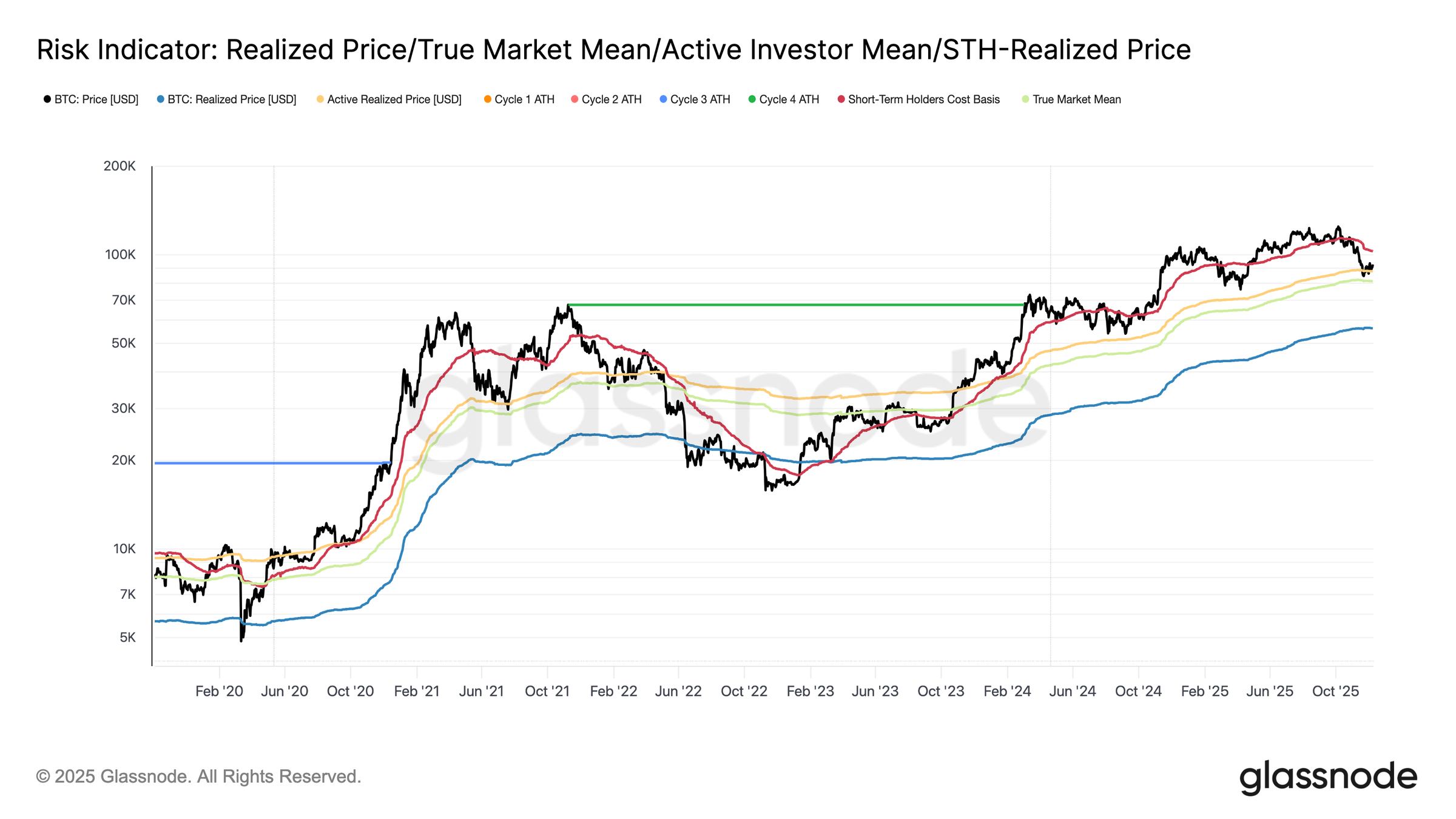
Realized price and true market mean for Bitcoin. Source: Glassnode

The 30-day simple moving average (SMA) of relative unrealized loss has risen to 4.4%, breaking out of a two-year sub-2% range and signaling an entry into a higher-stress market environment. Despite Bitcoin's rebound from the November 22 low to around $92,700, the entity-adjusted realized loss continues to climb, reaching $555 million per day, levels consistent with the FTX capitulation period.

Simultaneously, long-term holders (holding for over one year) are realizing over $1 billion in profits daily, with peaks hitting a record $1.3 billion. Capitulation from top buyers combined with massive distribution by long-term holders will likely keep BTC suppressed below key cost bases, preventing a reclaim of the $95,000–$102,000 resistance zone, which marks the upper bound of the fragile zone.
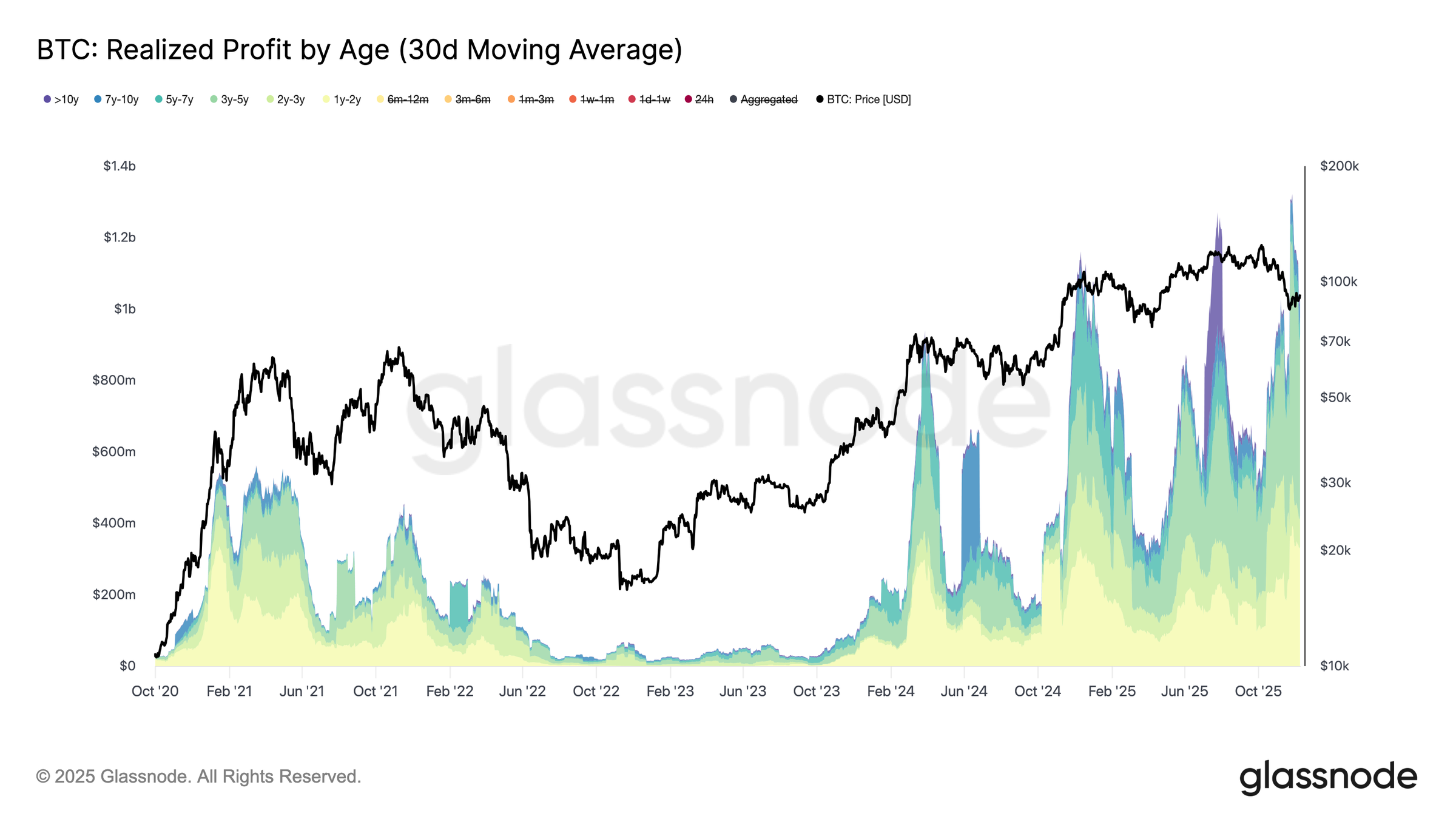
Realized profit by age. Source: Glassnode

Spot-Led Rally Meets a Shrinking Futures Market

Data from CryptoQuant shows that crypto markets typically rally ahead of FOMC meetings, but a significant divergence has recently appeared: Bitcoin's price is rising while open interest (OI) continues to decline.
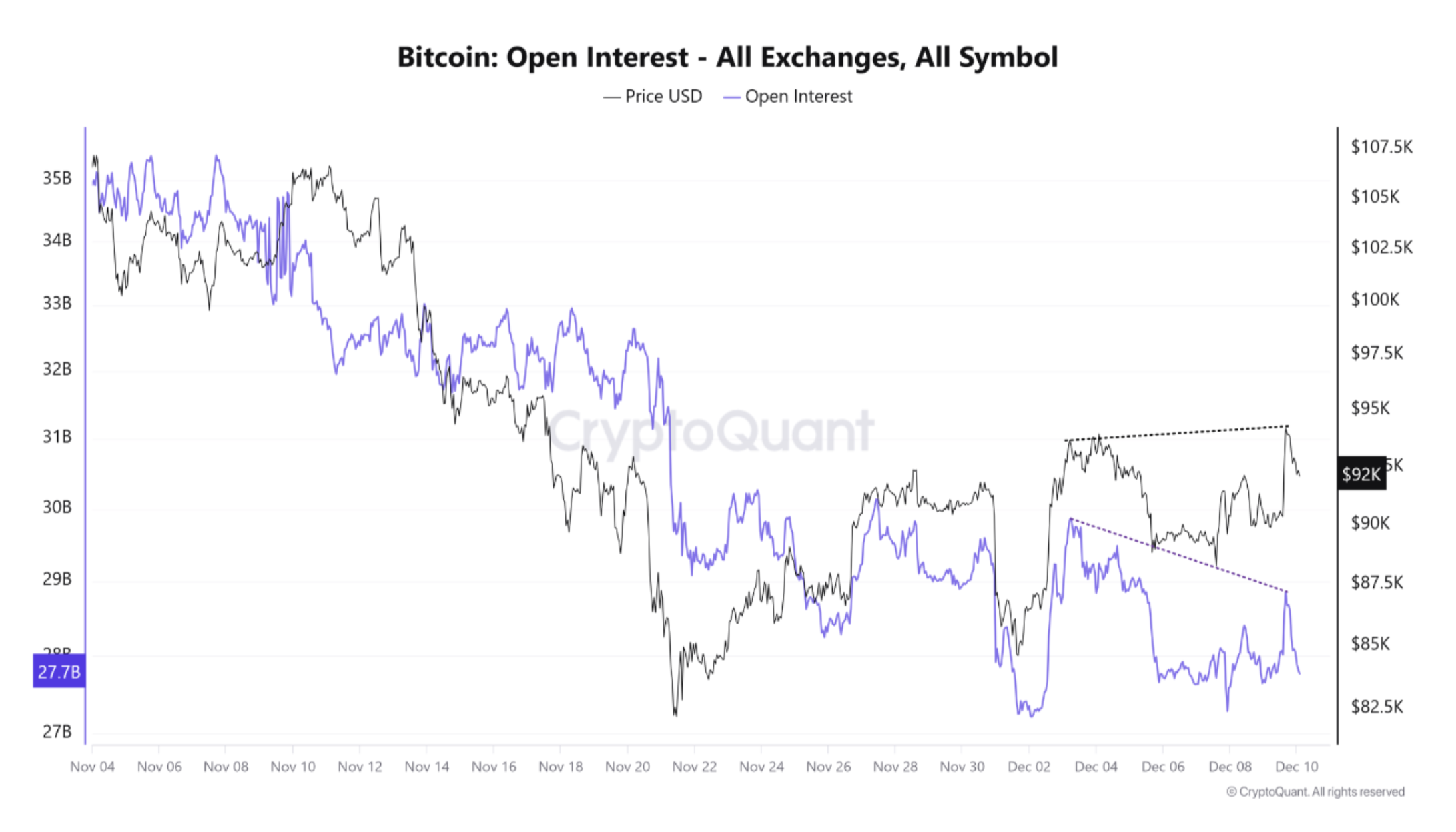
Bitcoin price versus open interest divergence. Source: CryptoQuant

Open interest has been declining throughout the correction since October, and even as Bitcoin found a bottom on November 21st and prices moved higher, OI continued to fall. This suggests the current rally is primarily driven by spot demand, not leveraged speculation.

CryptoQuant added that while spot-driven advances are generally healthier, sustained bullish momentum historically still requires a rise in leveraged positions. Given that derivatives trading volume structurally dominates the market—with spot volume accounting for only about 10% of derivatives activity—this spot-driven strength could be difficult to sustain if market expectations for future rate cuts weaken ahead of the meetings.


Связанные с этим вопросы

QWhat was the outcome of the recent Federal Reserve meeting regarding interest rates, and how did it align with market expectations?

AThe Federal Reserve approved a 25 basis point interest rate cut, which was the third cut of the year and in line with market expectations.

QAccording to Glassnode, what is the key price range trapping Bitcoin below $100,000, and what are the upper and lower bounds of this 'structurally fragile' zone?

ABitcoin is trapped in a structurally fragile range below $100,000, bounded by the short-term holder cost basis at $102,700 and the 'true market mean' at $81,300.

QWhat does the data show about the daily losses being realized in the Bitcoin market, and how does it compare to a previous significant event?

ARealized losses have surged to $555 million per day, which is the highest level since the FTX collapse in 2022.

QHow does the current market rally differ from previous ones in terms of the role of derivatives, and what does this suggest about its sustainability?

AThe current rally is primarily driven by spot demand rather than leveraged speculation, as indicated by declining open interest. While a spot-led rally is generally healthier, sustained bullish momentum has historically required an increase in leverage, which is currently absent.

QWhat two major groups of sellers are applying significant selling pressure, preventing Bitcoin from reclaiming a key resistance zone?

ALong-term holders (holding for over a year) are realizing profits at a record scale, and 'top buyers' are capitulating. These two groups are applying significant selling pressure, preventing Bitcoin from reclaiming the $95,000–$102,000 resistance zone.

Похожее

Raising Interest Rates Is Not a Tech Killer, EPS Is: A Strategy for Discarding the Weak and Retaining the Strong After the AI Theme's Sharp Decline

**Summary: Rising Interest Rates Are Not the Killer of Tech; EPS Is: The "Keep the Strong, Ditch the Weak" Strategy After the AI Theme Plunge** The author argues that the sharp sell-off in tech and AI-related stocks, triggered by a strong US jobs report that heightened Fed rate hike fears, represents a "pullback to pick up passengers" rather than a "car crash." The true end of a tech bull market is not determined by an extra 25 basis point hike, but by industry overcapacity and the disproval of earnings per share (EPS) expectations. Historical analysis shows that during past rate hike cycles, the Nasdaq-100 often outperformed, provided EPS growth remained strong. The current phase is seen as a shift from a "broad narrative-driven rally" to a "focused verification stage" for AI. The investment strategy should be to "keep the strong, ditch the weak." * **Retain exposure** to high-conviction AI infrastructure leaders with clear order visibility, stable margins, strong cash flow, and upward EPS revisions (e.g., AI servers, advanced packaging, optical modules, key cloud suppliers). * **Reduce exposure** to high-beta, narrative-driven stocks with unclear profit paths (e.g., some quantum computing, space, or speculative chip stocks), especially on rebounds. Valuation concerns should focus on whether earnings can catch up to high multiples, not on high P/E alone. Crowded positioning signals a concentration into quality assets, not necessarily a market top. The upcoming Q2 earnings season will be a key validation point. The core principle is to hold stocks with proven EPS, while using macro events (CPI data, central bank meetings) to manage timing and risk.

marsbit34 мин. назад

Raising Interest Rates Is Not a Tech Killer, EPS Is: A Strategy for Discarding the Weak and Retaining the Strong After the AI Theme's Sharp Decline

marsbit34 мин. назад

The Largest IPO in History Ignites Heated Debate: Is SpaceX Worth $1.77 Trillion?

SpaceX's potential IPO is priced at $135 per share, aiming to raise $75 billion and valuing the company at approximately $1.77 trillion, which would make it the largest IPO in history. This valuation has sparked intense debate among investors. Bullish analysts, including major underwriters Goldman Sachs and Morgan Stanley, argue the valuation is justified by SpaceX's long-term potential. They see it not just as a rocket company but as a future leader in space infrastructure, with key growth drivers being Starlink satellite internet, low-cost rocket launches, and future AI-related ventures. They project revenues reaching hundreds of billions to trillions of dollars by 2030-2040. ARK Invest's model suggests a 2030 enterprise value could reach $2.5 trillion. Bearish analysts from independent research firms like Morningstar, PitchBook, and New Constructs contend the IPO price is excessively high, already pricing in unrealistic future growth. Using DCF and sum-of-the-parts models, they estimate fair value between $780 billion and $1.7 trillion, significantly below the IPO target. They highlight risks such as the speculative nature of AI projections, over-dependence on Elon Musk, high growth expectations, and corporate governance concerns. Trefis set a target price of just $79 per share. While both sides acknowledge SpaceX's unique position in commercial space, the core disagreement centers on whether the $135 share price offers a reasonable margin of safety or is overly optimistic. Despite the valuation controversy, reported strong demand for the IPO indicates significant market interest.

marsbit2 ч. назад

The Largest IPO in History Ignites Heated Debate: Is SpaceX Worth $1.77 Trillion?

marsbit2 ч. назад

After the Passage of the GENIUS Act and the CLARITY Act, What Is the Correct Architecture for On-Chain Yield?

The article discusses the evolution of on-chain credit, distinguishing three markets: overcollateralized crypto lending, unsecured lending (largely unsuccessful), and asset-backed credit (ABC). ABC, backed by identifiable real-world collateral with legal recourse, is identified as the fastest-growing category and the only one credibly addressing adverse selection—the core problem in credit where the riskiest borrowers self-select. Current growth in on-chain Real World Assets (RWAs), particularly tokenized private credit funds (e.g., Maple Finance, Centrifuge), is substantial but often merely "wraps" existing fund structures, inheriting their risks rather than solving adverse selection at the protocol level. The regulatory landscape is a key driver, with the US GENIUS Act (prohibiting stablecoin issuers from paying yield) and the proposed CLARITY Act (closing loopholes on indirect yield) set to redefine permissible yield-bearing products. This makes vaults (like ERC-4626) the critical architecture—they become the primary compliant vehicle for delivering yield, functioning as issuance, disclosure, distribution, and recovery mechanisms. The author's thesis is that the correct post-GENIUS/CLARITY architecture involves building ABC solutions where credit assessment, structure, and recovery are encoded directly into the smart contract vault layer, moving beyond mere tokenized fund wrappers to solve adverse selection fundamentally and ensure regulatory compliance.

Foresight News2 ч. назад

After the Passage of the GENIUS Act and the CLARITY Act, What Is the Correct Architecture for On-Chain Yield?

Foresight News2 ч. назад

Торговля

Спот
Фьючерсы

Популярные статьи

Как купить S

Добро пожаловать на HTX.com! Мы сделали приобретение Sonic (S) простым и удобным. Следуйте нашему пошаговому руководству и отправляйтесь в свое крипто-путешествие.Шаг 1: Создайте аккаунт на HTXИспользуйте свой адрес электронной почты или номер телефона, чтобы зарегистрироваться и бесплатно создать аккаунт на HTX. Пройдите удобную регистрацию и откройте для себя весь функционал.Создать аккаунтШаг 2: Перейдите в Купить криптовалюту и выберите свой способ оплатыКредитная/Дебетовая Карта: Используйте свою карту Visa или Mastercard для мгновенной покупки Sonic (S).Баланс: Используйте средства с баланса вашего аккаунта HTX для простой торговли.Третьи Лица: Мы добавили популярные способы оплаты, такие как Google Pay и Apple Pay, для повышения удобства.P2P: Торгуйте напрямую с другими пользователями на HTX.Внебиржевая Торговля (OTC): Мы предлагаем индивидуальные услуги и конкурентоспособные обменные курсы для трейдеров.Шаг 3: Хранение Sonic (S)После приобретения вами Sonic (S) храните их в своем аккаунте на HTX. В качестве альтернативы вы можете отправить их куда-либо с помощью перевода в блокчейне или использовать для торговли с другими криптовалютами.Шаг 4: Торговля Sonic (S)С легкостью торгуйте Sonic (S) на спотовом рынке HTX. Просто зайдите в свой аккаунт, выберите торговую пару, совершайте сделки и следите за ними в режиме реального времени. Мы предлагаем удобный интерфейс как для начинающих, так и для опытных трейдеров.

1.4k просмотров всегоОпубликовано 2025.01.15Обновлено 2026.06.02

Как купить S

Sonic: Обновления под руководством Андре Кронье – новая звезда Layer-1 на фоне спада рынка

Он решает проблемы масштабируемости, совместимости между блокчейнами и стимулов для разработчиков с помощью технологических инноваций.

2.3k просмотров всегоОпубликовано 2025.04.09Обновлено 2025.04.09

Sonic: Обновления под руководством Андре Кронье – новая звезда Layer-1 на фоне спада рынка

HTX Learn: Пройдите обучение по "Sonic" и разделите 1000 USDT

HTX Learn — ваш проводник в мир перспективных проектов, и мы запускаем специальное мероприятие "Учитесь и Зарабатывайте", посвящённое этим проектам. Наше новое направление .

1.8k просмотров всегоОпубликовано 2025.04.10Обновлено 2025.04.10

HTX Learn: Пройдите обучение по "Sonic" и разделите 1000 USDT

Обсуждения

Добро пожаловать в Сообщество HTX. Здесь вы сможете быть в курсе последних новостей о развитии платформы и получить доступ к профессиональной аналитической информации о рынке. Мнения пользователей о цене на S (S) представлены ниже.

活动图片