Every Ethereum Whale Cohort Now Underwater: ETH Capitulation Marking The Final Bottom?

bitcoinistОпубликовано 2026-02-21Обновлено 2026-02-21

Введение

Ethereum is struggling below the $2,000 mark amid persistent selling pressure and weak market sentiment. Analysis shows all major whale cohorts are now holding ETH at an unrealized loss, with profit ratios turning negative. This increases the risk of capitulation, which could deepen short-term volatility. However, ETH has so far held above recent local support levels, suggesting large-scale selling hasn't yet occurred. Historically, such stress among large holders has sometimes marked medium-term bottoms. Technically, ETH remains fragile, trading below key moving averages with resistance near $2,200–$2,600. A sustained recovery would require improved liquidity, stronger demand, and supportive macro conditions.

Ethereum continues to struggle below the $2,000 level as persistent selling pressure and elevated uncertainty weigh on broader crypto market sentiment. Despite occasional rebound attempts, price action remains fragile, with volatility still elevated after months of corrective momentum. The inability to decisively reclaim this psychological threshold has reinforced caution among traders, particularly as liquidity conditions tighten and macro uncertainty continues to influence risk appetite across digital assets.

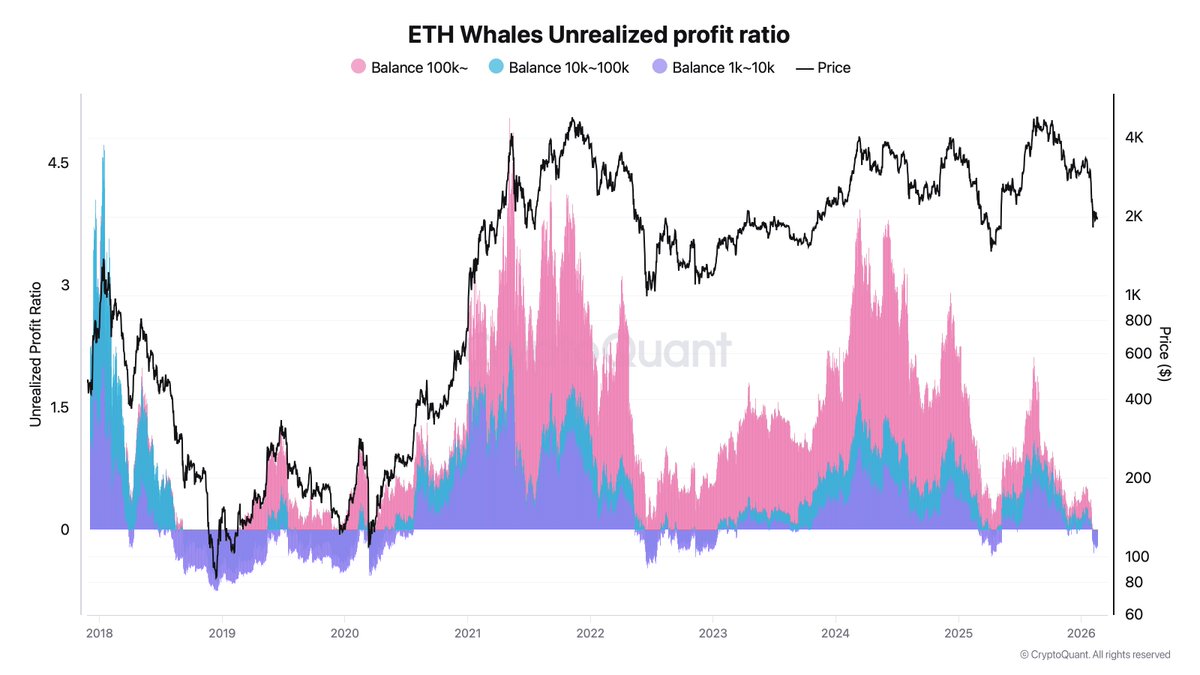
Recent analysis from Darkfost adds further context to the current market structure. According to the data, the ongoing correction is now affecting all investor cohorts, including Ethereum’s largest holders. Notably, the unrealized profit ratio for whale groups has shifted into negative territory across the board. Wallets holding between 1,000 and 10,000 ETH show an unrealized profit ratio of approximately -0.21, while those with 10,000 to 100,000 ETH stand near -0.18. Even the largest cohort — addresses holding more than 100,000 ETH — has slipped into negative territory around -0.08.

Ethereum Whales Unrealized profit ratio | Source: CryptoQuant

This development is notable because Ethereum has not yet revisited its April lows, suggesting the depth of unrealized losses is expanding earlier than in some previous corrective phases. Such conditions can increase market sensitivity, as even traditionally resilient holders may reassess positioning amid prolonged volatility.

Whale Stress Raises Capitulation Risk While Bottom Formation Signals Emerge

Darkfost further notes that if Ethereum extends its decline, large holders could face increasing financial pressure. Sustained downside would deepen unrealized losses across whale cohorts, potentially forcing some participants to reduce exposure or liquidate portions of their holdings. Historically, such capitulation events among large investors tend to amplify short-term volatility, particularly when liquidity conditions are already fragile.

However, despite the negative profit ratios now visible across whale groups, Ethereum has so far managed to stabilize above recent local support zones. This relative resilience suggests that, while sentiment remains cautious, immediate large-scale distribution from whales has not yet materialized. The distinction is important because unrealized losses alone do not necessarily trigger selling unless accompanied by liquidity stress, leverage pressure, or broader market shocks.

Periods in which major holders experience stress have often coincided with medium-term bottom formation phases in previous cycles. As weaker hands exit and leverage unwinds, markets sometimes transition into accumulation regimes characterized by lower volatility and gradual stabilization.

Still, this interpretation should be approached cautiously. Whale positioning is only one element of market structure, and confirmation typically requires improving liquidity, stronger spot demand, and supportive macro conditions before a sustained recovery can take hold.

Ethereum Price Structure Remains Fragile Below Key Averages

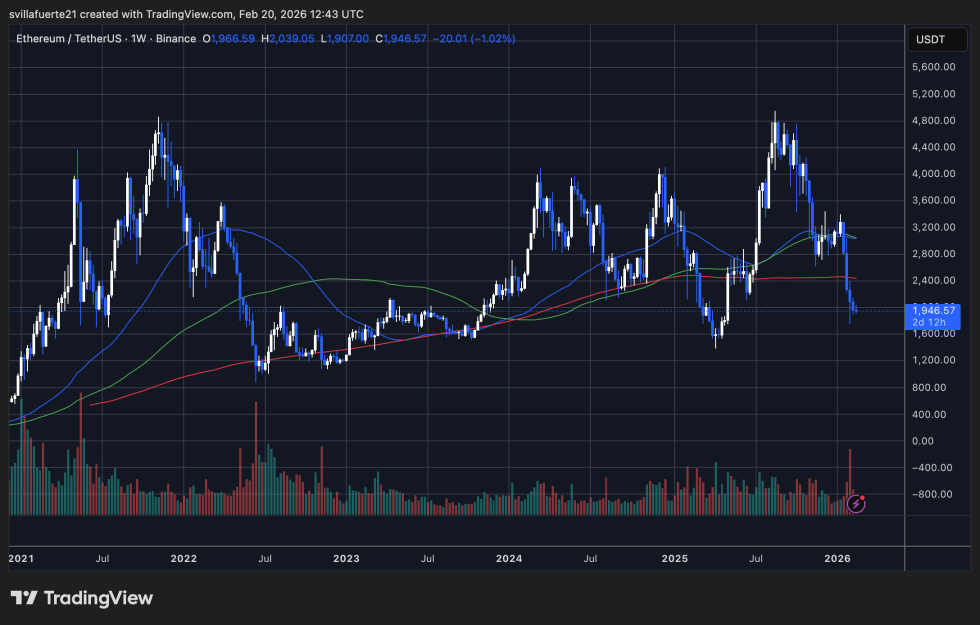
Ethereum continues to trade under clear technical pressure, with the weekly chart showing a sustained inability to reclaim the $2,000 region decisively. Following the sharp rejection from the 2025 highs near the $4,800 zone, price action has transitioned into a sequence of lower highs and weakening rebounds, typically associated with corrective market phases rather than accumulation-led recoveries.

ETH testing critical demand level | Source: ETHUSDT chart on TradingView

Technically, ETH is currently positioned below several major moving averages that previously acted as dynamic support. These levels now function as resistance, limiting upside attempts unless a strong reclaim occurs with expanding volume. The recent decline toward the $1,900 area reflects persistent selling pressure, while repeated failures near the mid-$2,000 range reinforce cautious market sentiment.

Volume activity has moderated compared with the impulsive rally phase, suggesting reduced speculative participation. While declining volume during corrections can sometimes signal seller exhaustion, confirmation of stabilization usually requires sustained buying interest rather than temporary rebounds.

From a structural perspective, immediate support appears concentrated near the recent local lows around the $1,800 region, while resistance remains clustered between roughly $2,200 and $2,600. Until Ethereum reclaims these levels convincingly, the broader technical outlook remains vulnerable, with consolidation or further downside still plausible.

Featured image from ChatGPT, chart from TradingView.com

Связанные с этим вопросы

QWhat is the current unrealized profit ratio for Ethereum whale cohorts holding between 1,000 and 10,000 ETH?

AThe unrealized profit ratio for wallets holding between 1,000 and 10,000 ETH is approximately -0.21.

QAccording to the article, what key psychological price level is Ethereum struggling to reclaim?

AEthereum is struggling to decisively reclaim the $2,000 psychological threshold.

QWhat potential risk arises if Ethereum extends its decline, according to Darkfost's analysis?

AIf Ethereum extends its decline, large holders could face increasing financial pressure, potentially forcing some to reduce exposure or liquidate portions of their holdings, which would amplify short-term volatility.

QWhat technical pattern is Ethereum's price action showing on the weekly chart after the rejection from 2025 highs?

AFollowing the rejection from the 2025 highs near $4,800, Ethereum's price action has transitioned into a sequence of lower highs and weakening rebounds, typical of corrective market phases.

QWhat does the article suggest periods of whale stress have often coincided with in previous market cycles?

APeriods in which major holders experience stress have often coincided with medium-term bottom formation phases in previous cycles, as weaker hands exit and leverage unwinds.

Похожее

You Bet on the News, the Pros Read the Rules: The True Cognitive Gap in Losing Money on Polymarket

The article explains that the key to profiting on Polymarket, a prediction market platform, lies not just predicting real-world events correctly, but in meticulously understanding the specific rules that govern how each market will be resolved. It illustrates this with examples, such as a market on Venezuela's 2026 leader, where the official rules defining "officially holds" the office overruled the intuitive answer of who was in practical control. Other examples include debates over the definition of a "token" or what constitutes an "agreement." The core argument is that a "reality vs. rules" gap creates pricing discrepancies that savvy traders ("车头" or "whales") exploit. The platform has a formal dispute resolution process managed by UMA token holders to settle ambiguous outcomes. This process involves proposal submission, a challenge window, a discussion period, and a final vote. However, the article highlights a critical flaw in this system compared to a traditional court: the lack of separation between the arbiters (UMA voters) and the interested parties (traders with financial stakes in the outcome). This conflict of interest undermines the discussion phase, leads to herd mentality, and results in opaque final decisions without explanatory rulings. Consequently, the system lacks a body of precedent, making it difficult for users to learn from past disputes. The ultimate takeaway is that success on Polymarket requires a lawyer-like scrutiny of the rules to identify and capitalize on the cognitive gap between how events appear and how they are contractually defined for settlement.

marsbit6 мин. назад

You Bet on the News, the Pros Read the Rules: The True Cognitive Gap in Losing Money on Polymarket

marsbit6 мин. назад

Will the Fed Still Cut Interest Rates? Tonight's Data Is Crucial

The core debate surrounding the Federal Reserve's potential interest rate cuts is intensifying amid geopolitical conflict and rebounding inflation. The key question is whether high energy prices will cause persistent inflation or weaken consumer demand enough to force the Fed to cut rates. Citigroup presents a bullish case for cuts, arguing that oil supply disruptions from the Strait of Hormuz are temporary and will not lead to lasting inflationary pressure. They point to receding bond yields and oil prices as evidence the market is pricing in a short-lived shock. Citi's data also shows tightening financial conditions, a stabilizing labor market, and healthy tax returns, supporting their view that the path to lower rates remains open. Conversely, Deutsche Bank offers a starkly contrasting, more hawkish outlook. They argue the Fed's current policy is already neutral and expect rates to remain unchanged indefinitely. Their view is based on stalled disinflation progress and a shift toward more hawkish rhetoric from key Fed officials like Waller, who cited risks from prolonged Middle East conflict and tariffs. Other officials, including Williams and Hammack, signaled rates would likely stay on hold for a "considerable time." The market pricing has shifted dramatically, now forecasting zero cuts in 2026. The imminent release of the March retail sales "control group" data is highlighted as a critical test. This metric, which excludes gas station sales, will reveal if high gasoline prices are eroding consumer spending in other areas. A weak reading could support the case for imminent rate cuts, while a strong one would bolster the argument for the Fed to hold steady. This data is pivotal for determining the near-term policy path.

marsbit26 мин. назад

Will the Fed Still Cut Interest Rates? Tonight's Data Is Crucial

marsbit26 мин. назад

The Second Half of Macro Influencer Fu Peng's Career

Fu Peng, a prominent Chinese macroeconomist and former chief economist of Northeast Securities, has joined Hong Kong-based digital asset management firm Bitfire Group (formerly New Huo Group) as its chief economist. This move, announced in April 2026, triggered an 11% surge in Bitfire's stock price. Fu, known for his accessible macroeconomic commentary and large social media following, will focus on integrating digital assets into global asset allocation frameworks, particularly combining FICC (fixed income, currencies, and commodities) with cryptocurrencies for institutional clients. His career includes roles at Lehman Brothers and Solomon International, with significant influence gained through public communication. However, in late 2024, Fu faced temporary social media bans after a controversial private speech at HSBC on China's economic challenges, though he denied regulatory sanctions. He later left Northeast Securities citing health reasons. Bitfire, a licensed virtual asset manager serving high-net-worth clients, seeks to build trust and attract traditional capital through Fu’s expertise and credibility. The partnership represents a strategic shift for both: Fu enters the crypto sector after a traditional finance peak, while Bitfire aims to leverage his macro framework for institutional adoption. Outcomes remain uncertain regarding capital inflows and compatibility within corporate structure.

marsbit1 ч. назад

The Second Half of Macro Influencer Fu Peng's Career

marsbit1 ч. назад

Торговля

Спот
Фьючерсы

Популярные статьи

Manyu: восходящая мем-звезда на Ethereum, готовая открыть новую эру культуры Shiba

Manyu - это мемтокен на Ethereum, который приносит децентрализованную культурную и развлекательную ценность через вирусное влияние в соцсетях и вовлечённость сообщества.

1.9k просмотров всегоОпубликовано 2025.11.27Обновлено 2025.11.27

Manyu: восходящая мем-звезда на Ethereum, готовая открыть новую эру культуры Shiba

Обсуждения

Добро пожаловать в Сообщество HTX. Здесь вы сможете быть в курсе последних новостей о развитии платформы и получить доступ к профессиональной аналитической информации о рынке. Мнения пользователей о цене на ETH (ETH) представлены ниже.

活动图片