Ethereum Takes The Lead In DeFi Lending Revenue, Leaving Rivals Behind – See How

bitcoinistОпубликовано 2025-12-19Обновлено 2025-12-19

Введение

Despite facing selling pressure, Ethereum has solidified its dominance in DeFi lending revenue, capturing 80-90% of all activity and fees. Data from Leon Waidmann shows Ethereum remains the core settlement layer for DeFi, significantly outpacing rivals like Base and Arbitrum. Aave drives over 50% of lending funds and 60% of active loans on Ethereum, generating $885 million in fees in 2025 alone. While Layer 2s improve user experience, the mainnet continues to be reinforced as the trusted hub for liquidity and credit markets. Additionally, active Ethereum addresses are nearing all-time highs, with 2.4 million weekly users, signaling strong retail and institutional engagement.

Ethereum’s price may be hampered by selling pressure, but the leading network continues to experience heavy utilization from developers and users. After robust interaction from the participants, the blockchain giant emerged once again as the leader in Decentralized Finance (DeFi) lending.

DeFi Lending Still Pays Best On The Ethereum Network

A recent report has underscored Ethereum’s growing dominance within the blockchain sector. The network is solidifying its position as the financial foundation for decentralized finance lending, and the data is starting to present a convincing picture.

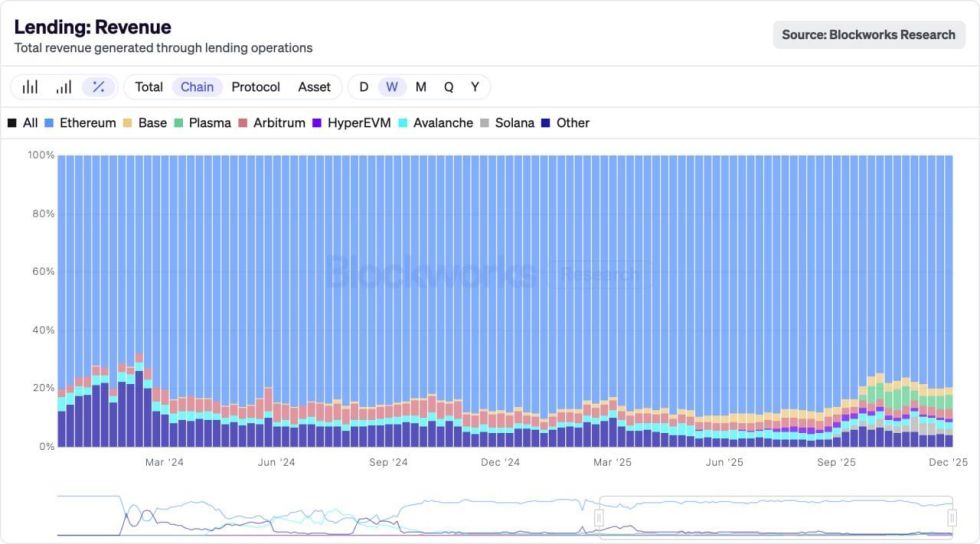
A look at the data shared by Leon Waidmann, a market expert and the head of research at On-Chain Foundation, shows that ETH is now the revenue center of DeFi lending. This implies that most of the revenue flowed through the ETH ecosystem, outpacing other major chains like Base, Plasma, and Arbitrum.

From borrowing fees to interest paid by active users, the ETH network continues to be the key settlement layer where value is persistently created. ETH is at the center of the revenue outlines the network’s usage in addition to its ongoing dominance as the fundamental infrastructure driving DeFi’s most lucrative lending activity.

Source: Chart from Leon Waidmann on X

As seen on the chart, Ethereum mainnet steadily secured over 80% to 90% of all DeFi lending revenue and activity, reinforcing its increasing role in the financial landscape. Interestingly, this share has remained a dominant force even with the vigorous expansion of the Layer 2 and alt-Layer 1 chains.

Data shows that usage may be fragmented, but fees do not. Meanwhile, at the protocol layer, Waidmann highlighted that concentration is quite stronger. Amid this rising DeFi revenue lending, Aave is the core revenue engine on the Ethereum mainnet, attracting more than 50% of the total lending funds.

This part of the network was also responsible for over 60% of all active loans on ETH. In the end, the project generated approximately $885 million in fees in 2025 alone, reflecting the significant usage of the network.

While Ethereum mainnet secures balance sheets and profits, layer 2s are optimizing execution and User Experience (UX). Waidmann noted that where confidence and liquidity are greatest, DeFi credit markets converge. “Ethereum Mainnet is not being disrupted, but is being reinforced,” the expert added.

Active ETH Addresses Targeting Its Peak

Another instance of robust engagement across the Ethereum network is a spike in active wallet addresses. Joseph Young, a crypto enthusiast, previously highlighted that the active users on the network are drawing close to its all-time high. Such a rise in active addresses suggests a resurgence of interest and conviction among larger and retail investors.

At the time of the post, about 2.4 million wallet addresses were actively interacting with the network every week. This is an indication that tokenization, stablecoins, and privacy infrastructure are all converging on Ethereum. Currently, Young stated ETH is dominating the big three metas, while expressing his conviction in the network’s prospects.

ETH trading at $2,954 on the 1D chart | Source: ETHUSDT on Tradingview.com

Связанные с этим вопросы

QAccording to the article, which blockchain network is the leader in DeFi lending revenue?

AEthereum is the leader in DeFi lending revenue, securing over 80% to 90% of all activity.

QWhat is the name of the expert and head of research at On-Chain Foundation cited in the report?

AThe expert cited is Leon Waidmann, the head of research at On-Chain Foundation.

QWhich protocol is highlighted as the core revenue engine on the Ethereum mainnet for DeFi lending?

AAave is the core revenue engine on the Ethereum mainnet, attracting more than 50% of the total lending funds.

QWhat does the significant increase in active Ethereum wallet addresses suggest, according to the article?

AThe spike in active wallet addresses suggests a resurgence of interest and conviction among both larger and retail investors.

QWhat role do Layer 2 networks play in relation to the Ethereum mainnet, as described in the article?

ALayer 2 networks are optimizing execution and User Experience (UX), while the Ethereum Mainnet secures balance sheets and profits, thereby being reinforced rather than disrupted.

Похожее

Gensyn AI: Don't Let AI Repeat the Mistakes of the Internet

In recent months, the rapid growth of the AI industry has attracted significant talent from the crypto sector. A persistent question among researchers intersecting both fields is whether blockchain can become a foundational part of AI infrastructure. While many previous AI and Crypto projects focused on application layers (like AI Agents, on-chain reasoning, data markets, and compute rentals), few achieved viable commercial models. Gensyn differentiates itself by targeting the most critical and expensive layer of AI: model training. Gensyn aims to organize globally distributed GPU resources into an open AI training network. Developers can submit training tasks, nodes provide computational power, and the network verifies results while distributing incentives. The core issue addressed is not decentralization for its own sake, but the increasing centralization of compute power among tech giants. In the era of large models, access to GPUs (like the H100) has become a decisive bottleneck, dictating the pace of AI development. Major AI companies are heavily dependent on large cloud providers for compute resources. Gensyn's approach is significant for several reasons: 1) It operates at the core infrastructure layer (model training), the most resource-intensive and technically demanding part of the AI value chain. 2) It proposes a more open, collaborative model for compute, potentially increasing resource utilization by dynamically pooling idle GPUs, similar to early cloud computing logic. 3) Its technical moat lies in solving complex challenges like verifying training results, ensuring node honesty, and maintaining reliability in a distributed environment—making it more of a deep-tech infrastructure company. 4) It targets a validated, high-growth market with genuine demand, rather than pursuing blockchain integration without purpose. Ultimately, the boundaries between Crypto and AI are blurring. AI requires global resource coordination, incentive mechanisms, and collaborative systems—areas where crypto-native solutions excel. Gensyn represents a step toward making advanced training capabilities more accessible and collaborative, moving beyond a niche controlled by a few giants. If successful, it could evolve into a fundamental piece of AI infrastructure, where the most enduring value in the AI era is often created.

marsbit8 ч. назад

Gensyn AI: Don't Let AI Repeat the Mistakes of the Internet

marsbit8 ч. назад

Why is China's AI Developing So Fast? The Answer Lies Inside the Labs

A US researcher's visit to China's top AI labs reveals distinct cultural and organizational factors driving China's rapid AI development. While talent, data, and compute are similar to the West, Chinese labs excel through a pragmatic, execution-focused culture: less emphasis on individual stardom and conceptual debate, and more on teamwork, engineering optimization, and mastering the full tech stack. A key advantage is the integration of young students and researchers who approach model-building with fresh perspectives and low ego, prioritizing collective progress over personal credit. This contrasts with the US culture of self-promotion and "star scientist" narratives. Chinese labs also exhibit a strong "build, don't buy" mentality, preferring to develop core capabilities—like data pipelines and environments—in-house rather than relying on external services. The ecosystem feels more collaborative than tribal, with mutual respect among labs. While government support exists, its scale is unclear, and technical decisions appear driven by labs, not state mandates. Chinese companies across sectors, from platforms to consumer tech, are building their own foundational models to control their tech destiny, reflecting a broader cultural drive for technological sovereignty. Demand for AI is emerging, with spending patterns potentially mirroring cloud infrastructure more than traditional SaaS. Despite challenges like a less mature data industry and GPU shortages, Chinese labs are propelled by vast talent, rapid iteration, and deep integration with the open-source community. The competition is evolving beyond a pure model race into a contest of organizational execution, developer ecosystems, and industrial pragmatism.

marsbit9 ч. назад

Why is China's AI Developing So Fast? The Answer Lies Inside the Labs

marsbit9 ч. назад

3 Years, 5 Times: The Rebirth of a Century-Old Glass Factory

Corning, a 175-year-old glass company, is experiencing a dramatic revival as a key player in AI infrastructure, driven by surging demand for high-performance optical fiber in data centers. AI data centers require vastly more fiber than traditional ones—5 to 10 times as much per rack—to handle high-speed data transmission between GPUs. This structural demand shift, coupled with supply constraints from the lengthy expansion cycle for fiber preforms, has created a significant supply-demand gap. Nvidia has invested in Corning, along with Lumentum and Coherent, in a $4.5 billion total commitment to secure the optical supply chain for AI. Corning's competitive edge lies in its expertise in producing ultra-low-loss, high-density, and bend-resistant specialty fiber, which is critical for 800G+ and future 1.6T data rates. Its deep involvement in co-packaged optics (CPO) with partners like Nvidia further solidifies its position. While not the largest fiber manufacturer globally, Corning's revenue from enterprise/data center clients now exceeds 40% of its optical communications sales, and it has secured multi-year supply agreements with major hyperscalers including Meta and Nvidia. Financially, Corning's optical communications revenue has surged, doubling from $1.3 billion in 2023 to over $3 billion in 2025. Its stock price has risen nearly 6-fold since late 2023. Key future catalysts include the rollout of Nvidia's CPO products and the scale of undisclosed customer agreements. However, risks include high current valuations and potential disruption from next-generation technologies like hollow-core fiber. The company's long-term bet on light over electricity, maintained even through the telecom bubble crash, is now being validated by the AI boom.

marsbit10 ч. назад

3 Years, 5 Times: The Rebirth of a Century-Old Glass Factory

marsbit10 ч. назад

Торговля

Спот
Фьючерсы

Популярные статьи

Manyu: восходящая мем-звезда на Ethereum, готовая открыть новую эру культуры Shiba

Manyu - это мемтокен на Ethereum, который приносит децентрализованную культурную и развлекательную ценность через вирусное влияние в соцсетях и вовлечённость сообщества.

1.9k просмотров всегоОпубликовано 2025.11.27Обновлено 2025.11.27

Manyu: восходящая мем-звезда на Ethereum, готовая открыть новую эру культуры Shiba

Неделя обучения по популярным токенам 14: Glamsterdam — самое ожидаемое обновление Ethereum в 2026 году

Ordinals/Runes по-прежнему стимулируют доходы от комиссий за блоки и активность разработчиков, рассматриваются как отправная точка «нативной эмиссии активов» в сети.

1.2k просмотров всегоОпубликовано 2026.04.29Обновлено 2026.04.29

Неделя обучения по популярным токенам 14: Glamsterdam — самое ожидаемое обновление Ethereum в 2026 году

Обсуждения

Добро пожаловать в Сообщество HTX. Здесь вы сможете быть в курсе последних новостей о развитии платформы и получить доступ к профессиональной аналитической информации о рынке. Мнения пользователей о цене на ETH (ETH) представлены ниже.

活动图片