Ethereum Takes The Lead In DeFi Lending Revenue, Leaving Rivals Behind – See How

bitcoinistОпубликовано 2025-12-19Обновлено 2025-12-19

Введение

Despite facing selling pressure, Ethereum has solidified its dominance in DeFi lending revenue, capturing 80-90% of all activity and fees. Data from Leon Waidmann shows Ethereum remains the core settlement layer for DeFi, significantly outpacing rivals like Base and Arbitrum. Aave drives over 50% of lending funds and 60% of active loans on Ethereum, generating $885 million in fees in 2025 alone. While Layer 2s improve user experience, the mainnet continues to be reinforced as the trusted hub for liquidity and credit markets. Additionally, active Ethereum addresses are nearing all-time highs, with 2.4 million weekly users, signaling strong retail and institutional engagement.

Ethereum’s price may be hampered by selling pressure, but the leading network continues to experience heavy utilization from developers and users. After robust interaction from the participants, the blockchain giant emerged once again as the leader in Decentralized Finance (DeFi) lending.

DeFi Lending Still Pays Best On The Ethereum Network

A recent report has underscored Ethereum’s growing dominance within the blockchain sector. The network is solidifying its position as the financial foundation for decentralized finance lending, and the data is starting to present a convincing picture.

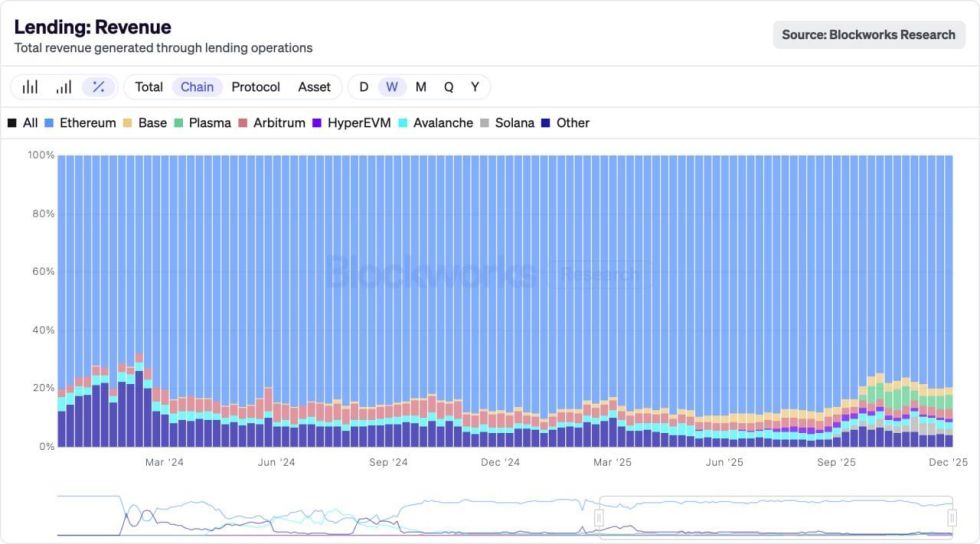
A look at the data shared by Leon Waidmann, a market expert and the head of research at On-Chain Foundation, shows that ETH is now the revenue center of DeFi lending. This implies that most of the revenue flowed through the ETH ecosystem, outpacing other major chains like Base, Plasma, and Arbitrum.

From borrowing fees to interest paid by active users, the ETH network continues to be the key settlement layer where value is persistently created. ETH is at the center of the revenue outlines the network’s usage in addition to its ongoing dominance as the fundamental infrastructure driving DeFi’s most lucrative lending activity.

Source: Chart from Leon Waidmann on X

As seen on the chart, Ethereum mainnet steadily secured over 80% to 90% of all DeFi lending revenue and activity, reinforcing its increasing role in the financial landscape. Interestingly, this share has remained a dominant force even with the vigorous expansion of the Layer 2 and alt-Layer 1 chains.

Data shows that usage may be fragmented, but fees do not. Meanwhile, at the protocol layer, Waidmann highlighted that concentration is quite stronger. Amid this rising DeFi revenue lending, Aave is the core revenue engine on the Ethereum mainnet, attracting more than 50% of the total lending funds.

This part of the network was also responsible for over 60% of all active loans on ETH. In the end, the project generated approximately $885 million in fees in 2025 alone, reflecting the significant usage of the network.

While Ethereum mainnet secures balance sheets and profits, layer 2s are optimizing execution and User Experience (UX). Waidmann noted that where confidence and liquidity are greatest, DeFi credit markets converge. “Ethereum Mainnet is not being disrupted, but is being reinforced,” the expert added.

Active ETH Addresses Targeting Its Peak

Another instance of robust engagement across the Ethereum network is a spike in active wallet addresses. Joseph Young, a crypto enthusiast, previously highlighted that the active users on the network are drawing close to its all-time high. Such a rise in active addresses suggests a resurgence of interest and conviction among larger and retail investors.

At the time of the post, about 2.4 million wallet addresses were actively interacting with the network every week. This is an indication that tokenization, stablecoins, and privacy infrastructure are all converging on Ethereum. Currently, Young stated ETH is dominating the big three metas, while expressing his conviction in the network’s prospects.

ETH trading at $2,954 on the 1D chart | Source: ETHUSDT on Tradingview.com

Связанные с этим вопросы

QAccording to the article, which blockchain network is the leader in DeFi lending revenue?

AEthereum is the leader in DeFi lending revenue, securing over 80% to 90% of all activity.

QWhat is the name of the expert and head of research at On-Chain Foundation cited in the report?

AThe expert cited is Leon Waidmann, the head of research at On-Chain Foundation.

QWhich protocol is highlighted as the core revenue engine on the Ethereum mainnet for DeFi lending?

AAave is the core revenue engine on the Ethereum mainnet, attracting more than 50% of the total lending funds.

QWhat does the significant increase in active Ethereum wallet addresses suggest, according to the article?

AThe spike in active wallet addresses suggests a resurgence of interest and conviction among both larger and retail investors.

QWhat role do Layer 2 networks play in relation to the Ethereum mainnet, as described in the article?

ALayer 2 networks are optimizing execution and User Experience (UX), while the Ethereum Mainnet secures balance sheets and profits, thereby being reinforced rather than disrupted.

Похожее

2026 New Policy Interpretation: The "Mutual Pursuit" of Intelligent Agents and AI Terminals, and the Three Major Value Reconstructions in the AIoT Industry

In May 2026, China's national ministries released two pivotal policy documents that jointly establish a strategic "dual-track" framework for the AIoT industry. The "Intelligent Agent Standardized Application and Innovation Development Implementation Opinions" defines the "soul"—positioning intelligent agents as core AI products. The "Artificial Intelligence Terminal Intelligence Grading" national standard defines the "body"—establishing a four-tier capability ladder (L1 to L4) for AI hardware. This synchronized policy approach is globally unique, moving beyond market-led (US) or risk-focused (EU) models. It frames AIoT as a new type of "intelligent infrastructure," comparable to electricity or the internet in historical significance. The core analysis identifies a value evolution from IoT 1.0 (connection) to AIoT 4.0 (collaboration, represented by the forward-looking L4 level). This "L4" signifies a paradigm shift: from users operating tools to delegating tasks to agent-like devices ("Intelligent Action of All Things"). The article outlines three strategic paths for companies: becoming Standard Definers, Scenario Integrators (focusing on 19 specified application areas), or Infrastructure Builders. A critical 18-24 month window is identified for strategic positioning. A "Four Levers" strategy is proposed: leveraging Standards (L-level certification), leveraging Scenarios (deep vertical focus), leveraging Open Source (for cost reduction and ecosystem influence), and leveraging Momentum (engaging in global protocol ecosystems). In conclusion, these policies are a starting gun for a decade-long industrial transformation, shifting the industry narrative from "Intelligent Connection of All Things" to "Intelligent Action of All Things," with companies needing to choose their赛道and execution strategy decisively.

marsbit55 мин. назад

2026 New Policy Interpretation: The "Mutual Pursuit" of Intelligent Agents and AI Terminals, and the Three Major Value Reconstructions in the AIoT Industry

marsbit55 мин. назад

Splashing Out 27 Billion Yuan, OpenAI Establishes New Company to Accelerate AI Deployment

On May 11th, OpenAI announced the formation of a new company, "OpenAI Deployment Company," with an initial investment of over $4 billion (approximately 27.2 billion RMB). This venture aims to help businesses build and deploy AI solutions. OpenAI is also acquiring the AI consulting firm Toromo to rapidly scale the deployment company's capabilities. This new entity, majority-owned by OpenAI, brings together 19 investment, consulting, and system integration partners, led by TPG with co-lead founding partners including Advent International, Bain Capital, and Brookfield. OpenAI's Chief Revenue Officer, Denise Dresser, stated that while AI is becoming increasingly capable, the current challenge lies in integrating these systems into core business infrastructure and workflows. The deployment company is designed to bridge this gap and translate AI capabilities into operational impact. This move comes as OpenAI emphasizes the next competitive phase will depend on the efficiency of deploying AI in real business scenarios. The company reports over 1 million businesses already use its products and APIs. OpenAI is significantly increasing its investments in computing power, with co-founder Greg Brockman stating the company expects to spend $50 billion on compute this year, a dramatic increase from $3 million in 2017. The announcement follows OpenAI's recent completion of a record $122 billion funding round in late March, led by Amazon, Nvidia, and SoftBank, valuing the company at $852 billion post-money. Major strategic investors committed $110 billion as a base for this round. Concurrently, OpenAI is advancing its core model development. It has shifted focus from its Sora video generator to developing advanced robotics and AI models that interact with the physical world. It has also begun allowing select users access to a new model specialized in identifying software vulnerabilities and is reportedly preparing to launch an enhanced image generation model in the coming weeks. According to reports citing founder Sam Altman, OpenAI is considering an IPO as early as 2027, with a potential valuation around $1 trillion.

marsbit1 ч. назад

Splashing Out 27 Billion Yuan, OpenAI Establishes New Company to Accelerate AI Deployment

marsbit1 ч. назад

Торговля

Спот
Фьючерсы

Популярные статьи

Manyu: восходящая мем-звезда на Ethereum, готовая открыть новую эру культуры Shiba

Manyu - это мемтокен на Ethereum, который приносит децентрализованную культурную и развлекательную ценность через вирусное влияние в соцсетях и вовлечённость сообщества.

1.9k просмотров всегоОпубликовано 2025.11.27Обновлено 2025.11.27

Manyu: восходящая мем-звезда на Ethereum, готовая открыть новую эру культуры Shiba

Неделя обучения по популярным токенам 14: Glamsterdam — самое ожидаемое обновление Ethereum в 2026 году

Ordinals/Runes по-прежнему стимулируют доходы от комиссий за блоки и активность разработчиков, рассматриваются как отправная точка «нативной эмиссии активов» в сети.

1.3k просмотров всегоОпубликовано 2026.04.29Обновлено 2026.04.29

Неделя обучения по популярным токенам 14: Glamsterdam — самое ожидаемое обновление Ethereum в 2026 году

Обсуждения

Добро пожаловать в Сообщество HTX. Здесь вы сможете быть в курсе последних новостей о развитии платформы и получить доступ к профессиональной аналитической информации о рынке. Мнения пользователей о цене на ETH (ETH) представлены ниже.

活动图片