Ethereum Faces Liquidation Zones: Large Holders Cluster Risk Levels Between $1,700 And $1,000

bitcoinistОпубликовано 2026-02-07Обновлено 2026-02-07

Введение

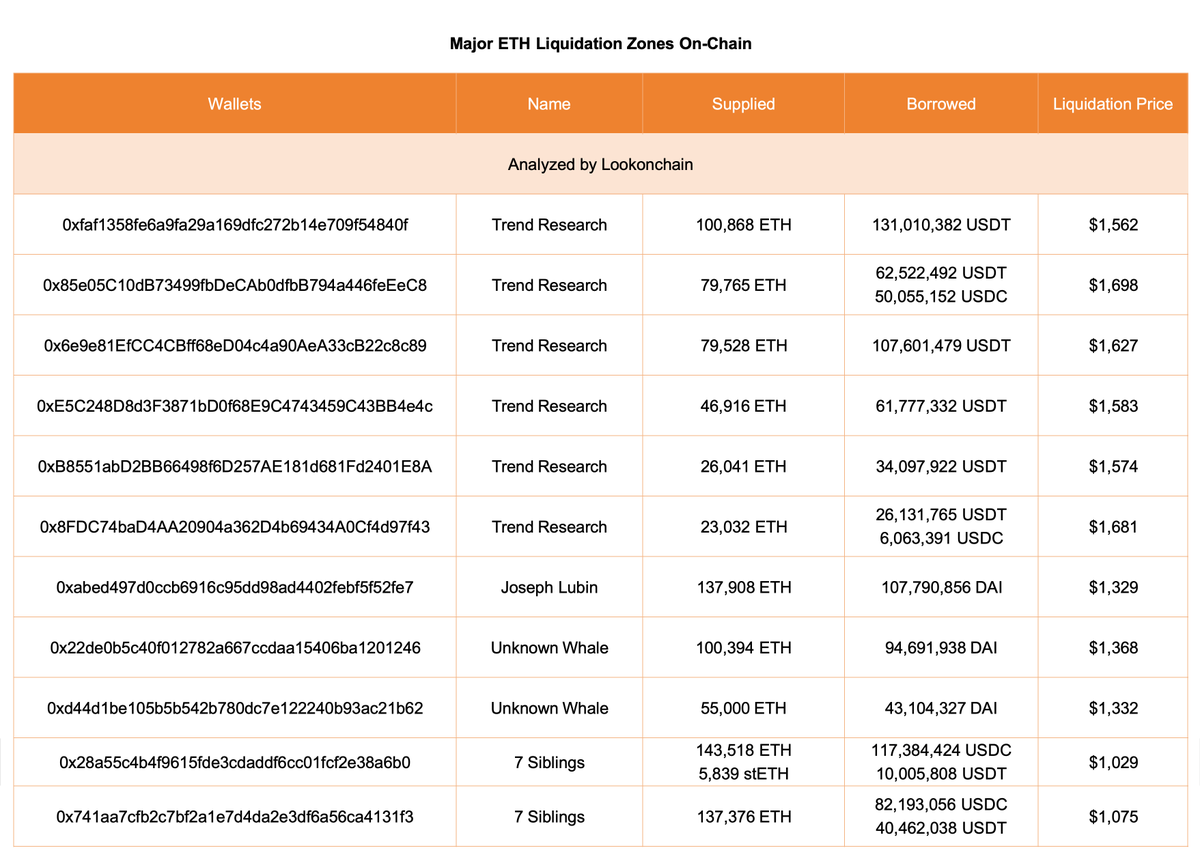
Ethereum has fallen below the critical $2,000 mark amid a broader bearish market structure, weakening macro sentiment, and persistent outflows from risk assets. According to Lookonchain data, three major on-chain liquidation clusters could significantly impact ETH's short-term price action if selling pressure continues. These include Trend Research (356,150 ETH, liquidation between $1,562–$1,698), a group including Joseph Lubin (293,302 ETH, liquidation at $1,329–$1,368), and the entity 7 Siblings (286,733 ETH, liquidation near $1,075–$1,029). These zones may act as volatility accelerators if prices decline further, potentially triggering cascading liquidations. Market sentiment has also been affected by reports of Vitalik Buterin moving ETH, though these are often for operational or charitable purposes.

Ethereum has slipped below the critical $2,000 level, reinforcing a broader bearish market structure as selling pressure intensifies across the crypto sector. The breakdown comes amid weakening macro sentiment, persistent outflows from risk assets, and declining confidence in short-term crypto demand. Together, these factors have pushed ETH into a defensive phase, with traders increasingly focused on downside liquidity zones rather than recovery signals.

Recent data highlighted by Lookonchain points to three major on-chain liquidation clusters that could shape Ethereum’s next moves. These zones represent areas where leveraged positions may be forced to close if price declines continue, potentially accelerating volatility. Historically, such liquidation pockets tend to act as magnets during corrective phases, amplifying both panic selling and short-term price swings.

Market sentiment has also been affected by reports of Ethereum co-founder Vitalik Buterin moving and selling ETH. While these transactions are often linked to funding ecosystem development, charitable initiatives, or operational needs rather than outright bearish positioning, they can still influence trader psychology. In fragile markets, even neutral fundamental events can trigger disproportionate reactions.

Lookonchain data highlights three major on-chain liquidation clusters that could significantly influence Ethereum’s short-term price dynamics if bearish pressure persists. According to the analysis, Trend Research reportedly holds about 356,150 ETH, valued near $671 million, with estimated liquidation levels between $1,562 and $1,698. If price approaches this band, forced position closures could amplify volatility and accelerate downside momentum.

Ethereum Transactions | Source: Lookonchain

Another key concentration involves Ethereum co-founder Joseph Lubin alongside two unidentified large wallets. Combined holdings are estimated at around 293,302 ETH, roughly $553 million, with potential liquidation thresholds between $1,329 and $1,368. This zone sits deeper in the corrective structure and could act as a secondary stress level if broader market weakness continues.

A third cluster attributed to the entity known as 7 Siblings holds approximately 286,733 ETH, valued at around $541 million. Their liquidation prices are significantly lower, near $1,075 and $1,029, representing a deeper capitulation scenario should selling pressure intensify further.

It is important to note that liquidation estimates depend heavily on leverage assumptions, collateral adjustments, and evolving market conditions. Still, these zones provide a useful framework for understanding where volatility could increase, as leveraged positions historically tend to magnify both downward cascades and eventual stabilization phases in crypto markets.

Связанные с этим вопросы

QWhat are the three major on-chain liquidation clusters for Ethereum mentioned in the article, and what are their approximate liquidation price ranges?

AThe three major liquidation clusters are: 1) Trend Research, with liquidation levels between $1,562 and $1,698; 2) Joseph Lubin and two unidentified wallets, with thresholds between $1,329 and $1,368; 3) The entity 7 Siblings, with liquidation prices near $1,075 and $1,029.

QAccording to the article, what factors have contributed to pushing Ethereum into a defensive phase below $2,000?

AThe factors include weakening macro sentiment, persistent outflows from risk assets, declining confidence in short-term crypto demand, and intensifying selling pressure across the crypto sector.

QHow can transactions by Ethereum co-founders, like Vitalik Buterin, impact the market even if they are not bearish in nature?

AEven when these transactions are for funding development, charity, or operational needs rather than bearish positioning, they can still influence trader psychology and trigger disproportionate reactions in fragile markets.

QWhat is the estimated value of the ETH holdings for the Trend Research cluster, and how many ETH does it represent?

AThe Trend Research cluster holds about 356,150 ETH, which is valued at approximately $671 million.

QWhy is it important to note that liquidation estimates depend on certain factors, according to the article?

ALiquidation estimates depend heavily on leverage assumptions, collateral adjustments, and evolving market conditions, meaning they are not absolute but provide a useful framework for anticipating potential volatility.

Похожее

Agents Take Over Traffic Distribution Power: What Are Tencent, ByteDance, and Alibaba Competing For?

In the race to dominate the AI era's entry point, China's tech giants—Tencent, ByteDance, and Alibaba—are aggressively deploying AI Agents to control the future of traffic distribution. Alibaba is pursuing a dual-track "closed loop + openness" strategy. Its Qianwen app is evolving into a super-Agent integrated across its ecosystem (Taobao, Alipay, etc.) to handle complex tasks like travel planning. Concurrently, it is opening its platform to external brands (Luckin Coffee, KFC) and has launched a B2B Agent platform, "Wukong," targeting enterprise automation. Its other flagship, Quark, aims to be an "AI super search box" for information and tasks. ByteDance is executing an omnipresent "sprawl strategy." Its Doubao app boasts over 300 million monthly active users and is evolving into a default AI entry point for daily life, with plans for paid versions and e-commerce integration. Its core weapon is the Kouzi platform, a visual "AI assembly factory" for developers to build custom Agents. ByteDance is also pushing hardware integration, collaborating on AI phones and developing smart glasses to embed Doubao everywhere. Tencent is playing its long-held "ultimate card" by quietly embedding an AI Agent directly into WeChat. This Agent, accessible via a swipe, can understand user commands and automatically execute tasks by calling upon WeChat's millions of mini-programs (e.g., finding and ordering coffee). This leverages WeChat's unparalleled 1.4-billion-user ecosystem to position the app as an AI-powered "service operating system," a move that could dramatically reshape the competitive landscape. The core battleground is shifting from competing for "user screen time" to competing to be the "default execution layer" for user intent. The business model is evolving from an "attention economy" to an "intent economy," where the Agent that can most efficiently fulfill a user's need gains control over service access and token flow. This represents a fundamental change in how users connect with digital services, making the fight for the Agent入口 (entry point) a pivotal moment for redefining industry leadership in the AI age.

marsbit58 мин. назад

Agents Take Over Traffic Distribution Power: What Are Tencent, ByteDance, and Alibaba Competing For?

marsbit58 мин. назад

From Banning Doubao to Embracing Honor: Why Did WeChat Suddenly 'Change Its Face'?

The article explores the sudden shift in WeChat's strategy towards AI assistants from mobile phone manufacturers, transitioning from strict opposition to active collaboration. For over a year, WeChat fiercely resisted attempts by phone AI assistants (like ByteDance's Doubao in late 2025) to control its features via GUI automation ("simulated clicking"), citing security and data control concerns. This stance created a significant barrier for system-level AI integration. Now, Tencent has initiated A2A (Agent-to-Agent) partnerships with major phone brands like Honor, Xiaomi, OPPO, and vivo. This model allows a phone's system AI (e.g., Honor's YOYO) to parse a user's voice command and send a structured request directly to WeChat's own internal AI agent via secure APIs. WeChat then executes the action (e.g., sending a message) and returns the result. The article attributes Tencent's "change of face" to strategic pressure. While leading in social app usage, Tencent trails rivals like ByteDance and Alibaba in standalone AI app popularity. WeChat, with its vast mini-program ecosystem, is Tencent's key asset for an AI comeback. The upcoming WeChat AI agent aims to handle tasks like booking and payments within the app. However, phone system assistants remain the primary AI entry point for most users. The A2A collaboration allows Tencent to extend WeChat's AI reach to this crucial system layer while maintaining control over its core functions and data. For phone manufacturers, embracing A2A is a pragmatic move. The GUI route proved unviable due to WeChat's blocks. A2A offers a compliant path to integrate a vital service, enhancing their AI assistants' usefulness. It allows them to focus on developing their own AI ecosystems for other services while cooperating on WeChat access. The collaboration is framed as a mutual, strategic necessity: Tencent gains a distribution channel, and manufacturers gain a key functionality. The partnership relies on a "dual authorization" mechanism for security, requiring both user and app consent for each action. While questions about long-term data privacy practices remain, experts note A2A is more secure and compliant than GUI automation. Ultimately, this cooperation is seen as a tentative, calculated truce. Tencent's long-term goal is to make WeChat an AI-powered "service OS." Phone manufacturers aim to make their system AI the central user interface. Their paths may converge or clash in the future, but for now, the A2A deal represents the opening chapter in the battle for the AI-era user入口, driven by necessity and strategic calculus on both sides.

marsbit2 ч. назад

From Banning Doubao to Embracing Honor: Why Did WeChat Suddenly 'Change Its Face'?

marsbit2 ч. назад

Торговля

Спот
Фьючерсы

Популярные статьи

Manyu: восходящая мем-звезда на Ethereum, готовая открыть новую эру культуры Shiba

Manyu - это мемтокен на Ethereum, который приносит децентрализованную культурную и развлекательную ценность через вирусное влияние в соцсетях и вовлечённость сообщества.

1.9k просмотров всегоОпубликовано 2025.11.27Обновлено 2025.11.27

Manyu: восходящая мем-звезда на Ethereum, готовая открыть новую эру культуры Shiba

Неделя обучения по популярным токенам 14: Glamsterdam — самое ожидаемое обновление Ethereum в 2026 году

Ordinals/Runes по-прежнему стимулируют доходы от комиссий за блоки и активность разработчиков, рассматриваются как отправная точка «нативной эмиссии активов» в сети.

1.5k просмотров всегоОпубликовано 2026.04.29Обновлено 2026.04.29

Неделя обучения по популярным токенам 14: Glamsterdam — самое ожидаемое обновление Ethereum в 2026 году

Обсуждения

Добро пожаловать в Сообщество HTX. Здесь вы сможете быть в курсе последних новостей о развитии платформы и получить доступ к профессиональной аналитической информации о рынке. Мнения пользователей о цене на ETH (ETH) представлены ниже.

活动图片