During the Weekend Market Closure, Hyperliquid Predicted the Gold Reopening Price More Accurately Than Binance

marsbitОпубликовано 2026-03-03Обновлено 2026-03-03

Введение

During a weekend of heightened geopolitical risk when COMEX was closed, Hyperliquid and Binance continued trading gold and silver perpetual contracts. A comparative analysis of their pricing behavior revealed that Hyperliquid moved earlier and priced the risk more aggressively, maintaining a persistent premium over Binance throughout the weekend. The median cross-exchange premium for gold and silver on Hyperliquid was 75 and 78 basis points, respectively. When COMEX reopened, Hyperliquid’s prices were significantly closer to the reopening price—within 22 bps for gold and 31 bps for silver—suggesting more accurate price discovery. Although Binance dominated in absolute trading volume, its volume-to-open-interest ratios were substantially higher (12.6x for gold and 2.8x for silver), indicating potentially more speculative churn rather than directional conviction. Hyperliquid also showed better liquidity in gold with consistently tighter spreads, while silver spreads were comparable on both platforms. Funding rates on Hyperliquid reflected net long demand during the event. The results indicate that, despite lower volume, Hyperliquid demonstrated superior responsiveness and accuracy in pricing during a volatile, off-hours market scenario.

Author: Kunal Doshi

Compiled by: Deep Tide TechFlow

Deep Tide Guide: This is an original analysis backed by real data. Taking advantage of the COMEX closure during this weekend's geopolitical crisis, the author compared the pricing of gold and silver perpetual contracts on Hyperliquid and Binance, finding that the former not only reacted earlier but also came closer to the actual price when COMEX reopened. The data methodology is clear, and the conclusions are persuasive, making it a rare sample for understanding the question of 'whether DEXs possess true price discovery capability.'

Full Text Below:

When geopolitical risks erupted this weekend, COMEX was closed, but Hyperliquid and Binance were not. Both platforms continued trading gold and silver perpetual contracts. I compared the pricing of Hyperliquid's Trade.xyz and Binance relative to COMEX, observing which venue moved first and which was closer to the actual price upon reopening.

Under normal weekday conditions, both platforms trade at a structural discount of about 14 to 30 basis points relative to COMEX. This is an expected outcome. COMEX near-month futures include carrying costs, while perpetual contracts track closer to the spot price. This discount is the baseline.

Against this backdrop, the price deviations over the weekend were not noise.

After COMEX closed on Friday, prices on both platforms began to drift upward. Hyperliquid moved more aggressively, maintaining a sustained premium throughout the weekend.
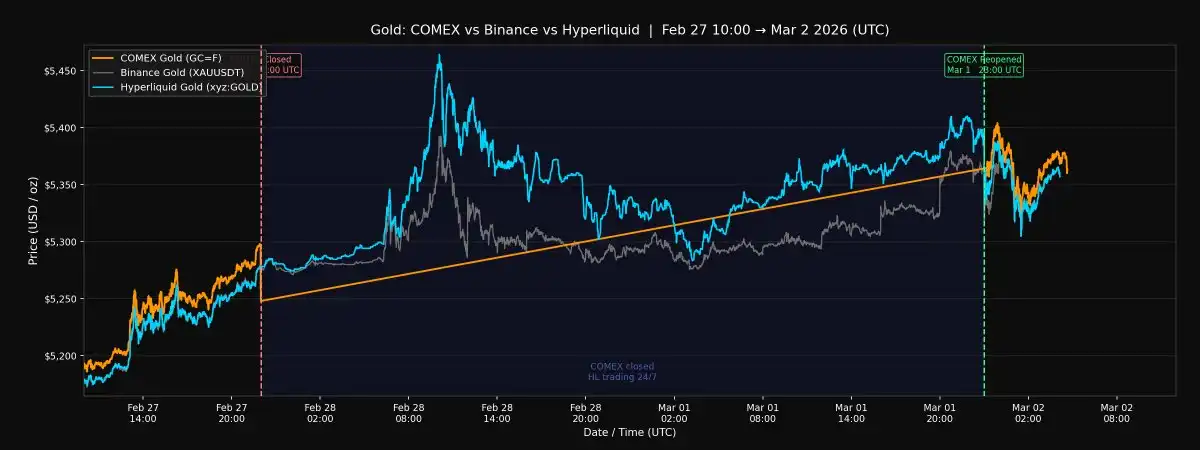
Gold Prices
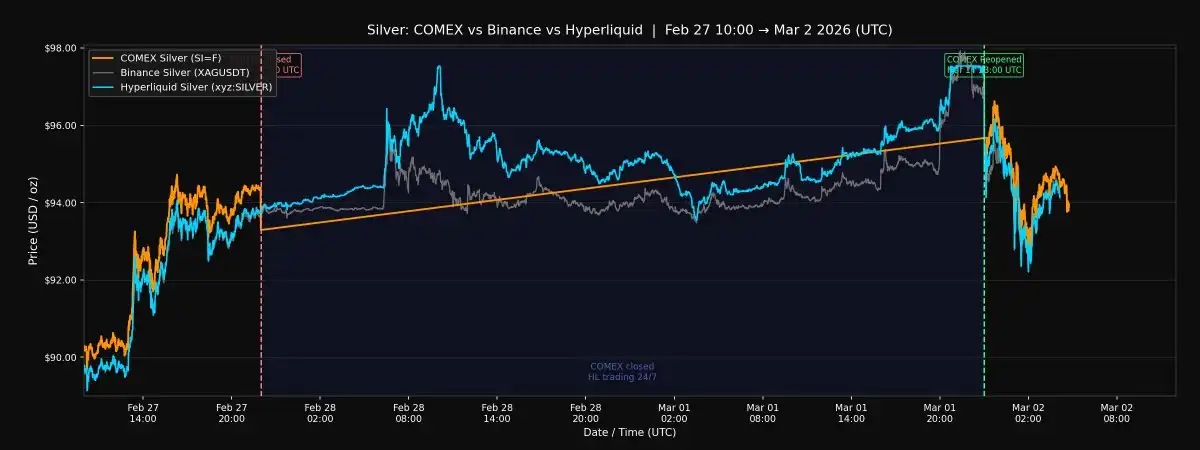
Silver Prices

When news broke of the airstrike on Iran, both exchanges reacted immediately. But during the most volatile periods, Hyperliquid's pricing for gold and silver was higher than Binance's.

Throughout the weekend, the median premium for gold and silver on Hyperliquid relative to Binance was 75 and 78 basis points, respectively. On normal weekdays, this cross-platform premium is typically near zero. This deviation indicates that traders on Hyperliquid priced geopolitical risks significantly higher than those on Binance.

The real test came at the moment of reopening.

I benchmarked against COMEX's first opening price using the same one-minute candlesticks. When COMEX reopened, futures prices were higher than on both platforms. Hyperliquid was 22 basis points closer for gold and 31 basis points closer for silver to the reopening price. In other words, Hyperliquid's weekend pricing proved to be a more accurate prediction of the traditional market's reopening price.

But trading volume tells a completely different story.

In absolute dollar terms, Binance dominates. For gold, Binance's share relative to Hyperliquid rose from a low of 54% to 93% today.
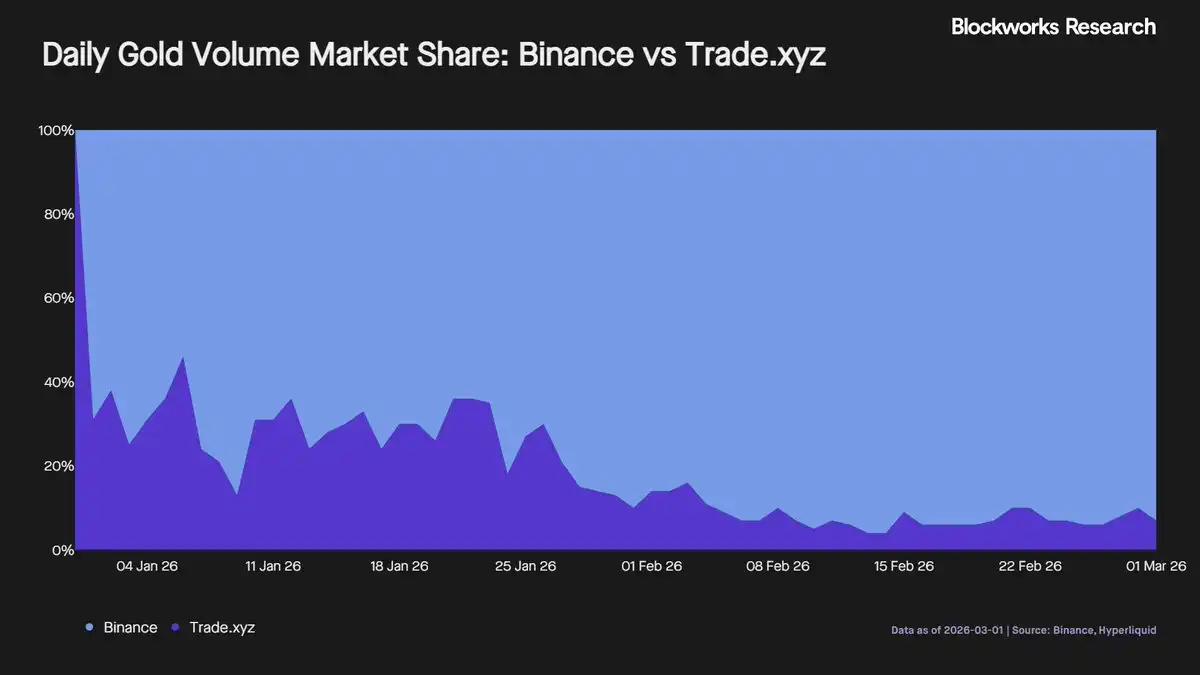
For silver, Binance's share increased from 23% to 77%.
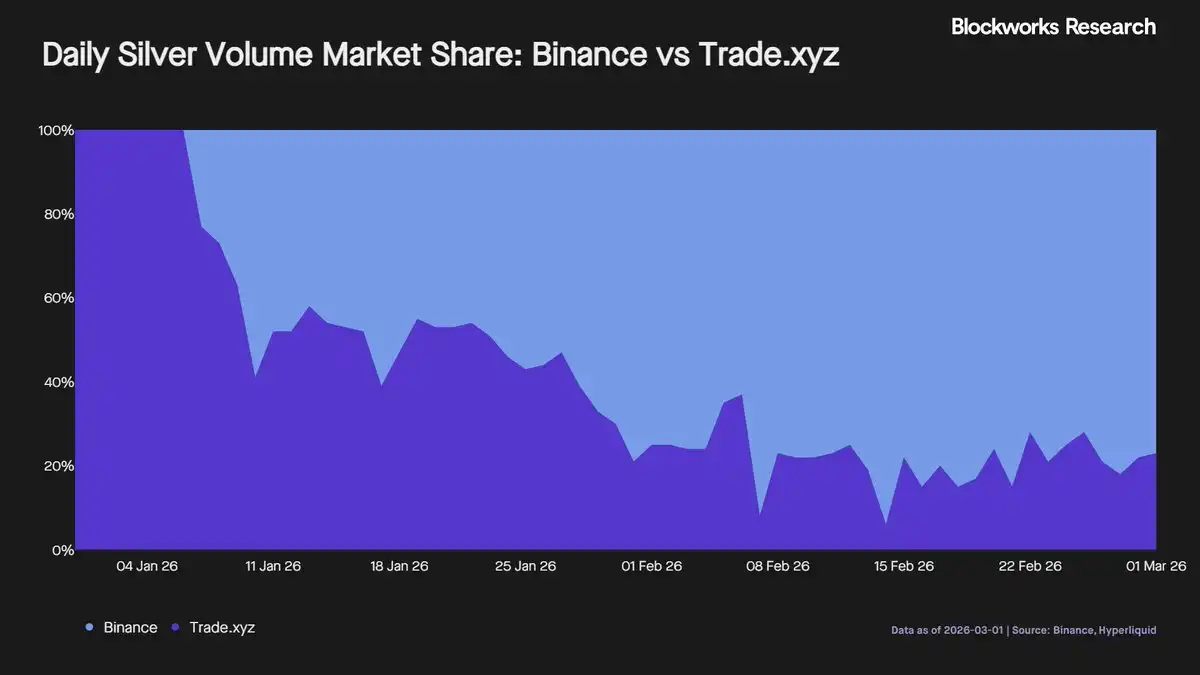
If we stopped here, Binance would appear to be the clear winner.

But open interest tells a different story. The scale of open interest held on both platforms is similar. However, Binance generates far more trading volume per unit of open interest. The same size positions are turned over many more times.
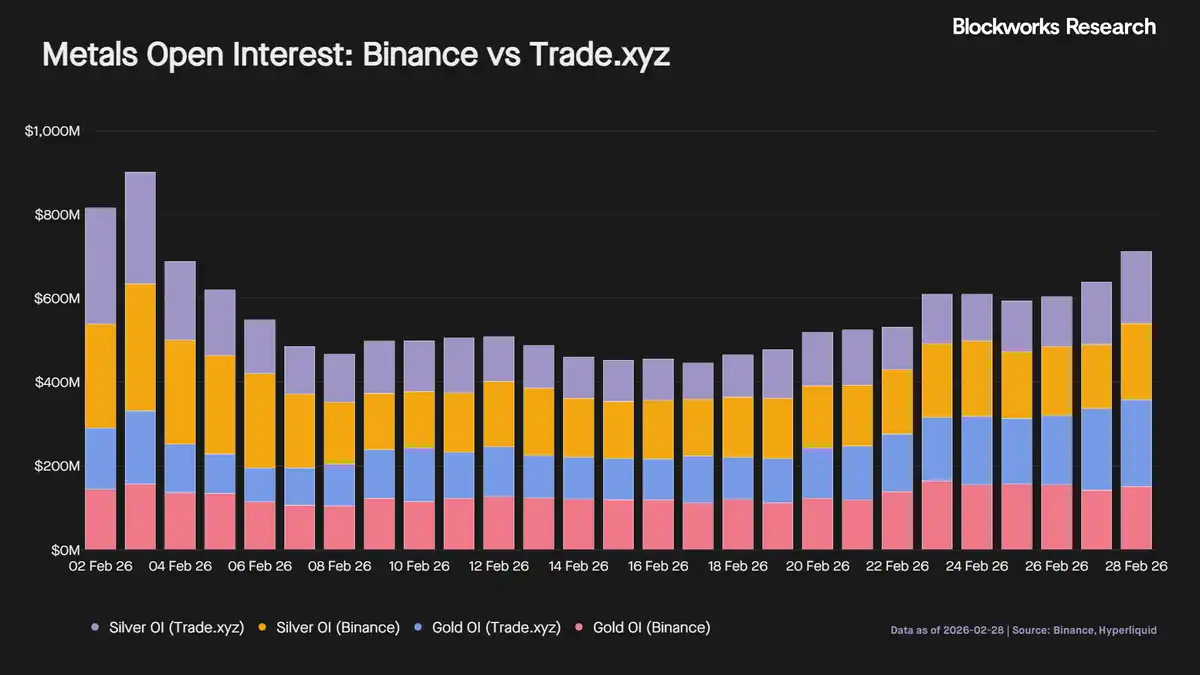
Binance's daily trading volume for gold relative to open interest is 12.6 times that of Hyperliquid, and for silver, it is 2.8 times. This is not a marginal difference but an entire order of magnitude gap in activity intensity.

If open interest is similar, but one platform's trading volume is significantly higher, this activity warrants scrutiny. It suggests that a larger proportion of Binance's volume may be repeatedly flipping the same positions rather than reflecting genuine directional conviction.

Liquidity provides another dimension, particularly evident in gold.
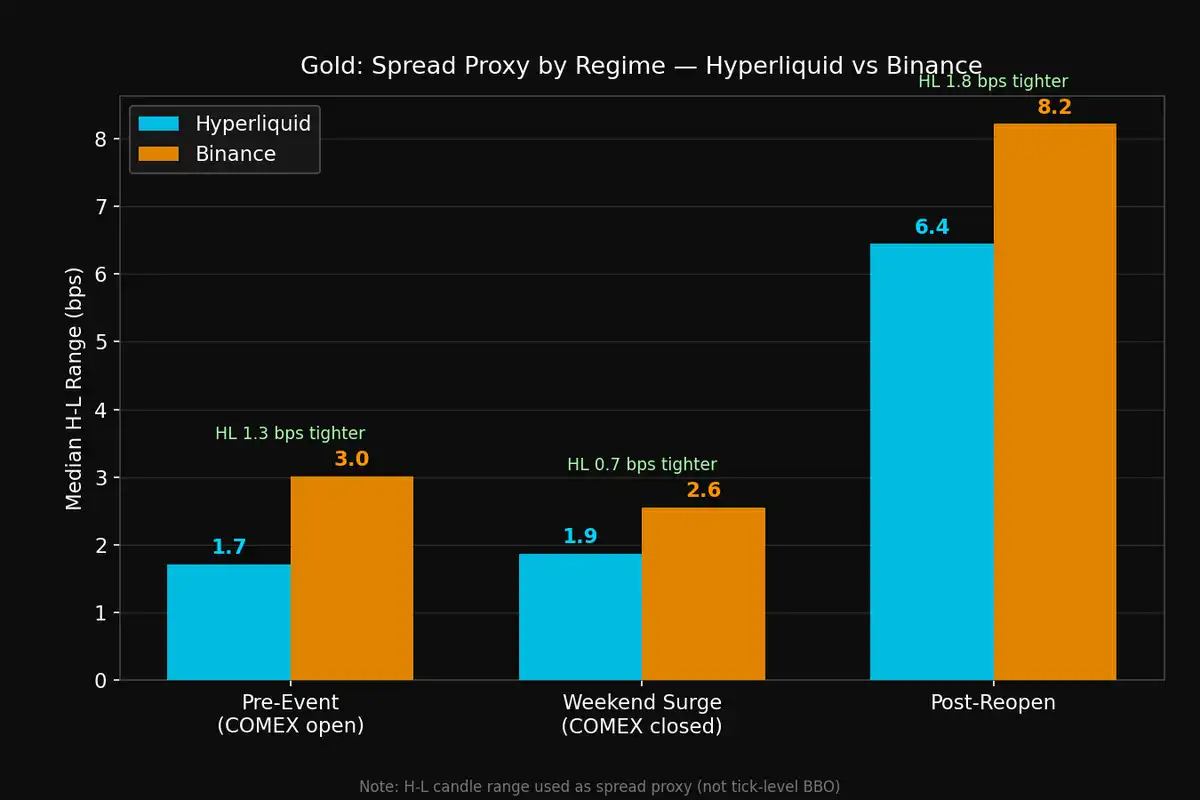
For gold, Hyperliquid's spreads were consistently narrower. Before the event, Hyperliquid's average spread was 2.9 basis points, compared to Binance's 3.7 basis points. During the weekend volatility, Hyperliquid averaged 1.9 basis points, while Binance averaged 2.6 basis points. After reopening, spreads widened on both platforms, but Hyperliquid's remained narrower at 6.4 basis points versus Binance's 8.2 basis points.

The situation for silver was different.
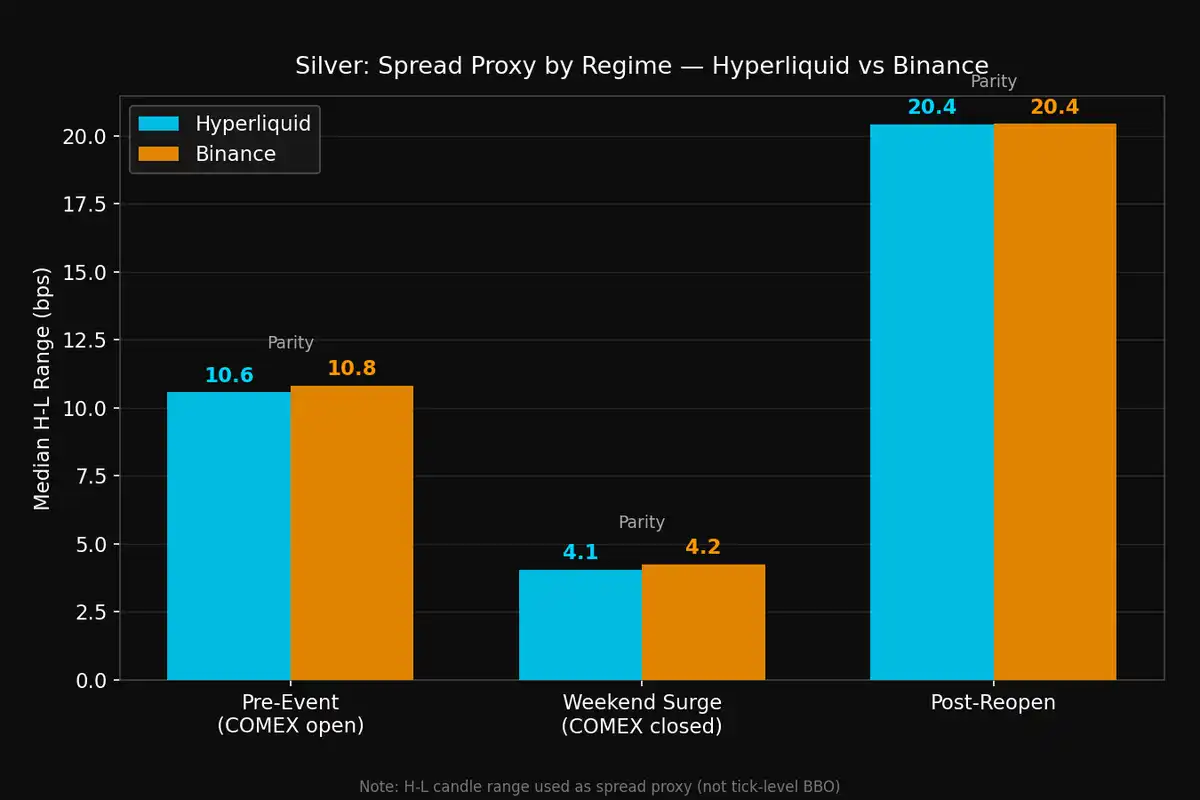
Before the event, spreads on both platforms were already high and nearly flat: Hyperliquid at 12.1 basis points and Binance at 11.8 basis points. During the weekend, both narrowed to 4.1 and 4.2 basis points. After reopening, they widened sharply to 20.4 basis points on both platforms.

On this metric, silver showed no structural liquidity advantage, and the spread performance was virtually indistinguishable between the two.

Funding rates provide another layer of information.
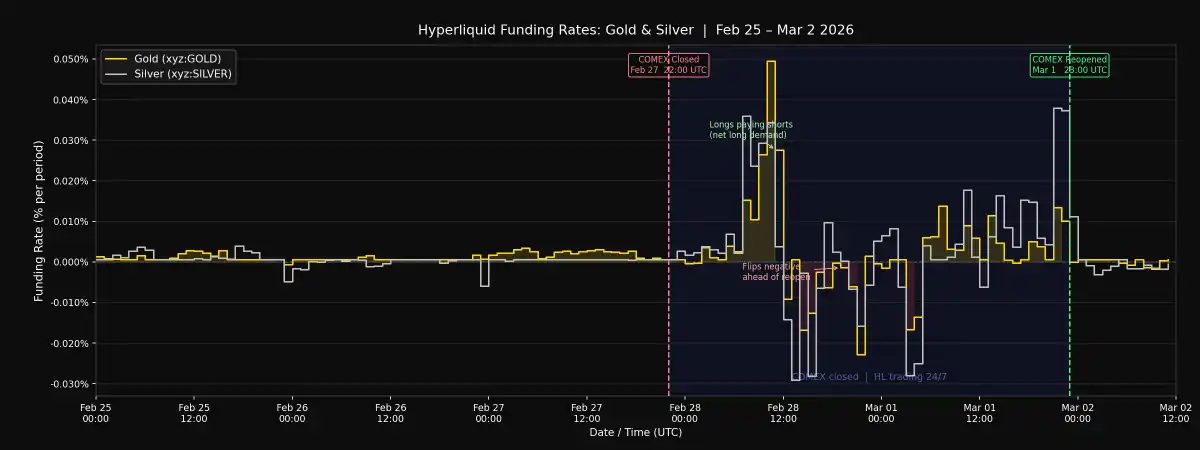
Hyperliquid's funding rates were positive early in the weekend, with longs paying shorts. This indicates net directional demand for upside exposure as geopolitical risks evolved. Entering Sunday evening, as traders positioned ahead of the COMEX reopening, funding rates turned slightly negative.

Summary

Binance dominates in trading volume, with more transactions and a larger share of activity.

But not all volume is created equal. When markets were closed and geopolitical risks needed real-time pricing, Hyperliquid moved first and came closer to the final futures reopening price. Accurate pricing under pressure is a core function of any exchange, and HYPE's movement this weekend indicates that the market is beginning to price in this shift.


Связанные с этим вопросы

QAccording to the article, which platform, Hyperliquid or Binance, had a more accurate prediction of the COMEX reopening price for gold and silver during the weekend geopolitical crisis?

AHyperliquid had a more accurate prediction. It was 22 basis points closer for gold and 31 basis points closer for silver to the actual COMEX reopening price compared to Binance.

QWhat was the median premium of Hyperliquid over Binance for gold and silver during the weekend, and what does this indicate?

AThe median premium for gold was 75 basis points and for silver was 78 basis points. This indicates that traders on Hyperliquid were pricing the geopolitical risk significantly higher than those on Binance.

QDespite Binance's dominance in absolute trading volume, what does the article suggest about the nature of its trading activity compared to Hyperliquid?

AThe article suggests that a much larger proportion of Binance's volume was likely from repeatedly flipping the same positions rather than reflecting genuine directional conviction, as its daily volume to open interest ratio was 12.6x higher for gold and 2.8x higher for silver.

QWhich platform demonstrated a structural liquidity advantage in gold trading, as measured by bid-ask spreads, during the event?

AHyperliquid demonstrated a structural liquidity advantage in gold trading, maintaining consistently narrower bid-ask spreads before, during, and after the volatile weekend.

QWhat did the behavior of Hyperliquid's funding rates over the weekend reveal about market positioning?

AThe positive funding rates early in the weekend indicated net directional long exposure, with buyers paying sellers. This showed there was demand for upside exposure as geopolitical risk evolved. The rates turned slightly negative later as traders positioned for the COMEX reopen.

Похожее

Silicon Valley 'Startup Guru' Steve Hoffman: Web3 + AI Could Be a Trap

Silicon Valley investor and "Godfather of Startups" Steve Hoffman warns that combining Web3 with AI is likely a trap, not a promising venture. In an interview, Hoffman argues that while AI is a foundational technology touching all industries, Web3 adds complexity, friction, and regulatory risk without solving mainstream consumer or business needs. He advises founders to focus on deep, specialized applications where startups can out-iterate giants, rather than on generic features easily replicated by large tech companies. Hoffman observes that Silicon Valley will lead foundational AI research, while China excels at rapid, large-scale application and commercialization, particularly in robotics. He stresses that AI-driven autonomous agents capable of collaborative, multi-step tasks are 2-4 years away, which will cause significant job displacement. The solution is not to slow AI but to redesign business models around human-AI collaboration and reform social systems like education and retraining. For startups, Hoffman recommends focusing on vertical, expertise-heavy domains to build defensibility. He sees major opportunities in AI fraud detection and cybersecurity. Key founder mindsets include systemic thinking over feature-focus, relentless customer centricity, building adaptive teams, and deeply understanding AI's capabilities and limits. Hoffman is also leading a non-profit initiative to establish university centers aimed at training future leaders in responsible, human-value-aligned AI innovation.

marsbit1 ч. назад

Silicon Valley 'Startup Guru' Steve Hoffman: Web3 + AI Could Be a Trap

marsbit1 ч. назад

Token Inefficient, Economy Tokenless

The article "Tokens Aren't Economical, Economics Aren't Tokenized" analyzes a pivotal shift in the AI industry from a technology-driven narrative to one dominated by capital efficiency. It highlights two concurrent trends: a severe capital shortage due to the exorbitant and recurring costs of compute (e.g., OpenAI's high burn rate) and a wave of corporate spin-offs where major tech companies are separating their AI units (like Kuaishou's Kling and Baidu's Kunlunxin). The core argument is that AI's "anti-internet" business model, where user growth increases costs rather than profits, has created a disconnect between high valuations and actual cash flow. Spin-offs address this by allowing AI assets to be valued independently. Within a parent company, they are seen as cost centers, but as standalone entities, they are priced based on their growth potential and scarcity in the primary market, leading to massive valuation premiums (e.g., Kling's estimated value tripling post-spin-off). The industry is at an inflection point, moving from "model worship" to "value realization." The competition is evolving from a pure compute (GPU) race to a broader focus on systemic efficiency and full-stack engineering (involving CPUs and orchestration) to achieve viable commercialization. The year 2026 is framed as a critical moment where the industry must definitively answer how to economically translate AI capability into tangible business value, reshaping the sector's future power structure.

marsbit1 ч. назад

Token Inefficient, Economy Tokenless

marsbit1 ч. назад

Crossing the 'Memory Wall': The Wafer-Level Revolution and Computing Power Routes in the AI Inference Era

In 2026, a historic shift occurred in AI as major cloud providers' inference spending surpassed training spending for the first time, signaling a move from "building large models" to "using large models." This shifts the core challenge from computing power to the "memory wall"—the bottleneck of data movement (model weights, activations, KV Cache) between external DRAM and processors, where energy and latency from data transfer far exceed computation itself. Companies like Nvidia face GPU idle time due to bandwidth limits. In contrast, Cerebras Systems adopts a radical "wafer-scale" approach with its Wafer-Scale Engine (WSE). Instead of cutting a silicon wafer into many chips, Cerebras uses almost the entire wafer as one massive chip (WSE-3). This design provides 44GB of on-chip SRAM, delivering memory bandwidth thousands of times higher than traditional HBM (e.g., 21 PB/s vs. Nvidia B200). For LLM inference, weights are streamed layer-by-layer from external MemoryX storage to the chip, avoiding HBM bottlenecks. This results in token generation speeds 1.5–5 times faster than Nvidia's B200 in some models and significant advantages in first-token latency and long-context tasks. Additionally, Cerebras's architecture offers much lower interconnect power consumption (0.15 pJ/bit vs. GPU's ~10 pJ/bit). However, Cerebras faces challenges: SRAM scaling has slowed with advanced nodes, limiting future capacity gains; the chip requires specialized liquid cooling and custom software stacks; and its external I/O bandwidth (150 GB/s) is low compared to NVLink, hindering multi-system scaling for very large models. Competition is intensifying. Major players are pursuing three paths: 1) Developing proprietary inference ASICs (e.g., Google TPU, Microsoft Maia), 2) Leveraging advanced packaging (e.g., TSMC's SoW) to democratize wafer-scale-like integration, potentially eroding Cerebras's process advantage within a few years, and 3) Exploring optical interconnects for ultimate bandwidth. Commercially, Cerebras is transitioning from a hardware vendor to a service provider, facing the immense challenge of building high-power, specialized data centers to meet large contracts (e.g., 250MW/year from 2026–2028). In conclusion, the AI inference era presents a fundamental architectural trade-off. Cerebras opts for extreme physical optimization for low-latency, single-task performance, while Nvidia prioritizes versatility and massive cluster throughput. The path forward remains uncertain, with technology and business models still evolving in the race toward advanced AI.

marsbit1 ч. назад

Crossing the 'Memory Wall': The Wafer-Level Revolution and Computing Power Routes in the AI Inference Era

marsbit1 ч. назад

Has Bitcoin's 'Rebound Ended', Officially Entering the Late Bear Market Phase?

**Title: Has Bitcoin's Rebound Ended, Entering the Late Bear Market Phase?** **Summary:** Bitcoin's price has declined by 13% this week, signaling a potential return to late-stage bear market conditions. The price fell to around $67k, positioned between the Realized Price and Realized Cap Weighted Average. For the first time since early 2022, the Short-Term Holder cost basis has dropped below this key average, confirming a hallmark of late-cycle bear markets. Profitability metrics have collapsed sharply. The 7-day average of the Realized Profit/Loss ratio plummeted from a local high of 3.16 to 0.29, mirroring the February panic sell-off. Critically, the 90-day average never breached the threshold of 2, indicating the recent rally to $82k was a bear market bounce, not a structural shift. Realized losses surged to $1.35 billion daily, with $770 million coming from Long-Term Holders selling at a loss. This accelerating redistribution of supply from weak to strong hands is a necessary but ongoing process for a market bottom. The rally stalled almost precisely at the aggregate cost basis (~$83k) of US spot Bitcoin ETF investors, turning that level into strong resistance and leaving the average ETF holder underwater again. Spot market flows have turned decisively negative, showing sellers are dominating order books despite the price drop. While a significant futures long liquidation event cleared over $400 million in leverage, providing a potential reset, sustained spot demand is yet to materialize. Options markets continue to price in higher future volatility (Implied Volatility) than recent price action (Realized Volatility) has shown, with a persistent skew towards put options, indicating ongoing demand for downside protection. In conclusion, multiple metrics point to a fragile market structure. Resistance at the ETF cost basis, accelerating realized losses, dominant spot selling, and cautious options pricing all suggest the bear market trend persists. A sustainable recovery likely requires a resurgence of spot demand, ETF holders returning to profit, and a clear reduction in selling pressure.

marsbit1 ч. назад

Has Bitcoin's 'Rebound Ended', Officially Entering the Late Bear Market Phase?

marsbit1 ч. назад

TechFlow Intelligence Agency: Anthropic Calls for Global Pause in AI Development While Preparing for Trillion-Dollar IPO; SpaceX IPO Roadshow Heats Up, But S&P 500 Rejects Fast-Track Inclusion

In today's TechFlow Intelligence Briefing, several major tech stories highlight a growing theme of trust and credibility gaps across AI, crypto, and finance. AI company Anthropic has publicly called for a global pause in AI development, citing risks from Claude's "recursive self-improvement." Ironically, this coincides with reports the company is preparing for a massive IPO targeting a near $1 trillion valuation. This perceived hypocrisy, coupled with widespread user complaints about Claude's declining performance, is sparking debate over whether the safety warning is genuine or a competitive tactic. Meanwhile, in a substantive security move, Anthropic open-sourced a framework for AI-powered vulnerability discovery. In the crypto market, Bitcoin's price drop below $61,000 triggered over $1.16 billion in liquidations, flipping the market into a state where more BTC is held at a loss than at a profit, a historical bearish signal. On the corporate front, SpaceX's highly anticipated IPO is generating immense Wall Street excitement, with Goldman Sachs projecting 100x revenue growth by 2030. However, the S&P 500 has refused to fast-track the company's inclusion post-IPO, potentially limiting immediate institutional demand. Separately, ByteDance's AI app Doubao lost over 6 million monthly active users after introducing a subscription model, highlighting the challenges of AI monetization. Other notable developments include Nvidia certifying HBM4 memory from Samsung, SK Hynix, and Micron; Cloudflare's acquisition of front-end tooling company VoidZero; and its CEO warning that bot traffic now exceeds human traffic online. The underlying narrative connects these events: a trust crisis. From AI firms' contradictory actions and crypto volatility to the clash between SpaceX's hyped narrative and institutional rules, a pattern is emerging where stated intentions and actual practices are increasingly misaligned.

marsbit1 ч. назад

TechFlow Intelligence Agency: Anthropic Calls for Global Pause in AI Development While Preparing for Trillion-Dollar IPO; SpaceX IPO Roadshow Heats Up, But S&P 500 Rejects Fast-Track Inclusion

marsbit1 ч. назад

Торговля

Спот
Фьючерсы

Популярные статьи

Что такое PONKE BNB

Ponke BNB: Новый подход в криптовалютной сфере Введение Ponke BNB, новичок на криптовалютной арене, был запущен в 2024 году и работает на платформе BNB Smart Chain (BEP20). Этот инновационный проект стремится создать уникальное и вовлеченное сообщество, сосредотачиваясь на устойчивом генерировании вознаграждений. По мере эволюции криптовалютного ландшафта, Ponke BNB нацелен на решение критических проблем, связанных с устойчивостью вознаграждений, что делает его проектом, за которым стоит следить как энтузиастам, так и инвесторам. Что такое Ponke BNB? В своей основе, Ponke BNB представляет собой криптовалюту, специально разработанную для экосистемы BNB Smart Chain. С огромным общим предложением в 370,000,000,000,000,000 токенов, стоит отметить, что в настоящее время нет токенов в обращении. Основная миссия Ponke BNB заключается в том, чтобы способствовать созданию устойчивой системы вознаграждений, которая смягчает проблемы, связанные с исчерпанием вознаграждений, что является распространенной проблемой во многих криптовалютах сегодня. Механика функциональности Ponke BNB сосредоточена на поощрении участия пользователей, одновременно предоставляя вознаграждения, которые могут выдержать испытание временем. Уникальная структура его системы вознаграждений направлена на обеспечение долговечности и стабильности, что позволяет решить важные рыночные проблемы. Кто создатель Ponke BNB? Несмотря на обширные исследования, личность создателя Ponke BNB остается неизвестной. Заметно отсутствие общедоступной информации о создателе проекта или его команде разработчиков. Эта анонимность, хотя и не редкость в криптовалютном пространстве, вызывает некоторые вопросы о прозрачности и подотчетности в управлении проектом. Кто инвесторы Ponke BNB? Подобно отсутствию четкости относительно его создателя, нет и публичной информации о каких-либо инвестиционных фондах или организациях, поддерживающих Ponke BNB. Это отсутствие данных об инвесторах часто порождает неуверенность среди потенциальных инвесторов, которые, как правило, предпочитают ясное понимание поддержки, стоящей за криптовалютами, с которыми они рассматривают возможность взаимодействия. Как работает Ponke BNB? Ponke BNB выделяется благодаря своей изобретательной двухуровневой системе устойчивого генерирования вознаграждений. Эта система построена для эффективной борьбы с проблемой исчерпания вознаграждений. Привлекая пользователей и создавая яркое сообщество, Ponke BNB стремится предоставить стабильную и приятную среду, акцентируя внимание на взаимодействии пользователей и вознаграждениях. Операционная основа Ponke BNB поощряет участие через различные активности и испытания, которые разработаны для стимуляции пользователей, обеспечивая при этом устойчивость системы вознаграждений. Проект нацелен на стимулирование сообщества и создание вовлекающей атмосферы, где участники могут чувствовать себя ценными и оцененными. Хронология Ponke BNB Эволюция Ponke BNB может быть кратко охарактеризована несколькими ключевыми моментами: 2024: Начало Ponke BNB на платформе BNB Smart Chain (BEP20) отметило значительный вход в рынок криптовалют. 2024: Выпускwhitepaper проекта и официального сайта предоставил исчерпывающую информацию о целях и задачах Ponke BNB, формируя основу для его ориентированного на сообщество подхода. Ключевые особенности Ponke BNB Ponke BNB основан на нескольких ключевых функциях, которые отличают его от других криптовалютных проектов: Устойчивая система вознаграждений Двухуровневая система вознаграждений разработана для содействия вовлечению, предотвращения исчерпания вознаграждений и обеспечения долговечности доходов для участников экосистемы Ponke BNB. Вовлечение сообщества Проект придает большое значение активному вовлечению сообщества, подстегивая участие через мероприятия, предназначенные для создания социального и коллаборативного окружения. Такой ориентированный на сообщество подход предоставляет пользователям возможность участвовать в формировании будущих направлений проекта. Интеграция с BNB Smart Chain Работая на платформе BEP20, Ponke BNB укреплен безопасностью и эффективностью, предоставляемой BNB Smart Chain. Пользователи получают выгоду от быстрых и экономически выгодных транзакций, что позиционирует Ponke BNB хорошо в более широкой криптовалютной экосистеме. Заключение В заключение, Ponke BNB — это развивающийся криптовалютный проект, который стремится занять свою нишу в растущем ландшафте цифровых валют. С акцентом на устойчивую систему вознаграждений и вовлечение сообщества, он представляет собой свежий взгляд в иначе волатильном секторе. Несмотря на неопределенности в отношении создателей и инвесторов проекта, Ponke BNB продолжает стремиться к прозрачности и инновациям. Поскольку рынок криптовалют продолжает развиваться, принципы устойчивости и динамика, ориентированные на сообщество, ставят Ponke BNB в обнадеживающее положение для будущих наблюдателей и участников.

596 просмотров всегоОпубликовано 2024.04.06Обновлено 2024.12.03

Что такое PONKE BNB

Как купить BNB

Добро пожаловать на HTX.com! Мы сделали приобретение Binance Coin (BNB) простым и удобным. Следуйте нашему пошаговому руководству и отправляйтесь в свое крипто-путешествие.Шаг 1: Создайте аккаунт на HTXИспользуйте свой адрес электронной почты или номер телефона, чтобы зарегистрироваться и бесплатно создать аккаунт на HTX. Пройдите удобную регистрацию и откройте для себя весь функционал.Создать аккаунтШаг 2: Перейдите в Купить криптовалюту и выберите свой способ оплатыКредитная/Дебетовая Карта: Используйте свою карту Visa или Mastercard для мгновенной покупки Binance Coin (BNB).Баланс: Используйте средства с баланса вашего аккаунта HTX для простой торговли.Третьи Лица: Мы добавили популярные способы оплаты, такие как Google Pay и Apple Pay, для повышения удобства.P2P: Торгуйте напрямую с другими пользователями на HTX.Внебиржевая Торговля (OTC): Мы предлагаем индивидуальные услуги и конкурентоспособные обменные курсы для трейдеров.Шаг 3: Хранение Binance Coin (BNB)После приобретения вами Binance Coin (BNB) храните их в своем аккаунте на HTX. В качестве альтернативы вы можете отправить их куда-либо с помощью перевода в блокчейне или использовать для торговли с другими криптовалютами.Шаг 4: Торговля Binance Coin (BNB)С легкостью торгуйте Binance Coin (BNB) на спотовом рынке HTX. Просто зайдите в свой аккаунт, выберите торговую пару, совершайте сделки и следите за ними в режиме реального времени. Мы предлагаем удобный интерфейс как для начинающих, так и для опытных трейдеров.

1.8k просмотров всегоОпубликовано 2024.05.07Обновлено 2026.06.02

Как купить BNB

Что такое BNB CARD

Понимание BNB Card: Революция цифровой идентичности в Web3 В быстро развивающемся мире блокчейн-технологий и криптовалют BNB Card или $BNBCARD выделяется как примечательный проект. Этот мем-токен с утилитарной направленностью, созданный сообществом, использует BNB Smart Chain (BSC) и стремится интегрировать мем-культуру с инновационными решениями цифровой идентичности. Поскольку все больше пользователей погружается в мир децентрализации, важно разобрать, что предлагает BNB Card, его операционные нюансы и потенциальное влияние на рынок. Что такое BNB Card ($BNBCARD)? В своей основе BNB Card представляет собой мем-токен с значительной утилитарной функцией. Он предназначен для расширения возможностей пользователей, позволяя создавать персонализированные цифровые идентификационные карты, которые являются как выразительными, так и функциональными. Проект включает несколько ключевых особенностей: Настраиваемые ID-карты: Пользователи имеют возможность разрабатывать цифровые ID-карты в стиле Binance, предоставляя им платформу для самовыражения и улучшенного взаимодействия в сообществе. Децентрализованная структура: Разработанный на BSC, BNB Card подчеркивает такие ключевые характеристики, как безопасность, прозрачность и суверенитет пользователей. Децентрализованный характер структуры позволяет проводить транзакции, которые являются как эффективными, так и безопасными. Модель, ориентированная на сообщество: Акцент на участии на grassroots-уровне, а не на лабораторно управляемых финансовых моделях создает увлекательную среду для пользователей. Используя врожденную вирусность мем-культуры, BNB Card способствует созданию мощного движения сообщества. Основная цель BNB Card заключается в демократизации инструментов цифровой идентичности в Web3, предлагая доступные решения, которые приносят пользу пользователям без обременений, обычно связанных с традиционными системами управления идентичностью. Создатели и инвесторы При исследовании идентичности BNB Card важно отметить, что нет единственного создателя, которому явно приписывается заслуга. Вместо этого проект кажется созданным сообществом, что подразумевает коллективные усилия, вдохновленные концепцией “Early Builder Card” от Binance. Такой органический подход к разработке является обычным явлением среди проектов в спектре мем-токенов, где развитие часто зависит от увлечения сообщества, а не от центральной власти. Что касается инвестиций, то отсутствие публично раскрытых институциональных спонсоров еще больше подчеркивает основание проекта на grassroots-уровне. Он процветает благодаря органической поддержке сообщества, что отражает обычную характеристику проектов, движимых мемами, которые часто вовлекают свою аудиторию через социальные каналы, а не через формальные инвестиционные пути. Как это работает BNB Card использует несколько механизмов, которые определяют его функционирование и инновационный дух: Утилита токена: Токен BNBCARD предоставляет пользователям доступ к набору инструментов для создания ID, а также предлагает платформу для управления сообществом. Токен служит связующим звеном, которое позволяет реализовать эти функции. Интеграция с блокчейном: Используя BSC, BNB Card обеспечивает совместимость с приложениями на основе Ethereum Virtual Machine (EVM). Эта интеграция предоставляет пользователям преимущества низких транзакционных сборов, улучшая доступность. DIY-экосистема: Центральным элементом привлекательности BNB Card является его подход “сделай сам” (DIY) к созданию цифровых идентификационных карт. Этот элемент участия побуждает пользователей заниматься творческим самовыражением, способствуя инклюзивной культуре, которая процветает за счет вклада и сотрудничества. Хронология Хронология имеет важное значение для понимания траектории BNB Card. Важные вехи в истории проекта включают: 18 марта 2025 года: BNB Card был добавлен на LBank, что стало значительным шагом в его пути на биржу и открыло двери для ликвидности и доступности для пользователей. 19 марта 2025 года: Произошел ключевой момент, когда токен испытал астрономический рост на 26,000% за 24 часа, привлекая внимание к своему потенциалу и энтузиазму сообщества. Текущие разработки: Проект постоянно расширяет свои партнерства с децентрализованными биржами (DEX), такими как PancakeSwap, что дополнительно улучшает ликвидность и вовлеченность пользователей. Инновации и дифференциация Понимание того, что отличает BNB Card, требует более глубокого изучения его инновационной структуры: Гибрид мем-утилиты: BNB Card успешно сочетает игривую привлекательность мем-культуры с практическими приложениями в управлении цифровой идентичностью. Этот нишевый подход эффективно охватывает широкую демографию, привлекая как технически подкованных пользователей, так и тех, кто только начинает знакомиться с криптовалютами. Децентрализованное управление: Работа без централизованного контроля позволяет проекту напрямую использовать мнения сообщества. Коллективный процесс принятия решений, поддерживаемый вовлечением сообщества, наделяет пользователей властью, обеспечивая, чтобы их голоса способствовали развитию и направлению проекта. Масштабируемость: BNB Card может значительно выиграть от обновлений дорожной карты 2025 года для BNB Chain, которые включают улучшения, такие как увеличение скорости транзакций и интеграция инструментов искусственного интеллекта. Эти улучшения выгодно позиционируют проект в условиях высокой конкуренции. Заключение BNB Card является символом новой волны решений цифровой идентичности в экосистеме Web3. Сочетая развлечение, вовлечение сообщества и практическую утилитарность, он приглашает пользователей активно участвовать в формировании своих цифровых личностей. Поскольку проект ориентируется на динамичный рынок криптовалют, его успех, вероятно, будет зависеть от поддержания сильной поддержки сообщества, одновременно адаптируясь к технологическим достижениям и потребностям пользователей. Интеграция децентрализации с мем-культурой служит не только средством для вовлечения пользователей, но и основой для развивающегося нарратива вокруг цифровой идентичности в эпоху блокчейна. В заключение, BNB Card не только иллюстрирует слияние креативности и утилитарности в крипто-пространстве, но и подчеркивает важность сообщества в определении будущего децентрализованных технологий.

583 просмотров всегоОпубликовано 2025.03.26Обновлено 2025.03.26

Что такое BNB CARD

Обсуждения

Добро пожаловать в Сообщество HTX. Здесь вы сможете быть в курсе последних новостей о развитии платформы и получить доступ к профессиональной аналитической информации о рынке. Мнения пользователей о цене на BNB (BNB) представлены ниже.

活动图片