DOGE Year-End Review: Did Musk's Hundred-Day Reform Work?

marsbitОпубликовано 2025-12-31Обновлено 2025-12-31

Введение

DOGE Year-End Review: Did Musk's 100-Day Reform Work? The DOGE (Department of Government Efficiency) initiative, led by Elon Musk and Vivek Ramaswamy, aimed to cut bureaucratic waste, reduce regulations, and save $2 trillion to balance the federal budget. Despite ambitious goals, Musk resigned after just 130 days, and DOGE was dissolved by November—10 months into an 18-month plan. DOGE achieved a 9% reduction in federal employees (271,000 jobs cut) and claimed $21.4–25 billion in savings through contract terminations and program closures. However, total federal spending increased from $6.75–7.135 trillion in 2024 to $7.01–7.6 trillion in 2025, a 4–6% rise. Mandatory spending (e.g., Social Security, Medicare) and interest on debt—unaffected by administrative cuts—drove this growth. Independent analyses suggested actual savings were as low as $3 billion, with potential future tax losses from weakened IRS enforcement offsetting gains. Post-Musk, DOGE’s influence waned, and service disruptions emerged. The reform highlighted the fundamental mismatch between corporate efficiency models and government operations, where statutory spending and systemic inertia limit top-down restructuring. The experiment underscored that government cannot be run like a business, as efficiency must balance fairness, stability, and public trust.

Federal employees were successfully reduced by 271,000, a decrease of 9%, setting the largest peacetime layoff record. However, at the same time, total federal expenditures did not decrease but instead increased, soaring from $6.75-7.135 trillion in 2024 to $7.01-7.6 trillion, a net increase of $248-480 billion. This phenomenon of "losing weight but gaining mass" is the core contradiction of the DOGE (Department of Government Efficiency) reform.

This "external advisor" agency, initially led by Elon Musk and Vivek Ramaswamy, promised to use commercial means to dismantle government bureaucracy, cut redundant regulations, reduce wasteful spending, and ultimately save $2 trillion to balance the federal budget. This ambitious plan was expected to last until July 2026, giving them 18 months to transform the government. However, reality proved far harsher than expected: Musk resigned hastily in May, serving only a 130-day term as a special government employee; by November, DOGE quietly dissolved, a full 8 months before the original term was set to end.

This was not an unfinished reform, but a complete abandonment. From launch to disappearance, DOGE's actual lifespan was only about 10 months. When the savings target was clearly unattainable, legal challenges ensued, and disputes with Trump became public, Musk chose to return to his business empire, leaving behind a crumbling agency and a host of unanswered questions. This rapid fall from ambition to disillusionment exposed not only missteps in reform strategy but also the essential, difficult-to-cross chasm between corporate logic and government operations.

I. The Grand Vision vs. The Harsh Reality: A Complete Divergence

DOGE's reform vision was full of Silicon Valley-style idealism. They planned to use lean management principles to terminate hundreds of billions of dollars in inefficient contracts, close redundant facilities, reduce the federal workforce from about 3.015 million to a leaner size, and replace some bureaucratic functions with AI and automation tools. This methodology has proven successful time and again in the business world—why couldn't it be used to transform the government?
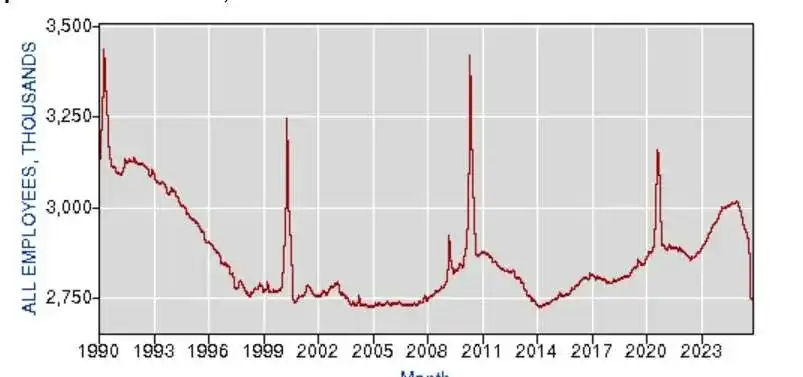
Chart: Federal Employee Count Since 1990

In January 2025, Musk joined DOGE as a special government employee, with a term set for 130 days. In Silicon Valley, 130 days is enough to launch a product prototype, complete a round of financing, or even turn around a startup's fate. In the initial months, DOGE demonstrated dazzling execution. From January to November, federal employees decreased from 3.015 million to 2.744 million, a net reduction of 271,000 positions. This was not only the largest peacetime federal layoff since WWII, but the speed of execution was also staggering. Specific actions included terminating a $290 million refugee facility contract at the Department of Health and Human Services, $190 million in IT redundancy spending at the Treasury Department, and closing hundreds of inefficient agencies and programs, cumulatively undertaking over 29,000 reduction actions. DOGE claimed these measures saved approximately $21.4-25 billion, primarily concentrated in non-defense federal mandatory spending, which decreased by 22.4% year-on-year.
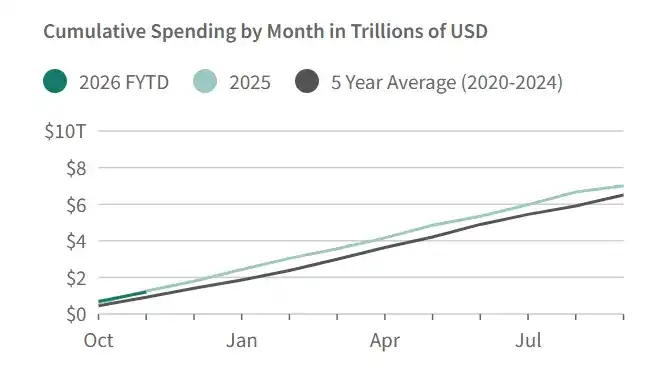
Chart: Cumulative Federal Government Expenditure

But the data on the spending side told a completely different story. Overall federal expenditure rose from about $6.75-7.135 trillion in 2024 to about $7.01-7.6 trillion in 2025, an increase of 4%-6%. Spending in just the first 11 months reached $7.6 trillion, $248 billion more than the same period the previous year. More ironically, some independent analyses suggested that DOGE's claimed savings figures might be severely inflated, with verifiable savings potentially only in the tens of billions, even as low as $3 billion. Due to the weakening of IRS enforcement capabilities, this could lead to at least $350 billion in lost tax revenue over the next decade, making the net effect of the so-called "savings" close to zero or even negative.

Resistance from reality soon became apparent. Federal spending continued to climb; mandatory spending like Social Security, Medicare, and interest on the national debt was completely unaffected by administrative layoffs. By May, multiple pressures converged. Musk's relationship with Trump began to deteriorate, with public disputes between the two. Legal challenges followed, questioning DOGE's authority and procedural legality. Tesla's business was also calling him back—stock price fluctuations, production issues, market competition, all requiring the CEO's attention. Most crucially, the $2 trillion savings target was clearly an impossible mission; staying on a project doomed to fail held no benefit for Musk's personal brand. As soon as his 130-day term ended, Musk announced his return to private enterprise. He did not apply for an extension, did not ask for more resources, but chose a clean break. This decision itself was the loudest admission: transforming the government with business methods was far more difficult than he had thought.

II. The Struggles of the Headless Horseman: Decline from May to November
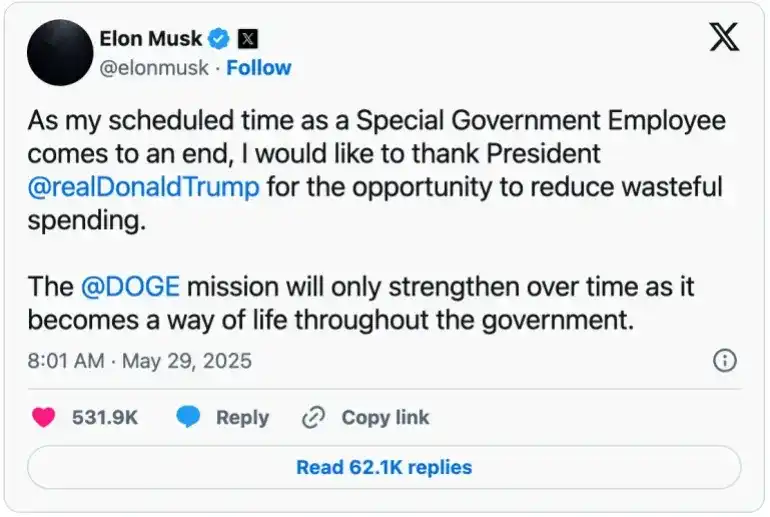
After Musk's departure, DOGE tried to prove it could continue. The White House signaled that the "DOGE spirit" would be integrated into the government's daily operations, becoming part of the "government lifestyle." Some former DOGE employees were embedded in various federal agencies to continue pushing layoffs and cost cuts. Ramaswamy was still nominally leading the agency, trying to maintain the reform momentum.

But DOGE without Musk was like a rocket without an engine; inertia could only last so long. Without the star founder's halo, the agency's attention rapidly declined. Without Musk's direct communication channel with Trump, DOGE's influence within the government was greatly diminished. More importantly, the limitations of the reform became increasingly apparent—those large expenditure items that truly required Congressional legislation to change were utterly beyond DOGE's reach.

During this period, DOGE's achievements became harder to define. Although some layoff actions continued, spending data kept rising. Reports of service disruptions began to increase. Social Security applications were delayed, regulatory gaps appeared, and key positions were left unfilled due to over-cutting. Criticism grew louder: in the name of optimizing efficiency, DOGE was undermining the government's basic operational capacity. Legal challenges also accumulated, questioning whether many of DOGE's actions exceeded executive authority.

By November, several authoritative media outlets began reporting a fact: DOGE had quietly disbanded. Reuters, TIME, CNN, Newsweek, and others used terms like "disbanded," "quietly shut down," and "no longer exists" to describe the agency's fate. There was no formal dissolution announcement, no press conference; DOGE simply vanished from public view. Its charter, originally meant to last until July 2026, was terminated early, with many functions transferred to the Office of Personnel Management or other常规 agencies.

This silent end perhaps speaks volumes more than any failure. Not even a decent farewell, because admitting failure itself was an embarrassment. DOGE went from a revolutionary agency promising to change the government to a brief interlude everyone wanted to forget as quickly as possible.

III. The Underlying Logic of "Reducing Staff Without Saving Money"

1. The Impenetrable Wall of Mandatory Spending
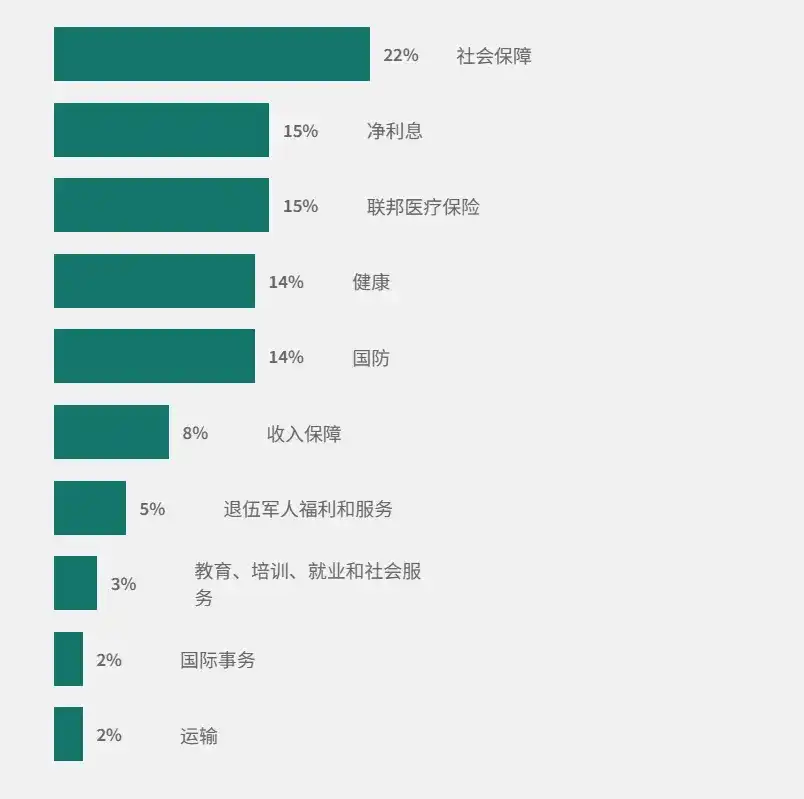
The most fundamental difference between the government fiscal system and a corporation is that over 70% of federal spending is on mandatory programs. These expenditures grow automatically as mandated by law, influenced by demographics, economic cycles, and interest rate fluctuations, completely unaffected by administrative layoffs. The 2025 data clearly shows this rigidity: benefit spending like Social Security and Medicare increased by about $168 billion, driven mainly by an aging population and inflation adjustments; national debt interest costs soared by $71 billion, with the debt scale already expanded to $36-38.3 trillion, making interest expenditure even exceed the defense budget, becoming the federal government's largest single expense.

These rigid expenditures directly offset all of DOGE's savings efforts. No matter how many administrative staff were cut, Social Security payments still had to be made according to statutory formulas, Medicare subsidies still had to be paid based on enrollment, and national debt interest had to be paid on time to maintain national credit. As an executive agency, DOGE could not unilaterally modify benefit programs authorized by Congress, meaning the effort was confined to the "periphery" from the start, unable to touch the "core" of expenditures.

At a deeper level, this rigidity stems from constitutional and legislative frameworks. The government is not a profit-seeking enterprise but a public institution承担ing the function of a social safety net. When a 65-year-old applies for Social Security, the government cannot refuse payment for "cost optimization." This is the essential difference between government and business, and the fundamental reason corporate thinking hit a wall here.

2. The "Offsetting" of Inter-Departmental Spending

DOGE did achieve some results in the discretionary spending area. They terminated 5,200 projects and hundreds of billions of dollars in contracts in departments like Health and Human Services, Education, and the Agency for International Development, saving about $37 billion. But these savings were quickly吞噬ed by growth in other departments. Defense spending increased due to geopolitical tensions, infrastructure investment膨胀ed due to the Trump administration's priorities, and the spillover effects of mandatory spending further pushed up the overall budget.

The result was "local slimming, global expansion." This is similar to the "savings transfer" phenomenon common in corporate mergers and acquisitions—costs cut in one department often reappear in another form elsewhere. But the government lacks the flexible adjustment mechanisms of a company and cannot reconfigure resources as quickly. The 2025 spending growth also included emergency response (increased natural disaster funds) and inflation adjustments (CPI rose about 3%-4%), these external factors further amplified the "offsetting" effect.

Specific data shows that DOGE's savings accounted for only 0.3%-0.5% of total spending, far insufficient to reverse the overall trend. In 2025, mandatory spending increased by $221 billion, discretionary spending increased by $80 billion, and net interest costs increased by $71 billion. When you save a few billion in one pocket but pull out hundreds of billions from three others, the so-called "efficiency improvement" becomes a numbers game.

3. The Cost Inertia and Transition Friction of Agency Operations

Layoffs are never a zero-cost operation, especially in the government system. Implementing the DOGE reform itself generated huge expenses: severance pay, paid leave, rehiring costs after wrongful termination, totaling an estimated $135 billion. This figure already far exceeds many of the "savings" projects claimed by DOGE. More hidden costs came from productivity losses and service disruptions.

The operation of government agencies highly relies on institutional memory and human networks. When large numbers of experienced employees left, Social Security applications began to delay, regulatory gaps appeared, and policy implementation efficiency actually decreased. Although AI and automation were held in high hopes, these tools are far from mature enough to completely replace human judgment. Algorithmic governance might be efficient, but it also brings new problems like data privacy leaks and algorithmic bias. In the process of transitioning from a "public service apparatus" to a "data-driven terminal," the government is losing something difficult to quantify but crucial—legitimacy, social cohesion, and public trust.

A more practical problem is the increase in overtime pay for remaining employees and rising contract outsourcing costs. The government outsourced work previously done internally to private contractors, often at a higher price. In the long run, large-scale brain drain could create a "knowledge gap," affecting policy continuity and professional capacity accumulation.

Conclusion: Who Lost? Reflecting on the Cost and Boundaries of Reform

In this collision of ideals and reality, who ultimately lost? Perhaps first the idealistic reformers, who underestimated the complexity of government operations and mistakenly thought business logic could be directly transplanted into the public sector. Taxpayers might benefit from partial savings in the short term, but face the risk of service cuts and quality decline in the long run. Beneficiaries of public services, especially groups relying on Social Security and Medicare, might suffer from service disruptions and reduced efficiency.

The deeper loser might be the entire system's sustainability and democratic legitimacy. When the government is "optimized" like a business, those values that cannot be measured by numbers—fairness, stability, social cohesion—are quietly being eroded. Opinion polls showed DOGE's approval rating hovering around 40%, reflecting public recognition of efficiency gains coexisting with concerns about service disruptions.

But this collision was not entirely meaningless. If DOGE can push Congress to take action and truly touch core issues like welfare reform and debt control, it could still become a historical turning point. The key is to recognize that the government is not a business; efficiency needs to be balanced with fairness, sustainability, and democratic principles. A business can sacrifice everything for profit, but the government must保留 the last line of defense for society's most vulnerable groups. This is the most important lesson corporate thinking needs to learn, and the most profound insight left to us by this激烈 collision.

Data for this report was compiled and edited by WolfDAO. Please contact us if you have any questions for updates;

Author: Nikka / WolfDAO ( X : @10xWolfdao )

Связанные с этим вопросы

QWhat was the main contradiction in the DOGE reform efforts as described in the article?

AThe main contradiction was that while the DOGE successfully reduced the federal workforce by 271,000 employees (a 9% cut), the total federal spending actually increased by $248-480 billion, from $6.75-7.135 trillion to $7.01-7.6 trillion. This 'slimming down but gaining weight' phenomenon highlighted the core failure of the reform.

QWhy did Elon Musk leave the DOGE after only 130 days?

AElon Musk left due to multiple converging pressures: a deteriorating relationship with Trump, mounting legal challenges questioning DOGE's authority, the need to return to his business empire (Tesla) to address stock volatility and production issues, and the realization that the $2 trillion savings goal was an impossible task that could damage his personal brand.

QWhat happened to the DOGE after Elon Musk's departure?

AAfter Musk left, the DOGE attempted to continue but quickly lost influence and momentum. It was described as losing its engine. It was eventually quietly disbanded in November, about 10 months after its start and 8 months before its original end date, with many of its functions transferred to other agencies like the Office of Personnel Management.

QAccording to the article, what are the fundamental reasons why corporate logic failed within the government?

ACorporate logic failed due to three fundamental reasons: 1) The 'impregnable wall' of mandatory spending (over 70% of the budget) on programs like Social Security and Medicare, which is required by law and unaffected by administrative cuts. 2) The 'see-saw effect' of spending, where savings in one department were swallowed by increases in others like defense and infrastructure. 3) The high cost inertia and transition friction of the reforms themselves, including severance pay, productivity loss, and the inability of AI to fully replace human judgment.

QWhat were some of the hidden costs and negative consequences of the DOGE's workforce reductions?

AHidden costs included an estimated $135 billion in implementation costs (severance, paid leave, rehiring after wrongful termination). Negative consequences included service disruptions (delays in Social Security applications), regulatory vacuums, loss of institutional memory, increased overtime pay for remaining staff, higher costs from outsourcing to contractors, and a long-term 'knowledge gap' affecting policy continuity.

Похожее

Торговля

Спот
Фьючерсы

Популярные статьи

Что такое POO DOGE

Poo Doge: Инновационный игрок в крипто-пространстве Введение В быстро меняющемся мире криптовалют и технологии блокчейн новые проекты постоянно появляются, привлекая внимание как инвесторов, так и технических энтузиастов. Одним из таких проектов является Poo Doge ($POO DOGE), запущенный в 2022 году как уникальное предложение в экосистеме Web3. Работая на платформе Dogechain, Poo Doge занял нишу децентрализованного инструмента, который стремится улучшить способ управления пользователями своими цифровыми активами. В этой статье рассматриваются основные аспекты Poo Doge, его цели, функциональность, создатели и уникальные характеристики, которые выделяют его на переполненном рынке. Что такое Poo Doge? Poo Doge — это децентрализованная криптовалюта, разработанная специально для экосистемы Dogechain. Используя Эфириум виртуальной машины (EVM), она функционирует как универсальный и удобный трекер портфеля. Основная цель этого проекта — предоставить пользователям возможность эффективно отслеживать и управлять несколькими токенами в рамках структуры Dogechain. Как децентрализованная валюта, Poo Doge выделяется своим акцентом на безопасность и простоту в управлении активами. Пользователи могут отслеживать свои инвестиции и управлять портфелями токенов без тех сложностей, которые обычно связаны с традиционными криптоплатформами. Этот ориентированный на пользователя подход к управлению активами является беспрецедентным, особенно в уникальном контексте Dogechain, который предоставляет легковесную, управляемую сообществом среду. Кто создатель Poo Doge? Информация о конкретных лицах или команде, ответственной за создание Poo Doge, остается недоступной. В индустрии, где прозрачность часто провозглашается как основная ценность, отсутствие публичных данных о создателе может вызывать вопросы среди потенциальных пользователей и инвесторов. Тем не менее, эта анонимность не умаляет целей проекта и предполагаемого влияния в пространстве Web3. Кто инвесторы Poo Doge? В настоящее время нет общедоступной информации о конкретных инвесторах или инвестиционных организациях, поддерживающих проект Poo Doge. Это отсутствие может свидетельствовать о том, что проект либо самофинансируемый, либо он еще не привлек внимание крупных инвестиционных организаций, которые обычно связаны с более крупными криптоинициативами. Хотя отсутствие идентифицируемой поддержки можно воспринимать скептически, это довольно часто встречается у новых проектов, особенно тех, которые сосредоточены на децентрализованных технологиях, первоначально работающих без заметной институциональной поддержки. По мере того как Poo Doge продолжает развиваться и расширять свою пользовательскую базу, может произойти дальнейшая интеграция с потенциальными инвесторами. Как работает Poo Doge? Poo Doge работает на принципах децентрализации, используя Dogechain (EVM) для предоставления конечного решения по отслеживанию портфелей. Вот ключевые аспекты работы проекта: Децентрализованная платформа Строиться на децентрализованной основе означает, что Poo Doge предназначен для устранения центральных точек отказа, которые часто представляют собой риск в традиционных банковских и финансовых системах. Эта децентрализация не только повышает безопасность, но и способствует прозрачности, так как все транзакции могут быть проверены на блокчейне. Отслеживание портфеля Выдающейся чертой Poo Doge является его роль трекера портфеля, первого в своем роде на оригинальном мем-криптовалютном блокчейне Dogechain. Этот инновационный подход позволяет пользователям эффективно управлять своими инвестициями по различным токенам. Пользователи могут получать информацию о своих активах, волатильности и исторической производительности, что позволяет принимать более обоснованные инвестиционные решения. Совместимость с EVM Poo Doge использует Эфириум виртуальную машину, что позволяет осуществлять бесшовную интеграцию и взаимодействие с другими блокчейнами, совместимыми с EVM. Эта техническая возможность имеет решающее значение в взаимосвязанной криптоэкосистеме, позволяя Poo Doge предоставлять улучшенные функции, облегчать кросс-цепочные транзакции и привлекать более широкую пользовательскую базу. Хронология Poo Doge Чтобы лучше понять эволюцию Poo Doge в мире криптовалют, вот краткая хронология, подчеркивающая значимые вехи в его истории: 2022: Poo Doge ($POO DOGE) был официально запущен, сделав свой вход в рынок криптовалют. Развитие в 2022 году: Проект сосредоточился на создании и оптимизации своей деятельности в среде Dogechain, акцентируя внимание на своей основной функции как трекера портфеля. Объем токенов: Установлен общий объем в 1,000,000,000,000 токенов, хотя отмечается, что в настоящее время токены, как сообщается, не находятся в обращении, что может свидетельствовать о том, что проект все еще находится на начальной стадии разработки. Уникальные особенности Poo Doge выделяется на фоне других проектов несколькими важными аспектами: Преимущество первопроходца: Как первый трекер портфеля на Dogechain, Poo Doge занимает уникальную позицию, которая может привлечь ранних последователей и улучшить его рыночное положение. Ориентированность на пользователя: Проект акцентирует внимание на простоте и удобстве, обеспечивая, чтобы даже те, кто может не обладать обширными знаниями в блокчейне, могли эффективно управлять своими цифровыми активами. Децентрализованный и безопасный: Работая в рамках децентрализованной структуры, пользователи могут наслаждаться повышенной безопасностью и уверенностью в том, что их портфели защищены от потенциальных взломов, которые могут затронуть централизованные платформы. Подход, управляемый сообществом: Зависимость Poo Doge от вовлеченности и обратной связи сообщества имеет ключевое значение для его развития, что потенциально приводит к продукту, который более точно соответствует потребностям пользователей. Заключение Poo Doge ($POO DOGE) представляет собой увлекательное развитие в пространстве Web3 и криптовалют. Несмотря на заметные пробелы в общедоступной информации о его создателях и инвесторах, инновационный подход проекта к децентрализованным финансам и управлению активами имеет значительный потенциал. С акцентом на пользовательский опыт и пионерскую концепцию трекера портфеля на Dogechain, Poo Doge готов привлечь внимание по мере продолжения своего развития. С ростом и развитием криптовалютного ландшафта инициативы вроде Poo Doge подчеркивают продолжающийся переход к децентрализации и расширению прав пользователей в финансах, прокладывая путь для новой эры управления цифровыми активами.

521 просмотров всегоОпубликовано 2024.04.05Обновлено 2024.12.03

Что такое POO DOGE

Что такое DOGE M

Doge Matrix ($doge m): Новая порода криптовалюты, управляемой сообществом Введение В постоянно развивающемся мире криптовалют новые проекты постоянно появляются, каждый из которых стремится привлечь интерес инвесторов и энтузиастов. Одним из последних участников этой области является Doge Matrix, представленный тикером $doge m. Этот проект привлек внимание благодаря своим корням в популярной мем-культуре, окружающей Dogecoin, и занял свое место в пространстве web3. Эта статья направлена на предоставление всестороннего анализа Doge Matrix, охватывающего его обзор, создателя, инвесторов, функциональность, временную шкалу и примечательные аспекты. Что такое Doge Matrix ($doge m)? Doge Matrix — это проект криптовалюты, управляемый сообществом, который, по-видимому, основывается на широкой привлекательности Dogecoin, цифровой валюты, известной своим маскотом Шиба Ину и мем-истоками. Хотя общие цели Doge Matrix не определены в широком смысле, он характеризуется стремлением к вовлечению и поддержке сообщества. В отличие от традиционных криптовалют, которые часто подчеркивают полезность или внутреннюю ценность через базовые технологии, Doge Matrix позиционирует себя в пространстве, которое охватывает культурный феномен криптовалют, особенно привлекая тех, кто резонирует с этосом активов на основе мемов. Опираясь на сильные стороны сообщества Dogecoin, Doge Matrix функционирует как часть более широкой экосистемы, приглашая участие и вовлеченность пользователей, которые разделяют интерес к криптовалюте и цифровому пространству. Кто является создателем Doge Matrix ($doge m)? Личность создателя Doge Matrix остается неизвестной. Эта нехватка прозрачности не является редкостью в пространстве криптовалют, где некоторые проекты запускаются без раскрытия личностей своих основателей. Отсутствие информации о команде основателей может вызывать вопросы у потенциальных инвесторов о подотчетности и направлении проекта. Кто являются инвесторами Doge Matrix ($doge m)? На данный момент нет общедоступной информации, подробно описывающей инвесторов или инвестиционные фонды, поддерживающие Doge Matrix. Проект, похоже, в основном полагается на поддержку сообщества, а не на институциональные инвестиции. Эта модель соответствует управляемой сообществом природе инициативы, способствуя созданию среды, в которой направление проекта формируется его участниками, а не диктуется избранными финансовыми спонсорами. Как работает Doge Matrix ($doge m)? Специфика операционных механизмов Doge Matrix несколько расплывчата, отражая более широкую тенденцию проектов в пространстве мем-коинов, где инновационные функции не всегда четко сформулированы. Тем не менее, Doge Matrix, похоже, разработан для того, чтобы использовать существующую экосистему криптовалют, поощряя участие пользователей и опираясь на знакомые культурные ссылки, связанные с Dogecoin. Его потенциально уникальные характеристики происходят от взаимодействий сообщества, а не от технологических достижений, подчеркивая общие переживания и сотрудничество среди держателей токенов. Хотя точные инновации не были явно изложены, проект, похоже, создает пространство, где члены сообщества могут взаимодействовать, делиться идеями и продвигать потенциал проекта вперед. Временная шкала Doge Matrix ($doge m) Обзор временной шкалы проекта выявляет значимые события, которые определили его путь до сих пор: 25 ноября 2024 года: Doge Matrix достиг своего исторического максимума, что стало значительной вехой в его ранней истории. 1 января 2025 года: Напротив, Doge Matrix достиг своего исторического минимума, иллюстрируя волатильность, часто ассоциируемую с криптовалютами, особенно на ранних стадиях жизненного цикла проекта. В процессе: Проект продолжает активно торговаться и поддерживаться своим сообществом, хотя конкретные будущие вехи или цели еще не были раскрыты. Ключевые моменты о Doge Matrix ($doge m) Ориентированность на сообщество В центре Doge Matrix лежит стремление к вовлечению сообщества. Проект процветает на основе сотрудничества и общих целей среди своих участников, подчеркивая важность коллективных усилий. В отличие от централизованных проектов, которые часто имеют четкую структуру руководства, Doge Matrix в настоящее время демонстрирует более гибкий подход к управлению, где голос каждого члена сообщества имеет значение. Волатильность Криптовалютный рынок известен своей волатильностью, и Doge Matrix не является исключением. Его история цен отражает значительные колебания между высокими и низкими значениями, что типично для многих новых криптовалют, но подчеркивает риски, связанные с инвестициями в новые токены. Нехватка детальной информации Одной из самых поразительных особенностей Doge Matrix является нехватка детальной информации о его технологических основах и операционных механизмах. Эта неопределенность требует от потенциальных инвесторов проведения тщательной проверки перед взаимодействием с проектом. Заключение В заключение, Doge Matrix ($doge m) иллюстрирует новую волну проектов криптовалют, которые сильно полагаются на вовлечение сообщества и культурную значимость. Хотя проект и не хватает некоторых конкретных деталей — таких как четкое руководство, определенные цели и детальная функциональность — он сумел вызвать интерес в крипто-сообществе, используя установленную привлекательность мем-культуры. Как и в случае с любыми инвестициями в пространстве криптовалют, понимание присущих рисков и проведение комплексного исследования являются необходимыми для потенциальных участников. Doge Matrix служит напоминанием о динамичной, иногда непредсказуемой природе криптоиндустрии, отмеченной постоянной эволюцией и энтузиазмом в отношении инициатив, управляемых сообществом.

539 просмотров всегоОпубликовано 2025.02.03Обновлено 2025.02.03

Что такое DOGE M

Обсуждения

Добро пожаловать в Сообщество HTX. Здесь вы сможете быть в курсе последних новостей о развитии платформы и получить доступ к профессиональной аналитической информации о рынке. Мнения пользователей о цене на DOGE (DOGE) представлены ниже.

活动图片