DeAgentAI Announces Establishment of AIA Ecosystem Fund, Focusing on 'AI Agent + Physical AI' Track

marsbitОпубликовано 2026-04-14Обновлено 2026-04-14

Введение

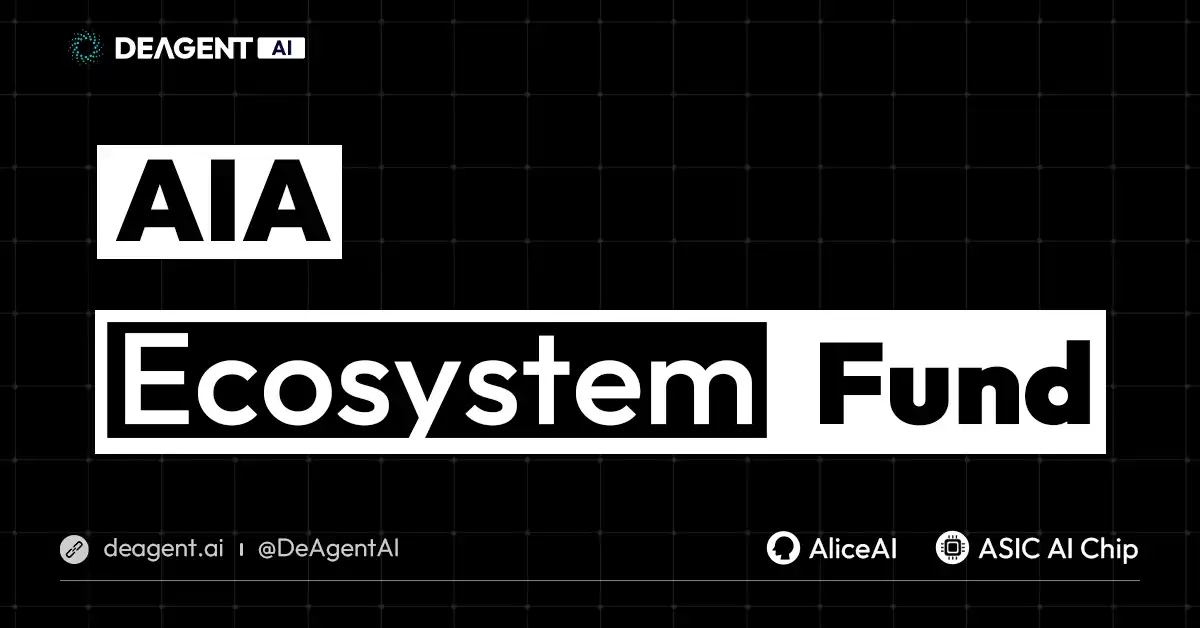
DeAgentAI, a leading decentralized AI infrastructure project on SUI and BNB Chain, has announced the establishment of the AIA Ecosystem Fund. The fund will focus on the integrated track of "AI Agent + Physical AI," aiming to incubate and accelerate the next generation of AI applications with autonomous decision-making capabilities and extend AI technology from on-chain intelligence to the real world. The fund will provide comprehensive support in technology, user traffic, and ecosystem resources. Its core investment directions include AI Agent applications with autonomous on-chain execution and multi-agent collaboration capabilities, and Physical AI projects that extend AI inference into the physical world through hardware and computing efficiency. The fund has already made seed-round investments in two projects: - AliceAI: An AI-driven prediction market decision system that compresses fragmented information into verifiable, tamper-proof decision signals, offering a full-cycle solution from signal generation to automated execution via Telegram Bot. - An ASIC AI chip project: A custom hardware solution designed specifically for Transformer-based inference, aiming to reduce token processing costs to less than one-tenth of current GPU solutions while significantly improving energy efficiency and lowering latency. According to DeAgentAI’s founder, the goal is to bridge the gap between on-chain intelligence and the physical world, supporting key protocols that connect users...

April 14, 2026, DeAgentAI, a leading decentralized AI infrastructure project in the SUI and BNB ecosystems, today announced the establishment of the AIA Ecosystem Fund. This fund will focus on the integrated track of "AI Agent + Physical AI," dedicated to incubating and accelerating the next generation of AI application ecosystems with autonomous decision-making capabilities, and promoting the extension of AI technology from on-chain intelligence to the real world.

Ecosystem Accelerator for the AI Era

The establishment of the AIA Ecosystem Fund marks DeAgentAI's strategic extension from a single infrastructure provider to an ecosystem investor. Leveraging DeAgentAI's accumulated AI Agent infrastructure capabilities in the SUI, BSC, and BTC ecosystems, as well as the AlphaX product matrix with over 191 million on-chain interactions, the AIA Ecosystem Fund will provide comprehensive support to invested projects in terms of technology, traffic, and ecosystem resources.

The fund's core investment directions focus on two major areas:

AI Agent: Application-layer projects with autonomous decision-making, on-chain execution, and multi-agent collaboration capabilities;

Physical AI: Hardware infrastructure and computing power optimization projects that extend AI inference capabilities to the real world.

Seed Round Already Invests in Two Ecosystem Projects

Currently, the AIA Ecosystem Fund has completed strategic investments in two projects during the seed round:

AliceAI: AI-Driven Prediction Market Decision System

In 2026, with the proliferation of deepfakes and extreme information noise overload, mere predictions have lost their scarcity, and "verifiable decision-making judgment" has become the gold standard of the AI era. AliceAI is not a simple prediction tool; it compresses multi-source, fragmented asymmetric information into a single, tamper-proof decision signal through a decentralized protocol, covering scenarios such as crypto markets, sports events, political issues, and public events.

Through the lightweight entry point of Telegram Bot, AliceAI provides core functions such as judgment signal推送, automatic copy-trading execution, fixed-amount orders, automatic stop-loss, and position visualization, achieving a complete closed loop from "signal generation" to "automatic execution." The AIA Ecosystem Fund is optimistic about the new paradigm of "verifiable judgment" pioneered by AliceAI and believes it has the potential to become the core infrastructure of the prediction market track.

ASIC AI Chip

If AI Agent is the soul, then efficient computing hardware is the body of Physical AI. The current AI inference market is experiencing a structural矛盾 between exploding demand and high costs. The general-purpose GPU architecture faces significant computing power redundancy and energy efficiency losses when handling large-scale Transformer inference loads, and this bottleneck is becoming a core obstacle to the large-scale adoption of AI Agents.

The ASIC AI chip project invested in by the AIA Ecosystem Fund has undergone hardware-level deep customization tailored to the inference computing characteristics of the Transformer architecture. In terms of energy efficiency ratio, the design of dedicated inference paths enables the chip to handle higher-density token throughput under the same power budget, aiming to compress the per-token processing cost to less than one-tenth of existing mainstream GPU solutions while significantly reducing inference latency.

Lower inference costs mean that on-chain Agents' autonomous decisions can run in real-time with higher frequency and lower barriers. The competition in the Physical AI era is essentially a competition in computing efficiency. The AIA Ecosystem Fund's decision to介入 at the seed round is based on this judgment: true AI democratization requires reconstruction starting from the hardware layer.

The founder of DeAgentAI stated: "The evolution path of AI is progressing from 'souls in dialog boxes' to 'bodies in the physical world.' The original intention of the AIA Ecosystem Fund is to break the boundary between on-chain intelligence and physical reality. We are not just looking for good projects; we are looking for 'key protocols' that can connect users to the future AI physical world."

About DeAgentAI:

DeAgentAI is a leading decentralized AI infrastructure in the SUI and BNB ecosystems. Through its self-developed Minimum Entropy Consensus mechanism, DeAgentAI addresses the three core challenges faced by AI Agents in distributed environments from the ground up: Identity consistency, State continuity, and Result credibility. It is committed to building a truly trustworthy on-chain AI agent ecosystem.

Связанные с этим вопросы

QWhat is the main focus of the AIA Ecosystem Fund announced by DeAgentAI?

AThe AIA Ecosystem Fund focuses on the 'AI Agent + Physical AI' integration, aiming to incubate and accelerate the next generation of AI applications with autonomous decision-making capabilities, extending AI technology from on-chain intelligence to the real world.

QWhich two key areas does the AIA Ecosystem Fund primarily invest in?

AThe fund invests in two core areas: AI Agent (applications with autonomous decision-making, on-chain execution, and multi-agent collaboration capabilities) and Physical AI (hardware infrastructure and computing optimization projects that extend AI reasoning into the real world).

QWhat is the unique value proposition of AliceAI, one of the seed-round projects supported by the AIA fund?

AAliceAI is an AI-driven predictive market decision system that compresses multi-source, fragmented asymmetric information into a single, tamper-proof decision signal. It provides a complete closed loop from signal generation to automatic execution via a Telegram Bot, offering verifiable judgment in an era of information overload.

QHow does the ASIC AI chip project, backed by the AIA fund, address current challenges in AI inference?

AThe ASIC AI chip is custom-designed for Transformer architecture inference, significantly improving energy efficiency and reducing latency. It aims to compress the per-token processing cost to less than one-tenth of mainstream GPU solutions, enabling higher-frequency, lower-cost autonomous decision-making for on-chain Agents.

QWhat underlying technology does DeAgentAI use to address core challenges in distributed AI Agent environments?

ADeAgentAI employs a self-developed Minimum Entropy Consensus mechanism to solve the core challenges of identity consistency, state continuity, and result credibility for AI Agents in distributed environments, aiming to build a trustworthy on-chain AI Agent ecosystem.

Похожее

Fei-Fei Li's Team Clarifies the Concept of 'World Models', Sora Merely a Renderer

"World Models" has become a widely used yet confusing term in AI. To address this, a team led by Fei-Fei Li and World Labs proposed a functional taxonomy based on the Partially Observable Markov Decision Process framework. This taxonomy categorizes systems called "world models" into three distinct projections: Renderers, Simulators, and Planners. Renderers, like OpenAI's Sora and other video generation models, focus on producing photorealistic visual outputs for human perception. They prioritize visual fidelity over physical accuracy. Simulators, such as NVIDIA Omniverse, aim to compute precise future environmental states for computational tasks like engineering analysis or digital twins. Planners, like Vision-Language-Action models, take in observations and goals to output executable actions for robots or agents. The article clarifies that most current "world models," including Sora, are primarily Renderers. They generate convincing visuals but lack the core ability to simulate state transitions based on actions, a key requirement for a true world model in classic reinforcement learning definitions. This conceptual confusion has practical implications, leading to potential misalignment in technology selection, investment, and public understanding of AI capabilities. Clear categorization is crucial. It helps enterprises avoid costly mistakes (e.g., using a renderer for robot training), allows investors to accurately assess markets, and enables researchers to build comparable benchmarks. While future systems may integrate these functions, recognizing current boundaries is essential for honest assessment and progress.

marsbit1 ч. назад

Fei-Fei Li's Team Clarifies the Concept of 'World Models', Sora Merely a Renderer

marsbit1 ч. назад

Bloomberg Uncovered: How Do China's Wealthy Circumvent the Annual $50,000 Limit to Transfer Assets?

**Summary: How Wealthy Chinese Circumvent $50,000 Annual Foreign Exchange Limits** Despite China's strict capital controls, including an annual $50,000 per person foreign exchange quota, an estimated $150 billion in funds still leaves the country annually via various gray and underground channels. This report outlines the evolution of China's "capital wall" and the methods used to bypass it. **The Evolving Capital Controls:** * **Foundation (1994):** The system of "current account convertibility with strict capital account controls" was established. * **Quota Set (2007):** The $50,000 individual annual forex purchase limit was formalized. * **Crackdown Begins (2015-2017):** Following market volatility, enforcement tightened. Banks were required to scrutinize transactions, and channels like using UnionPay cards for Hong Kong insurance premiums or buying overseas property were blocked. * **Digital & Legal Upgrades (2024-2026):** Enhanced algorithms now flag suspicious patterns (e.g., "smurfing"). The Common Reporting Standard (CRS) provides Chinese tax authorities with data on citizens' offshore accounts. Unlicensed cross-border brokers have been targeted. **Five Primary Methods for Moving Capital:** 1. **Underground Banking / "Hawala" (Duiqiao):** The largest-scale method. No money crosses borders. Clients pay RMB to a domestic account; an overseas associate deposits equivalent foreign currency into the client's offshore account. Risks include high fees, account freezes, and legal penalties. 2. **"Smurfing" or "Ant Moving":** Using multiple individuals' $50,000 quotas to pool funds for one offshore recipient. Increasingly detected by anti-money laundering algorithms. 3. **Trade Invoice Manipulation:** Businesses over-invoice imports or under-invoice exports via offshore shell companies, creating a pretext to transfer excess funds abroad under the guise of trade. 4. **Channel Migration:** After a crackdown on internet brokers, funds flow toward more compliant but costly channels like major banks' cross-border wealth management services or Qualified Domestic Institutional Investor (QDII) quotas. 5. **Structural Arrangements:** High-net-worth individuals use complex, high-cost legal structures involving offshore trusts, insurance, and investment migration programs to transfer asset ownership. **Regulatory Response: Focusing on People, Not Just Money** The current strategy extends oversight from enterprises to **individual residents**. Tools like CRS allow retroactive visibility into offshore assets. Cryptocurrencies, once seen as a potential loophole, are now actively monitored and prosecuted as an illegal channel. The underlying driver remains: with significant wealth concentrated among millions of affluent households seeking diversification amid domestic economic shifts, the incentive to move assets offshore persists despite regulatory barriers.

marsbit1 ч. назад

Bloomberg Uncovered: How Do China's Wealthy Circumvent the Annual $50,000 Limit to Transfer Assets?

marsbit1 ч. назад

Торговля

Спот
Фьючерсы

Популярные статьи

Неделя обучения по популярным токенам (2): 2026 может стать годом приложений реального времени, сектор AI продолжает оставаться в тренде

2025 год — год институциональных инвесторов, в будущем он будет доминировать в приложениях реального времени.

1.8k просмотров всегоОпубликовано 2025.12.16Обновлено 2025.12.16

Неделя обучения по популярным токенам (2): 2026 может стать годом приложений реального времени, сектор AI продолжает оставаться в тренде

Обсуждения

Добро пожаловать в Сообщество HTX. Здесь вы сможете быть в курсе последних новостей о развитии платформы и получить доступ к профессиональной аналитической информации о рынке. Мнения пользователей о цене на AI (AI) представлены ниже.

活动图片