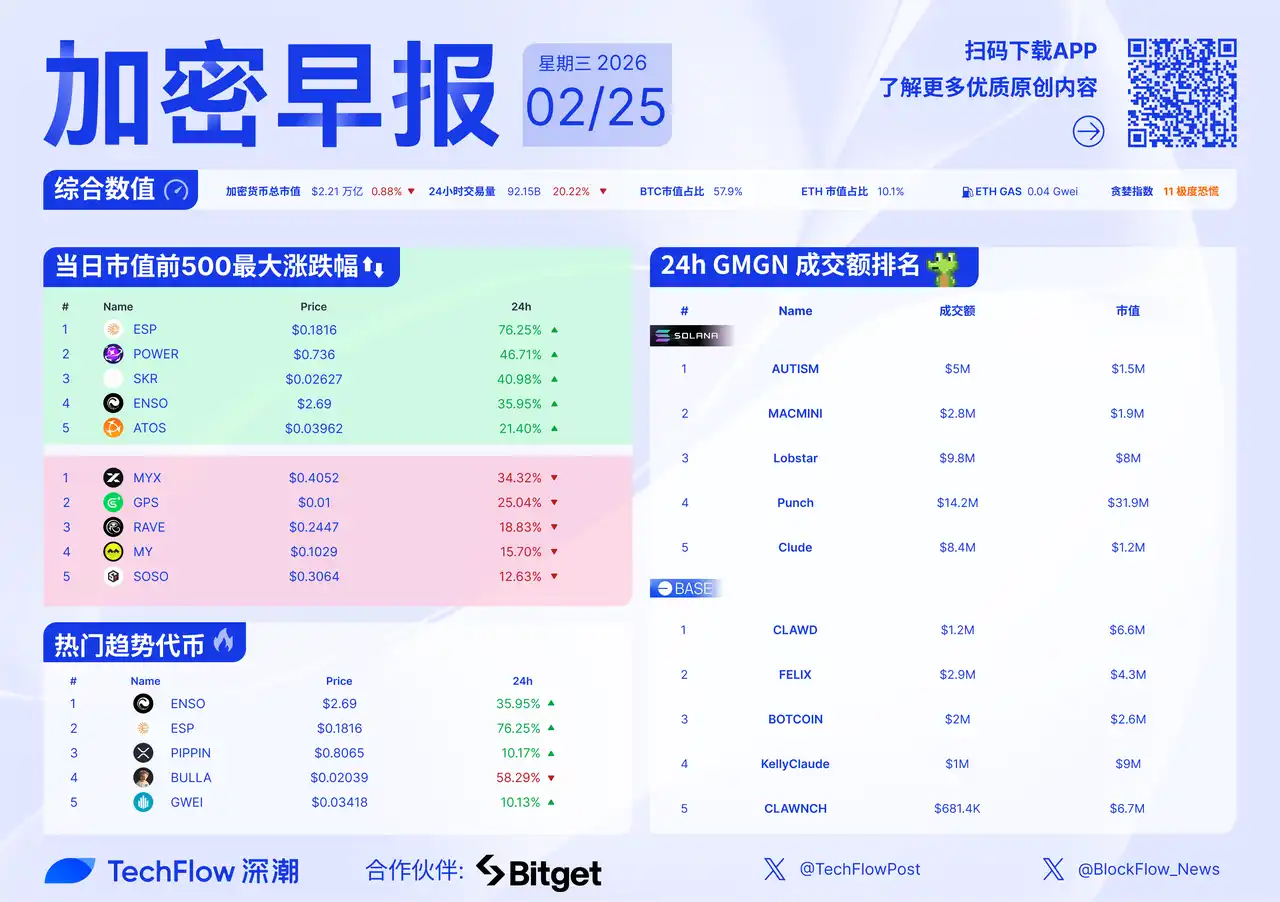
Crypto Morning Brief: Meta Plans to Relaunch Stablecoin Project, Ethereum Foundation Announces Staking of Treasury Funds

marsbitОпубликовано 2026-02-25Обновлено 2026-02-25

Введение

Fed plans to permanently remove "reputation risk" from bank supervision, potentially easing crypto firms' "de-banking" issues. Emirates NBD explores adding Bitcoin to its portfolio, calling it "digital gold." White House denies Trump will pardon SBF. Ethereum Foundation begins staking 70K ETH from its treasury. Kraken launches regulated tokenized stock perpetual contracts for non-US users. Coinbase expands stock trading to all US users with 24/5 access. Meta plans to re-enter stablecoins in H2 2026, seeking third-party partners like Stripe, which is also considering acquiring PayPal. Crypto.com receives conditional US approval to form a national trust bank. Hong Kong’s RedotPay considers a US IPO aiming to raise over $1B. Cipher Mining shifts from Bitcoin mining to HPC data centers.

Author: Deep Tide TechFlow

Yesterday's Market Dynamics

Fed Plans to Permanently Remove "Reputational Risk" Regulatory Requirement, Potentially Easing Crypto Firms' "De-banking" Dilemma

According to The Block, the Federal Reserve recently proposed a plan to permanently remove the "reputational risk" consideration from the bank regulatory framework and has opened a 60-day public comment period. The proposal aims to ensure that bank regulatory decisions are based solely on substantive financial risks, preventing banks from denying services to clients due to their political views, religious beliefs, or involvement in legal but sensitive industries. Fed Vice Chair for Supervision Michelle W. Bowman stated that she has heard of multiple "de-banking" cases and that such discriminatory behavior should not exist within the Fed's regulatory framework. Senator Cynthia Lummis welcomed the proposal, saying it will help the U.S. become a global digital asset hub.

Emirates NBD Exploring Possibility of Adding BTC to Investment Portfolio

Maurice Gravier, Group Chief Investment Officer of Emirates NBD, one of the largest banks in the UAE, stated in an interview with CNBC that the bank views Bitcoin as "digital gold" and is exploring the possibility of adding BTC to its investment portfolio. However, he noted that reasonably valuing Bitcoin remains challenging against the backdrop of ongoing market volatility. He also mentioned that Bitcoin's positioning has evolved from initially being seen as an alternative currency to a store of value.

Fortune Magazine: White House Says President Trump Will Not Grant SBF a Pardon

According to Fortune, convicted FTX founder Sam Bankman-Fried is campaigning on social media for a presidential pardon, but a White House spokesperson reiterated to Fortune that President Trump has no intention of pardoning him.

Although Bankman-Fried was a major donor to the Democratic Party, his recent remarks on social platform X have noticeably shifted towards supporting the MAGA stance, criticizing the "deep state" and praising Trump. This strategy emerges against the backdrop of the Trump administration's lenient attitude towards cryptocurrency regulation and its previous pardons, including for Binance founder Changpeng Zhao.

Bankman-Fried is currently serving a 25-year sentence in federal prison while simultaneously challenging his conviction in a federal appeals court. The White House spokesperson cited Trump's statement from January of this year, confirming that the President does not intend to pardon Bankman-Fried or several other high-profile prisoners.

Ethereum Foundation Announces It Has Begun Staking Its Treasury Funds, Plans to Stake a Total of Approximately 70,000 ETH

The Ethereum Foundation announced that it has begun staking its treasury funds, with an initial deposit of 2016 ETH, and plans to stake a total of approximately 70,000 ETH. This move aligns with the Foundation's treasury policy announced last year, and all staking rewards will be returned to the Foundation's treasury.

The Foundation is using the open-source software Dirk and Vouch, developed by @AttestantIO, for operations, ensuring multi-jurisdictional operation through distributed signers to avoid single points of failure. The Foundation stated that this initiative not only helps secure the Ethereum network but will also provide funding support for core operations such as protocol research and development, ecosystem growth, and community grants.

Kraken Launches 24/7 Trading of Tokenized Assets

According to CoinDesk, cryptocurrency exchange Kraken announced the launch of the world's first regulated trading service for tokenized stock perpetual contracts. The product is available to non-U.S. users in over 110 countries, supporting 24/7 trading of tokenized assets such as the S&P 500, Nasdaq 100, Apple, Nvidia, Tesla, and the SPDR Gold ETF, with leverage of up to 20x.

Kraken stated that the underlying tokenized stocks are fully collateralized 1:1 by the reference assets, providing a pricing anchor even when U.S. exchanges are closed. The company plans to expand its product line in the coming months by adding more tokenized stocks and ETFs.

Coinbase Launches Stock Trading Service for All U.S. Users, Enabling 24-Hour Trading 5 Days a Week

Coinbase has opened its stock trading feature to all U.S. users, allowing customers to trade stocks and ETFs 24 hours a day, five days a week. The platform offers commission-free trading and supports fractional share trading, with purchases starting as low as $1. Users can fund their trading accounts using USD and USDC, and Coinbase One members can also earn rewards based on their USDC trading balances.

As part of this new offering, Coinbase has partnered with Yahoo Finance, enabling users to jump directly from asset research pages on Yahoo Finance to execute trades on Coinbase. This integration allows traders to discover and track assets on the Yahoo interface and then complete transactions directly. The company stated that it will start with mainstream market stocks initially and plans to expand 24/5 trading to more stocks in the coming months; it also plans to expand its stock perpetual product range this spring, enabling traders outside the U.S. to gain exposure to U.S. stocks around the clock.

Meta Plans to Relaunch Stablecoin Project in Second Half of 2026

According to CoinDesk, informed sources revealed that Meta, the parent company of Facebook, plans to re-enter the stablecoin arena in the second half of 2026 and is currently seeking partnerships with third-party vendors to manage stablecoin payments and implement new wallet features. Sources mentioned that Meta has sent out Requests for Proposal (RFPs) to several third-party companies, with payments giant Stripe seen as a potential partner; Stripe acquired stablecoin specialist Bridge last year.

This would be Meta's second attempt at a stablecoin following its 2019 effort to launch Libra (later renamed Diem). Unlike before, Meta is adopting an "arm's length" strategy this time, relying on third parties to manage the payment system to avoid potential regulatory risks.

Informed Sources: Stripe Considering Acquiring All or Part of Paypal's Business

According to informed sources, payment processing company Stripe is considering acquiring all or part of Paypal's (PYPL.O) business. Sources revealed that Stripe, one of the most valuable companies in the industry, has preliminarily expressed interest in acquiring this digital payments pioneer or its assets. Sources indicated that discussions are still in the early stages, and it is uncertain whether a deal will ultimately be reached.

Crypto.com Receives Conditional Approval from U.S. OCC to Establish National Trust Bank

According to an official announcement from Crypto.com, the company has received conditional approval from the U.S. Office of the Comptroller of the Currency (OCC) to establish the Foris Dax National Trust Bank (also known as Crypto.com National Trust Bank). Once fully approved, Crypto.com will operate as a federally regulated national trust bank, offering custody services, staking assets across various blockchain and digital asset protocols (including Cronos), and transaction settlement services, among others.

Crypto.com CEO Kris Marszalek stated that this milestone brings the company closer to meeting the demand from leading institutions for a one-stop, qualified custodian under federal regulation. The company submitted its application to the OCC in October 2025; this approval does not affect the ongoing operations of Crypto.com Custody Trust Company, which is regulated by the New Hampshire Banking Department as a qualified custodian.

Bloomberg: Hong Kong Stablecoin Payments Company RedotPay Considers U.S. IPO as Early as This Year, Potential Raise Exceeds $1 Billion

According to Bloomberg, Hong Kong-based stablecoin payments company RedotPay is considering an initial public offering (IPO) in the U.S., with a potential raise exceeding $1 billion.

Informed sources revealed that RedotPay is working with JPMorgan Chase & Co., Goldman Sachs Group Inc., and Jefferies Financial Group Inc. and plans to list in New York as early as this year. The company may seek a valuation of over $4 billion.

Cipher Digital Announces Strategic Pivot from Bitcoin Mining to High-Performance Computing Data Center Business

According to CoinDesk, Cipher Digital (formerly Cipher Mining) announced a strategic pivot from Bitcoin mining to the high-performance computing (HPC) data center business and is rebranding as Cipher Digital. The company's Q4 revenue was $60 million, below analysts' expectations of $84.4 million; adjusted loss per share was $0.14, a wider loss than the expected $0.06. The company has signed a 15-year, 300-megawatt lease with Amazon AWS, a 10-year, 300-megawatt lease with Fluidstack and Google, and has raised $3.73 billion through three bond issuances to fund the Barber Lake and Black Pearl data center projects. Affected by the earnings, the company's stock fell approximately 5% in pre-market trading.

Market Dynamics

Recommended Reading

Waking Up: When the Dream Maker OpenAI Starts Counting Costs

This article provides a detailed analysis of OpenAI's journey from proposing the "Stargate" plan to encountering difficulties due to funding and management issues, ultimately forcing a strategic adjustment. Despite facing significant challenges, OpenAI is seeking survival and growth through partnerships and pragmatic strategies.

AI Doomsday Theory is a Massive Short

This article explores the potential impact of the rapid development of artificial intelligence (AI) technology on the economy, society, and geopolitics. It refutes the "AI Doomsday Theory," arguing that the reduction in cognitive costs brought by AI will usher in a new era of "abundance economy." Although short-term market volatility and industry restructuring may occur, in the long run, AI is expected to significantly increase productivity, reduce economic friction, and potentially promote global peace.

BackPack Token for Equity: A Brutal Self-Rescue in the Crypto Winter

This article analyzes the challenges of the cryptocurrency market in a bear market environment and how exchanges are conducting self-rescue through innovative token-to-equity linkage models, focusing on the background, mechanism, and potential impact of the token staking for equity scheme launched by Backpack exchange.

Bitcoin's "Narrative Crisis": Bloomberg is Right, But Only Half Right

This article discusses how Bitcoin's value and narrative functions are changing, with gold, stablecoins, and prediction markets encroaching on Bitcoin's traditional narratives. Nevertheless, Bitcoin's holder structure has changed due to the emergence of ETFs, and institutional investor participation provides some market support. The article also points out that Bitcoin is not dying but is undergoing a "shedding skin" process; narrative failure may reflect valuation regression rather than a true crisis.

February 24 Market Summary: IBM Becomes the New AI Sacrifice, Crypto Market Suffers Confidence Blow

This article summarizes recent major dynamics in the global market, including the impact of Trump's increased global tariffs on market confidence, the impact of Anthropic's new features on traditional tech companies like IBM, the prominent performance of gold as a safe-haven asset, and the volatility in the cryptocurrency market.

Связанные с этим вопросы

QWhat is the Federal Reserve's new proposal regarding bank supervision, and how might it impact crypto businesses?

AThe Federal Reserve has proposed to permanently remove the 'reputation risk' factor from its bank supervision framework. This aims to ensure regulatory decisions are based solely on substantive financial risks, preventing banks from denying services to clients based on political views, religion, or involvement in legal but sensitive industries like crypto. This could help alleviate the 'debanking'困境 faced by crypto companies.

QWhat significant announcement did the Ethereum Foundation make regarding its treasury?

AThe Ethereum Foundation announced it has begun staking its treasury funds. It deposited an initial 2,016 ETH and plans to stake a total of approximately 70,000 ETH. All staking rewards will be returned to the foundation's treasury to fund protocol development, ecosystem growth, and community grants.

QWhat is Meta's reported plan for re-entering the stablecoin market, and how does it differ from its previous attempt?

AMeta plans to re-enter the stablecoin market in the second half of 2026. Unlike its previous Libra/Diem project, Meta is adopting an 'arm's length' strategy this time by seeking to partner with third-party vendors to manage stablecoin payments and wallet functions, aiming to avoid potential regulatory risks.

QWhich major cryptocurrency exchange received conditional approval from the OCC to form a national trust bank, and what services will it offer?

ACrypto.com received conditional approval from the Office of the Comptroller of the Currency (OCC) to form the Foris Dax National Trust Bank (Crypto.com National Trust Bank). Once fully approved, it will operate as a federally regulated national trust bank offering custody services, staking for assets across various blockchains, and transaction settlement.

QWhat new service did Kraken launch, and what are its key features?

AKraken launched the world's first regulated tokenized stock perpetual contracts trading service. It is available to non-US users in over 110 countries, supports 24/7 trading of assets like the S&P 500, Nasdaq 100, and stocks such as Apple and Tesla with up to 20x leverage. The tokenized stocks are fully collateralized 1:1 by the reference assets.

Похожее

Has the 'Digital Gold' Narrative for BTC Failed?

**Title: Has the "Digital Gold" Narrative for Bitcoin Failed?** The article argues that Bitcoin's "digital gold" narrative remains valid despite a recent sharp price decline (from a peak near $126k in Oct 2025 to briefly under $61k in Feb 2026). It presents a long-term investment framework based on three core points: **1. Viewing Bitcoin as an Asset:** Bitcoin is presented as a superior potential store of value compared to gold. Key arguments are its absolute scarcity (21 million cap), superior portability, and transparent auditability via its public ledger. While acknowledging its current use in early, volatile stages (~3-4% global adoption), the author draws parallels to the early, disruptive phases of the internet and e-commerce. **2. Understanding the Recent Downturn:** The current ~50% correction is framed as a predictable, consensus-driven cycle following its post-halving peak (the 2024 halving preceded the Oct 2025 high). A crucial factor is a historic "changing of hands": the influx of new institutional buyers via ETFs allowed early, low-cost holders (miners, OG believers) to take profits. The author notes that while severe, Bitcoin's historical drawdowns (e.g., 93% in 2011, 77% in 2021-22) have been progressively smaller, suggesting maturing holder structure and decreasing volatility over time. **3. The Long-Term Perspective:** The long-term thesis hinges on Bitcoin capturing a portion of gold's market value. With Bitcoin's market cap at ~$1.4 trillion (at $70k) versus gold's ~$20 trillion, significant upside potential exists if the "digital gold" narrative is partially realized. However, the author strongly cautions that short-term risks remain, the bottom is unpredictable, and high volatility is inherent. The real risk is not Bitcoin failing but poor personal position management (over-leverage, wrong capital) and a lack of deep understanding, which can force investors out during severe downturns. The conclusion uses Amazon's 95% crash post-2000 dot-com bubble and subsequent 42x recovery as an analogy. The ultimate question is not if Bitcoin's price will rise, but if an investor's strategy and conviction can withstand the volatility to see the long-term play out. The recent divergence (gold up, Bitcoin down) is posed not as a narrative failure, but as potential evidence of this ongoing, painful transition from a speculative asset to a mainstream allocation.

marsbit3 ч. назад

Has the 'Digital Gold' Narrative for BTC Failed?

marsbit3 ч. назад

Has BTC's 'Digital Gold' Narrative Failed?

The article discusses Bitcoin's "digital gold" narrative, its recent price drop, and long-term outlook through the perspective of "Jason". It argues the narrative is not a failure but that Bitcoin represents a superior, new asset class due to its fixed supply (21 million), portability, and auditability. The piece compares its current ~3-4% global adoption rate to early internet/e-commerce, suggesting significant growth potential. Regarding the 2025-2026 price decline (from ~$126k to briefly under $61k), the author views it as a predictable, consensus-driven sell-off within Bitcoin's ~4-year cycle post-halving, exacerbated by a major "handover" from early, low-cost holders to new institutional buyers via ETFs. A key observation is that historical peak-to-trough drawdowns have lessened over time (e.g., 93% in 2011 to ~50% in 2026), indicating maturing volatility as holder structure changes. For the long term, the author uses a simple framework: Bitcoin's total market cap (~$1.4T at $70k) is only about 7% of gold's (~$20T). Even capturing 30-50% of gold's value would imply substantial upside. However, the article strongly cautions against viewing this as investment advice, emphasizing extreme volatility and the critical importance of risk management, position sizing, and deep fundamental understanding to survive severe drawdowns. It concludes by drawing a parallel to Amazon's 95% crash in 2000 and subsequent 42x recovery, stressing that the key is surviving market cycles to realize long-term potential.

链捕手3 ч. назад

Has BTC's 'Digital Gold' Narrative Failed?

链捕手3 ч. назад

From Code to Cognition: A Ten-Thousand-Word Guide to the Evolution of the Robot Brain

"From Code to Cognition: The Evolution of Robot Brains" The journey of robotic intelligence has shifted dramatically from manually coded systems to AI-driven brains. For decades, robots relied on layered software stacks—perception, state estimation, planning, control—each handcrafted. While predictable, they lacked adaptability. The 2010s saw deep learning revolutionize perception (e.g., object detection) and control (via reinforcement learning), but learned skills remained narrow. The arrival of Large Language Models (LLMs) marked a turning point. LLMs acted as high-level planners, interpreting natural language instructions and generating sequences of actions for traditional robotic systems to execute. However, true integration came with Visual-Language-Action (VLA) models, which fused vision, language, and motion prediction into a single network. Pioneered by models like RT-2 and open-source projects like OpenVLA, VLAs enable robots to reason and act directly from visual input and commands. The most advanced humanoid robots now employ a "dual-brain" architecture: a slow-thinking, large VLA (System 2) for reasoning and planning, and a fast-reacting, small network (System 1) for high-frequency motion control, sometimes with an even lower-level System 0 for balance. This split balances cognition with the physics of real-time movement. Computation is split between onboard hardware (e.g., NVIDIA Jetson) for safety-critical control loops and cloud/edge servers for non-critical tasks like learning and interfaces. A crucial driver is the open-source ecosystem—models like GR00T and OpenVLA allow startups to build upon pre-trained brains and fine-tune them with their own data, accelerating development. Despite progress, current systems struggle with recovery from errors, sample inefficiency, and long-horizon tasks. This has spurred the rise of **World Models**—neural networks that predict the consequences of actions. By simulating possible futures before acting (like NVIDIA Cosmos or Meta V-JEPA), robots can plan, recover, and generalize better. This represents the next frontier: shifting intelligence from learned reactions to an internal model of physics and cause-and-effect. The field is rapidly evolving. While not yet at its "ChatGPT moment," the convergence of cheaper hardware, scalable simulation, and world models points toward robots that are increasingly capable, adaptive, and useful. The question is shifting from "what can robots do?" to "what *should* they do?"

marsbit3 ч. назад

From Code to Cognition: A Ten-Thousand-Word Guide to the Evolution of the Robot Brain

marsbit3 ч. назад

AI Bubble Is Bursting

The AI Bubble is Bursting: A Necessary Purge on the Path to Ubiquitous Intelligence Market volatility has reignited debates about an AI bubble, with figures like Ray Dalio pointing to high valuations. However, this parallels the dot-com bubble, which, despite its crash, laid the physical infrastructure for today's internet era. The current AI investment frenzy, with tech giants planning trillions in infrastructure spending far outstripping current AI application revenues, appears similarly imbalanced. This 'bubble' is seen as an inevitable phase for a disruptive technology, paying the "innovation tax." Critically, AI inference costs have plummeted over 99.7% since 2023, making intelligence nearly free at the margin. This hasn't reduced spending but has instead unlocked massive new demand, as seen in enterprise AI cloud expenditure tripling. This follows the Jevons Paradox: efficiency gains lead to greater total consumption. The market is now entering a cleansing phase, weeding out speculative ventures lacking real moats. The deeper shift is a move from capital expenditure (CapEx) on hardware to value creation in operational expenditure (OpEx) through AI applications that solve real industry problems. While infrastructure valuations are high, rapid earnings growth from widespread AI adoption across sectors—from manufacturing and finance to law and healthcare—may digest these valuations over time. Ultimately, this creative destruction will leave behind robust infrastructure and optimized models, cheaply powering an AI-augmented future for all industries, much as the internet became indispensable after its own bubble burst. The core productive potential remains undiminished.

链捕手4 ч. назад

AI Bubble Is Bursting

链捕手4 ч. назад

Торговля

Спот
Фьючерсы

Популярные статьи

Manyu: восходящая мем-звезда на Ethereum, готовая открыть новую эру культуры Shiba

Manyu - это мемтокен на Ethereum, который приносит децентрализованную культурную и развлекательную ценность через вирусное влияние в соцсетях и вовлечённость сообщества.

1.9k просмотров всегоОпубликовано 2025.11.27Обновлено 2025.11.27

Manyu: восходящая мем-звезда на Ethereum, готовая открыть новую эру культуры Shiba

Неделя обучения по популярным токенам 14: Glamsterdam — самое ожидаемое обновление Ethereum в 2026 году

Ordinals/Runes по-прежнему стимулируют доходы от комиссий за блоки и активность разработчиков, рассматриваются как отправная точка «нативной эмиссии активов» в сети.

1.5k просмотров всегоОпубликовано 2026.04.29Обновлено 2026.04.29

Неделя обучения по популярным токенам 14: Glamsterdam — самое ожидаемое обновление Ethereum в 2026 году

Обсуждения

Добро пожаловать в Сообщество HTX. Здесь вы сможете быть в курсе последних новостей о развитии платформы и получить доступ к профессиональной аналитической информации о рынке. Мнения пользователей о цене на ETH (ETH) представлены ниже.

活动图片