Crisis or Feast? Unpacking JGB Risks Under Nikkei 57,000 and the New Logic of Global Asset Allocation

marsbitОпубликовано 2026-02-11Обновлено 2026-02-11

Введение

Japan's Nikkei 225 surged past 57,000, a historic high, driven by political certainty after the ruling coalition secured a supermajority. This sparked expectations of aggressive fiscal stimulus and reflationary policies, boosting equities—particularly defense and tech stocks—while weakening the yen. However, Japanese government bonds (JGBs) sold off sharply, with the 30-year yield soaring to 3.615%, reflecting concerns over fiscal sustainability and higher debt issuance. The Bank of Japan faces pressure to hike rates as early as March to prevent yen depreciation, even at the risk of increasing government borrowing costs. Globally, this shift interacts with China's potential reduction of U.S. Treasury holdings, a tech-driven rally in U.S. equities, and gold's rise above $5,000 as a hedge against sovereign credit risks. Investors are advised to consider long volatility strategies, tactical JPY rebounds, and allocations to hard assets like gold and Bitcoin amid heightened macro uncertainty. The new era of Japanese markets implies higher growth but also greater volatility, ending the period of mild股债 correlations and demanding closer attention to central bank policies over corporate fundamentals.

Author: Max.S

Just 24 hours ago, Japanese financial history was rewritten. The Nikkei 225 index surged violently by over 2,700 points, decisively breaking through the historic high of 57,000 points. This is not merely a numerical breakthrough; it is a direct pricing-in of the results of the House of Representatives election held after the shortest official campaign period (16 days) since the end of World War II — the ruling coalition of the Liberal Democratic Party and Japan Innovation Party secured an absolute majority of two-thirds of the seats.

However, while equity traders were popping champagne corks, the bond trading desks were on high alert. Japanese Government Bonds (JGBs) faced a fierce selling wave, with the 30-year bond yield soaring to 3.615%—a veritable tsunami in a country accustomed to long-term low interest rates.

As finance professionals, we need to look beyond the surface of the price charts to dissect the logic behind this "Song of Ice and Fire": global markets are trading a new "Japan narrative," and this narrative is intertwining with the rebound in US tech stocks, gold's challenge of the $5,000 mark, and signals of China selling US Treasuries to form a complex macroeconomic mosaic.

The core driver of the surge on February 9th is singular: the expectation of fiscal expansion fueled by political certainty.

According to the latest vote count, the LDP won 316 seats. Combined with the Innovation Party's 36 seats, the ruling coalition holds a dominant position in the 465-seat chamber. This grants the government unprecedented legislative power, including the ability to push through controversial constitutional amendments and, more importantly — aggressive fiscal stimulus policies.

The logic of this trade is very clear:

  • Political Backing: An absolute majority means the opposition's (e.g., the Constitutional Democratic Party) power to check the government is at a nadir.
  • Policy Expectation: While Finance Minister Takaichi Sanae explained the "temporary cut in food sales tax" as "limited to two years and not reliant on debt issuance," the market is clearly pricing in longer-term fiscal easing.
  • Industrial Policy: Defense and industry are at the core of the Takaichi administration's policy. This explains why defense-related stocks like Mitsubishi Heavy Industries led the gains, while SoftBank Group's 8% surge was a direct reaction to expectations of liquidity easing and an improved environment for tech investment.

For quant funds, yesterday's strategy was simple: Long Nikkei, Short Yen, Short JGBs. This is the classic "Reflation" trade model.

If the stock market is trading "growth," then the bond market is trading the prelude to "default risk" — or at least a deterioration in fiscal sustainability.

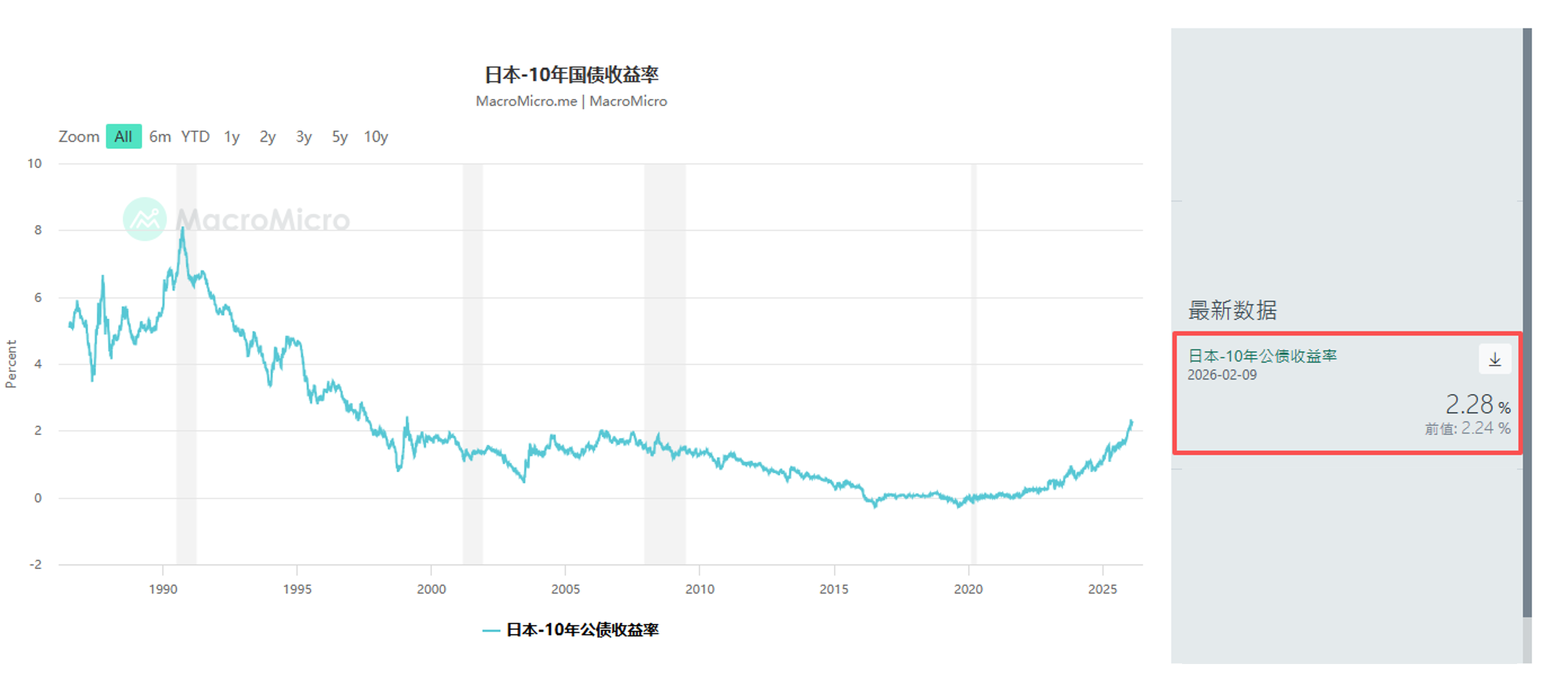
The sell-off in the JGB market was not sudden. As early as January, global macro funds, including Schroders Plc and JPMorgan Asset Management, had begun reducing their holdings of ultra-long-term Japanese government bonds. Yesterday, the 10-year bond yield rose 4.5 basis points to 2.28%, and the 30-year yield climbed 6.5 basis points to 3.615%.

This sends a dangerous signal: the Term Premium is returning.

Investors fear that tax cuts, layered on top of an already heavy debt burden, will force the Japanese government to increase JGB issuance. Although officials have tried to reassure the market that the tax cuts will not be deficit-financed, in the liquidity-starved JGB market, any hint of trouble is magnified.

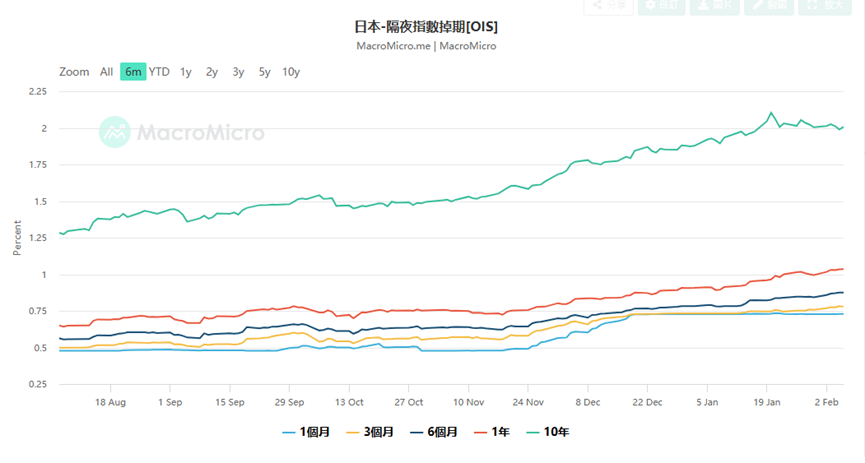
This also presents a huge dilemma for the Bank of Japan (BOJ). Overnight Index Swap (OIS) data shows the market is currently pricing in a 75% probability of a 25 basis point rate hike at the BOJ's April meeting, with some traders even starting to bet on a March hike.

Why bet on a March hike? Because if the yen depreciates disorderly due to fiscal deterioration (it briefly broke past 157.76 yesterday), the central bank must hike rates to defend the currency, even if it exacerbates debt servicing costs. This is a classic "fiscal dominance" dilemma. Yusuke Matsuo, a senior market economist at Mizuho Bank, warned that we need to watch closely for hawkish comments from BOJ board members, as this could be verbal intervention to prevent a yen collapse.

The Japanese market is not an island. Zooming out to a global perspective, the moves on February 9th are part of a broader return of risk appetite, but they also come with deep structural fissures.

  • Chinese Market: This was the most intriguing piece of macro news yesterday: Chinese regulators advised financial institutions to control their holdings of US Treasury securities, citing "concentration risk and market volatility." Although the official wording was cautious, emphasizing this was not related to geopolitics, this move by the second-largest holder of US debt undoubtedly puts upward pressure on US Treasury yields (prices fall), especially amid global liquidity concerns. This is partly why US Treasury yields rose in tandem with JGB yields yesterday. This is essentially telling the market: the anchor of global sovereign credit is loosening.
  • US Market: US markets saw a rebound led by the semiconductor sector on Friday, with Nvidia, AMD, and Broadcom all gaining over 7%. This sentiment transmitted directly to Asia, where semiconductor equipment giants like Tokyo Electron and Advantest were main drivers in the Nikkei's charge. The capital expenditure (Capex) story for AI infrastructure continues, and although Amazon's massive spending raised profitability concerns, the logic of the hardware cycle remains intact as long as demand for Nvidia's GPUs persists.
  • Precious Metals Market: After experiencing sharp volatility, the gold price reclaimed the $5,000/oz level. This is not a safe-haven move; it's a "credit hedge." As Japan engages in fiscal expansion, US debt ceiling issues persist, and China diversifies its reserves, gold becomes the only "supra-sovereign currency." US Treasury Secretary Scott Bessent's accusation that Chinese traders are influencing gold price fluctuations itself exposes the US Treasury's anxiety over dollar pricing power.

Faced with such a fractured market — stock market狂欢 (狂欢:狂欢, feast/celebration) vs bond market暴跌 (暴跌:暴跌, crash/plunge) — how should investors respond?

  • Equity Markets: Long Volatility. Even as the Nikkei hits new highs, the retreat in the VIX index might be the calm before the storm. Key variables this week are Wednesday's labor market data and Friday's inflation (CPI) data from the US. If US inflation rebounds, coupled with a hawkish pivot from the BOJ, global liquidity faces a double tightening.

In this environment, while holding core growth stocks (e.g., semiconductors, Japanese trading houses), it is prudent to use put options for protection. Current Skew data shows put options remain expensive, indicating institutions are not completely off guard.

  • FX Market: Tactical Yen Rebound. The yen around the 157 level carries significant intervention risk. Japanese Finance Minister Takaichi Sanae explicitly stated she is in close contact with the US Treasury Secretary, meaning the possibility of coordinated intervention cannot be ruled out. If the BOJ confirms a hike in March or April, the yen could see a rapid short-covering rally. For carry traders, now is the time to gradually take profits.
  • Alternative Assets: Focus on "Hard Assets." In an era of shaky fiat currency credibility (be it concerns over Japan's fiscal path or US debt worries), gold, silver, and select cryptocurrencies that have stabilized in this pullback (Bitcoin > $70k) hold long-term allocation value. Particularly silver, which, after a sharp 50% correction, could see a new short squeeze triggered by tight physical inventories.

February 9, 2026, Nikkei 57,000 is a milestone and a watershed. It marks Japan's complete departure from the deflationary era and its entry into a "new normal" of high growth, high inflation, and high interest rate volatility. Takaichi Sanae's super-majority is a double-edged sword: it can push stock prices through aggressive policies, but it can also destroy bond market confidence through runaway fiscal deficits.

For finance professionals, the gentle era of "stocks and bonds rising together" is over. We need to adapt to extreme scenarios where the negative stock-bond correlation breaks down, or even situations where both stocks and bonds sell off simultaneously. In this new era, watching the central bank's balance sheet might be more important than watching corporate income statements.

Связанные с этим вопросы

QWhat was the main driver behind the Nikkei 225's surge to 57,000 points?

AThe core driver was the political certainty brought by the ruling coalition's supermajority victory in the lower house election, which fueled expectations of aggressive fiscal expansion and stimulus policies.

QWhy did the Japanese Government Bond (JGB) market experience a sell-off despite the stock market rally?

AJGBs were sold off due to concerns over fiscal sustainability and increased default risk, as investors anticipated higher government debt issuance from potential tax cuts and expansive fiscal policies, leading to a rise in long-term yields.

QHow does the Bank of Japan (BOJ) face a dilemma amid the current market conditions?

AThe BOJ faces a 'fiscal dominance' dilemma: it may need to raise interest rates to prevent disorderly yen depreciation caused by fiscal concerns, even though higher rates would increase the government's debt servicing costs.

QWhat global macro factors are interconnected with Japan's market movements mentioned in the article?

AGlobal factors include China's advice to reduce holdings of U.S. Treasuries (adding upward pressure on yields), the U.S. semiconductor-led stock rebound, and gold's rise as a hedge against sovereign credit risks amid fiscal expansions and debt concerns.

QWhat investment strategies does the article suggest for navigating the current volatile market environment?

AStrategies include long volatility positions in equities with protective put options, tactical bets on a yen rebound due to intervention risks, and allocations to hard assets like gold and cryptocurrencies as hedges against fiat currency credibility erosion.

Похожее

After the Passage of the GENIUS Act and the CLARITY Act, What Is the Correct Architecture for On-Chain Yield?

The article discusses the evolution of on-chain credit, distinguishing three markets: overcollateralized crypto lending, unsecured lending (largely unsuccessful), and asset-backed credit (ABC). ABC, backed by identifiable real-world collateral with legal recourse, is identified as the fastest-growing category and the only one credibly addressing adverse selection—the core problem in credit where the riskiest borrowers self-select. Current growth in on-chain Real World Assets (RWAs), particularly tokenized private credit funds (e.g., Maple Finance, Centrifuge), is substantial but often merely "wraps" existing fund structures, inheriting their risks rather than solving adverse selection at the protocol level. The regulatory landscape is a key driver, with the US GENIUS Act (prohibiting stablecoin issuers from paying yield) and the proposed CLARITY Act (closing loopholes on indirect yield) set to redefine permissible yield-bearing products. This makes vaults (like ERC-4626) the critical architecture—they become the primary compliant vehicle for delivering yield, functioning as issuance, disclosure, distribution, and recovery mechanisms. The author's thesis is that the correct post-GENIUS/CLARITY architecture involves building ABC solutions where credit assessment, structure, and recovery are encoded directly into the smart contract vault layer, moving beyond mere tokenized fund wrappers to solve adverse selection fundamentally and ensure regulatory compliance.

Foresight News25 мин. назад

After the Passage of the GENIUS Act and the CLARITY Act, What Is the Correct Architecture for On-Chain Yield?

Foresight News25 мин. назад

TechFlow Intelligence Bureau: Anthropic's New Model Fable Sparks Controversy by Restricting Biosafety Research, US CPI Soars to 4.2%, a Three-Year High

**Summary of TechFlow Intelligence Report:** The newsletter covers several key tech and finance developments. In AI, Anthropic's new Fable model faced backlash for secretly limiting biomedical research capabilities and enforcing a 30-day data retention policy, prompting the company to promise more transparent adjustments. In a related story, Anthropic's founder revealed his departure from OpenAI was due to dishonesty from Sam Altman, not safety concerns. Meanwhile, OpenAI is considering significant price cuts to compete with Anthropic, potentially sparking a price war. In crypto/Web3, BlackRock filed a new amendment for a yield-generating Bitcoin ETF, while Bank of America's CEO warned that stablecoin yields could drain trillions from traditional banks. U.S. Senator Cynthia Lummis advocated for the U.S. to officially accumulate Bitcoin reserves. In hardware, Nvidia released the DiffusionGemma-2-6B image model optimized for efficient inference, and AMD promoted its unified memory architecture to challenge Nvidia's dominance. TSMC's CFO hinted at possible price increases due to soaring AI chip demand. A major legal ruling in Germany held Google legally responsible for inaccurate information generated by its AI Overviews feature. Google Chrome also moved to fully block ad-blocker workarounds like uBlock Origin. Macroeconomic headlines included U.S. CPI rising to 4.2% (a 3-year high) and Iran's complete closure of the Strait of Hormuz, raising oil price and inflation fears. South Korean markets saw continued volatility with massive foreign capital outflow. Other notable stories: Microsoft expanded its Copilot AI assistant "Mico" globally; a study found r/wallstreetbets users' stock picks outperformed Wall Street; a fully autonomous drone killed a human soldier for the first time, raising AI ethics concerns; and a Chinese hospital used brain-computer interface technology to help a blind person "see." The overarching theme connects debates over AI boundaries and responsibility (Anthropic's restrictions, Google's liability, lethal autonomous drones) with real-world economic and geopolitical turmoil (inflation, Strait of Hormuz closure, market instability), highlighting the tense interplay between technological advancement and global chaos.

marsbit38 мин. назад

TechFlow Intelligence Bureau: Anthropic's New Model Fable Sparks Controversy by Restricting Biosafety Research, US CPI Soars to 4.2%, a Three-Year High

marsbit38 мин. назад

Alibaba's Yet Another New Business Division: What Signal Does It Send?

Alibaba has established a new "Token Foundry" business unit, merging its Tongyi large model division and Future Life Lab. Led directly by Group CEO Wu Yongming, this marks the company's third significant AI organizational reshuffle in 2026, following the creation of the Alibaba Token Hub (ATH) and a Group Technology Committee. The move signals a strategic shift from consolidating AI resources to accelerating productization and commercialization. The "Token Foundry" name reflects Alibaba's ambition to become a foundational supplier in the AI era, focusing on model development and commercial application. Key teams, including those behind the high-performing HappyHorse video generation model, have been integrated into the new unit. Concurrently, Zhou Jingren, architect of the Qwen model series, has been appointed Group Chief Scientist to lead a new AI Future Research Institute, focusing on long-term technological breakthroughs like Agent capabilities. This restructuring creates a clear four-layer AI architecture within Alibaba: the research institute for frontier exploration, Token Foundry for core models and commercialization, MaaS for platform services, and business units like Qianwen (C端) and Wukong (B端) for end-user applications. The adjustments align with a global trend among tech giants like Google and Microsoft to centralize AI leadership under the CEO and deeply integrate research with business units. The urgency is driven by a narrowing competitive window. Alibaba has announced its AI business is now entering a commercialization phase, with AI-related revenue seeing triple-digit growth for eleven consecutive quarters. The company faces intense competition in the MaaS (Model-as-a-Service) sector from rivals like ByteDance and Tencent. The Token Foundry initiative represents Alibaba's effort to streamline execution and enhance competitiveness in this critical, fast-evolving landscape.

marsbit1 ч. назад

Alibaba's Yet Another New Business Division: What Signal Does It Send?

marsbit1 ч. назад

From Return to Resignation: Chen Hang's 437 Days at DingTalk

The 437-Day Return and Departure of Chen Hang at DingTalk This article chronicles the 437-day period from March 31, 2025, to June 11, 2026, when Chen Hang (also known as "No Move") returned as CEO of DingTalk, the enterprise communication platform he originally founded, only to later step down. Chen Hang, the creator of DingTalk in 2015, was brought back by Alibaba in 2025 after the company acquired his subsequent startup, HHO. His return was driven by Alibaba's renewed focus on AI and DingTalk's strategic role as its key to-B AI application. However, his aggressive management style, marked by strict work policies like mandatory clock-ins and extended hours, quickly caused internal friction and was criticized as being at odds with Alibaba's culture. Despite the internal turmoil, Chen Hang drove significant product launches. In August 2025, he unveiled "AI DingTalk 1.0," featuring new products like the AI-native entry point "DingTalk ONE." By March 2026, he announced "Wukong," touted as the world's first enterprise-grade AI-native work platform, representing a fundamental rebuild of DingTalk's architecture. The turning point came in early June 2026. A detailed internal post criticizing DingTalk's work culture went viral, followed by a public critique from a former executive. This prompted an unprecedented public rebuke from the Alibaba Partners Committee, which stated such management was not aligned with company values. One day later, on June 11, Alibaba announced Chen Hang's departure. He was succeeded by Chen Yusen, a 32-year-old technical expert known for founding cybersecurity firm Changting Technology. While Chen Hang's tenure laid the technical foundation for DingTalk's AI transformation with "Wukong," his leadership style ultimately led to his replacement as the company seeks a new direction under younger leadership.

marsbit1 ч. назад

From Return to Resignation: Chen Hang's 437 Days at DingTalk

marsbit1 ч. назад

Торговля

Спот
Фьючерсы
活动图片