CoinShares Survey: Institutional Investors Managing $1.3 Trillion Are Increasing Their BTC Holdings

marsbitОпубликовано 2026-05-08Обновлено 2026-05-08

Введение

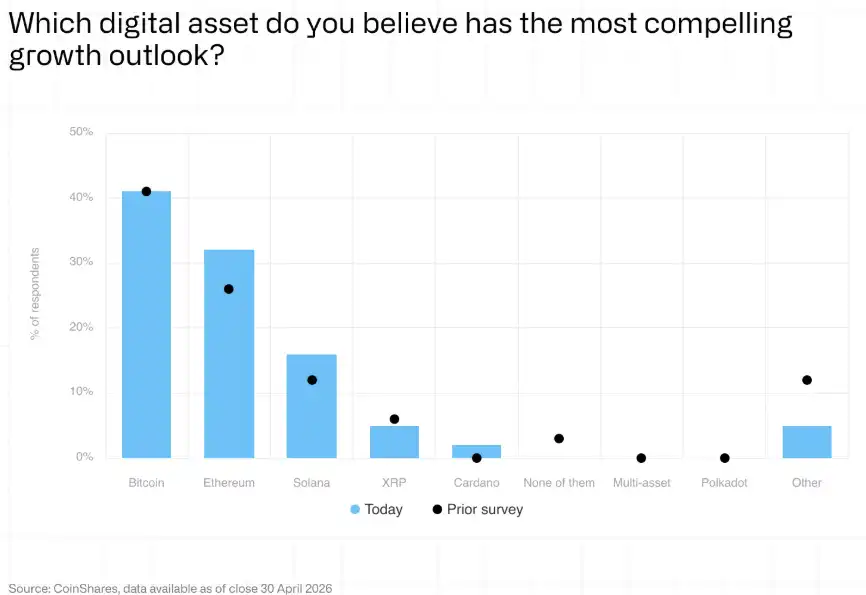
CoinShares' latest quarterly survey reveals a cautious yet growing institutional interest in cryptocurrencies. Among 26 surveyed investors managing a combined $1.3 trillion in assets, 32% now hold Bitcoin (BTC) and 25% hold Ethereum (ETH), though digital assets typically comprise only about 1% of their portfolios. The report identifies Bitcoin as having the strongest growth prospects, followed by ETH and Solana (SOL). This sentiment is reflected in sustained capital inflows. Digital asset investment products have seen four consecutive weeks of net inflows, totaling $3.9 billion in that period. U.S. spot Bitcoin ETFs alone attracted nearly $1 billion in net inflows in early May, coinciding with BTC's price rising above $80,000. Key drivers for this adoption include improved regulatory clarity and the availability of regulated ETF products, which simplify exposure. However, internal compliance restrictions and regulatory uncertainty remain the primary obstacles to larger-scale investment. A trend noted is capital shifting from older altcoins towards newer DeFi protocols and emerging blockchain sectors.

Author: Sam Bourgi

Compiled by: TechFlow Deep Tide

Deep Tide Introduction: The latest quarterly survey from CoinShares shows that among 26 institutional investors managing a combined $1.3 trillion in assets, 32% already hold BTC and 25% have allocated to ETH. The proportion of digital asset allocation remains low at only about 1%, but fund inflows have been positive for four consecutive weeks, with spot BTC ETFs seeing nearly $1 billion in net inflows in a single week in early May. Improved regulatory friendliness and the opening of ETF channels are the core drivers, while internal compliance restrictions remain the biggest obstacle.

Fund managers are embracing digital assets again. The latest CoinShares survey shows that Bitcoin continues to dominate institutional allocation preferences, and overall crypto market sentiment is also warming.

This April survey covered 26 institutional investors with a combined AUM of $1.3 trillion. The allocation of digital assets in investment portfolios remains low, at about 1%. CoinShares describes this as a "typical entry-level position," corresponding to the current risk-off market environment.

James Butterfill, Head of Research at CoinShares, wrote in the report: "Bitcoin remains the digital asset with the most compelling growth prospects." Sentiment towards ETH and SOL has also improved moderately compared to previous quarters.

Survey data: 32% of respondents have already invested in BTC, and 25% have allocated to ETH.

Institutional investors are gradually increasing their positions, driven by factors such as improving market sentiment, rising ETF adoption, and a more friendly regulatory environment. Meanwhile, respondents cited internal compliance restrictions and regulatory uncertainty as the primary obstacles to broader adoption. The survey also noted a trend: funds are flowing from "legacy altcoins" to newer DeFi protocols and emerging blockchain sectors.

Caption: Fund managers believe Bitcoin has the strongest growth prospects among digital assets, followed by ETH and SOL

Source:CoinShares

Sustained Inflows, Sentiment Indicators Warm Across the Board

The survey's optimistic tone aligns with broader institutional flow data. CoinShares data shows that digital asset investment products have recorded net inflows for multiple consecutive weeks, primarily driven by Bitcoin demand.

Crypto ETPs attracted $1.2 billion in inflows in the four weeks ending April 27, marking the fourth consecutive positive week, with cumulative inflows of $3.9 billion over those four weeks.

This momentum continued into early May. SoSoValue data shows that US spot Bitcoin ETFs recorded nearly $1 billion in net inflows this week, with BTC prices climbing back above $80,000.

Caption: Bitcoin ETF inflows have continued to rise since last Friday

Source: SoSoValue

The inflow trend also aligns with a joint survey by Coinbase and EY-Parthenon: 73% of institutional investors plan to increase their digital asset exposure this year, with most expecting crypto asset prices to rise over the next 12 months.

The launch of US spot Bitcoin ETFs in January 2024 is widely regarded as a turning point for institutional adoption. The ETF structure reduces operational friction for institutions, providing regulated Bitcoin exposure without the need for direct digital asset custody.

Связанные с этим вопросы

QWhat percentage of the surveyed institutional investors manage $1.3 trillion in assets are currently holding Bitcoin?

A32% of the surveyed institutional investors are currently holding Bitcoin.

QWhat are the two main factors cited as driving increased institutional allocation to digital assets according to the CoinShares report?

AThe two main driving factors are improved regulatory friendliness and the opening of ETF access channels.

QWhat does the survey identify as the primary obstacle to larger-scale adoption of digital assets by institutions?

AThe survey identifies internal compliance restrictions and regulatory uncertainty as the primary obstacles to larger-scale adoption.

QHow much net inflow did US spot Bitcoin ETFs record in a single week in early May, according to the article?

AUS spot Bitcoin ETFs recorded nearly $1 billion in net inflows in a single week in early May.

QBesides Bitcoin, which two digital assets showed improved sentiment among institutional investors compared to previous quarters?

ABesides Bitcoin, sentiment for Ethereum (ETH) and Solana (SOL) showed moderate improvement compared to previous quarters.

Похожее

Agents Take Over Traffic Distribution Power: What Are Tencent, ByteDance, and Alibaba Competing For?

In the race to dominate the AI era's entry point, China's tech giants—Tencent, ByteDance, and Alibaba—are aggressively deploying AI Agents to control the future of traffic distribution. Alibaba is pursuing a dual-track "closed loop + openness" strategy. Its Qianwen app is evolving into a super-Agent integrated across its ecosystem (Taobao, Alipay, etc.) to handle complex tasks like travel planning. Concurrently, it is opening its platform to external brands (Luckin Coffee, KFC) and has launched a B2B Agent platform, "Wukong," targeting enterprise automation. Its other flagship, Quark, aims to be an "AI super search box" for information and tasks. ByteDance is executing an omnipresent "sprawl strategy." Its Doubao app boasts over 300 million monthly active users and is evolving into a default AI entry point for daily life, with plans for paid versions and e-commerce integration. Its core weapon is the Kouzi platform, a visual "AI assembly factory" for developers to build custom Agents. ByteDance is also pushing hardware integration, collaborating on AI phones and developing smart glasses to embed Doubao everywhere. Tencent is playing its long-held "ultimate card" by quietly embedding an AI Agent directly into WeChat. This Agent, accessible via a swipe, can understand user commands and automatically execute tasks by calling upon WeChat's millions of mini-programs (e.g., finding and ordering coffee). This leverages WeChat's unparalleled 1.4-billion-user ecosystem to position the app as an AI-powered "service operating system," a move that could dramatically reshape the competitive landscape. The core battleground is shifting from competing for "user screen time" to competing to be the "default execution layer" for user intent. The business model is evolving from an "attention economy" to an "intent economy," where the Agent that can most efficiently fulfill a user's need gains control over service access and token flow. This represents a fundamental change in how users connect with digital services, making the fight for the Agent入口 (entry point) a pivotal moment for redefining industry leadership in the AI age.

marsbit36 мин. назад

Agents Take Over Traffic Distribution Power: What Are Tencent, ByteDance, and Alibaba Competing For?

marsbit36 мин. назад

From Banning Doubao to Embracing Honor: Why Did WeChat Suddenly 'Change Its Face'?

The article explores the sudden shift in WeChat's strategy towards AI assistants from mobile phone manufacturers, transitioning from strict opposition to active collaboration. For over a year, WeChat fiercely resisted attempts by phone AI assistants (like ByteDance's Doubao in late 2025) to control its features via GUI automation ("simulated clicking"), citing security and data control concerns. This stance created a significant barrier for system-level AI integration. Now, Tencent has initiated A2A (Agent-to-Agent) partnerships with major phone brands like Honor, Xiaomi, OPPO, and vivo. This model allows a phone's system AI (e.g., Honor's YOYO) to parse a user's voice command and send a structured request directly to WeChat's own internal AI agent via secure APIs. WeChat then executes the action (e.g., sending a message) and returns the result. The article attributes Tencent's "change of face" to strategic pressure. While leading in social app usage, Tencent trails rivals like ByteDance and Alibaba in standalone AI app popularity. WeChat, with its vast mini-program ecosystem, is Tencent's key asset for an AI comeback. The upcoming WeChat AI agent aims to handle tasks like booking and payments within the app. However, phone system assistants remain the primary AI entry point for most users. The A2A collaboration allows Tencent to extend WeChat's AI reach to this crucial system layer while maintaining control over its core functions and data. For phone manufacturers, embracing A2A is a pragmatic move. The GUI route proved unviable due to WeChat's blocks. A2A offers a compliant path to integrate a vital service, enhancing their AI assistants' usefulness. It allows them to focus on developing their own AI ecosystems for other services while cooperating on WeChat access. The collaboration is framed as a mutual, strategic necessity: Tencent gains a distribution channel, and manufacturers gain a key functionality. The partnership relies on a "dual authorization" mechanism for security, requiring both user and app consent for each action. While questions about long-term data privacy practices remain, experts note A2A is more secure and compliant than GUI automation. Ultimately, this cooperation is seen as a tentative, calculated truce. Tencent's long-term goal is to make WeChat an AI-powered "service OS." Phone manufacturers aim to make their system AI the central user interface. Their paths may converge or clash in the future, but for now, the A2A deal represents the opening chapter in the battle for the AI-era user入口, driven by necessity and strategic calculus on both sides.

marsbit2 ч. назад

From Banning Doubao to Embracing Honor: Why Did WeChat Suddenly 'Change Its Face'?

marsbit2 ч. назад

Торговля

Спот
Фьючерсы

Популярные статьи

Тест по Bitcoin Биткоина

HTX Learn: Изучите Bitcoin halving и Заработаете Токены USDT

3.1k просмотров всегоОпубликовано 2024.04.16Обновлено 2024.04.16

Тест по Bitcoin  Биткоина

Что такое $BITCOIN

ЦИФРОВОЕ ЗОЛОТО ($BITCOIN): Комплексный анализ Введение в ЦИФРОВОЕ ЗОЛОТО ($BITCOIN) ЦИФРОВОЕ ЗОЛОТО ($BITCOIN) — это проект на основе блокчейна, работающий в сети Solana, который стремится объединить характеристики традиционных драгоценных металлов с инновациями децентрализованных технологий. Хотя он носит имя Биткойн, часто называемого “цифровым золотом” из-за его восприятия как средства хранения ценности, ЦИФРОВОЕ ЗОЛОТО является отдельным токеном, предназначенным для создания уникальной экосистемы в ландшафте Web3. Его цель — позиционировать себя как жизнеспособный альтернативный цифровой актив, хотя детали его применения и функциональности все еще развиваются. Что такое ЦИФРОВОЕ ЗОЛОТО ($BITCOIN)? ЦИФРОВОЕ ЗОЛОТО ($BITCOIN) — это токен криптовалюты, специально разработанный для использования в блокчейне Solana. В отличие от Биткойна, который выполняет широко признанную роль хранения ценности, этот токен, похоже, сосредоточен на более широких приложениях и характеристиках. Примечательные аспекты включают: Инфраструктура блокчейна: Токен построен на блокчейне Solana, известном своей способностью обрабатывать высокоскоростные и недорогие транзакции. Динамика предложения: ЦИФРОВОЕ ЗОЛОТО имеет максимальное предложение, ограниченное 100 квадриллионами токенов (100P $BITCOIN), хотя детали о его обращающемся предложении в настоящее время не раскрыты. Утилита: Хотя точные функциональные возможности не описаны, есть указания на то, что токен может быть использован для различных приложений, потенциально связанных с децентрализованными приложениями (dApps) или стратегиями токенизации активов. Кто создатель ЦИФРОВОГО ЗОЛОТА ($BITCOIN)? На данный момент личность создателей и команды разработчиков, стоящих за ЦИФРОВЫМ ЗОЛОТОМ ($BITCOIN), остается неизвестной. Эта ситуация типична для многих инновационных проектов в области блокчейна, особенно тех, которые связаны с децентрализованными финансами и феноменом мем-криптовалют. Хотя такая анонимность может способствовать культуре, ориентированной на сообщество, она усиливает опасения по поводу управления и ответственности. Кто инвесторы ЦИФРОВОГО ЗОЛОТА ($BITCOIN)? Доступная информация указывает на то, что у ЦИФРОВОГО ЗОЛОТА ($BITCOIN) нет известных институциональных спонсоров или значительных венчурных капиталовложений. Проект, похоже, функционирует по модели пирингового взаимодействия, сосредоточенной на поддержке и принятии сообществом, а не на традиционных путях финансирования. Его активность и ликвидность в основном сосредоточены на децентрализованных биржах (DEX), таких как PumpSwap, а не на устоявшихся централизованных торговых платформах, что еще больше подчеркивает его подход, ориентированный на grassroots. Как работает ЦИФРОВОЕ ЗОЛОТО ($BITCOIN) Операционные механизмы ЦИФРОВОГО ЗОЛОТА ($BITCOIN) можно подробно описать на основе его дизайна блокчейна и характеристик сети: Механизм консенсуса: Используя уникальный механизм доказательства истории (PoH) Solana в сочетании с моделью доказательства доли (PoS), проект обеспечивает эффективную валидацию транзакций, что способствует высокой производительности сети. Токеномика: Хотя конкретные дефляционные механизмы не были подробно описаны, большое максимальное предложение токенов подразумевает, что оно может быть предназначено для микротранзакций или нишевых случаев использования, которые еще предстоит определить. Интероперабельность: Существует потенциал для интеграции с более широкой экосистемой Solana, включая различные платформы децентрализованных финансов (DeFi). Однако детали относительно конкретных интеграций остаются неуточненными. Хронология ключевых событий Вот хронология, которая подчеркивает значимые вехи, касающиеся ЦИФРОВОГО ЗОЛОТА ($BITCOIN): 2023: Первоначальное развертывание токена происходит в блокчейне Solana, отмеченное его адресом контракта. 2024: ЦИФРОВОЕ ЗОЛОТО приобретает видимость, когда оно становится доступным для торговли на децентрализованных биржах, таких как PumpSwap, позволяя пользователям обменивать его на SOL. 2025: Проект наблюдает спорадическую торговую активность и потенциальный интерес к инициативам, возглавляемым сообществом, хотя на данный момент не зафиксировано никаких значительных партнерств или технических достижений. Критический анализ Сильные стороны Масштабируемость: Основная инфраструктура Solana поддерживает высокие объемы транзакций, что может повысить полезность $BITCOIN в различных сценариях транзакций. Доступность: Потенциально низкая цена торговли за токен может привлечь розничных инвесторов, способствуя более широкому участию благодаря возможностям дробного владения. Риски Отсутствие прозрачности: Отсутствие публично известных спонсоров, разработчиков или процесса аудита может вызвать скептицизм относительно устойчивости и надежности проекта. Волатильность рынка: Торговая активность сильно зависит от спекулятивного поведения, что может привести к значительной волатильности цен и неопределенности для инвесторов. Заключение ЦИФРОВОЕ ЗОЛОТО ($BITCOIN) является интригующим, но неоднозначным проектом в быстро развивающейся экосистеме Solana. Хотя он пытается использовать нарратив “цифрового золота”, его отход от установленной роли Биткойна как средства хранения ценности подчеркивает необходимость более четкого различения его предполагаемой утилиты и структуры управления. Будущее принятие и усвоение, вероятно, будут зависеть от решения текущей непрозрачности и более четкого определения его операционных и экономических стратегий. Примечание: Этот отчет охватывает синтезированную информацию, доступную на октябрь 2023 года, и с тех пор могут произойти события.

99 просмотров всегоОпубликовано 2025.05.13Обновлено 2025.05.13

Что такое $BITCOIN

Fractal Bitcoin: масштабирование Биткоина с помощью рекурсивной системы

Fractal Bitcoin — масштабное Layer-1-решнение, созданное на базе кода Биткоина, позволяющего достигать бесконечного масштабирования с помощью рекурсивного подхода.

2.3k просмотров всегоОпубликовано 2025.06.30Обновлено 2025.06.30

Fractal Bitcoin: масштабирование Биткоина с помощью рекурсивной системы

Обсуждения

Добро пожаловать в Сообщество HTX. Здесь вы сможете быть в курсе последних новостей о развитии платформы и получить доступ к профессиональной аналитической информации о рынке. Мнения пользователей о цене на BTC (BTC) представлены ниже.

活动图片