By The Numbers: How Much Bitcoin Supply Is Exposed To Quantum Risk?

bitcoinistОпубликовано 2026-05-21Обновлено 2026-05-21

Введение

Glassnode estimates that 6.04 million BTC, representing over 30% of the circulating supply, is potentially exposed to quantum computing risk. The risk arises when a wallet's public key is visible on the blockchain, which quantum computers could theoretically use to break cryptographic security. This exposed supply is divided into two categories: structurally unsafe coins (1.92 million BTC, 9.6%) due to older wallet designs, and operationally unsafe coins (4.12 million BTC, 20.6%) where practices like address reuse have revealed public keys. While structurally unsafe supply has decreased over time, operationally unsafe supply has grown. The remaining 13.99 million BTC are considered safe. Concurrently, Bitcoin's price is near $77,000, down over 3% weekly.

Analytics firm Glassnode has broken down how much of the Bitcoin supply is at risk due to Quantum Computing and what its composition looks like.

6.04 Million Bitcoin Is Estimated To Be Exposed To Quantum Risk

In a new X article, Glassnode has talked about the part of the Bitcoin supply in circulation that’s exposed to the risk posed by Quantum Computing. “Quantum Computing” refers to an emerging class of computers that can, in theory, be powerful enough to break advanced cryptographic systems. Bitcoin and other cryptocurrencies could be examples of such systems.

While Quantum Computing is something that has been “upcoming” for years now, the technology has made some advancements recently that has made many in the digital asset industry talk about its possible consequences for the sector.

For Bitcoin, the main threat from Quantum Computing involves the supply that’s sitting in vulnerable wallets. “The relevant threshold is whether the public key needed to spend a coin is already visible on-chain,” noted Glassnode.

Based on this criteria, the analytics firm has estimated 6.04 million tokens to be vulnerable to potential Quantum Computing attacks. In terms of the supply percentage, these coins make up for more than 30% of all BTC in existence today.

The supply at risk to the Quantum Computing threat can be further divided into two categories. As Glassnode explained:

The first is structural exposure: outputs whose script type reveals the public key by design. The second is operational exposure: coins that may have been protected initially, but where address reuse, partial spending, or custody behaviour has already made the public key visible while BTC remains tied to it.

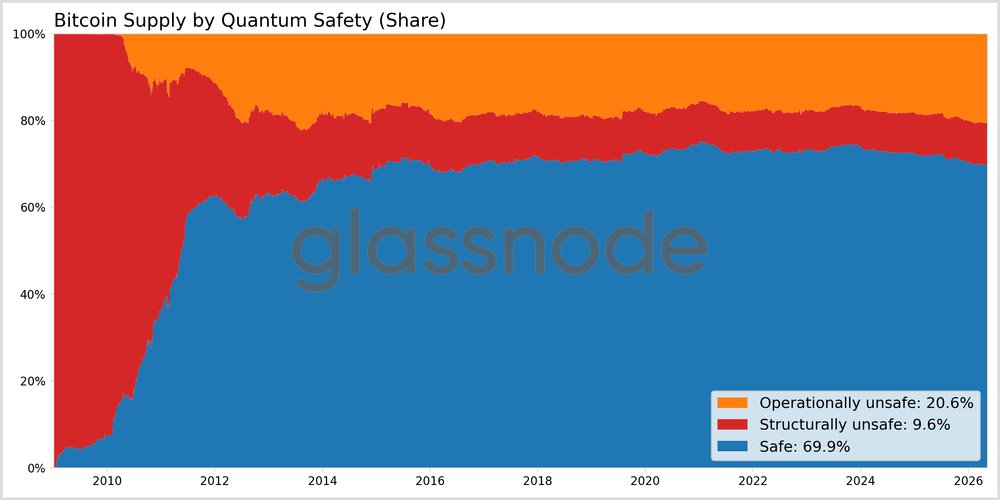
Below is a chart that shows how the composition of the Bitcoin supply has changed in terms of these two categories over the years.

Looks like the operationally unsafe supply has grown in size | Source: Glassnode on X

As is visible in the graph, a major part of the Bitcoin supply was structurally unsafe during the cryptocurrency’s early years. This is naturally due to the fact that early wallets weren’t as secure as those in use today.

As the years have gone by and investors have adopted better wallet standards, the structurally unsafe supply has shrunken to just 9.6%. A notable 20.6% of the supply, however, is still inside the operationally unsafe category. This part of the supply has actually seen some growth in recent years.

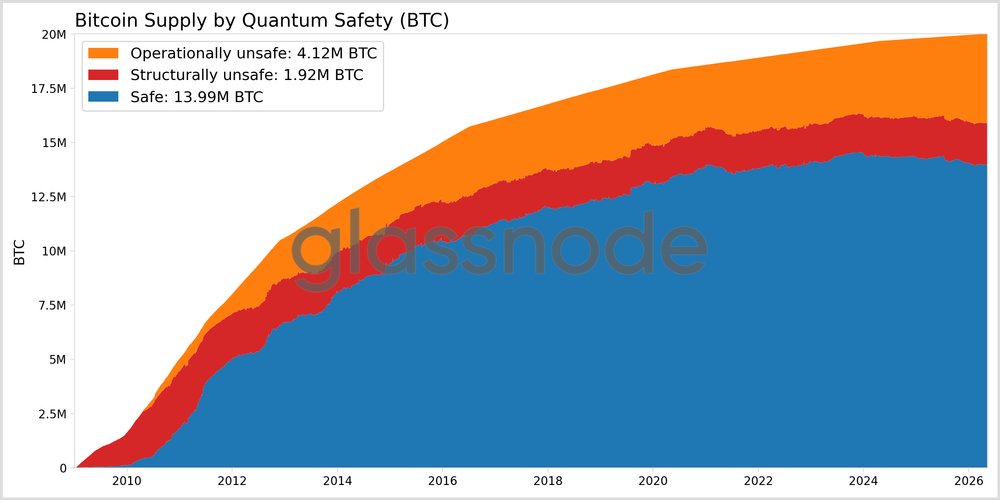
In pure numbers, the operationally unsafe supply includes about 4.12 million BTC right now, as the below chart shows.

The breakdown of the BTC supply by quantum safety | Source: Glassnode on X

Meanwhile, the structurally unsafe supply is made up of 1.92 million BTC, while the safe one includes 13.99 million BTC.

BTC Price

At the time of writing, Bitcoin is floating around $77,000, down more than 3% in the last seven days.

The price of the coin seems to have declined recently | Source: BTCUSDT on TradingView

Связанные с этим вопросы

QAccording to Glassnode, how many Bitcoin are estimated to be exposed to quantum risk, and what percentage of the total supply does this represent?

AGlassnode estimates that 6.04 million Bitcoin are exposed to quantum risk, which represents more than 30% of the total Bitcoin supply in existence today.

QWhat are the two categories into which the Bitcoin supply at risk from Quantum Computing is divided, and what are the current figures for each in terms of supply percentage?

AThe two categories are 'structural exposure' and 'operational exposure'. Currently, structurally unsafe supply makes up 9.6% of the total supply, while operationally unsafe supply makes up 20.6%.

QWhat specific condition, according to the article, determines if a Bitcoin holding is vulnerable to a potential Quantum Computing attack?

AThe relevant condition is whether the public key needed to spend a coin is already visible on the blockchain. If it is, that Bitcoin is considered vulnerable to a potential Quantum Computing attack.

QHow has the 'structurally unsafe' Bitcoin supply changed from the cryptocurrency's early years to the present?

ADuring Bitcoin's early years, a major part of the supply was structurally unsafe due to less secure wallet standards. Over time, as better wallet standards were adopted, this portion has shrunk to just 9.6%.

QBased on the data provided in the article's final charts, how many Bitcoin are currently in the 'safe' category regarding quantum risk, and what was the price of Bitcoin at the time of writing?

AThere are 13.99 million Bitcoin in the 'safe' category. At the time of writing, Bitcoin was floating around $77,000.

Похожее

Putting Markets On-Chain: Canton Network Quietly Becoming the New Backbone for Institutional Finance

Canton Network: A New Institutional Financial Infrastructure Emerges Visa's rapid three-day approval as a super-validator on Canton Network in March 2026 marks a significant institutional endorsement. Unlike public blockchains like Ethereum, which prioritize transparency, Canton is designed for regulated financial institutions. Its core innovation is built-in data visibility control, where transaction details are only visible to direct participants. This enables institutions like Goldman Sachs, JPMorgan, and DTCC to conduct private, secure business on-chain without exposing sensitive strategies or positions. Canton, developed by Wall Street-focused Digital Asset, emphasizes slow, methodical development to meet stringent institutional requirements. Current on-chain activity, exceeding $9 trillion monthly, involves real balance-sheet operations like tokenized repos, treasury settlements, and collateral movement—not retail speculation. Key applications include JPMorgan's deposit token (JPM Coin), DTCC's U.S. Treasury tokenization, and Visa-enabled atomic settlement, aiming to synchronize asset delivery and payment instantly. The network's CC token is a utility asset, with value tied to real financial activity volume. It features no pre-mine or VC allocations, aligning with institutional preferences for transparency. Canton's 3–5 year vision is to become an "invisible" foundational layer for global finance—facilitating real-time cross-border capital flows, institutional stablecoin settlement, and native on-chain operations for major asset classes. While regulatory harmonization and legacy system integration remain challenges, Canton represents a pragmatic shift towards embedding markets themselves into blockchain infrastructure.

Odaily星球日报4 ч. назад

Putting Markets On-Chain: Canton Network Quietly Becoming the New Backbone for Institutional Finance

Odaily星球日报4 ч. назад

Торговля

Спот
Фьючерсы

Популярные статьи

Тест по Bitcoin Биткоина

HTX Learn: Изучите Bitcoin halving и Заработаете Токены USDT

3.0k просмотров всегоОпубликовано 2024.04.16Обновлено 2024.04.16

Тест по Bitcoin  Биткоина

Что такое $BITCOIN

ЦИФРОВОЕ ЗОЛОТО ($BITCOIN): Комплексный анализ Введение в ЦИФРОВОЕ ЗОЛОТО ($BITCOIN) ЦИФРОВОЕ ЗОЛОТО ($BITCOIN) — это проект на основе блокчейна, работающий в сети Solana, который стремится объединить характеристики традиционных драгоценных металлов с инновациями децентрализованных технологий. Хотя он носит имя Биткойн, часто называемого “цифровым золотом” из-за его восприятия как средства хранения ценности, ЦИФРОВОЕ ЗОЛОТО является отдельным токеном, предназначенным для создания уникальной экосистемы в ландшафте Web3. Его цель — позиционировать себя как жизнеспособный альтернативный цифровой актив, хотя детали его применения и функциональности все еще развиваются. Что такое ЦИФРОВОЕ ЗОЛОТО ($BITCOIN)? ЦИФРОВОЕ ЗОЛОТО ($BITCOIN) — это токен криптовалюты, специально разработанный для использования в блокчейне Solana. В отличие от Биткойна, который выполняет широко признанную роль хранения ценности, этот токен, похоже, сосредоточен на более широких приложениях и характеристиках. Примечательные аспекты включают: Инфраструктура блокчейна: Токен построен на блокчейне Solana, известном своей способностью обрабатывать высокоскоростные и недорогие транзакции. Динамика предложения: ЦИФРОВОЕ ЗОЛОТО имеет максимальное предложение, ограниченное 100 квадриллионами токенов (100P $BITCOIN), хотя детали о его обращающемся предложении в настоящее время не раскрыты. Утилита: Хотя точные функциональные возможности не описаны, есть указания на то, что токен может быть использован для различных приложений, потенциально связанных с децентрализованными приложениями (dApps) или стратегиями токенизации активов. Кто создатель ЦИФРОВОГО ЗОЛОТА ($BITCOIN)? На данный момент личность создателей и команды разработчиков, стоящих за ЦИФРОВЫМ ЗОЛОТОМ ($BITCOIN), остается неизвестной. Эта ситуация типична для многих инновационных проектов в области блокчейна, особенно тех, которые связаны с децентрализованными финансами и феноменом мем-криптовалют. Хотя такая анонимность может способствовать культуре, ориентированной на сообщество, она усиливает опасения по поводу управления и ответственности. Кто инвесторы ЦИФРОВОГО ЗОЛОТА ($BITCOIN)? Доступная информация указывает на то, что у ЦИФРОВОГО ЗОЛОТА ($BITCOIN) нет известных институциональных спонсоров или значительных венчурных капиталовложений. Проект, похоже, функционирует по модели пирингового взаимодействия, сосредоточенной на поддержке и принятии сообществом, а не на традиционных путях финансирования. Его активность и ликвидность в основном сосредоточены на децентрализованных биржах (DEX), таких как PumpSwap, а не на устоявшихся централизованных торговых платформах, что еще больше подчеркивает его подход, ориентированный на grassroots. Как работает ЦИФРОВОЕ ЗОЛОТО ($BITCOIN) Операционные механизмы ЦИФРОВОГО ЗОЛОТА ($BITCOIN) можно подробно описать на основе его дизайна блокчейна и характеристик сети: Механизм консенсуса: Используя уникальный механизм доказательства истории (PoH) Solana в сочетании с моделью доказательства доли (PoS), проект обеспечивает эффективную валидацию транзакций, что способствует высокой производительности сети. Токеномика: Хотя конкретные дефляционные механизмы не были подробно описаны, большое максимальное предложение токенов подразумевает, что оно может быть предназначено для микротранзакций или нишевых случаев использования, которые еще предстоит определить. Интероперабельность: Существует потенциал для интеграции с более широкой экосистемой Solana, включая различные платформы децентрализованных финансов (DeFi). Однако детали относительно конкретных интеграций остаются неуточненными. Хронология ключевых событий Вот хронология, которая подчеркивает значимые вехи, касающиеся ЦИФРОВОГО ЗОЛОТА ($BITCOIN): 2023: Первоначальное развертывание токена происходит в блокчейне Solana, отмеченное его адресом контракта. 2024: ЦИФРОВОЕ ЗОЛОТО приобретает видимость, когда оно становится доступным для торговли на децентрализованных биржах, таких как PumpSwap, позволяя пользователям обменивать его на SOL. 2025: Проект наблюдает спорадическую торговую активность и потенциальный интерес к инициативам, возглавляемым сообществом, хотя на данный момент не зафиксировано никаких значительных партнерств или технических достижений. Критический анализ Сильные стороны Масштабируемость: Основная инфраструктура Solana поддерживает высокие объемы транзакций, что может повысить полезность $BITCOIN в различных сценариях транзакций. Доступность: Потенциально низкая цена торговли за токен может привлечь розничных инвесторов, способствуя более широкому участию благодаря возможностям дробного владения. Риски Отсутствие прозрачности: Отсутствие публично известных спонсоров, разработчиков или процесса аудита может вызвать скептицизм относительно устойчивости и надежности проекта. Волатильность рынка: Торговая активность сильно зависит от спекулятивного поведения, что может привести к значительной волатильности цен и неопределенности для инвесторов. Заключение ЦИФРОВОЕ ЗОЛОТО ($BITCOIN) является интригующим, но неоднозначным проектом в быстро развивающейся экосистеме Solana. Хотя он пытается использовать нарратив “цифрового золота”, его отход от установленной роли Биткойна как средства хранения ценности подчеркивает необходимость более четкого различения его предполагаемой утилиты и структуры управления. Будущее принятие и усвоение, вероятно, будут зависеть от решения текущей непрозрачности и более четкого определения его операционных и экономических стратегий. Примечание: Этот отчет охватывает синтезированную информацию, доступную на октябрь 2023 года, и с тех пор могут произойти события.

99 просмотров всегоОпубликовано 2025.05.13Обновлено 2025.05.13

Что такое $BITCOIN

Fractal Bitcoin: масштабирование Биткоина с помощью рекурсивной системы

Fractal Bitcoin — масштабное Layer-1-решнение, созданное на базе кода Биткоина, позволяющего достигать бесконечного масштабирования с помощью рекурсивного подхода.

2.3k просмотров всегоОпубликовано 2025.06.30Обновлено 2025.06.30

Fractal Bitcoin: масштабирование Биткоина с помощью рекурсивной системы

Обсуждения

Добро пожаловать в Сообщество HTX. Здесь вы сможете быть в курсе последних новостей о развитии платформы и получить доступ к профессиональной аналитической информации о рынке. Мнения пользователей о цене на BTC (BTC) представлены ниже.

活动图片