BlackRock CEO's Annual Shareholder Letter: How Will Wall Street Continue to Make Money with AI and National Pension Funds?

marsbitОпубликовано 2026-03-24Обновлено 2026-03-24

Введение

BlackRock CEO Larry Fink's 2026 shareholder letter warns that AI is creating a "K-shaped outcome," accelerating wealth concentration. Over the past 20 years, the S&P 500 grew eightfold, but 54% of stock wealth went to the top 1% of U.S. households, while the bottom 90% held just 7%. Fink argues that AI could exacerbate this inequality by benefiting large corporations and investors. He proposes two solutions: a bipartisan plan to inject $1.5 trillion into a government-managed investment fund to address Social Security shortfalls, and the promotion of tokenization to lower investment barriers for ordinary investors through regulated digital wallets. Notably, BlackRock’s tokenized U.S. Treasury fund (BUIDL) has grown significantly, positioning the firm to benefit from both proposals. Simultaneously, JPMorgan launched a credit default swap basket targeting major tech firms, signaling institutional preparation for AI-related debt risks. Fink’s diagnosis of inequality is accurate, but his solutions align closely with BlackRock’s business interests, highlighting a structural overlap between his policy advocacy and the firm’s growth strategy.

Larry Fink, CEO of BlackRock, which manages $14 trillion in assets, released his 2026 annual shareholder letter on March 23. In the letter, he warned that AI is creating a "K-shaped outcome," with leading companies accelerating away from everyone else. He wrote, "When market capitalization climbs while ownership remains narrow, prosperity can feel increasingly distant."

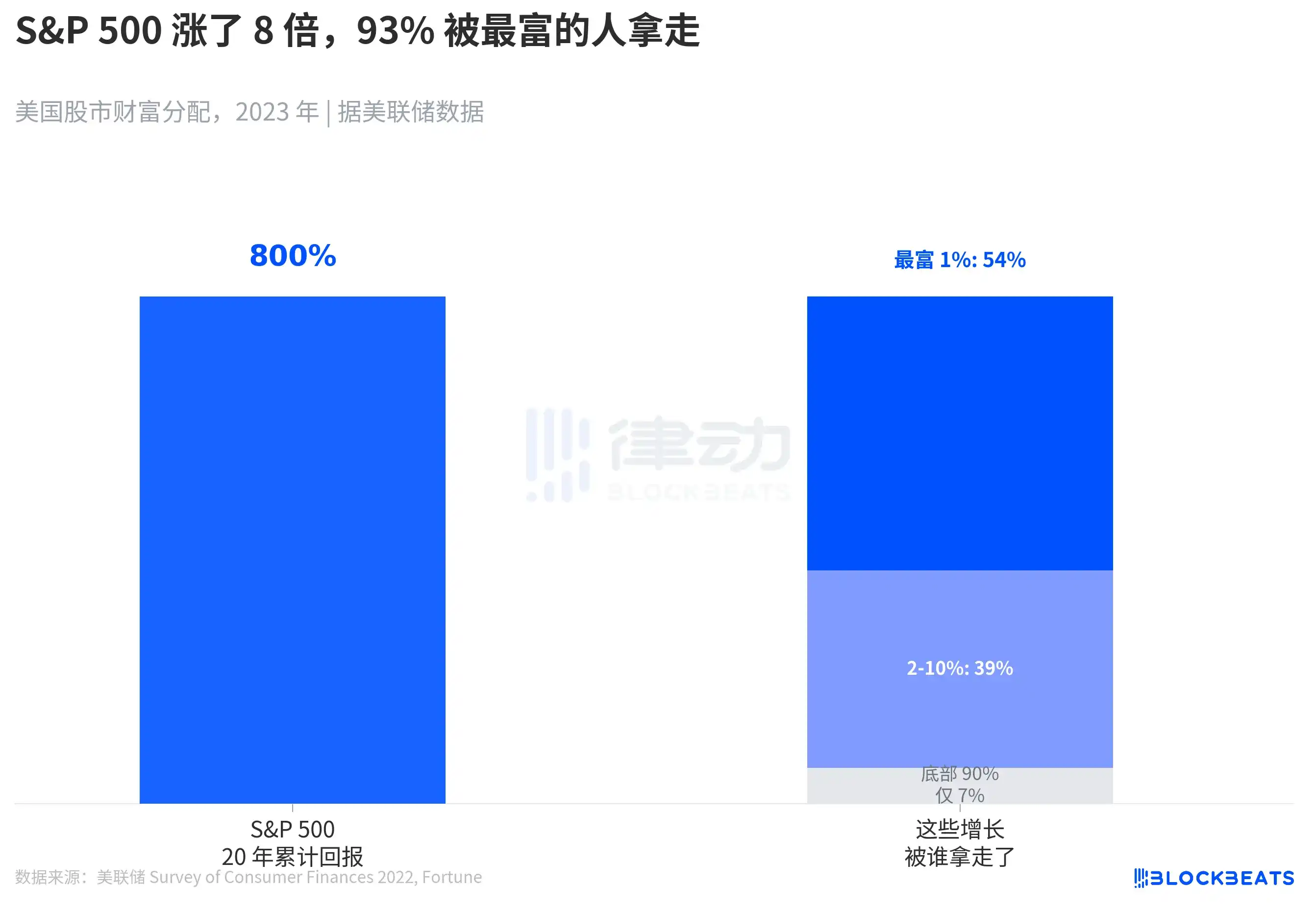
This is not an empty statement. Over the past 20 years, the S&P 500 has increased 8-fold. But according to the Federal Reserve's 2022 Survey of Consumer Finances (SCF), the distribution of this 8-fold growth has been extremely concentrated.

The wealthiest 1% of U.S. households captured 54% of all stock market wealth, a figure that was 40% 20 years ago. The next 2-10% captured 39%. The bottom 90% of Americans collectively hold only 7% of stocks, and the bottom 50% hold just 1%. According to Gallup data, 87% of households with an annual income over $100,000 own stocks, compared to only 28% of those with incomes under $50,000.

Fink used a precise analogy in his letter. "Since 1989, one dollar invested in the U.S. stock market has appreciated more than 15 times one dollar tied to the median wage." In other words, the gap between those with money to invest and those relying solely on wages has widened 15-fold over 35 years. He worries that AI will "repeat this pattern on a larger scale, concentrating wealth in the companies and investors capable of capturing it."

This diagnosis is accurate. The prescription that follows is the part of the letter that is truly worth dissecting.

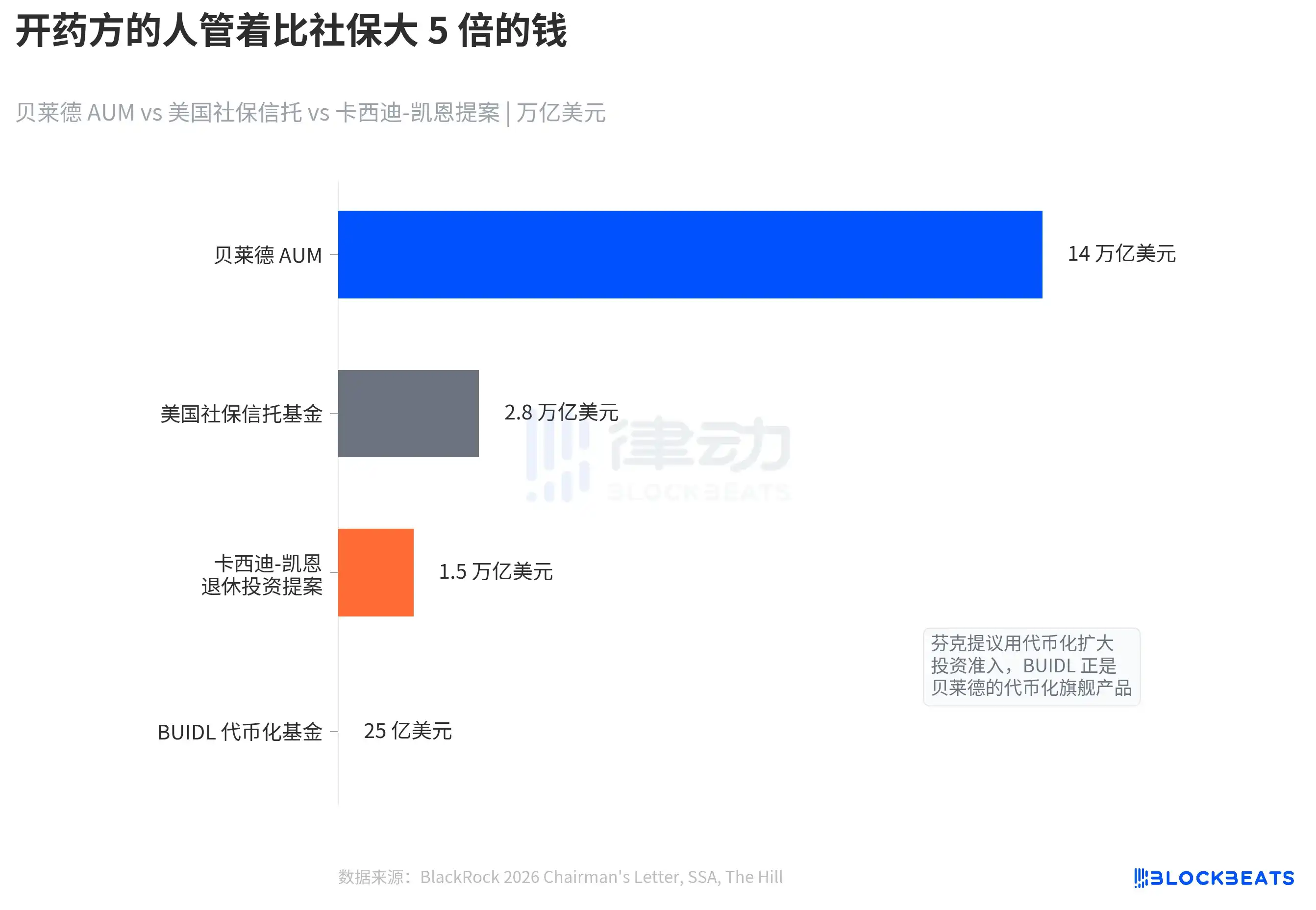
Fink cited a bipartisan proposal by Senators Bill Cassidy and Tim Kaine. The content involves the federal government borrowing $1.5 trillion over 5 years to inject into an investment fund independent of the existing social security system. This fund would buy stocks, private equity, and other assets, lock them in for 75 years, and use the returns to supplement the social security shortfall. The U.S. Social Security Trust Fund is projected to be depleted by 2033, at which point beneficiaries would receive only 83% of promised benefits.

Compare the numbers. The U.S. Social Security Trust Fund is about $2.8 trillion; the Cassidy-Kaine proposal would inject $1.5 trillion. BlackRock's assets under management are $14 trillion, 5 times the size of the Social Security fund. If the government really establishes a $1.5 trillion investment fund, who will manage it? Fink didn't say it directly, but BlackRock is the world's largest asset manager.

Even more intriguing is the second prescription Fink offers. He positions tokenization as being "roughly equivalent to the internet in 1996" and proposes establishing "a regulated digital wallet" that would allow ordinary investors to use it to hold ETFs, bonds, stablecoins, and infrastructure shares. This would lower the barrier to investment and allow more people to participate in the market.

This vision corresponds perfectly to BlackRock's biggest business bets over the past two years. BlackRock's BUIDL fund (an on-chain tokenized U.S. Treasury fund) surpassed $1 billion in AUM in March 2025, peaking at nearly $2.9 billion mid-year, capturing over 40% of the tokenized Treasury market. In February 2026, BUIDL launched on Uniswap, allowing whitelisted investors to trade with stablecoins 24/7. According to CCN, BUIDL has become one of the world's largest tokenized cash products.

Fink's declaration of interest and policy recommendations align perfectly. He calls for more people to enter the investment market through tokenization, and BlackRock's flagship tokenized product is already waiting to onboard clients. He proposes the government establish a large investment fund, and BlackRock is the most qualified institution to manage that money. This is not an accusation that he is lying; it is pointing out a structural fact. When the CEO of the world's largest asset manager calls for expanded investment access, he is simultaneously calling for an expansion of his own client base.

On the same day, another signal came from Wall Street.

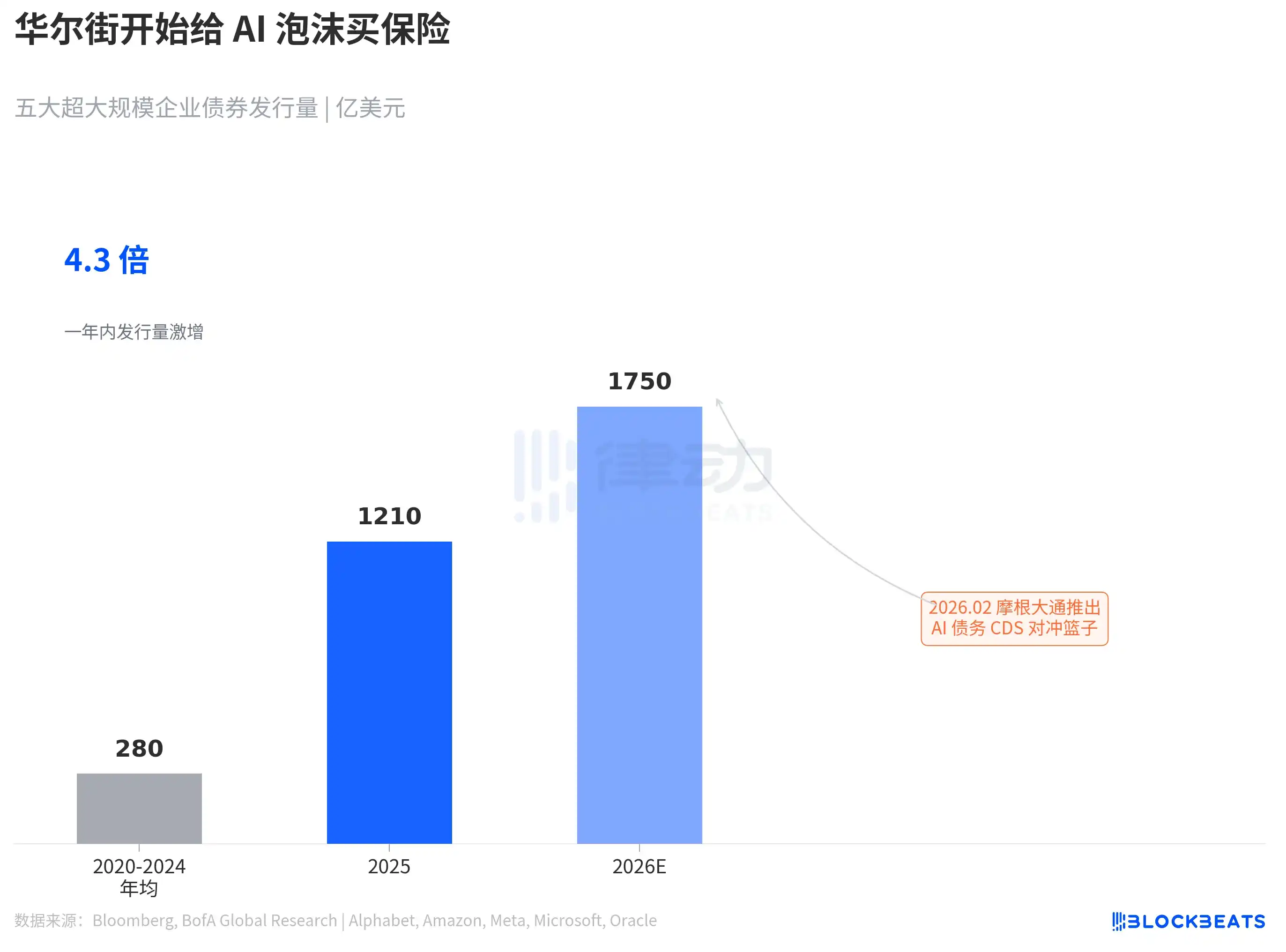
According to Bloomberg, JPMorgan Chase launched a CDS (credit default swap) basket in February 2026 targeting the five hyperscale companies (Alphabet, Amazon, Meta, Microsoft, Oracle), with a trading unit of $25 million. These five companies issued approximately $121 billion in bonds in 2025, 4.3 times the average annual issuance of $28 billion from 2020-2024. According to Bank of America forecasts, issuance will further climb to $175 billion in 2026.

When Wall Street starts designing hedging tools for AI infrastructure debt, it indicates that institutional investors are already preparing for a potential bubble burst. Fink says AI will exacerbate inequality; JPMorgan says AI's debt risk is already significant enough to warrant selling insurance. Both signals point to the same fact. The AI boom is creating enormous wealth, but the distribution of this wealth and its risk exposure are repeating the pattern of the previous cycle in a familiar way.

Fink manages $14 trillion. His diagnosis of inequality is accurate. But the medicine he prescribes happens to be his own product.

Связанные с этим вопросы

QWhat is the 'K-shaped outcome' that BlackRock CEO Larry Fink warns about in his annual shareholder letter?

ALarry Fink warns that AI is creating a 'K-shaped outcome,' where leading companies accelerate and pull away from everyone else, concentrating wealth among those with the capacity to capture it.

QAccording to the Federal Reserve's 2022 Survey of Consumer Finances, what percentage of total stock market wealth do the top 1% of U.S. households hold?

AThe top 1% of U.S. households hold 54% of all stock market wealth, up from 40% twenty years ago.

QWhat is the bipartisan proposal mentioned by Fink that involves the federal government borrowing $1.5 trillion?

AThe bipartisan proposal by Senators Bill Cassidy and Tim Kaine suggests the federal government borrow $1.5 trillion over five years to inject into an independent investment fund that buys stocks, private equity, and other assets to supplement the Social Security shortfall.

QWhat is BlackRock's BUIDL fund, and what milestone did it achieve in 2025?

ABlackRock's BUIDL fund is an on-chain tokenized U.S. Treasury fund. In March 2025, it surpassed $1 billion in assets under management (AUM), with a mid-year value nearing $2.9 billion, capturing over 40% of the tokenized Treasury market.

QWhat does the launch of JPMorgan's CDS basket for five mega-cap tech companies indicate about the AI boom?

AJPMorgan's launch of a CDS basket for Alphabet, Amazon, Meta, Microsoft, and Oracle indicates that institutional investors are preparing for potential risks and a possible bubble burst in AI infrastructure debt, highlighting the concentrated wealth and associated risks in the AI sector.

Похожее

Has the 'Digital Gold' Narrative for BTC Failed?

**Title: Has the "Digital Gold" Narrative for Bitcoin Failed?** The article argues that Bitcoin's "digital gold" narrative remains valid despite a recent sharp price decline (from a peak near $126k in Oct 2025 to briefly under $61k in Feb 2026). It presents a long-term investment framework based on three core points: **1. Viewing Bitcoin as an Asset:** Bitcoin is presented as a superior potential store of value compared to gold. Key arguments are its absolute scarcity (21 million cap), superior portability, and transparent auditability via its public ledger. While acknowledging its current use in early, volatile stages (~3-4% global adoption), the author draws parallels to the early, disruptive phases of the internet and e-commerce. **2. Understanding the Recent Downturn:** The current ~50% correction is framed as a predictable, consensus-driven cycle following its post-halving peak (the 2024 halving preceded the Oct 2025 high). A crucial factor is a historic "changing of hands": the influx of new institutional buyers via ETFs allowed early, low-cost holders (miners, OG believers) to take profits. The author notes that while severe, Bitcoin's historical drawdowns (e.g., 93% in 2011, 77% in 2021-22) have been progressively smaller, suggesting maturing holder structure and decreasing volatility over time. **3. The Long-Term Perspective:** The long-term thesis hinges on Bitcoin capturing a portion of gold's market value. With Bitcoin's market cap at ~$1.4 trillion (at $70k) versus gold's ~$20 trillion, significant upside potential exists if the "digital gold" narrative is partially realized. However, the author strongly cautions that short-term risks remain, the bottom is unpredictable, and high volatility is inherent. The real risk is not Bitcoin failing but poor personal position management (over-leverage, wrong capital) and a lack of deep understanding, which can force investors out during severe downturns. The conclusion uses Amazon's 95% crash post-2000 dot-com bubble and subsequent 42x recovery as an analogy. The ultimate question is not if Bitcoin's price will rise, but if an investor's strategy and conviction can withstand the volatility to see the long-term play out. The recent divergence (gold up, Bitcoin down) is posed not as a narrative failure, but as potential evidence of this ongoing, painful transition from a speculative asset to a mainstream allocation.

marsbit6 ч. назад

Has the 'Digital Gold' Narrative for BTC Failed?

marsbit6 ч. назад

Has BTC's 'Digital Gold' Narrative Failed?

The article discusses Bitcoin's "digital gold" narrative, its recent price drop, and long-term outlook through the perspective of "Jason". It argues the narrative is not a failure but that Bitcoin represents a superior, new asset class due to its fixed supply (21 million), portability, and auditability. The piece compares its current ~3-4% global adoption rate to early internet/e-commerce, suggesting significant growth potential. Regarding the 2025-2026 price decline (from ~$126k to briefly under $61k), the author views it as a predictable, consensus-driven sell-off within Bitcoin's ~4-year cycle post-halving, exacerbated by a major "handover" from early, low-cost holders to new institutional buyers via ETFs. A key observation is that historical peak-to-trough drawdowns have lessened over time (e.g., 93% in 2011 to ~50% in 2026), indicating maturing volatility as holder structure changes. For the long term, the author uses a simple framework: Bitcoin's total market cap (~$1.4T at $70k) is only about 7% of gold's (~$20T). Even capturing 30-50% of gold's value would imply substantial upside. However, the article strongly cautions against viewing this as investment advice, emphasizing extreme volatility and the critical importance of risk management, position sizing, and deep fundamental understanding to survive severe drawdowns. It concludes by drawing a parallel to Amazon's 95% crash in 2000 and subsequent 42x recovery, stressing that the key is surviving market cycles to realize long-term potential.

链捕手6 ч. назад

Has BTC's 'Digital Gold' Narrative Failed?

链捕手6 ч. назад

From Code to Cognition: A Ten-Thousand-Word Guide to the Evolution of the Robot Brain

"From Code to Cognition: The Evolution of Robot Brains" The journey of robotic intelligence has shifted dramatically from manually coded systems to AI-driven brains. For decades, robots relied on layered software stacks—perception, state estimation, planning, control—each handcrafted. While predictable, they lacked adaptability. The 2010s saw deep learning revolutionize perception (e.g., object detection) and control (via reinforcement learning), but learned skills remained narrow. The arrival of Large Language Models (LLMs) marked a turning point. LLMs acted as high-level planners, interpreting natural language instructions and generating sequences of actions for traditional robotic systems to execute. However, true integration came with Visual-Language-Action (VLA) models, which fused vision, language, and motion prediction into a single network. Pioneered by models like RT-2 and open-source projects like OpenVLA, VLAs enable robots to reason and act directly from visual input and commands. The most advanced humanoid robots now employ a "dual-brain" architecture: a slow-thinking, large VLA (System 2) for reasoning and planning, and a fast-reacting, small network (System 1) for high-frequency motion control, sometimes with an even lower-level System 0 for balance. This split balances cognition with the physics of real-time movement. Computation is split between onboard hardware (e.g., NVIDIA Jetson) for safety-critical control loops and cloud/edge servers for non-critical tasks like learning and interfaces. A crucial driver is the open-source ecosystem—models like GR00T and OpenVLA allow startups to build upon pre-trained brains and fine-tune them with their own data, accelerating development. Despite progress, current systems struggle with recovery from errors, sample inefficiency, and long-horizon tasks. This has spurred the rise of **World Models**—neural networks that predict the consequences of actions. By simulating possible futures before acting (like NVIDIA Cosmos or Meta V-JEPA), robots can plan, recover, and generalize better. This represents the next frontier: shifting intelligence from learned reactions to an internal model of physics and cause-and-effect. The field is rapidly evolving. While not yet at its "ChatGPT moment," the convergence of cheaper hardware, scalable simulation, and world models points toward robots that are increasingly capable, adaptive, and useful. The question is shifting from "what can robots do?" to "what *should* they do?"

marsbit7 ч. назад

From Code to Cognition: A Ten-Thousand-Word Guide to the Evolution of the Robot Brain

marsbit7 ч. назад

Торговля

Спот
Фьючерсы

Популярные статьи

Неделя обучения по популярным токенам (2): 2026 может стать годом приложений реального времени, сектор AI продолжает оставаться в тренде

2025 год — год институциональных инвесторов, в будущем он будет доминировать в приложениях реального времени.

1.8k просмотров всегоОпубликовано 2025.12.16Обновлено 2025.12.16

Неделя обучения по популярным токенам (2): 2026 может стать годом приложений реального времени, сектор AI продолжает оставаться в тренде

Обсуждения

Добро пожаловать в Сообщество HTX. Здесь вы сможете быть в курсе последних новостей о развитии платформы и получить доступ к профессиональной аналитической информации о рынке. Мнения пользователей о цене на AI (AI) представлены ниже.

活动图片