Bitmine Loads Up On 101,627 Ether In Record Post-December Buy

bitcoinistОпубликовано 2026-04-21Обновлено 2026-04-21

Введение

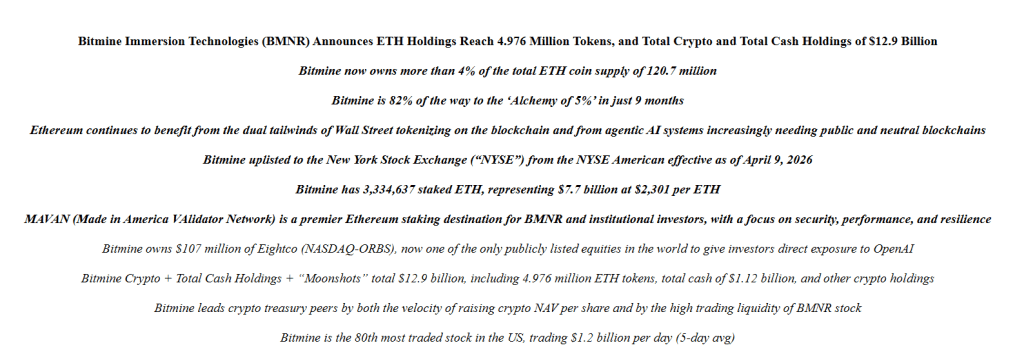
Bitmine Immersion Technologies significantly expanded its Ethereum holdings by acquiring 101,627 ETH in mid-April, marking its largest single-week purchase since December 2025. The company now holds nearly 5 million ETH, valued at approximately $11.5 billion, representing about 4.12% of all circulating Ether. Its goal is to reach 5% ownership. Of its total ETH, 3.33 million is actively staked, generating over $200 million in annualized revenue. Chairman Tom Lee stated that the company has increased its buying pace, believing Ethereum is nearing the end of a "mini-crypto winter." Bitmine also recently uplisted to the NYSE, improving its visibility among institutional investors.

Buried in Bitmine Immersion Technologies’ latest disclosure is a number that speaks to just how deep the company has gone on Ethereum.

Of the nearly 5 million ETH it now holds, 3.33 million is actively staked through its validator platform, generating more than $200 million in annualized staking revenue.

For a company built around accumulating a single digital asset, that income stream turns what might look like a speculative bet into something closer to an operating business.

The purchase that pushed those numbers higher came during the week of April 13 to April 19. Bitmine acquired 101,627 ETH in that period, its largest single-week buy since December 2025.

The transaction was disclosed Monday through a press release and a Form 8-K filing with the US Securities and Exchange Commission.

Source: SEC

Closing In On Target

Following the purchase, Bitmine held 4,976,485 ETH — valued at roughly $11.5 billion based on a reference price of $2,301 per toke`n. That puts the company’s ownership at about 4.12% of total Ether in circulation.

Its stated target is 5%, a goal the company refers to internally as the “alchemy of 5%.” At the current pace, it is around 80% of the way there.

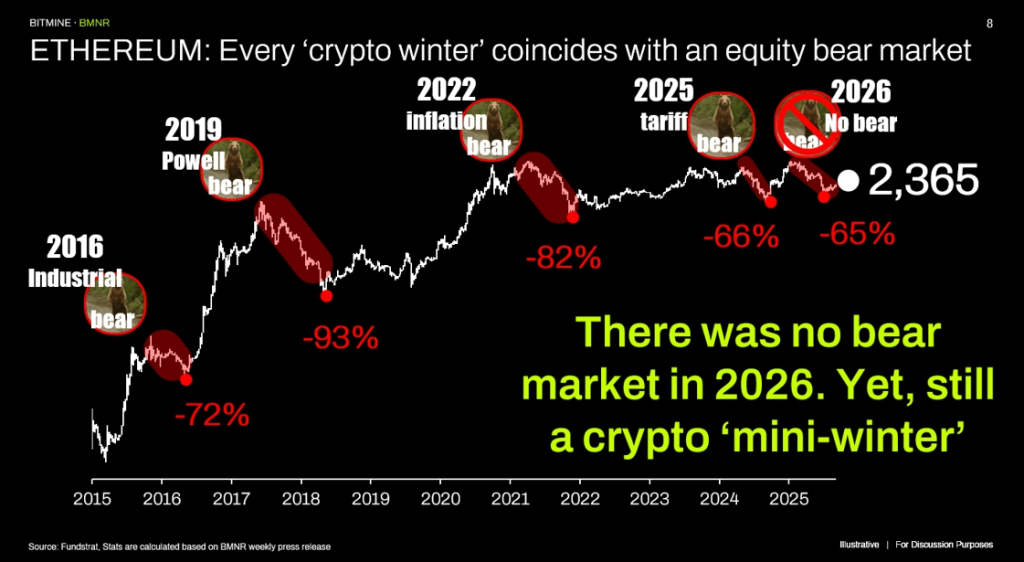
Chairman Tom Lee said the company has kept up an increased buying pace for four straight weeks. “Our base case ETH is in the final stages of the mini-crypto winter,” he said. Lee made similar remarks at Paris Blockchain Week 2026, where he predicted Ether could eventually top $60,000.

Source: Fundstrat

Beyond its ETH position, Bitmine also holds 199 Bitcoin, a $200 million stake in Beast Industries, a $107 million stake in Eightco Holdings, and $1.12 billion in cash. Total crypto and cash holdings stand at close to $13 billion.

NYSE Uplisting Came Before The Push

The buying acceleration follows a significant corporate move. Bitmine recently uplisted from the NYSE American to the New York Stock Exchange and expanded its share buyback program.

ETHUSD trading at $2,308 on the 24-hour chart: TradingView

The NYSE listing gives the company broader visibility among institutional investors at a time when crypto balance sheet strategies are spreading across public markets.

No other public company comes close to Bitmine’s total ETH exposure, according to data from CoinGecko, which tracks corporate Ethereum treasuries.

The gap between Bitmine and the next-largest holders has continued to grow with each successive purchase.

Featured image from Consensys, chart from TradingView

Связанные с этим вопросы

QHow much Ether did Bitmine acquire during the week of April 13 to April 19, and why is this purchase significant?

ABitmine acquired 101,627 ETH during that week, which is its largest single-week purchase since December 2025.

QWhat percentage of the total Ether supply does Bitmine now own, and what is its stated ownership target?

ABitmine now owns approximately 4.12% of the total Ether in circulation, and its stated target is to reach 5% ownership.

QHow much annualized staking revenue is generated from Bitmine's staked Ethereum, and how many ETH are staked?

ABitmine generates more than $200 million in annualized staking revenue from its 3.33 million staked ETH.

QWhat recent corporate move preceded Bitmine's accelerated buying of Ethereum?

AThe buying acceleration followed Bitmine's uplisting from the NYSE American to the New York Stock Exchange and the expansion of its share buyback program.

QBesides Ethereum, what other major assets does Bitmine hold in its portfolio?

ABeyond its ETH position, Bitmine also holds 199 Bitcoin, a $200 million stake in Beast Industries, a $107 million stake in Eightco Holdings, and $1.12 billion in cash.

Похожее

It Took Me a Year to See the Hard Truth About Agent Payments

**Title: It Took Me a Year to See the Hard Truth About Agent Payments** Over the past year, I've worked on infrastructure for the Agent economy, engaging with major players like Stripe, Visa, Coinbase, and numerous startups. The findings reveal a stark reality: genuine, widespread demand for Agent-based payments does not yet exist. **Key Observations:** * **Agent-to-Merchant (Shopping):** The user experience for AI shopping often falls short, especially for visual product discovery. While AI excels at understanding needs, conversational interfaces can't yet replace browsing and comparing multiple products visually. Current merchant interest is largely defensive ("Agent Engine Optimization") for a future that hasn't arrived. High-frequency, low-friction purchases (like food delivery) are potential fits, but lack open APIs and face high AI inference costs. Simpler, more affordable, or cross-language interactions for complex UIs are a niche opportunity but require massive consumer distribution to scale. * **Agent-to-API (Developer Tools):** Developer payment needs for APIs (computing, data, models) are already met through subscriptions and prepaid credits. The core challenge is not payment friction but supplier economics: most large SaaS providers prefer enterprise contracts over micropayments for API calls. Protocols like MPP and x402 suit the long-tail of smaller services but cater to a developer market historically reluctant to pay for these tools. Major infrastructure needs at the top of the stack are already being addressed. * **Agent-to-Agent (Machine Commerce):** This is a long-term vision with almost no current transaction volume. While a future with high-speed, high-frequency, multi-party machine-to-machine transactions would require novel infrastructure, it remains theoretical. The market is not here yet. * **Agent-to-Finance:** This is the only category with clear, present demand. Financial professionals and DeFi users already pay for tools, and AI augmentation is a natural evolution. Autonomous AI agents can enable entirely new financial strategies. However, competition is fierce from established, regulated incumbents who can more easily layer AI onto their existing products. **The Core Insight:** Companies, especially giants with long time horizons, are building defensively for a potential future of mass machine commerce. For them, early investment is a low-cost hedge. For startups, the current market reality is different. The primary challenge isn't just moving money between agents (payments). The larger, unsolved problem is **orchestration** – coordinating work between agents and humans, verifying outcomes, and then settling. Payment is just a part of settlement, which is just a part of orchestration. Companies that solve the orchestration problem will subsume payments, not the other way around. After a year of building, we see the real, growing, and underserved market opportunity lies in this broader domain of orchestration.

链捕手13 мин. назад

It Took Me a Year to See the Hard Truth About Agent Payments

链捕手13 мин. назад

Claude Opus 4.8 Finds a $4.5 Billion Bug: The AI Era is Mass-Producing Hackers

A researcher discovered a critical "infinite mint" vulnerability in the Zcash cryptocurrency's Orchard protocol using Claude Opus 4.8, leading to a swift fix but also a 50% market drop, erasing billions in value. This incident highlights a new era where powerful, accessible AI models are dramatically lowering the barrier to finding software vulnerabilities. Previously, the security community feared specialized models like Claude Mythos Preview, capable of finding decades-old zero-day exploits. The Zcash case, however, involved a publicly available, general-purpose model. This shift makes advanced security auditing—and attack capabilities—accessible to far more people, not just experts. The mass democratization of vulnerability discovery brings a dual challenge: a flood of low-quality, AI-generated false reports that overwhelm maintainers, and the real, rapid uncovering of deep, dangerous bugs. Open-source projects, often understaffed and unfunded, are particularly vulnerable to this "attention DDoS." The article cites examples like curl shutting down its bug bounty program due to the unsustainable workload. Our perceived digital safety has often been luck, relying on the high cost and effort required to find deeply hidden flaws in complex systems, as seen with historical vulnerabilities like Heartbleed or Baron Samedit. AI changes this cost structure, effectively "mass-producing flashlights" to illuminate every corner of our codebase. While large companies operate extensive security chains involving external white-hat hackers and massive defensive operations, the global cybersecurity workforce faces a severe shortage, especially of experienced personnel capable of analyzing complex threats and coordinating fixes. The core dilemma emerges: AI makes *finding* bugs cheap and scalable, but *fixing* them remains a slow, expensive, and human-intensive process. The article concludes that AI won't destroy the internet but acts as a bright light, revealing that our digital existence is not inherently secure but is precariously maintained by ongoing human effort. The true cost in the AI era may not be discovery, but whether there will be enough people left willing and able to do the hard work of repair.

marsbit47 мин. назад

Claude Opus 4.8 Finds a $4.5 Billion Bug: The AI Era is Mass-Producing Hackers

marsbit47 мин. назад

Codex Goal Mode Usage Guide: How to Make AI Continuously Pursue a Specific Objective

"Codex Goal Mode: How to Make AI Work Continuously Toward a Specific Goal" OpenAI's Codex "goal mode" (/goal) transforms the AI from a reactive code assistant into a proactive execution agent capable of working autonomously for hours or even days to achieve a defined objective. To maximize its effectiveness, follow these key principles: 1. **Define Clear, Verifiable Exit Criteria:** The goal prompt should be a concise, measurable success condition, not a lengthy specification. Use quantifiable metrics like "reduce build time by 30%" or "achieve 100% test parity." 2. **Provide Initial Guidance and Tools:** Direct Codex toward likely problem areas and specify available tools (e.g., browsers, testing environments) to prevent it from exploring unproductive paths. 3. **Enable Progress Measurement:** Equip Codex with ways to track advancement, such as creating comparison tools for visual tasks or evaluation sets, ensuring it can gauge its own progress. 4. **Use a Realistic Execution Environment:** For tasks like performance optimization, provide access to environments that closely mimic production (e.g., similar configs, databases) to yield valid results. 5. **Be Cautious with Visual Goals:** Avoid vague "pixel-perfect" instructions. Instead, supplement visual references with functional checklists or design system specifications to prevent Codex from obsessing over minor details. 6. **Implement Progress Tracking:** For long-running tasks, have Codex commit code to draft PRs, update progress documents, or send Slack updates to maintain visibility into its work. 7. **Review and Consolidate Results:** Once the goal is met, instruct Codex to review its work, clean up ineffective experimental code, and reflect on what strategies succeeded or failed. Ultimately, using goal mode shifts the developer's role from writing prompts to managing a persistent engineering agent—defining objectives, establishing metrics, configuring environments, and conducting final reviews.

marsbit1 ч. назад

Codex Goal Mode Usage Guide: How to Make AI Continuously Pursue a Specific Objective

marsbit1 ч. назад

From Ethereum to AI's 'CROPS': What Exactly Is This 'Slow Variable' That Vitalik Has Repeatedly Emphasized?

Recently, Vitalik Buterin has frequently emphasized the concept of "CROPS," first outlined in the Ethereum Foundation's March mandate as core principles guiding its focus: Censorship Resistance, Capture Resistance, Open Source, Privacy, and Security. CROPS represents Ethereum's commitment to providing foundational capabilities for user sovereignty—enabling asset ownership, identity expression, and coordination without reliance on centralized platforms or surrendering ultimate control. This framework is gaining new urgency with the rise of AI, particularly AI agents managing digital assets and automating transactions. While AI offers convenience, it risks centralizing user data, intent, and control if dependent on opaque, centralized services. Vitalik argues for "CROPS AI"—AI that is open, privacy-preserving, secure, and capable of local execution to maintain user agency. He highlights convergence between "CROPS Ethereum access layers" and "CROPS AI," such as using zero-knowledge proofs for private remote LLM calls and Ethereum RPC reads, ensuring users can access services without exposing sensitive information. Ultimately, CROPS is not just an abstract ideal but a practical guide for Ethereum's development and AI integration. It addresses the critical long-term question: as digital systems grow more powerful, how can users retain control over their privacy, assets, and autonomy? In an AI-driven era, these principles may define Ethereum's enduring value—prioritizing verifiable, secure, and user-centric design over short-term optimizations like speed and cost alone.

marsbit2 ч. назад

From Ethereum to AI's 'CROPS': What Exactly Is This 'Slow Variable' That Vitalik Has Repeatedly Emphasized?

marsbit2 ч. назад

Торговля

Спот
Фьючерсы

Популярные статьи

Manyu: восходящая мем-звезда на Ethereum, готовая открыть новую эру культуры Shiba

Manyu - это мемтокен на Ethereum, который приносит децентрализованную культурную и развлекательную ценность через вирусное влияние в соцсетях и вовлечённость сообщества.

1.9k просмотров всегоОпубликовано 2025.11.27Обновлено 2025.11.27

Manyu: восходящая мем-звезда на Ethereum, готовая открыть новую эру культуры Shiba

Неделя обучения по популярным токенам 14: Glamsterdam — самое ожидаемое обновление Ethereum в 2026 году

Ordinals/Runes по-прежнему стимулируют доходы от комиссий за блоки и активность разработчиков, рассматриваются как отправная точка «нативной эмиссии активов» в сети.

1.5k просмотров всегоОпубликовано 2026.04.29Обновлено 2026.04.29

Неделя обучения по популярным токенам 14: Glamsterdam — самое ожидаемое обновление Ethereum в 2026 году

Обсуждения

Добро пожаловать в Сообщество HTX. Здесь вы сможете быть в курсе последних новостей о развитии платформы и получить доступ к профессиональной аналитической информации о рынке. Мнения пользователей о цене на ETH (ETH) представлены ниже.

活动图片