Bitcoin’s Network Distribution Factor Plunge Signals A Redistribution Event

bitcoinistОпубликовано 2026-02-22Обновлено 2026-02-22

Введение

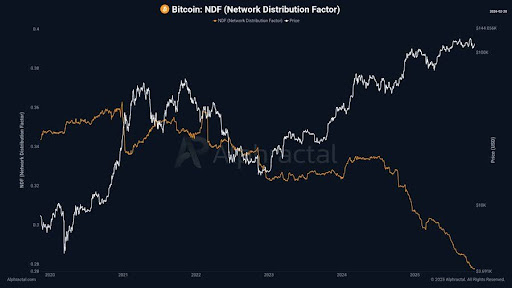
Bitcoin's Network Distribution Factor (NDF) is declining sharply, indicating a significant structural shift in BTC supply distribution. The NDF measures the proportion of total supply held by large entities controlling at least 0.01% of circulating BTC. A falling NDF suggests reduced concentration among major holders and a broader redistribution of Bitcoin to smaller participants and new entrants. This trend often occurs during market maturation phases following bull cycles, reflecting stronger economic decentralization and reduced structural risk from over-concentration. It signals Bitcoin’s evolution into a more widely distributed global financial network. Additionally, Bitcoin’s fixed supply of 21 million and predominantly individual-owned circulating supply (approx. 63%) reinforce its role as a structurally scarce, decentralized asset resistant to institutional or governmental control.

Bitcoin supply structure is undergoing a notable transformation as the Network Distribution Factor (NDF) declines rapidly. While price action often dominates headlines, shifts in distribution metrics can reveal structural changes. A falling NDF suggests that the balance of BTC holdings across different wallet cohorts is evolving, and potentially signaling a redistribution of market participants.

What The Network Distribution Factor Actually Measures

An advanced on-chain data analytics firm, Alphractal, noted on X that the NDF of Bitcoin is declining sharply, and revealing an important structural shift in how the asset supply is distributed across the market. The NDF measures the proportion of the total BTC supply held by larger holders controlling at least 0.01% of the entire circulating supply.

When the metric declines, it indicates that the BTC supply concentration among large holders is decreasing. In practical terms, this shift represents a reduced relative dominance of large holders over the total supply and broader redistribution of BTC among smaller participants and new market entrants.

A declining extreme concentration is often seen during early accumulation phases, and a natural redistribution process follows the periods of strong accumulation by large entities. Historically, extended declines in the NDF tend to occur during phases when the market is mature, and the asset becomes more widely distributed.

BTC market is undergoing a key shift | Source: Chart from Alphractal on X

This often occurs after major bull cycles, when large players accumulate supply and are gradually absorbed by the broader market. Rather than signaling weakness, this dynamic can strengthen BTC economic decentralization and reduce structural risk tied to excessive concentration.

At the same time, it reflects a transition phase where supply is being redistributed globally, reinforcing BTC’s evolution from a relatively concentrated asset into a widely distributed global financial network. However, this does not signal structural weakness, but rather signals maturation and the expansion of BTC’s ownership base.

Why Bitcoin Represents A True Financial Revolution

The clearest reasons Bitcoin remains the most compelling asset of our generation are its ownership structure and fixed supply. According to Crypto Patel, roughly 63% of the total circulating supply is held by everyday individual participants, not Wall Street, not the government, or even the institutions.

At the core of this thesis, there are only 21 million BTC in existence, and the number is fixed permanently; no central bank can inflate it, no politician can alter the code, and no corporation can dilute holders.

In a world characterized by aggressive money printing and currency debasement, BTC stands alone as mathematically enforced scarcity, and the majority of that asset belongs to ordinary individuals. Crypto Patel frames BTC’s decentralized ownership and fixed supply not just as a technology, but as a structural revolution.

BTC trading at $68,205 on the 1D chart | Source: BTCUSDT on Tradingview.com

Связанные с этим вопросы

QWhat does a declining Network Distribution Factor (NDF) indicate about Bitcoin's supply structure?

AA declining NDF indicates that the concentration of Bitcoin supply among large holders (those controlling at least 0.01% of the circulating supply) is decreasing, signaling a redistribution of BTC to smaller participants and new market entrants.

QAccording to the article, what phase of the market does a falling NDF typically occur in?

AA falling NDF typically occurs during phases when the market is mature, often after major bull cycles, when supply accumulated by large players is gradually absorbed by the broader market.

QHow does the declining NDF contribute to Bitcoin's economic structure?

AThe declining NDF strengthens Bitcoin's economic decentralization, reduces structural risk associated with excessive concentration, and reflects its evolution into a more widely distributed global financial network.

QWhat percentage of Bitcoin's circulating supply is held by everyday individual participants, according to Crypto Patel?

AAccording to Crypto Patel, roughly 63% of Bitcoin's total circulating supply is held by everyday individual participants.

QWhy is Bitcoin described as having 'mathematically enforced scarcity' in the article?

ABitcoin is described as having 'mathematically enforced scarcity' because its supply is permanently fixed at 21 million coins, which cannot be inflated by central banks, altered by politicians, or diluted by corporations.

Похожее

You Bet on the News, the Pros Read the Rules: The True Cognitive Gap in Losing Money on Polymarket

The article explains that the key to profiting on Polymarket, a prediction market platform, lies not just predicting real-world events correctly, but in meticulously understanding the specific rules that govern how each market will be resolved. It illustrates this with examples, such as a market on Venezuela's 2026 leader, where the official rules defining "officially holds" the office overruled the intuitive answer of who was in practical control. Other examples include debates over the definition of a "token" or what constitutes an "agreement." The core argument is that a "reality vs. rules" gap creates pricing discrepancies that savvy traders ("车头" or "whales") exploit. The platform has a formal dispute resolution process managed by UMA token holders to settle ambiguous outcomes. This process involves proposal submission, a challenge window, a discussion period, and a final vote. However, the article highlights a critical flaw in this system compared to a traditional court: the lack of separation between the arbiters (UMA voters) and the interested parties (traders with financial stakes in the outcome). This conflict of interest undermines the discussion phase, leads to herd mentality, and results in opaque final decisions without explanatory rulings. Consequently, the system lacks a body of precedent, making it difficult for users to learn from past disputes. The ultimate takeaway is that success on Polymarket requires a lawyer-like scrutiny of the rules to identify and capitalize on the cognitive gap between how events appear and how they are contractually defined for settlement.

marsbit1 ч. назад

You Bet on the News, the Pros Read the Rules: The True Cognitive Gap in Losing Money on Polymarket

marsbit1 ч. назад

Торговля

Спот
Фьючерсы

Популярные статьи

Как купить S

Добро пожаловать на HTX.com! Мы сделали приобретение Sonic (S) простым и удобным. Следуйте нашему пошаговому руководству и отправляйтесь в свое крипто-путешествие.Шаг 1: Создайте аккаунт на HTXИспользуйте свой адрес электронной почты или номер телефона, чтобы зарегистрироваться и бесплатно создать аккаунт на HTX. Пройдите удобную регистрацию и откройте для себя весь функционал.Создать аккаунтШаг 2: Перейдите в Купить криптовалюту и выберите свой способ оплатыКредитная/Дебетовая Карта: Используйте свою карту Visa или Mastercard для мгновенной покупки Sonic (S).Баланс: Используйте средства с баланса вашего аккаунта HTX для простой торговли.Третьи Лица: Мы добавили популярные способы оплаты, такие как Google Pay и Apple Pay, для повышения удобства.P2P: Торгуйте напрямую с другими пользователями на HTX.Внебиржевая Торговля (OTC): Мы предлагаем индивидуальные услуги и конкурентоспособные обменные курсы для трейдеров.Шаг 3: Хранение Sonic (S)После приобретения вами Sonic (S) храните их в своем аккаунте на HTX. В качестве альтернативы вы можете отправить их куда-либо с помощью перевода в блокчейне или использовать для торговли с другими криптовалютами.Шаг 4: Торговля Sonic (S)С легкостью торгуйте Sonic (S) на спотовом рынке HTX. Просто зайдите в свой аккаунт, выберите торговую пару, совершайте сделки и следите за ними в режиме реального времени. Мы предлагаем удобный интерфейс как для начинающих, так и для опытных трейдеров.

1.1k просмотров всегоОпубликовано 2025.01.15Обновлено 2025.03.21

Как купить S

Sonic: Обновления под руководством Андре Кронье – новая звезда Layer-1 на фоне спада рынка

Он решает проблемы масштабируемости, совместимости между блокчейнами и стимулов для разработчиков с помощью технологических инноваций.

2.2k просмотров всегоОпубликовано 2025.04.09Обновлено 2025.04.09

Sonic: Обновления под руководством Андре Кронье – новая звезда Layer-1 на фоне спада рынка

HTX Learn: Пройдите обучение по "Sonic" и разделите 1000 USDT

HTX Learn — ваш проводник в мир перспективных проектов, и мы запускаем специальное мероприятие "Учитесь и Зарабатывайте", посвящённое этим проектам. Наше новое направление .

1.8k просмотров всегоОпубликовано 2025.04.10Обновлено 2025.04.10

HTX Learn: Пройдите обучение по "Sonic" и разделите 1000 USDT

Обсуждения

Добро пожаловать в Сообщество HTX. Здесь вы сможете быть в курсе последних новостей о развитии платформы и получить доступ к профессиональной аналитической информации о рынке. Мнения пользователей о цене на S (S) представлены ниже.

活动图片