Bitcoin's Global Hash Rate Drops 15% from Peak: Are Miners Being Lured Away by AI?

marsbitОпубликовано 2026-01-20Обновлено 2026-01-20

Введение

Bitcoin's network hashrate has declined by approximately 15% from its October peak, falling to around 977 EH/s, as miners face prolonged financial strain. Profitability has been deteriorating for five consecutive months, with December’s average daily block reward per EH/s hitting a record low of $38,700—down 7% month-over-month and 32% year-over-year. Factors include post-halving reduced rewards, rising operational costs, and regulatory impacts, such as the shutdown of an estimated 1.3GW mining capacity in Xinjiang. Amid these challenges, many mining firms are pivoting to AI data center operations, leveraging their existing power infrastructure and low electricity costs (often 3–5 cents per kWh). Some companies, like IREN, are adopting cloud computing leasing models, while others offer power and data center leasing to major tech firms like Google and Microsoft. Despite short-term pressures, analysis from VanEck suggests that falling hashrates have historically correlated with positive Bitcoin price performance over the following 180 days, with average returns of +72% during periods of hashrate contraction. This may indicate a market cleansing phase that could lead to greater industry consolidation and longer-term stability.

Original Author: ChandlerZ, Foresight News

Bitcoin's hash rate has increased approximately 10-fold since 2020, but has shown a noticeable decline in recent months.

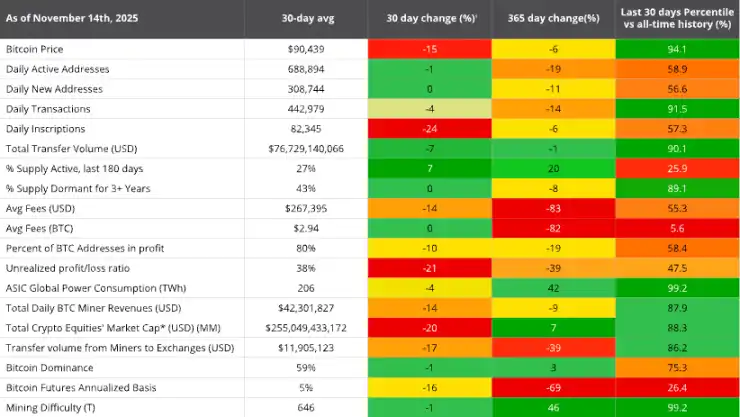
Data shows that the Bitcoin network's hash rate has fallen about 15% from its October high, with miner capitulation persisting for nearly 60 days. The network's average hash rate dropped from about 1.1 ZH/s in October to approximately 977 EH/s, indicating that miners are shutting down machines or capitulating as profitability declines.

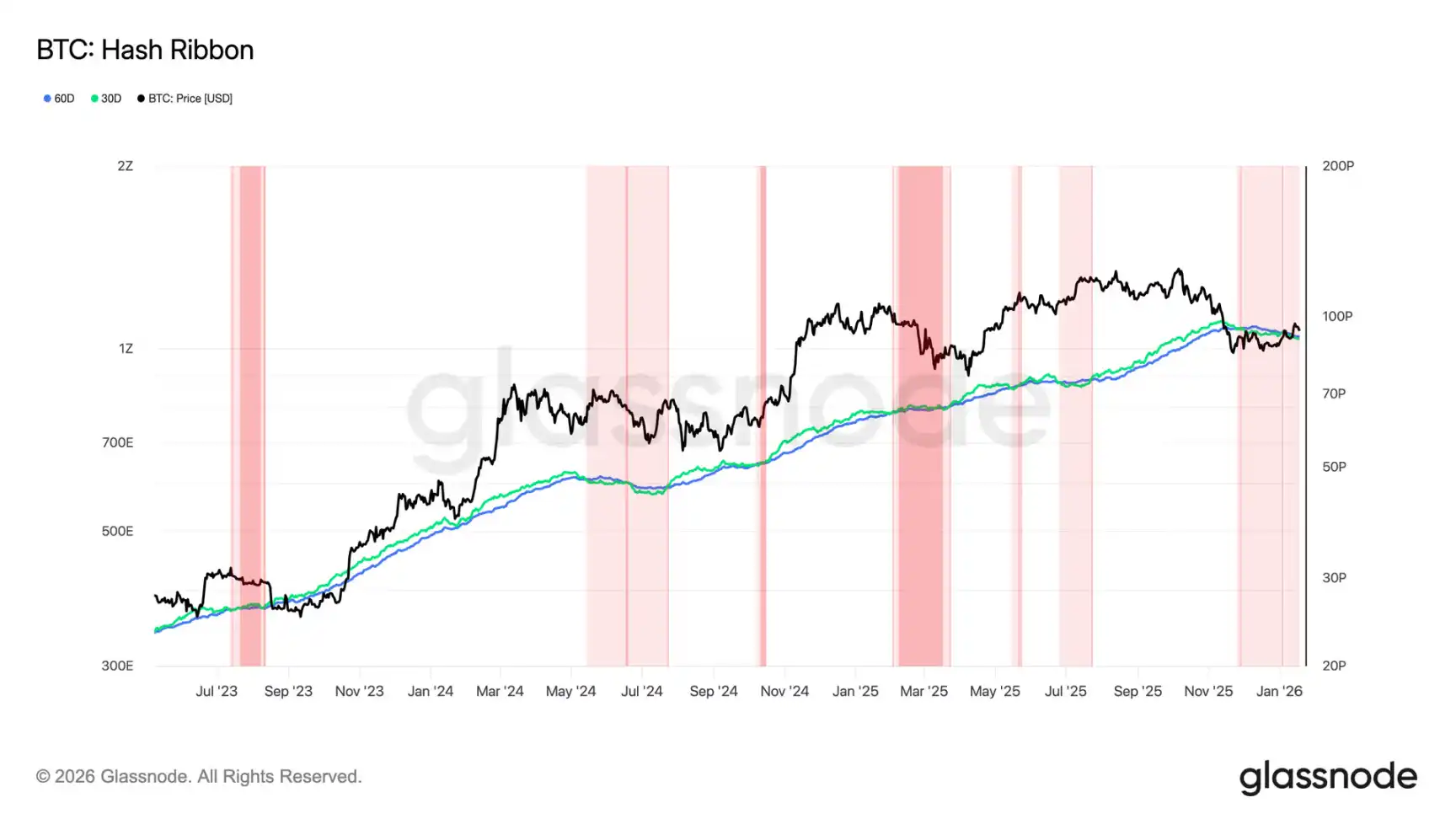
Furthermore, Glassnode's Hash Ribbons indicator reversed on November 29th. This indicator tracks short-term and long-term hash rate trends to reflect miner capitulation. The short-term supply pressure on the Bitcoin market may further increase, and the Bitcoin mining difficulty is expected to undergo its seventh reduction in the past eight adjustments on January 22nd, dropping to around 139 T.

Mining Profitability Declines for Five Consecutive Months

JPMorgan stated that the Bitcoin network's hash rate decreased by approximately 3% month-over-month to 1045 EH/s in December 2025, indicating some easing in miner competition, but mining profitability continues to decline.

Data shows that in December 2025, miners' average daily block reward revenue per EH/s was $38,700, a 7% decrease from November and a 32% decrease year-over-year, hitting a record low.

VanEck's report analysis suggests that the Bitcoin mining industry is experiencing significant pressure. On one hand, the periodic halving of block subsidies causes a "step-like" decrease in miner revenue; on the other hand, the global hash rate has expanded at a compound growth rate of about 62% since 2020, forcing miners to continuously invest CAPEX to increase hash power to avoid being淘汰. If the coin price cannot offset the rising unit costs caused by subsidy reductions and hash rate growth, miner profits will be systematically compressed.

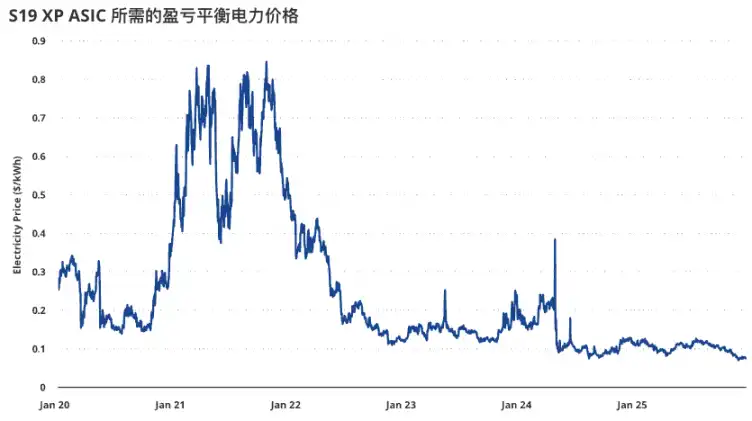
The deterioration of miner profitability can be seen intuitively from the electricity cost breakeven point. Taking the 2022-generation miner S19 XP as an example, its bearable breakeven electricity price dropped from about $0.12/kWh in December 2024 to about $0.077/kWh in December 2025. This means that against the backdrop of recent weak BTC prices, the marginal economics of mining have significantly worsened, and the industry's reliance on low-cost electricity resources, economies of scale, and operational efficiency has further increased.

Although the global hash rate has accumulated a growth of about 10 times since 2020, calculated on a 30-day moving average, the network hash rate has decreased by about 4% over the past 30 days, the largest drop since April 2024. Simultaneously, supply-side disruptions are also affecting the hash rate, such as the shutdown of approximately 1.3GW of capacity (estimated about 400,000 mining machines) at mining farms in Xinjiang due to regulatory scrutiny.

Mining Farms Actively Transitioning to AI Data Centers

A report by Sinolink Securities shows that in the third quarter of 2025, the mining cost including depreciation for US-listed companies had risen to $112,000, higher than the current Bitcoin price. Encryption mining farm companies possess powered-on computing infrastructure with high communication bandwidth near major metropolitan areas, and their electricity costs are generally between 3~5 cents, making them naturally suitable for AI cloud service businesses. With the growth in AI computing demand, the transition of encryption mining farms to AI data centers is an inevitable choice.

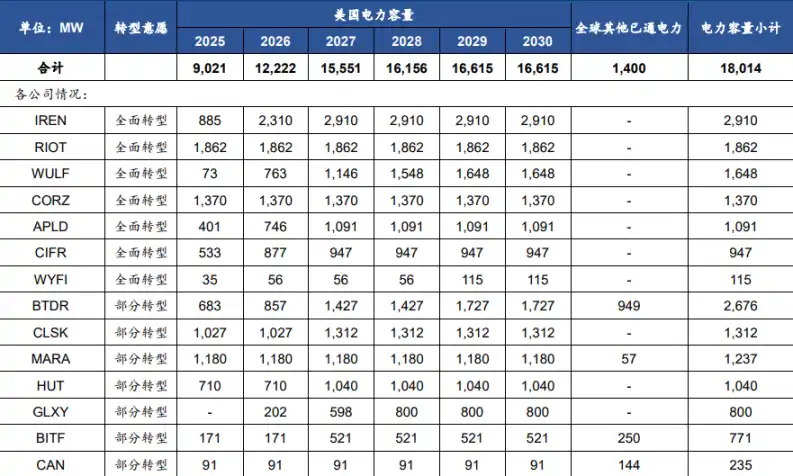
14 major US-listed mining farm companies are expected to reach a power capacity of 15.6GW by 2027. Their transition business models are primarily cloud computing leasing and IDC power leasing.

Encryption mining farms transitioning to AI data centers mainly adopt two business models.

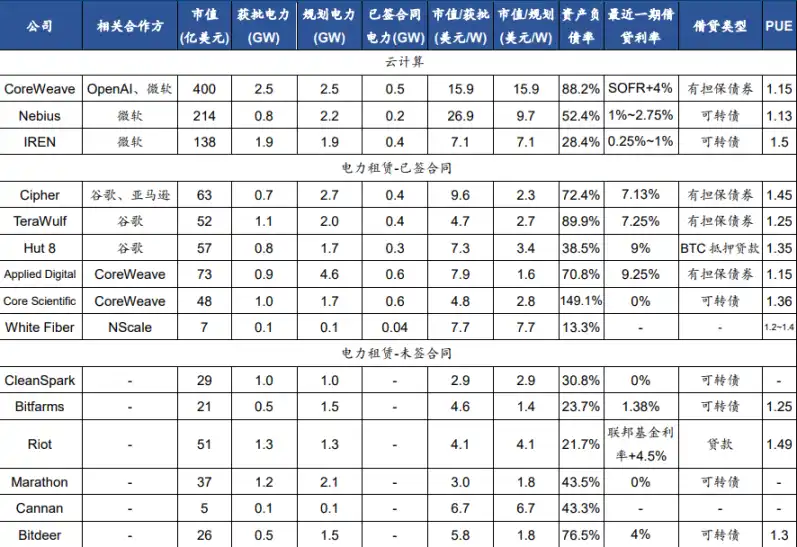
The first is similar to CoreWeave and Nebius, purchasing chips for cloud computing leasing. IREN currently uses this model. IREN has a gross power capacity of 2.91GW, corresponding to about 1.9GW of core capacity. Its market capitalization per watt is lower than CoreWeave and Nebius, and it has already cooperated with Microsoft on a 200MW core capacity project.

The second is a power leasing model similar to IDCs, only renting out the right to use the data center building and power capacity, with servers and electricity bills paid by the tenant. Most encryption mining farms currently adopt this hosting model. Some companies have signed leasing contracts with Google, Amazon, CoreWeave, and others. Most other companies, having transitioned later, are still seeking partners.

VanEck: Hash Rate Decline Could Actually Be a Positive Factor

However, VanEck's report also suggests that the hash rate decline could be a positive factor. By comparing the 30-day change in Bitcoin's hash rate since 2014 and the expected return over the subsequent 90 days, they found that when the Bitcoin hash rate decreases, the probability of a positive expected return is higher than when the hash rate increases. When the Bitcoin hash rate decreases, the average expected 180-day return is about 30 basis points higher than when it increases.

When hash rate compression lasts for a longer period, positive forward returns tend to be more frequent and of greater magnitude. Since 2014, during the 346 days when the 90-day hash rate growth was negative, the probability of a positive 180-day Bitcoin forward return was 77%, with an average return of +72%. For all other periods, the probability of a positive 180-day Bitcoin forward return was about 61%, with an average return of +48%.

Therefore, historically, buying BTC when the 90-day hash rate growth is negative has increased the expected 180-day return by 2400 basis points.

Even during periods of weak economics, many entities choose to continue mining. Short-term profit pressure and hash rate fluctuations are more likely to lead to accelerated industry consolidation and concentration, not necessarily indicating the long-term decline of the mining industry.

Связанные с этим вопросы

QWhat is the current trend in Bitcoin's network hashrate and by how much has it declined from its peak?

ABitcoin's network hashrate has been declining recently, dropping by approximately 15% from its October high of about 1.1 ZH/s to around 977 EH/s.

QAccording to the article, what are the two main reasons for the compression of miner profitability?

AMiner profitability is being compressed due to the cyclical halving of block subsidies, which reduces miner income in a 'step-like' fashion, and the rapid expansion of the network's total hashrate, which has grown at a compound rate of about 62% since 2020, forcing miners to continuously invest in CAPEX to stay competitive.

QHow are crypto mining farms adapting to the challenging economic conditions of Bitcoin mining?

ACrypto mining farms are adapting by transforming into AI data centers, leveraging their existing powered infrastructure and high communication bandwidth. They are shifting to business models like cloud computing rentals (similar to CoreWeave) and IDC power leasing (a托管 model).

QWhat positive signal does the VanEck report associate with a declining Bitcoin hashrate?

AThe VanEck report suggests that a declining Bitcoin hashrate can be a positive factor. Historically, when the 90-day hashrate growth is negative, the probability of a positive 180-day forward return for BTC is 77% with an average return of +72%, which is higher than periods of hashrate growth.

QWhat specific event is cited in the article as a supply-side disruption affecting the global hashrate?

AA supply-side disruption cited is the shutdown of mining farms in China's Xinjiang region, where approximately 1.3GW of capacity (estimated to be around 400,000 mining machines) was taken offline due to regulatory scrutiny.

Похожее

First Day Review of "Musk's WeChat" XChat: Even Worse Than Expected

Elon Musk's much-anticipated "WeChat-like" app, XChat, has officially launched after multiple delays. The initial review reveals a product that falls short of expectations, offering an experience largely similar to X Platform's (formerly Twitter) direct messages, despite being marketed as an encrypted communication tool. Key observations from the first-day test include: 1. The app's promoted "end-to-end encryption" and its claimed relation to Bitcoin's architecture were criticized by experts as a superficial attempt to capitalize on crypto buzz, with no real technical connection. 2. Musk's vision of an ad-free "secure communication system" is technically met, but only because the app is currently extremely basic, featuring only a single chat interface. 3. A promised anti-screenshot feature appears inconsistent; it works in X Platform group chats but fails within the XChat app itself, where screenshots still capture avatars. 4. The app supports 45 languages and has a 16+ age rating, indicating a broader tolerance for content compared to WeChat's 13+ rating. 5. A puzzling login process requires users to verify the email associated with their X account. 6. The touted encryption" feels minimal in practice, with its presence only indicated by a simple "Encrypted - Yes" label on messages. 7. Disappearing message timers for groups can be set from 5 minutes to 4 weeks, with the timer starting upon being read by a user. 8. Group invite links are shared with X Platform groups. 9. Group size limits are planned to be increased, aiming for 1000 members, a move that has drawn user criticism. 10. The app offers 8 different colored icons, and its chat bubbles are notably similar to WeChat's. Message deletion options mimic Telegram's. Crucially, many pre-announced features like importing X contacts, integrating Grok AI, X Money payments, and Cashtags are not yet available. The initial release is seen as a bare-bones and underwhelming first step.

Odaily星球日报38 мин. назад

First Day Review of "Musk's WeChat" XChat: Even Worse Than Expected

Odaily星球日报38 мин. назад

Торговля

Спот
Фьючерсы

Популярные статьи

Как купить S

Добро пожаловать на HTX.com! Мы сделали приобретение Sonic (S) простым и удобным. Следуйте нашему пошаговому руководству и отправляйтесь в свое крипто-путешествие.Шаг 1: Создайте аккаунт на HTXИспользуйте свой адрес электронной почты или номер телефона, чтобы зарегистрироваться и бесплатно создать аккаунт на HTX. Пройдите удобную регистрацию и откройте для себя весь функционал.Создать аккаунтШаг 2: Перейдите в Купить криптовалюту и выберите свой способ оплатыКредитная/Дебетовая Карта: Используйте свою карту Visa или Mastercard для мгновенной покупки Sonic (S).Баланс: Используйте средства с баланса вашего аккаунта HTX для простой торговли.Третьи Лица: Мы добавили популярные способы оплаты, такие как Google Pay и Apple Pay, для повышения удобства.P2P: Торгуйте напрямую с другими пользователями на HTX.Внебиржевая Торговля (OTC): Мы предлагаем индивидуальные услуги и конкурентоспособные обменные курсы для трейдеров.Шаг 3: Хранение Sonic (S)После приобретения вами Sonic (S) храните их в своем аккаунте на HTX. В качестве альтернативы вы можете отправить их куда-либо с помощью перевода в блокчейне или использовать для торговли с другими криптовалютами.Шаг 4: Торговля Sonic (S)С легкостью торгуйте Sonic (S) на спотовом рынке HTX. Просто зайдите в свой аккаунт, выберите торговую пару, совершайте сделки и следите за ними в режиме реального времени. Мы предлагаем удобный интерфейс как для начинающих, так и для опытных трейдеров.

1.2k просмотров всегоОпубликовано 2025.01.15Обновлено 2025.03.21

Как купить S

Sonic: Обновления под руководством Андре Кронье – новая звезда Layer-1 на фоне спада рынка

Он решает проблемы масштабируемости, совместимости между блокчейнами и стимулов для разработчиков с помощью технологических инноваций.

2.2k просмотров всегоОпубликовано 2025.04.09Обновлено 2025.04.09

Sonic: Обновления под руководством Андре Кронье – новая звезда Layer-1 на фоне спада рынка

HTX Learn: Пройдите обучение по "Sonic" и разделите 1000 USDT

HTX Learn — ваш проводник в мир перспективных проектов, и мы запускаем специальное мероприятие "Учитесь и Зарабатывайте", посвящённое этим проектам. Наше новое направление .

1.8k просмотров всегоОпубликовано 2025.04.10Обновлено 2025.04.10

HTX Learn: Пройдите обучение по "Sonic" и разделите 1000 USDT

Обсуждения

Добро пожаловать в Сообщество HTX. Здесь вы сможете быть в курсе последних новостей о развитии платформы и получить доступ к профессиональной аналитической информации о рынке. Мнения пользователей о цене на S (S) представлены ниже.

活动图片