Bitcoin Sentiment Back To Extreme Fear As Price Slips Under $76,000

bitcoinistОпубликовано 2026-05-28Обновлено 2026-05-28

Введение

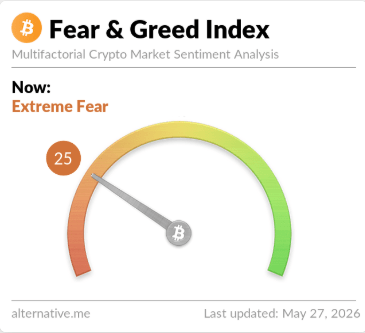
The Bitcoin Fear & Greed Index has fallen back into "extreme fear" territory with a value of 25, following a recent price retracement. Bitcoin's price has slipped below $75,500 after briefly recovering above $77,000. Historically, such extreme fear levels have been associated with potential market bottoms, though the indicator can remain in this zone for extended periods before a reversal. Concurrently, social media sentiment analysis shows bearish commentary currently outweighing bullish sentiment, reflecting broader market pessimism.

Data shows the Bitcoin Fear & Greed Index has slipped back into the extreme fear territory following the latest retrace in the asset’s price.

Bitcoin Fear & Greed Index Is Signaling Extreme Fear Again

The “Fear & Greed Index” is an indicator created by Alternative that tells us about the average sentiment present among investors in the Bitcoin and wider cryptocurrency markets.

To represent the market mentality, the index make use of a numerical scale running from zero to hundred. When the metric has a value under 47, it means the average investor is showing fear toward digital assets. On the other hand, the indicator being above 53 suggests the dominance of greed in the sector. Values between these two cutoffs naturally correspond to a net neutral sentiment.

Besides these three main zones, there are also two ‘extreme’ regions called the extreme fear (values of 25 and below) and extreme greed (above 75). Currently, the index is in the former of these two zones.

Looks like the index has a value of 25 at the moment | Source: Alternative

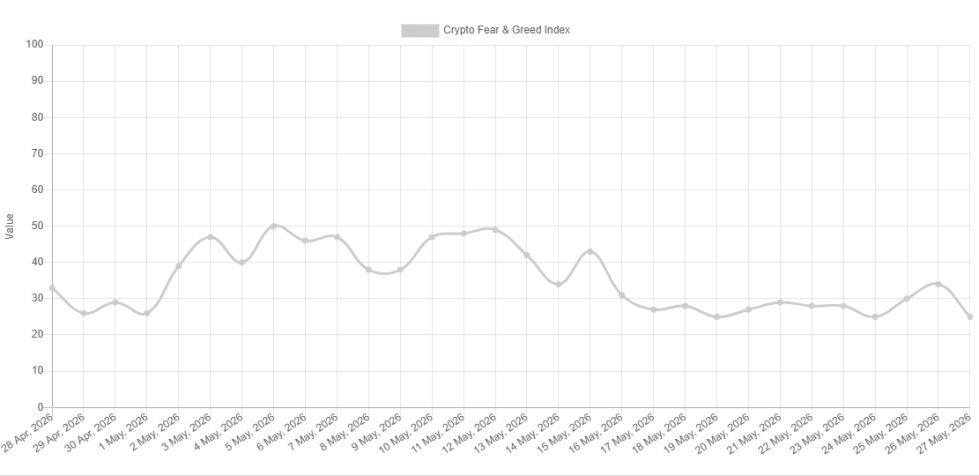
As is visible, the Bitcoin Fear & Greed Index has a value of 25, which is right on the boundary of the extreme fear territory. Earlier in the week, the indicator had managed to escape out of this zone, but the latest level suggests that the improvement in sentiment couldn’t last.

The trend in the BTC Fear & Greed Index over the past month | Source: Alternative

The latest decline in the index has come as the various cryptocurrencies have faced a pullback. Bitcoin, which had recovered into the high $77,000 levels earlier, is now back below $75,500.

Historically, the extreme sentiment zones have held much significance for the sector as they have been where major price tops and bottoms have tended to form. The relationship between sentiment and the market’s trajectory has been an inverse one, however, meaning that extreme fear is where bottoms have appeared while extreme greed has facilitated top formations.

Considering this, the return to extreme fear may not exactly be a negative for the market. That said, just entry into the zone alone isn’t enough to force a bottom, as in the past, the index has often stayed in the region for long periods before Bitcoin and others have reversed their course.

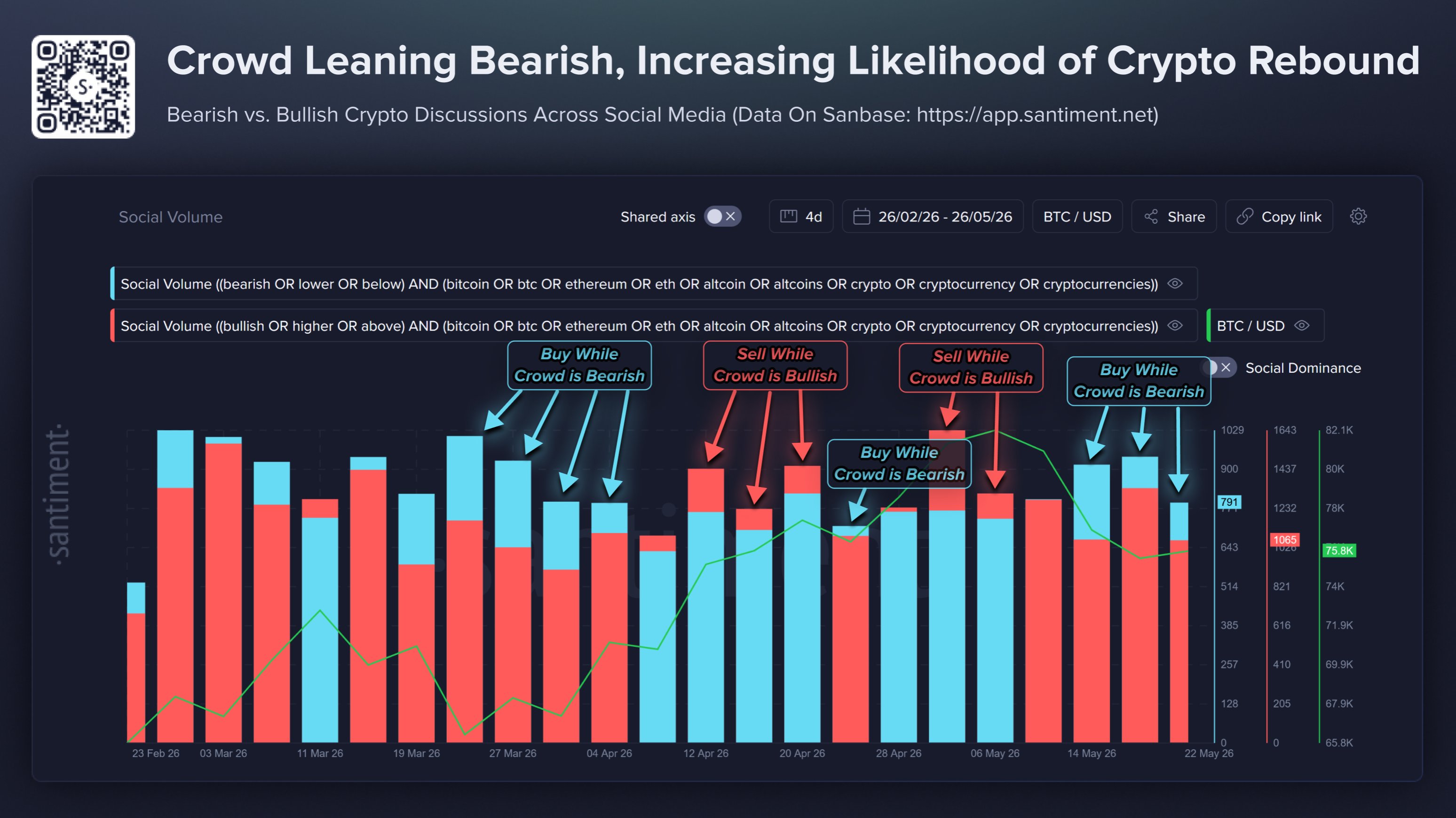
The Fear & Greed Index incorporates a variety of metrics related to the sector to determine the market sentiment. One factor included in the index is social media sentiment. In an X post, analytics firm Santiment has talked about how bullish and bearish comments related to digital assets have compared on the major social media platforms recently.

A bearish sentiment seems to have been more dominant in recent days | Source: Santiment on X

From the chart, it’s apparent that bearish sentiment has outweighed the bullish one on social media recently, indicating that the crowd on these platforms has also been pessimistic toward Bitcoin and others.

BTC Price

At the time of writing, Bitcoin is floating around $75,400, down almost 3% in the last seven days.

The price of the coin seems to have been consolidating | Source: BTCUSDT on TradingView

Связанные с этим вопросы

QWhat is the current value of the Bitcoin Fear & Greed Index and what sentiment zone does it represent?

AThe current value of the Bitcoin Fear & Greed Index is 25, which places it in the 'extreme fear' territory.

QAccording to the article, what is the general historical relationship between extreme sentiment zones and Bitcoin's price?

AHistorically, an inverse relationship exists where extreme fear has been associated with price bottoms forming, while extreme greed has been associated with price tops forming.

QWhat is Bitcoin's price at the time of the article's writing and how much has it changed over the past week?

AAt the time of writing, Bitcoin's price is floating around $75,400, which is down almost 3% over the last seven days.

QBesides social media sentiment, what general approach does the Fear & Greed Index use to determine market sentiment?

AThe Fear & Greed Index incorporates a variety of metrics related to the cryptocurrency sector to determine the overall market sentiment.

QWhat does the data from Santiment show about the recent sentiment on social media regarding cryptocurrencies?

AThe data from Santiment shows that bearish sentiment has recently outweighed bullish sentiment on major social media platforms, indicating a pessimistic crowd towards Bitcoin and other cryptocurrencies.

Похожее

After Marvell's 32% Surge, the Chinese Chip Family Behind It Emerges

The stock price of Marvell Technology surged 32.5% on June 2nd, driven by NVIDIA CEO Jensen Huang highlighting its custom ASICs and optical interconnects as core to AI data center architecture. This event brought attention to the Chinese semiconductor family behind Marvell: the Dai siblings. The story centers on three siblings, all UC Berkeley graduates, whose three-decade entrepreneurial journey aligns with major semiconductor industry shifts. In 1995, youngest sister Dai Wei Li co-founded Marvell with her husband Sehat Sutardja and his brother, focusing on storage controllers. Eldest brother Dai Wei Min founded EDA company Ultima, later sold to Cadence, and later founded VeriSilicon (芯原) in China, becoming a leading semiconductor IP provider. Second brother Dai Wei Jin co-founded EDA firm Silicon Perspective (sold to Cadence) and GPU IP company Vivante, later acquired by VeriSilicon. The combined "Dai-Sutardja" family network extends beyond Marvell. Their ventures and investments form a comprehensive ecosystem for the post-Moore's Law, chiplet era. Key holdings include: Dream Big Semiconductor (AI SuperNICs, acquired by Arm), Alphawave (high-speed SerDes IP, acquired by Qualcomm), and Silicon Box (a chiplet advanced packaging foundry). VeriSilicon itself thrives on the AI ASIC and IP boom in China. Collectively, the family's AI infrastructure-related portfolio is estimated at over $22 billion. Their strategy represents a distinct path: building critical components for open standards and key manufacturing capacity in the chiplet era, rather than pursuing standalone AI chip dominance. While this path may not create the next NVIDIA, it has enabled repeated successful exits and sustained influence within the global semiconductor industry.

marsbit52 мин. назад

After Marvell's 32% Surge, the Chinese Chip Family Behind It Emerges

marsbit52 мин. назад

Microsoft is Afraid of Being Marginalized by AI Giants

Microsoft, once the defining force of the PC era, now faces a familiar challenge in the AI age: the risk of being relegated to a profitable but invisible infrastructure provider. This anxiety was laid bare at Build 2026, where CEO Satya Nadella unveiled a major strategic pivot. The catalyst was a quiet April agreement that dissolved Microsoft's exclusive licensing and cloud-hosting deal with OpenAI, its once-vital partner. This erased Microsoft's key AI moat. With OpenAI and Anthropic defining AI applications and gaining enterprise traction—even within Microsoft's own ranks—Nadella had to answer: without exclusivity, what is Microsoft's role? The answer was a suite of seven in-house AI models, a developer-focused AI workstation (Surface RTX Spark Dev Box), and, most crucially, the Agent 365 platform for enterprise AI governance. The models, notably targeting Anthropic's strengths in coding and enterprise, signal a defensive move. However, the broader strategy is to make the models themselves less decisive. Financially, Microsoft's AI revenue is strong, driven largely by Azure running others' models. Yet its user-facing products like Copilot show weak penetration and engagement. Microsoft earns infrastructure money but lacks direct user mindshare. Nadella's core fear is being "hollowed out." As OpenAI and Anthropic prepare for IPOs and gain financial independence, they may build their own infrastructure, threatening Azure's lucrative AI revenue stream. Microsoft's window is to entrench itself deeper: not as the model creator, but as the indispensable platform for securely deploying, managing, and governing all AI models within the enterprise through Agent 365. Build 2026 revealed Microsoft's bet: in the AI era, the ultimate power lies not in any single model, but in the enterprise "operating system" that controls them. Nadella is determined to ensure Microsoft is the driver of this new era, not just a passenger.

marsbit1 ч. назад

Microsoft is Afraid of Being Marginalized by AI Giants

marsbit1 ч. назад

CPU, Quietly Returning to the Center of the AI Computing Power Stage

Over the past three years, AI computing power narratives have been dominated by GPUs. However, starting in 2026, this story began to shift. While training large models remains GPU-intensive, the rapid growth of inference and AI agent workloads, which require high levels of task orchestration, concurrency, and data flow management, has highlighted a renewed critical role for CPUs. These are tasks GPUs are not designed to handle. Intel's recent launch of the Xeon 6+ processor, built on its Intel 18A process and featuring up to 288 efficiency cores (E-cores), exemplifies this strategic pivot. It is positioned not as a mere companion to GPUs but as the essential "control plane" for AI infrastructure, optimized for high-density, energy-efficient, and high-throughput workloads characteristic of AI agents and inference. This "CPU resurgence" is not about CPUs outperforming GPUs in raw computation. It reflects a systemic bottleneck: as AI scales from training single models to deploying countless intelligent agents, the demand for coordination and data handling surges. Major cloud providers are also developing their own high-density ARM-based server CPUs for similar workloads. However, Intel's success with this strategy faces significant challenges. Competition includes NVIDIA's integrated CPU-GPU solutions, the expanding adoption of cloud vendors' in-house ARM CPUs, and the crucial market test of Intel's 18A manufacturing process against rivals like TSMC's N2. In conclusion, CPUs are indeed reclaiming a central, though redefined, role in AI compute—managing the complex orchestration that enables massive-scale AI deployment. While the trend is clear, which company will ultimately lead this CPU resurgence remains an open question to be decided in the data centers of 2027 and beyond.

marsbit1 ч. назад

CPU, Quietly Returning to the Center of the AI Computing Power Stage

marsbit1 ч. назад

Торговля

Спот
Фьючерсы

Популярные статьи

Тест по Bitcoin Биткоина

HTX Learn: Изучите Bitcoin halving и Заработаете Токены USDT

3.1k просмотров всегоОпубликовано 2024.04.16Обновлено 2024.04.16

Тест по Bitcoin  Биткоина

Что такое $BITCOIN

ЦИФРОВОЕ ЗОЛОТО ($BITCOIN): Комплексный анализ Введение в ЦИФРОВОЕ ЗОЛОТО ($BITCOIN) ЦИФРОВОЕ ЗОЛОТО ($BITCOIN) — это проект на основе блокчейна, работающий в сети Solana, который стремится объединить характеристики традиционных драгоценных металлов с инновациями децентрализованных технологий. Хотя он носит имя Биткойн, часто называемого “цифровым золотом” из-за его восприятия как средства хранения ценности, ЦИФРОВОЕ ЗОЛОТО является отдельным токеном, предназначенным для создания уникальной экосистемы в ландшафте Web3. Его цель — позиционировать себя как жизнеспособный альтернативный цифровой актив, хотя детали его применения и функциональности все еще развиваются. Что такое ЦИФРОВОЕ ЗОЛОТО ($BITCOIN)? ЦИФРОВОЕ ЗОЛОТО ($BITCOIN) — это токен криптовалюты, специально разработанный для использования в блокчейне Solana. В отличие от Биткойна, который выполняет широко признанную роль хранения ценности, этот токен, похоже, сосредоточен на более широких приложениях и характеристиках. Примечательные аспекты включают: Инфраструктура блокчейна: Токен построен на блокчейне Solana, известном своей способностью обрабатывать высокоскоростные и недорогие транзакции. Динамика предложения: ЦИФРОВОЕ ЗОЛОТО имеет максимальное предложение, ограниченное 100 квадриллионами токенов (100P $BITCOIN), хотя детали о его обращающемся предложении в настоящее время не раскрыты. Утилита: Хотя точные функциональные возможности не описаны, есть указания на то, что токен может быть использован для различных приложений, потенциально связанных с децентрализованными приложениями (dApps) или стратегиями токенизации активов. Кто создатель ЦИФРОВОГО ЗОЛОТА ($BITCOIN)? На данный момент личность создателей и команды разработчиков, стоящих за ЦИФРОВЫМ ЗОЛОТОМ ($BITCOIN), остается неизвестной. Эта ситуация типична для многих инновационных проектов в области блокчейна, особенно тех, которые связаны с децентрализованными финансами и феноменом мем-криптовалют. Хотя такая анонимность может способствовать культуре, ориентированной на сообщество, она усиливает опасения по поводу управления и ответственности. Кто инвесторы ЦИФРОВОГО ЗОЛОТА ($BITCOIN)? Доступная информация указывает на то, что у ЦИФРОВОГО ЗОЛОТА ($BITCOIN) нет известных институциональных спонсоров или значительных венчурных капиталовложений. Проект, похоже, функционирует по модели пирингового взаимодействия, сосредоточенной на поддержке и принятии сообществом, а не на традиционных путях финансирования. Его активность и ликвидность в основном сосредоточены на децентрализованных биржах (DEX), таких как PumpSwap, а не на устоявшихся централизованных торговых платформах, что еще больше подчеркивает его подход, ориентированный на grassroots. Как работает ЦИФРОВОЕ ЗОЛОТО ($BITCOIN) Операционные механизмы ЦИФРОВОГО ЗОЛОТА ($BITCOIN) можно подробно описать на основе его дизайна блокчейна и характеристик сети: Механизм консенсуса: Используя уникальный механизм доказательства истории (PoH) Solana в сочетании с моделью доказательства доли (PoS), проект обеспечивает эффективную валидацию транзакций, что способствует высокой производительности сети. Токеномика: Хотя конкретные дефляционные механизмы не были подробно описаны, большое максимальное предложение токенов подразумевает, что оно может быть предназначено для микротранзакций или нишевых случаев использования, которые еще предстоит определить. Интероперабельность: Существует потенциал для интеграции с более широкой экосистемой Solana, включая различные платформы децентрализованных финансов (DeFi). Однако детали относительно конкретных интеграций остаются неуточненными. Хронология ключевых событий Вот хронология, которая подчеркивает значимые вехи, касающиеся ЦИФРОВОГО ЗОЛОТА ($BITCOIN): 2023: Первоначальное развертывание токена происходит в блокчейне Solana, отмеченное его адресом контракта. 2024: ЦИФРОВОЕ ЗОЛОТО приобретает видимость, когда оно становится доступным для торговли на децентрализованных биржах, таких как PumpSwap, позволяя пользователям обменивать его на SOL. 2025: Проект наблюдает спорадическую торговую активность и потенциальный интерес к инициативам, возглавляемым сообществом, хотя на данный момент не зафиксировано никаких значительных партнерств или технических достижений. Критический анализ Сильные стороны Масштабируемость: Основная инфраструктура Solana поддерживает высокие объемы транзакций, что может повысить полезность $BITCOIN в различных сценариях транзакций. Доступность: Потенциально низкая цена торговли за токен может привлечь розничных инвесторов, способствуя более широкому участию благодаря возможностям дробного владения. Риски Отсутствие прозрачности: Отсутствие публично известных спонсоров, разработчиков или процесса аудита может вызвать скептицизм относительно устойчивости и надежности проекта. Волатильность рынка: Торговая активность сильно зависит от спекулятивного поведения, что может привести к значительной волатильности цен и неопределенности для инвесторов. Заключение ЦИФРОВОЕ ЗОЛОТО ($BITCOIN) является интригующим, но неоднозначным проектом в быстро развивающейся экосистеме Solana. Хотя он пытается использовать нарратив “цифрового золота”, его отход от установленной роли Биткойна как средства хранения ценности подчеркивает необходимость более четкого различения его предполагаемой утилиты и структуры управления. Будущее принятие и усвоение, вероятно, будут зависеть от решения текущей непрозрачности и более четкого определения его операционных и экономических стратегий. Примечание: Этот отчет охватывает синтезированную информацию, доступную на октябрь 2023 года, и с тех пор могут произойти события.

99 просмотров всегоОпубликовано 2025.05.13Обновлено 2025.05.13

Что такое $BITCOIN

Fractal Bitcoin: масштабирование Биткоина с помощью рекурсивной системы

Fractal Bitcoin — масштабное Layer-1-решнение, созданное на базе кода Биткоина, позволяющего достигать бесконечного масштабирования с помощью рекурсивного подхода.

2.3k просмотров всегоОпубликовано 2025.06.30Обновлено 2025.06.30

Fractal Bitcoin: масштабирование Биткоина с помощью рекурсивной системы

Обсуждения

Добро пожаловать в Сообщество HTX. Здесь вы сможете быть в курсе последних новостей о развитии платформы и получить доступ к профессиональной аналитической информации о рынке. Мнения пользователей о цене на BTC (BTC) представлены ниже.

活动图片