Bitcoin Rally May Have Ended, Beware of Adjustment Risks | Invited Analysis

Odaily星球日报Опубликовано 2025-12-15Обновлено 2025-12-15

Введение

BTC Rebound Likely Over, Correction Risk Ahead | Weekly Analysis by Conaldo The three-week Bitcoin rebound shows signs of exhaustion, with weakening bullish momentum. The market faces key resistance levels, suggesting a potential short-term pullback to test lower supports, possibly initiating a second wave of decline. Last week, three short positions were executed following a "sell the rally" strategy within the defined 94,200–83,500 USD range, yielding a total return of 6.15%. Key technical models (Momentum Quant + Spread Trading) identified precise entry and exit points near resistance. Weekly and daily technical analysis indicates the market has turned bearish on higher timeframes. The momentum model shows signals of a bearish crossover forming on the daily chart, confirming the rebound is losing strength. This week’s outlook is bearish-biased. If support at 87,500–89,000 USD fails, a move toward 80,000–83,500 is anticipated. Resistance is expected at 92,500–94,500 USD. Two short-term trading plans are proposed based on whether support holds or breaks. Key macro events this week include Fed speeches and U.S. November CPI data. A lower CPI may support risk assets, while higher inflation could strengthen the dollar and pressure BTC. Risk management is emphasized: set stop-losses immediately at entry, move to breakeven at +1% profit, and trail stops to lock in gains thereafter. Disclaimer: Views are based on technical analysis and personal strategy, not investment advi...

Odaily invited market analyst Conaldo, Master of Financial Statistics from Columbia University, USA, has focused on quantitative trading of US stocks since university, and gradually expanded to digital assets such as Bitcoin, constructing a systematic quantitative trading model and risk control system in practice; possesses keen data insight into market fluctuations, and is determined to continue深耕 in the professional trading field, pursuing steady returns; will deeply explore changes in BTC technology, macro, and capital aspects every week, review and display practical strategies, and preview major events worth paying attention to in the near future for reference.
Core Summary of Trading Weekly Report:

• The three-week consecutive rebound has entered its final stage, with bullish momentum明显衰竭. Technically, the market is facing key resistance levels, and a short-term pullback to test lower levels may be imminent, perhaps a secondary bottoming行情即将来临.

Last week's trading strictly followed the established strategy, successfully completing three short-term operations, achieving a cumulative return of 6.15%. The following will详细回顾行情预判, strategy execution, and specific trading process.

I. Bitcoin Last Week's Market Review (12.08~12.14)

1. Review of Core Views and Operation Strategies Last Week:

In last week's journal, the author clearly stated that the currency price would most likely maintain range-bound fluctuations, and accordingly proposed a short-term operation strategy of "selling high on rallies, buying the dip for rebounds". The following is a review and analysis of the strategy for further optimization reference.

1. Review of Market Trend Prediction:

Last week, the author divided the盘面 into three areas, namely $94,200~$91,000~$87,500~$83,500. Then, corresponding plans were formulated based on the direction choice of the行情.

• Core Resistance Levels:

• First Resistance Area: $91,000

• Second Resistance Area: $94,000~$96,500 area

• Third Resistance Area: $98,500~$100,000 area

• Core Support Levels:

• First Support Level: $85,500~$88,000 area

• Second Support Level: $83,500

• Important Support Level: $80,000

2. Review of Operation Strategy:

• Mid-term Strategy: Maintain about 65% mid-term short position仓位.

• Short-term Strategy: Because the行情 chose to fluctuate upwards at the beginning of the week, according to the plan,方案 A of selling high on rallies should be selected:

• Open Position: If the currency price rebounds to the $91,000~$94,200 area and encounters resistance, establish a 15% short position.

• Add Position: If the currency price continues to rebound to near $98,500 and encounters resistance again, add another 15% short position.

• Risk Control: Set stop loss for all short positions above $100,000.

• Close Position: After the rebound ends and the price moves downward, when it falls near the support level and shows resistance, consider partially or fully closing the position to take profits.

2. Last week, three short-term operations were successfully completed according to the plan (Figure 1), achieving a cumulative return of 6.93%. The specific trading details and review are as follows:

Bitcoin 30-minute K-line chart: (Momentum Quantitative Model + Price Difference Trading Model)
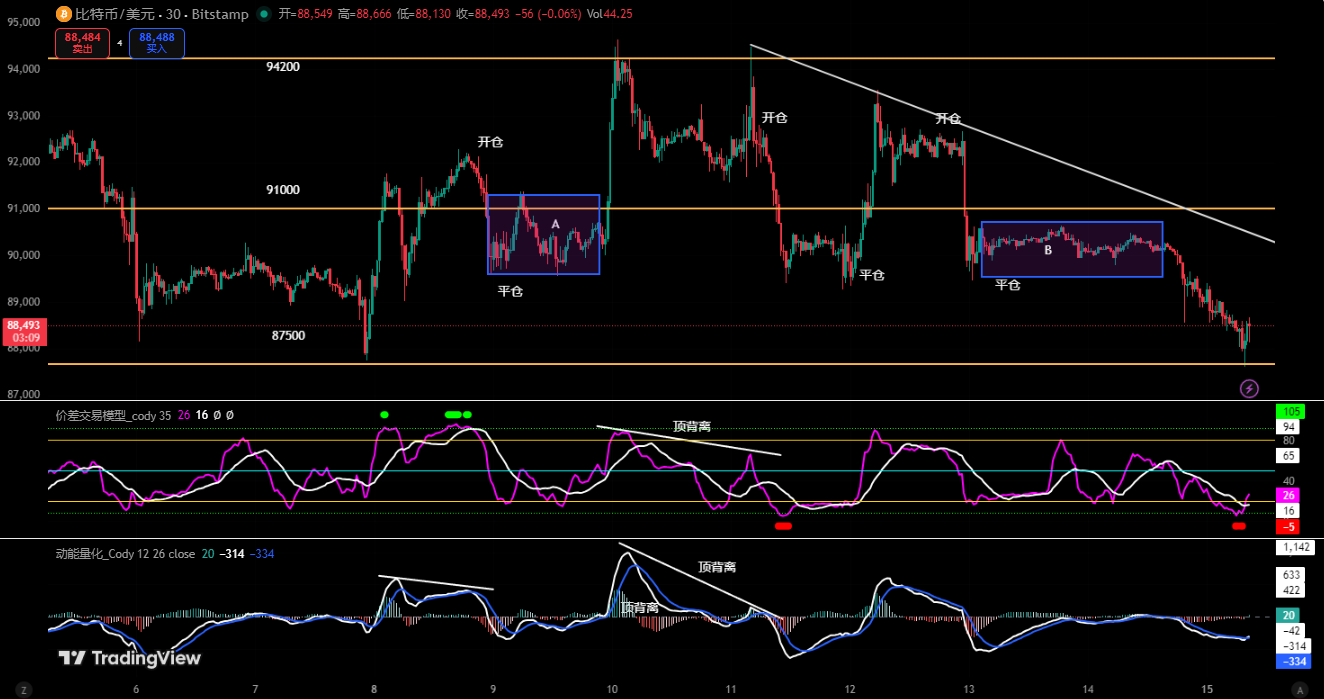
Figure 1

1. Trading Details Summary:

Trade Order Entry Time (UTC+8) Entry Price Position Direction Exit Time (UTC+8) Exit Price Return Rate

First Dec 08 20:30 $91,877 15% Short Dec 09 04:30 $90,477 +1.55%​

Second​ Dec 11 07:30 $92,154 15% Short Dec 12 01:30 $90,083 +2.30%​

Third​ Dec 12 20:00 $92,425 15% Short Dec 13 06:30 $90,349 +2.30%​

2. Short-term Trading Review:

• First Trade (Profit 1.55%): Adhering to the idea of "selling high on rallies". After the currency price hit the key point of $94,200 and fell back after encountering resistance,同时触发 the Price Difference Trading Model and the Momentum Quantitative Model发出顶部信号, decisively established a 15% short position at $91,877, and finally took profits near the previous low support. Utilizing the multi-indicator resonance principle to improve trading success rate.

• Second Trade (Profit 2.30%): "Selling on rallies" mode. After the currency price hit $94,200 and fell back after encountering resistance, the K-line showed a "strong top分型" combination, the two models again共振发出信号, so according to the plan, established a 15% short position at $92,154, successfully capturing the subsequent callback wave, and took profits near $90,083.

• Third Trade (Profit 2.30%): "Selling on rallies" mode. After the currency price hit $94,200 and fell back after encountering resistance, it showed a narrow range fluctuation trend, the price was suppressed by the short-term downward trend line, and the buying momentum gradually衰竭. When the two models共振发出信号, decisively opened a short position at $92,425, position 15%. When it fell to the support level below and showed resistance signals, actively took profits.

3. Key Decision Node Analysis:

• The前瞻性判断 of the trend provided key basis for short-term trading decisions and risk control, and also greatly improved the winning rate of trades.

• Capturing technical reversal signals at key resistance levels, using the multi-model resonance principle to enhance their reliability, and locking in profits near support levels.

3. Review of Bitcoin Core Data Last Week:

Opening Price​​: $90,406

Lowest​ Price​: $87,607 (Sunday)

Highest Price​​: $94,652 (Tuesday)

Closing​ Price​: $88,164

Price Change: Weekly decrease of 2.48%, maximum amplitude of 8.04%

Turnover: $9.859 billion

Trend: Rose then fell, turning into fluctuating decline, weekly K-line closed with an upper shadow line阴 K-line

4. Review of Actual Market Movement Last Week:

Last week, Bitcoin's movement showed a typical pattern of "rising on low volume then falling back and turning into decline". The whole week finally closed with a阴 K-line with an upper shadow line, closing down 2.48%, but the amplitude reached 8.04%, indicating fierce多空争夺. Specifically, the行情 continued to rebound at the beginning of the week, reached the weekly high of $94,652 in the middle of the week, then turned weak under pressure, and entered a fluctuating decline rhythm. In the second half of the week, the行情 turned into a fluctuating decline trend, the price gradually探至 near $87,607, closing近似 at the lowest price,最终 the weekly line formed a阴 K-line with a long upper shadow line, closing down 2.48%. It is worth emphasizing that the entire week's price movement轨迹, perfectly fit within the fluctuation framework划定 by the author last week. And the mid-week high of $94,652, differed from the previously locked upper resistance of $94,200 by only $452, an error of less than 0.5%. This once again verifies the effectiveness of the author's technical positioning of key supply and demand areas (resistance and support), and also provides a strong basis for the continuation of the "high抛低吸 within the structure" tactic.

II. Systematic Technical Analysis: Comprehensive Research and Judgment Based on Multiple Models and Dimensions

Combining last week's market operation, the author will conduct an in-depth analysis of the evolution of Bitcoin's internal structure using a multi-dimensional analysis model.

Bitcoin Weekly K-line Chart: (Momentum Quantitative Model + Sentiment Quantitative Model)
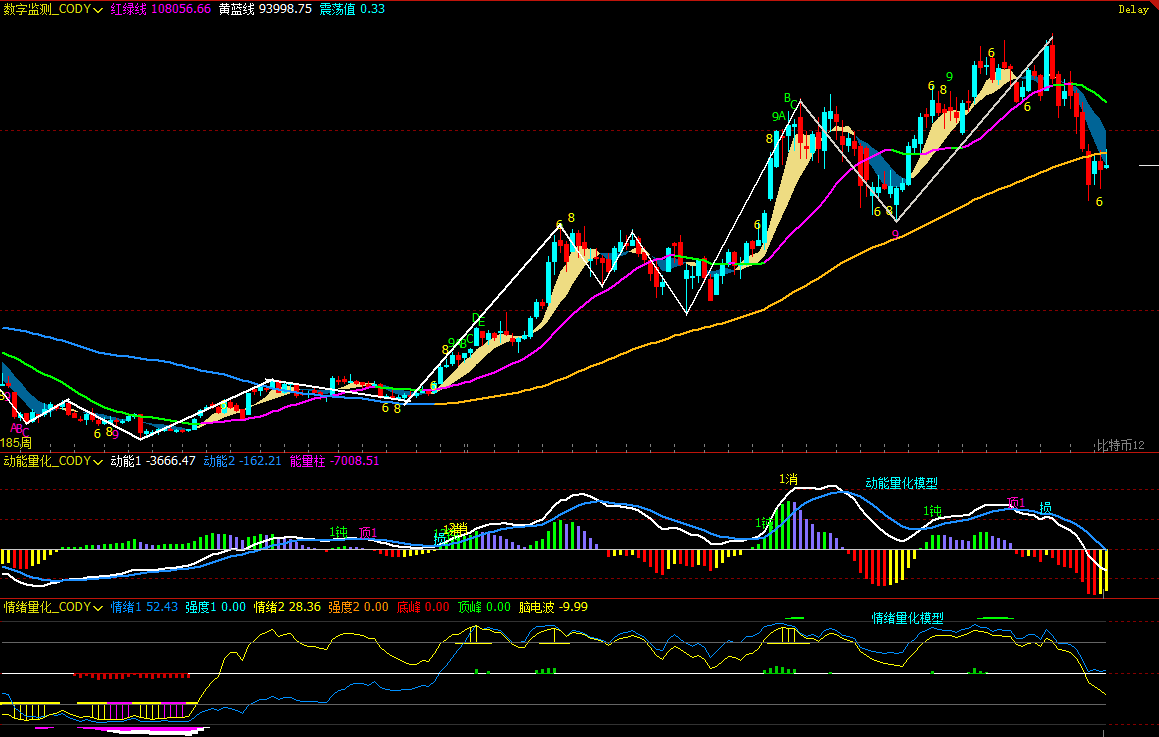
Figure 2

1. As shown in (Figure 2), analysis from the weekly chart:

• Momentum Quantitative Model: After last week's market movement, the two momentum lines continued their downward trend and both fell below the zero axis. On the weekly level, this is usually regarded as a technical signal that the bearish power is continuously strengthening and the market is turning bearish.

Momentum Quantitative Model Indicates: Currency price decline index: High

• Sentiment Quantitative Model: Blue sentiment line value 52.43, intensity zero; yellow sentiment line value 28.36, intensity zero, peak value is 0.

Sentiment Quantitative Model Indicates: Currency price pressure and support index: Neutral

• Digital Monitoring Model: No digital signals shown.

The above data indicates: Bitcoin is in a downward trend, and has entered a bear market on the weekly level.

Bitcoin Daily K-line Chart:
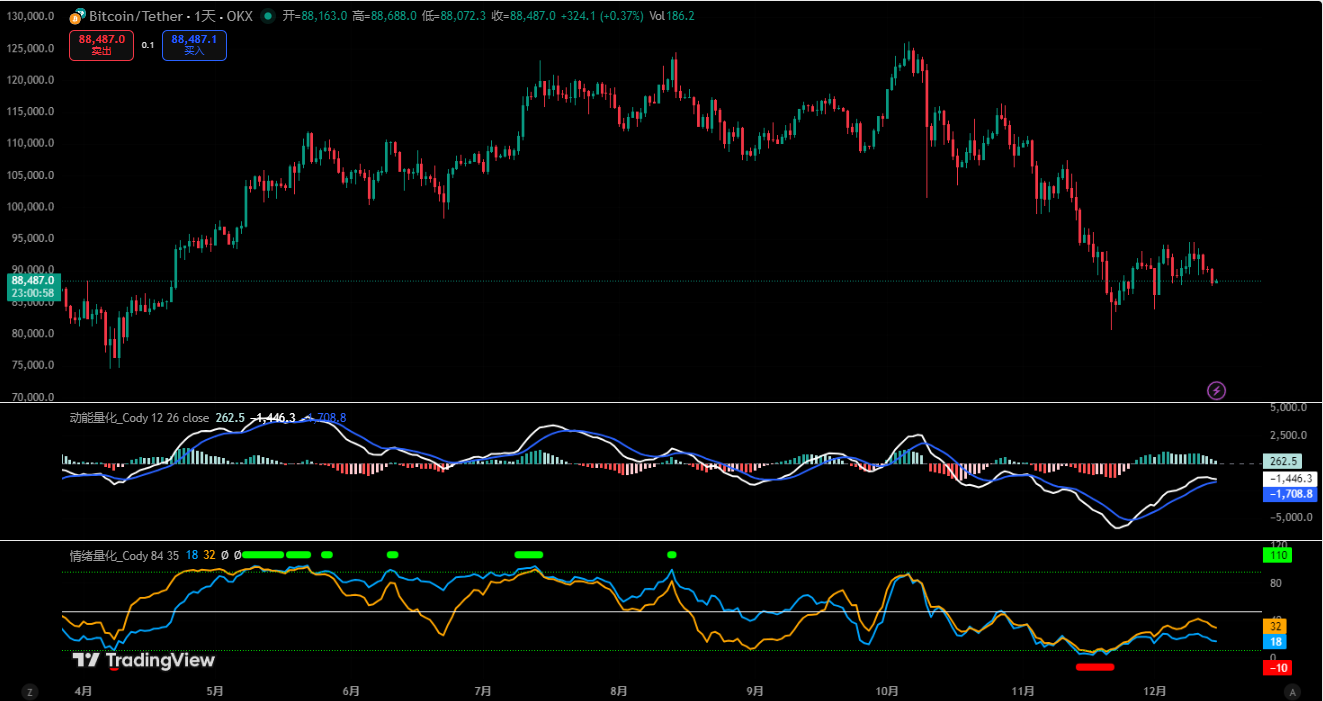
Figure 3

2. As shown in (Figure 3), analysis from the daily chart:

• Momentum Quantitative Model: After a week of rebound, the two momentum lines continued to rise below the zero axis, gradually approaching the zero axis. However, momentum line 1 began to flatten, gradually approaching line 2, and the energy柱较前几日逐渐缩短.

Momentum Quantitative Model Indicates: The momentum of the bullish rebound is gradually衰竭, and the two momentum lines are about to "dead cross".

• Sentiment Quantitative Model: After last week's daily close, blue sentiment line value 18, intensity zero; yellow sentiment line value 32, intensity zero.

Sentiment Quantitative Model Indicates: Pressure and support index: Neutral

The above data suggests: The daily level is in a bear market, and the oversold rebound行情 has entered its final stage.

III. This Week's Market Prediction (12.15~12.21)

1. After three consecutive weeks of oversold rebound (21 days is a变盘时间窗口), the bullish momentum has shown衰竭, and the market faces a direction choice. Currently, the currency price has encountered resistance and fallen back at the key resistance area. It is expected that this week's trend will be mainly fluctuating adjustments. Focus on observing the gain or loss of the $87,500~$89,000 area; if effectively broken below, the行情 may start a secondary bottoming.

2. Core Resistance Levels:

• First Resistance Area: $92,500~$94,500 area

• Second Resistance Area: $96,500~$98,500 area

• Important Resistance Area: $100,000

• Core Support Levels:

<极> • First Support Level: $87,500~$89,000 area

• Second Support Level: $80,000~$83,500 area

• Important Support Level: $74,500~$76,000 area.

IV. This Week's Operation Strategy (Excluding Sudden News Impact) (12.15~12.21)

1. Mid-term Strategy: Maintain about 65% mid-term position (short).

2. Short-term Strategy: Use 30% of the position, set stop loss points, and look for "price difference" opportunities based on support and resistance levels. (Use 60 minutes/240 minutes as the operation cycle).

3. The author judges that this week will be mainly fluctuating adjustments, and the $87,500~$89,000 area will become an important watershed. For the gain or loss of this area, short-term operations will execute the following two sets of plans:

Plan A: If the support in this area is effective:

• Open Position: If the currency price rebounds to the $92,000~$94,200 area and encounters resistance, establish a 30% short position.

• Risk Control: Set stop loss for short positions above $95,000.

• Close Position: When the currency price falls to the $87,500~$89,000 area and shows resistance, close all short positions to take profits.

Plan B: If this area is effectively broken below:

• Open Position: If the currency price breaks below this area and is confirmed, establish a 30% short position.

• Risk Control: Set stop loss above $89,000.

• Close Position: When the currency price探至 the $80,000~$83,500 area and shows resistance, close all short positions to take profits.

V. Special Tips

1. When opening a position: Immediately set the initial stop loss level.

2. When profit reaches 1%: Move the stop loss to the entry cost price (break-even point) to ensure capital safety.

3. When profit reaches 2%​​: Move the stop loss to the position of 1% profit.

4. Continuous tracking: Thereafter, for every additional 1% profit the currency price makes, move the stop loss level同步 by 1%, dynamically protecting and locking in existing profits.

(Note: The above 1% profit trigger threshold can be flexibly adjusted by investors according to their own risk preferences and标的 volatility.)

VI. This Week's Macro Outlook and Key Events (12.15~12.21)

1. Fed Officials Dense Speeches

Multiple core and potential voters will speak about the economic outlook, their wording will affect the market's re-assessment of the "pace and sustainability of interest rate cuts", especially the guidance on long-term interest rate expectations.

2. Inflation Data Becomes Key Turning Point

The US November CPI and core CPI data released on Thursday will be the core variables determining the direction of the US dollar and interest rates.

· If CPI is lower than expected (currently about 3%, still above the 2% target), it will further verify the rationality of the interest rate cut cycle, the US dollar may be under pressure, and risk assets may get breathing space;

· If inflation rises again, it may weaken market confidence in持续宽松,推动 the US dollar to rebound and suppress the performance of high-valuation assets.

3. Employment and Inflation Expectation Indicators Supplementary Verification

Initial jobless claims and the University of Michigan consumer inflation expectation data will, from the "actual and expected" two levels, test whether the downward trend of inflation has sustainability.

Financial markets are changing rapidly, all market analysis and trading strategies need to be dynamically adjusted. All views, analysis models and operation strategies involved in this article are derived from personal technical analysis, and are only for personal trading log use, do not constitute any investment advice or operation basis. The market has risks, investment needs to be cautious, DYOR.


Связанные с этим вопросы

QWhat is the core summary of the trading weekly report regarding the current Bitcoin market trend?

AThe report states that the three-week rebound has likely ended, with bullish momentum significantly weakening. Technically, the market is facing key resistance levels, and a short-term pullback to test lower support is expected, potentially signaling an upcoming secondary bottoming-out phase.

QWhat were the key support and resistance levels identified for Bitcoin in the previous week's analysis?

AThe key resistance levels were: First resistance zone: $91,000; Second resistance zone: $94,000–$96,500; Third resistance zone: $98,500–$100,000. The key support levels were: First support zone: $85,500–$88,000; Second support: $83,500; Important support: $80,000.

QWhat trading strategy does the analyst propose for the current week (Dec 15-21) if the $87,500–$89,000 support zone holds?

AIf the $87,500–$89,000 support zone holds (Scenario A), the strategy is to open a short position with 30% of capital if the price rebounds to the $92,000–$94,200 area and shows signs of resistance. A stop-loss is set above $95,000. The position would be closed for profit if the price falls back to the $87,500–$89,000 zone and shows support.

QAccording to the multi-model technical analysis, what is the outlook for Bitcoin on the weekly and daily charts?

AOn the weekly chart, the momentum量化 model indicates both动能 lines have crossed below zero, a signal that the market has turned bearish. On the daily chart, the momentum量化 model shows the rebound is losing steam, with the two动能 lines about to form a 'death cross,' indicating the oversold rebound is entering its final stage.

QWhat major macroeconomic event is highlighted for the week of Dec 15-21, and how could it impact the market?

AThe U.S. November CPI and Core CPI data release on Thursday is highlighted as a key turning point. If CPI is lower than expected (around 3%, still above the 2% target), it could validate the rationale for a rate-cut cycle, potentially pressuring the dollar and providing relief for risk assets like Bitcoin. If inflation rises again, it could dampen confidence in sustained easing, boosting the dollar and suppressing high-valuation assets.

Похожее

When AI Traffic Surpasses Humans, How Do You Prove You're Human?

As AI-generated web traffic now surpasses human activity, the internet's foundational business models—built on human attention, browsing, and advertising—face severe disruption. AI agents crawl websites at immense scale without generating ad revenue, while AI summaries divert traffic from original content sites. In response, over 2.5 million sites are blocking AI crawlers, and protections like Cloudflare's "honeypot" traps have emerged, though advanced AI can bypass these. The collapse of traditional CAPTCHAs, which assumed machines were weaker than humans, has led to a shift toward behavioral biometrics for human verification. Companies like IBM and BioCatch now analyze unique human patterns—cursor movements, typing rhythms, keystroke dynamics, and even cognitive delays like the Stroop effect—to distinguish real users from bots. These biometric signatures are difficult to fake or alter, offering a new layer of security but raising significant privacy concerns. Two competing visions for a reliable human verification system are emerging. One, exemplified by Sam Altman’s World (formerly Worldcoin), uses centralized iris scanning to generate unique credentials, though it faces bans and criticism over unauthorized data collection. The other employs cryptographic zero-knowledge proofs, allowing users to prove they are human without revealing identity or biometric data, as advocated by Vitalik Buterin. However, decentralized approaches risk exploitation through identity renting in economically unequal regions. The central dilemma is between a scalable but privacy-invasive centralized system that permanently controls users' biometric data, and a privacy-preserving cryptographic system vulnerable to real-world economic manipulation. The author expresses a preference for the cryptographic path, arguing that despite its flaws, it avoids the irreversible biometric surveillance inherent in centralized alternatives.

Foresight News1 мин. назад

When AI Traffic Surpasses Humans, How Do You Prove You're Human?

Foresight News1 мин. назад

Crypto Primary Market Investment and Financing Forward-Looking Weekly Report | Stablecoin Regulation Nears Implementation, ETF Funds Continue to Withdraw, Capital Begins Betting on Payment and Cash Flow

Crypto Market Weekly Report (Jun 1-7, 2026): Capital Shifts Focus to Payments & Cash Flow Market data indicates a significant divergence: while traditional institutional funds continue exiting via BTC and ETH ETFs (recording net outflows of $1.72B and $168M this week, respectively), stablecoin supply continues growing. This suggests capital is shifting from speculative asset allocation toward defensive positioning within on-chain liquidity, awaiting new, concrete opportunities. This trend is reflected in venture capital focus. Weekly fundraising fell 27% to $302M, with investments concentrating on infrastructure with tangible revenue potential: 1. **Stablecoin Infrastructure (28% of funding):** Projects like M0 Protocol ($35M raise) are gaining attention as regulatory clarity (e.g., the GENIUS Act) nears, shifting the focus from legitimacy to building payment and settlement networks. 2. **AI Agent Infrastructure (26%):** Investments are moving from conceptual AI Agents towards the execution and economic layers required for a functional "Agent economy." Key raises include OpenRouter ($40M) and Halliday ($20M). 3. **Real World Assets (RWA) (18%):** The search for on-chain yield and cash flow drives continued interest in RWA platforms like Ondo Finance. Security threats are evolving from smart contract exploits toward key management failures, permission control issues, and regulatory execution risks (e.g., court-ordered asset freezes). **Key Takeaways:** The investment thesis is shifting from narrative-driven bets to revenue and cash-flow-generating protocols. Future attention should be on the progression of stablecoin regulations, the commercial validation of AI Agent economies, and the performance of high-revenue protocols like derivatives platforms.

marsbit8 мин. назад

Crypto Primary Market Investment and Financing Forward-Looking Weekly Report | Stablecoin Regulation Nears Implementation, ETF Funds Continue to Withdraw, Capital Begins Betting on Payment and Cash Flow

marsbit8 мин. назад

Buy an NFT First to Get a Ticket? The Largest World Cup Ticket Slump in History

"Ticketing Woes for 2026 World Cup: NFT 'Right-to-Buy' and High Prices Dampen Sales" Despite anticipation for the 2026 FIFA World Cup, with 48 teams and 104 matches across North America, the tournament faces significant unsold tickets, with approximately 180,000 group-stage tickets still available for resale just before kick-off. This unexpected shortfall is attributed to FIFA's controversial new ticketing strategy, which includes an NFT-based "Right-to-Buy" (RTB) system and opaque, dynamic pricing. FIFA introduced RTBs as digital collectibles (NFTs) sold on its FIFA Collect platform. An RTB grants the holder only the right to purchase a ticket for a specific match later, not the ticket itself. This two-step process, criticized for selling "scarcity" first, saw RTBs priced from tens to hundreds of dollars, generating millions in revenue for FIFA. With many tickets remaining available on official channels, the value of these prepaid purchase rights is now being questioned. Compounding the issue are ticket prices, reported to be 2 to 4 times higher than the 2022 Qatar World Cup, and up to 7 times more for marquee matches. FIFA employed dynamic pricing, common in U.S. sports, but lacked transparency on seat availability and exact locations during sales, frustrating global fans facing high travel costs. This has drawn scrutiny from regulators in New York and New Jersey. FIFA's official resale platform also drew criticism for imposing high fees—roughly 10% on sellers and 17% on buyers, allowing FIFA to profit further from secondary market transactions. While FIFA President Gianni Infantino states over 6 million tickets have been sold, the situation highlights a potential disconnect between fan enthusiasm and willingness to pay under an aggressive commercial model.

marsbit16 мин. назад

Buy an NFT First to Get a Ticket? The Largest World Cup Ticket Slump in History

marsbit16 мин. назад

Торговля

Спот
Фьючерсы

Популярные статьи

Тест по Bitcoin Биткоина

HTX Learn: Изучите Bitcoin halving и Заработаете Токены USDT

3.1k просмотров всегоОпубликовано 2024.04.16Обновлено 2024.04.16

Тест по Bitcoin  Биткоина

Что такое $BITCOIN

ЦИФРОВОЕ ЗОЛОТО ($BITCOIN): Комплексный анализ Введение в ЦИФРОВОЕ ЗОЛОТО ($BITCOIN) ЦИФРОВОЕ ЗОЛОТО ($BITCOIN) — это проект на основе блокчейна, работающий в сети Solana, который стремится объединить характеристики традиционных драгоценных металлов с инновациями децентрализованных технологий. Хотя он носит имя Биткойн, часто называемого “цифровым золотом” из-за его восприятия как средства хранения ценности, ЦИФРОВОЕ ЗОЛОТО является отдельным токеном, предназначенным для создания уникальной экосистемы в ландшафте Web3. Его цель — позиционировать себя как жизнеспособный альтернативный цифровой актив, хотя детали его применения и функциональности все еще развиваются. Что такое ЦИФРОВОЕ ЗОЛОТО ($BITCOIN)? ЦИФРОВОЕ ЗОЛОТО ($BITCOIN) — это токен криптовалюты, специально разработанный для использования в блокчейне Solana. В отличие от Биткойна, который выполняет широко признанную роль хранения ценности, этот токен, похоже, сосредоточен на более широких приложениях и характеристиках. Примечательные аспекты включают: Инфраструктура блокчейна: Токен построен на блокчейне Solana, известном своей способностью обрабатывать высокоскоростные и недорогие транзакции. Динамика предложения: ЦИФРОВОЕ ЗОЛОТО имеет максимальное предложение, ограниченное 100 квадриллионами токенов (100P $BITCOIN), хотя детали о его обращающемся предложении в настоящее время не раскрыты. Утилита: Хотя точные функциональные возможности не описаны, есть указания на то, что токен может быть использован для различных приложений, потенциально связанных с децентрализованными приложениями (dApps) или стратегиями токенизации активов. Кто создатель ЦИФРОВОГО ЗОЛОТА ($BITCOIN)? На данный момент личность создателей и команды разработчиков, стоящих за ЦИФРОВЫМ ЗОЛОТОМ ($BITCOIN), остается неизвестной. Эта ситуация типична для многих инновационных проектов в области блокчейна, особенно тех, которые связаны с децентрализованными финансами и феноменом мем-криптовалют. Хотя такая анонимность может способствовать культуре, ориентированной на сообщество, она усиливает опасения по поводу управления и ответственности. Кто инвесторы ЦИФРОВОГО ЗОЛОТА ($BITCOIN)? Доступная информация указывает на то, что у ЦИФРОВОГО ЗОЛОТА ($BITCOIN) нет известных институциональных спонсоров или значительных венчурных капиталовложений. Проект, похоже, функционирует по модели пирингового взаимодействия, сосредоточенной на поддержке и принятии сообществом, а не на традиционных путях финансирования. Его активность и ликвидность в основном сосредоточены на децентрализованных биржах (DEX), таких как PumpSwap, а не на устоявшихся централизованных торговых платформах, что еще больше подчеркивает его подход, ориентированный на grassroots. Как работает ЦИФРОВОЕ ЗОЛОТО ($BITCOIN) Операционные механизмы ЦИФРОВОГО ЗОЛОТА ($BITCOIN) можно подробно описать на основе его дизайна блокчейна и характеристик сети: Механизм консенсуса: Используя уникальный механизм доказательства истории (PoH) Solana в сочетании с моделью доказательства доли (PoS), проект обеспечивает эффективную валидацию транзакций, что способствует высокой производительности сети. Токеномика: Хотя конкретные дефляционные механизмы не были подробно описаны, большое максимальное предложение токенов подразумевает, что оно может быть предназначено для микротранзакций или нишевых случаев использования, которые еще предстоит определить. Интероперабельность: Существует потенциал для интеграции с более широкой экосистемой Solana, включая различные платформы децентрализованных финансов (DeFi). Однако детали относительно конкретных интеграций остаются неуточненными. Хронология ключевых событий Вот хронология, которая подчеркивает значимые вехи, касающиеся ЦИФРОВОГО ЗОЛОТА ($BITCOIN): 2023: Первоначальное развертывание токена происходит в блокчейне Solana, отмеченное его адресом контракта. 2024: ЦИФРОВОЕ ЗОЛОТО приобретает видимость, когда оно становится доступным для торговли на децентрализованных биржах, таких как PumpSwap, позволяя пользователям обменивать его на SOL. 2025: Проект наблюдает спорадическую торговую активность и потенциальный интерес к инициативам, возглавляемым сообществом, хотя на данный момент не зафиксировано никаких значительных партнерств или технических достижений. Критический анализ Сильные стороны Масштабируемость: Основная инфраструктура Solana поддерживает высокие объемы транзакций, что может повысить полезность $BITCOIN в различных сценариях транзакций. Доступность: Потенциально низкая цена торговли за токен может привлечь розничных инвесторов, способствуя более широкому участию благодаря возможностям дробного владения. Риски Отсутствие прозрачности: Отсутствие публично известных спонсоров, разработчиков или процесса аудита может вызвать скептицизм относительно устойчивости и надежности проекта. Волатильность рынка: Торговая активность сильно зависит от спекулятивного поведения, что может привести к значительной волатильности цен и неопределенности для инвесторов. Заключение ЦИФРОВОЕ ЗОЛОТО ($BITCOIN) является интригующим, но неоднозначным проектом в быстро развивающейся экосистеме Solana. Хотя он пытается использовать нарратив “цифрового золота”, его отход от установленной роли Биткойна как средства хранения ценности подчеркивает необходимость более четкого различения его предполагаемой утилиты и структуры управления. Будущее принятие и усвоение, вероятно, будут зависеть от решения текущей непрозрачности и более четкого определения его операционных и экономических стратегий. Примечание: Этот отчет охватывает синтезированную информацию, доступную на октябрь 2023 года, и с тех пор могут произойти события.

99 просмотров всегоОпубликовано 2025.05.13Обновлено 2025.05.13

Что такое $BITCOIN

Fractal Bitcoin: масштабирование Биткоина с помощью рекурсивной системы

Fractal Bitcoin — масштабное Layer-1-решнение, созданное на базе кода Биткоина, позволяющего достигать бесконечного масштабирования с помощью рекурсивного подхода.

2.3k просмотров всегоОпубликовано 2025.06.30Обновлено 2025.06.30

Fractal Bitcoin: масштабирование Биткоина с помощью рекурсивной системы

Обсуждения

Добро пожаловать в Сообщество HTX. Здесь вы сможете быть в курсе последних новостей о развитии платформы и получить доступ к профессиональной аналитической информации о рынке. Мнения пользователей о цене на BTC (BTC) представлены ниже.

活动图片