Behind HYPE's Repeated Record Highs, the 'Minions' in the Ecosystem Can't Keep Up

Foresight NewsОпубликовано 2026-06-17Обновлено 2026-06-17

Введение

While HYPE, the native token of the Hyperliquid ecosystem, surges to new all-time highs above $76 and attracts significant institutional ETF inflows, a starkly different reality unfolds within its HyperEVM application layer. Multiple core DeFi protocols across lending, NFTs, stablecoins, and DEXs have announced shutdowns between May and June. The article argues HYPE functions more like an "application stock" than a traditional ecosystem token. Its value is anchored to the trading fees from Hyperliquid's core perpetual contracts platform (HyperCore), which boasts a diversified revenue stream from crypto, commodities, and indices. Approximately 97% of protocol fees fund buybacks and burns of HYPE. This means HYPE's price is largely decoupled from the health of projects built on HyperEVM. The closures of significant projects like lending protocol HypurrFi (peak TVL >$300M) and NFT marketplace Drip.Trade highlight a structural tension. Hyperliquid's minimalist philosophy offers infrastructure without official grants, liquidity support, or marketing coordination for HyperEVM projects. This forces protocols into a fiercely competitive environment from day one. Furthermore, the success of HyperCore creates a liquidity vacuum, and mechanisms like HIP-3 (allowing direct perpetual market deployment) divert user attention and capital away from application-layer projects. The stronger the core perpetual trading business becomes, the more difficult it is for peripheral "DeFi lego" proje...


Author: Sanqing, Foresight News


On June 16, HYPE reached 76.965 USDT, once again hitting a new all-time high, with a daily increase of about 10%, triggering over $11.5 million in short liquidations. Meanwhile, according to SoSoValue data, three US spot HYPE ETFs have attracted a cumulative net inflow of approximately $180 million in their first month of trading, indicating sustained institutional capital inflow.


However, the scene on the Hyperliquid ecosystem side is completely different. From May to June, several protocols across multiple sectors including lending, NFT, stablecoin, and DEX have successively announced their shutdown.


HYPE is an "Application Stock"


Hyperliquid injects about 97% of protocol fees into the Assistance Fund, continuously buys back HYPE in the open market and permanently burns it. According to buildix data, the current daily buyback is about 34,000 HYPE (approximately $2.57 million), with an annualized buyback scale of about $940 million, annualized protocol revenue of about $976 million, a P/E ratio of about 73x, and a buyback yield of about 5.6%.


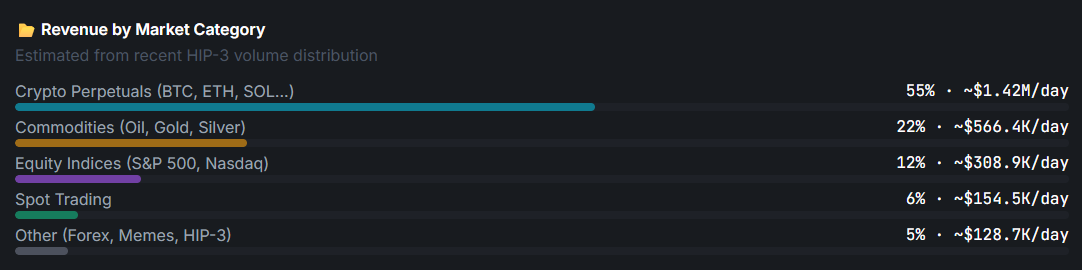
According to DefiLlama data, Hyperliquid's trading volume in the last 30 days exceeds $240 billion. This is precisely the fuel driving the buyback machine: the highly diversified revenue structure of the HyperCore perpetual contract trading layer. Crypto perpetual contracts (BTC, ETH, SOL, etc.) contribute about 55% of daily fees, commodities (crude oil, gold, silver) about 22%, stock indices (S&P 500, Nasdaq) about 12%, and spot trading about 6%.


This means HYPE resembles more of an "application-type stock" rather than a traditional "ecosystem token." Its value capture is anchored to HyperCore's trading fees and has almost no direct relationship with HyperEVM's TVL scale or the survival count of DeFi protocols.


This is fundamentally different from ETH's value logic. ETH's pricing premise is that ecosystem prosperity drives Gas consumption, which in turn pulls the token price. Therefore, the death of any ecosystem project is a negative signal for ETH.


But HYPE's fee source is almost unrelated to HyperEVM. Whether HyperEVM projects live or die does not change HyperCore's trading volume, nor does it affect the Assistance Fund's buyback pace. Investors holding HYPE are exposed to the operational risk of "the business of Hyperliquid's perpetual contract trading," not the risk of a particular DeFi protocol.


Five Announcements


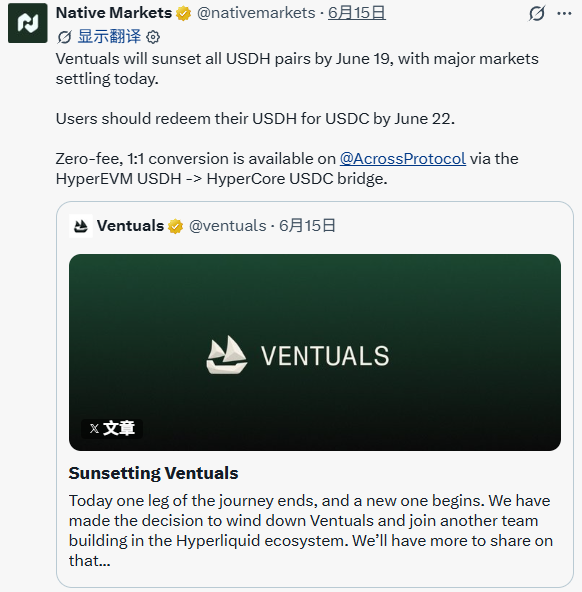
Ventuals (June 15): Cumulative trading volume exceeded $650 million, serving over 11,000 traders, with the announcement receiving 47,000 views. The team wrote: "Today, one segment of the journey ends, and a new one begins." The shutdown process was extremely orderly, listing settlement times and price mechanisms for 11 markets including OpenAI and Anthropic one by one, with user HYPE refunded in full at a 1:1 ratio.


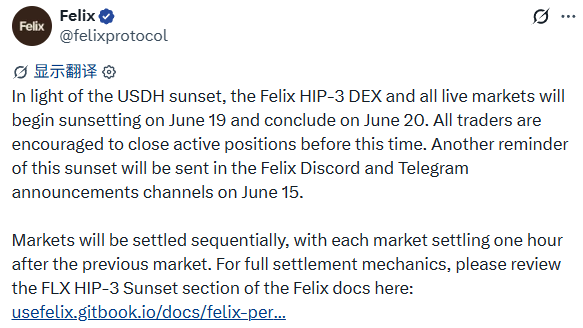
Felix (announced June 8, terminated June 20): Announcement: "In light of the deactivation of USDH, the Felix HIP-3 DEX and all active markets will begin deactivation on June 19 and conclude on June 20."


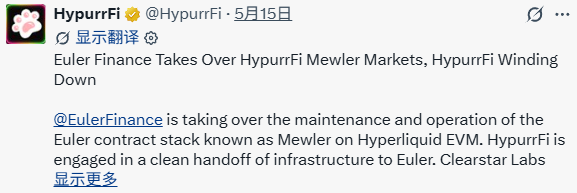
HypurrFi (May 15): Once a top lending protocol on HyperEVM, with a peak TVL exceeding $300 million. The announcement stated: "No security breach. No exploit. No emergency. This is a considered operational decision." The brand is exiting, infrastructure is being handed over to Euler Finance, and Pooled markets will complete final settlement on July 15.


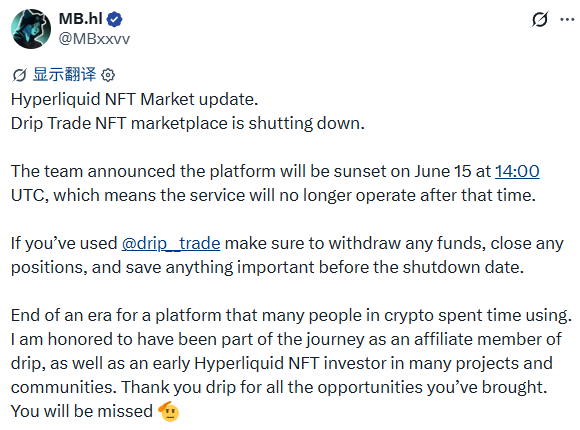
Drip.Trade (June 15): The only NFT marketplace on HyperEVM. Hyperliquid ecosystem KOL @MBxxvv relayed official news: "The platform will go offline at 22:00 on June 15, and services will no longer operate thereafter."


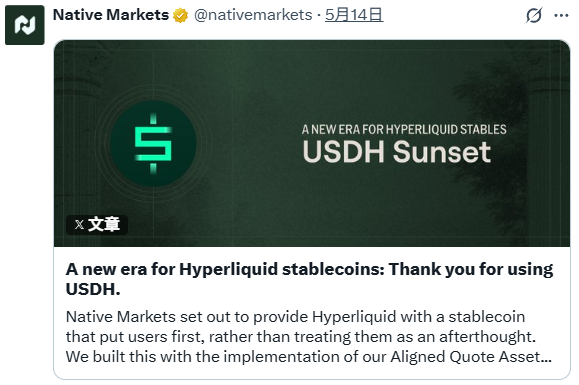
USDH / Native Markets (May 14): Announcement by Native Markets stated it would transfer the stablecoin brand rights of USDH to Coinbase, making Coinbase the official USDC deployer on Hyperliquid.


These five projects cover five sectors: lending, NFT, stablecoin, RWA private markets, and DEX, almost representing the main categories of DeFi infrastructure on HyperEVM. They were not marginal projects but protocols with real users and trading volume within the ecosystem at the time.


The Stronger the Core, the Harder the Ecosystem Lives


If HYPE's rise and the death of ecosystem projects were merely two independent trajectories, then this crisis would just be "the failure of peripheral projects themselves," not worth in-depth examination. But looking closely, these two events are not just happening in parallel.


Hyperliquid's design philosophy is minimalism: provide the chain and infrastructure, do not get involved in operations.


Since its launch in February 2025, HyperEVM has attracted over 170 project deployments, but from the start, there were no official grants, no coordinated market-making arrangements, no launch liquidity support. Projects faced the fully competitive secondary market head-on from day one. The core team hardly publicly participates in collaborative interactions with HyperEVM project parties; protocol projects are expected to be self-sufficient by default.


When on-chain products were scarce, any functioning protocol brought its own traffic. But the market in 2026 is already saturated. The survival of new protocols is not a technical problem; it's a cold start problem. Without official endorsement and liquidity guidance, the vast majority of projects simply cannot survive the cold start phase.


Furthermore, the HIP-3 mechanism allows anyone to directly deploy perpetual contract markets on HyperCore. It was originally an outlet for liquidity overflow, but it simultaneously diverts attention and user traffic away from protocol projects.


The leading project on HIP-3, TradeXYZ, already occupies about 97% of the market share in its category, leaving almost no room for latecomers. This means protocol projects are not only competing with external competitors but also competing with Hyperliquid's own liquidity siphon effect.


The more successful HyperCore is, the more traffic and capital it attracts, the harder it is for projects on HyperEVM to get a share. This is not HyperEVM's technical failure, but Hyperliquid's business model inherently reserves the highest-quality resources for the core layer, structurally compressing the peripheral survival space.

Связанные с этим вопросы

QAccording to the article, why is HYPE considered more like an 'application stock' rather than a traditional 'ecosystem token'?

AHYPE is considered an 'application stock' because its value is primarily tied to the revenue generated by HyperCore's perpetual contract trading business, not to the performance or survival of projects on the HyperEVM. Its buyback and burn mechanism is fueled by HyperCore's transaction fees, which come from a diversified range of assets. The health of HyperEVM DeFi projects does not directly impact HYPE's price, unlike ETH which depends on network activity and gas fees.

QWhat are the two main reasons mentioned in the article for the difficulty HyperEVM projects face in surviving?

AThe two main reasons are: 1) Hyperliquid's minimalist, hands-off philosophy means no official grants, liquidity support, or coordinated market-making for projects, leaving them to fend for themselves in a competitive market. 2) The success of the core HyperCore layer, particularly the HIP-3 mechanism, creates a 'liquidity siphon' effect. It attracts the most capital and user attention, making it extremely difficult for independent projects on HyperEVM to capture user traffic and sustain themselves.

QWhich five major sectors in the HyperEVM ecosystem have seen projects announce shutdowns, as highlighted in the article?

AAccording to the article, projects in five major sectors announced shutdowns: Lending (HypurrFi), NFTs (Drip.Trade), Stablecoins (USDH / Native Markets), RWA Private Markets (Ventuals), and DEXs (Felix).

QWhat is the primary source of transaction fees driving the HYPE buyback mechanism on Hyperliquid?

AThe primary source of transaction fees driving the HYPE buyback is the HyperCore perpetual contract trading layer. The revenue structure is highly diversified, with approximately 55% from crypto perpetuals (BTC, ETH, SOL), 22% from commodities (oil, gold, silver), 12% from stock indices (S&P 500, Nasdaq), and 6% from spot trading.

QHow does the relationship between the core protocol (HyperCore) and the broader ecosystem (HyperEVM) in Hyperliquid differ from that of Ethereum?

AIn Ethereum, the value of ETH is intrinsically linked to the health of its ecosystem. A thriving ecosystem with many successful dApps drives network usage and gas consumption, which benefits ETH's price. In Hyperliquid, the value of HYPE is decoupled from the HyperEVM ecosystem. HyperCore's trading fees, which fund the HYPE buyback, are generated independently of whether HyperEVM projects succeed or fail. A strong HyperCore can even hinder HyperEVM projects by absorbing most of the liquidity and user attention.

Похожее

Odaily Editorial Team Tea Talk (June 17)

Odaily Editorial Team Casual Chat (June 17) This is an informal column sharing real-time thoughts from Odaily's editorial team on industry news, data, and events. The content is based on actual investment and observations, does not constitute investment advice, and aims to expand perspectives. Azuma shared recent operations: small-scale buys in crypto (mainly BTC) at relatively high levels, a small addition to HOOD stock, and participation in World Cup prediction markets. He also discussed Hyperliquid, noting that while its token HYPE has performed well, its high price may hinder the expansion of its HIP-3 ecosystem by making market creation cost-prohibitive, potentially limiting the platform to just one major market (trade.xyz). Suzz emphasized the importance of a calm mindset in investing, stating that markets offer perpetual opportunities. He warned against "hindsight bias," where past opportunities seem obvious, and stressed that the present always holds new chances for those with the right knowledge and temperament. Golem analyzed SpaceX's acquisition of AI tool Cursor's parent company, Anysphere, for $60 billion paid entirely in SpaceX stock. He speculated whether Musk's interests might work to keep SpaceX's trading volume and market cap high in the short term to reduce the actual equity cost of the deal, noting current high retail investor enthusiasm. Wenser shared a market outlook: cautiously bullish on BTC, monitoring SpaceX stock post-IPO for a potential rise, observing World Cup trends favoring strong teams, and noting the continued strength of Japanese and Korean stocks. He highlighted Anthropic's potential for a massive future IPO and the defensive investment logic in "picks and shovels" AI infrastructure. Qin Xiaofeng discussed trading HYPE around $56-$70, viewing the $50-$60 range as long-term support due to Hyperliquid's dominance in on-chain traditional asset trading and its substantial fee revenue used to buy back HYPE. On ETH, he noted a divide between disappointed crypto natives and bullish traditional investors like Tom Lee, personally viewing current ETH prices as undervalued.

Odaily星球日报5 мин. назад

Odaily Editorial Team Tea Talk (June 17)

Odaily星球日报5 мин. назад

Under the Shock of Oil Prices and Inflation, Which Country Will Be the First to Sell Off Its Gold Reserves?

The article draws a parallel between the 2003 North American blackout and the potential collapse of the global financial system, framing the US dollar and Treasury market as the world's economic "power grid." It argues that the closure of the Strait of Hormuz is creating a shockwave, starting with oil-importing emerging markets like Turkey, India, and Indonesia. As oil prices rise, these nations are forced to sell dollar-denominated assets—first US Treasuries, then potentially their gold reserves—to afford fuel. Turkey is highlighted as a key case, having sold nearly 90% of its Treasuries and begun tapping gold reserves when oil was between $70-$105/barrel. The article warns that if prices spike to $150-$160/barrel, global buffers like oil inventories and strategic reserves will be depleted. This could trigger a cascade: vulnerable nations, having exhausted assets, could face economic and political collapse (like Sri Lanka in 2022). Their forced asset sales would drive US Treasury yields higher, potentially past a critical threshold (around 5%), forcing the US to choose between a bond market crash or hyperinflation through massive money printing. Ultimately, the piece posits that the dollar's long-term decline is inevitable. The first domino to fall will likely be a fragile emerging market, signaling the start of a chain reaction that eventually threatens the core of the dollar system. The conclusion advises holding tangible assets like gold and energy, which cannot be printed, as a hedge against currency devaluation.

marsbit29 мин. назад

Under the Shock of Oil Prices and Inflation, Which Country Will Be the First to Sell Off Its Gold Reserves?

marsbit29 мин. назад

Conversation with Arthur Hayes: AI Has Drained Market Liquidity, BTC Will Be Below 100k by Year-End

In this June 2026 podcast interview, BitMEX co-founder Arthur Hayes explains his decision to sell his major crypto holdings (HYPE, NEAR, Worldcoin, Zcash). His rationale is based on a macro view linking oil prices, the Iran conflict, US politics, and an impending AI bubble burst. Hayes argues that high oil prices, driven by the ongoing war, will pressure domestic US inflation. To salvage the Republican Party's chances in the midterm elections, he believes Donald Trump may pivot to a populist, anti-AI stance—advocating for taxes and regulation—which would deflate the AI investment narrative. He sees the AI sector, particularly massive capital expenditure on data centers, as having absorbed nearly all excess market liquidity (around $1.5 trillion in debt issuance since 2025), starving other assets like Bitcoin. He highlights the upcoming SpaceX IPO at a ~$1.8 trillion valuation and 100x price-to-sales ratio as a potential tipping point. If these hyped IPOs underperform, it could shatter market confidence in AI. In such a scenario, all risk assets, including crypto, would fall together as correlations converge to 1 during a broad correction. Hayes has moved his portfolio into Treasuries and energy stocks (like ExxonMobil), predicting Bitcoin will be below $100k by year-end. He sees a potential crypto bull market only after the AI frenzy cools, liquidity stops flowing exclusively into AI, and possibly after a significant market downturn prompts new monetary stimulus.

marsbit1 ч. назад

Conversation with Arthur Hayes: AI Has Drained Market Liquidity, BTC Will Be Below 100k by Year-End

marsbit1 ч. назад

Торговля

Спот
Фьючерсы

Популярные статьи

Как купить S

Добро пожаловать на HTX.com! Мы сделали приобретение Sonic (S) простым и удобным. Следуйте нашему пошаговому руководству и отправляйтесь в свое крипто-путешествие.Шаг 1: Создайте аккаунт на HTXИспользуйте свой адрес электронной почты или номер телефона, чтобы зарегистрироваться и бесплатно создать аккаунт на HTX. Пройдите удобную регистрацию и откройте для себя весь функционал.Создать аккаунтШаг 2: Перейдите в Купить криптовалюту и выберите свой способ оплатыКредитная/Дебетовая Карта: Используйте свою карту Visa или Mastercard для мгновенной покупки Sonic (S).Баланс: Используйте средства с баланса вашего аккаунта HTX для простой торговли.Третьи Лица: Мы добавили популярные способы оплаты, такие как Google Pay и Apple Pay, для повышения удобства.P2P: Торгуйте напрямую с другими пользователями на HTX.Внебиржевая Торговля (OTC): Мы предлагаем индивидуальные услуги и конкурентоспособные обменные курсы для трейдеров.Шаг 3: Хранение Sonic (S)После приобретения вами Sonic (S) храните их в своем аккаунте на HTX. В качестве альтернативы вы можете отправить их куда-либо с помощью перевода в блокчейне или использовать для торговли с другими криптовалютами.Шаг 4: Торговля Sonic (S)С легкостью торгуйте Sonic (S) на спотовом рынке HTX. Просто зайдите в свой аккаунт, выберите торговую пару, совершайте сделки и следите за ними в режиме реального времени. Мы предлагаем удобный интерфейс как для начинающих, так и для опытных трейдеров.

1.5k просмотров всегоОпубликовано 2025.01.15Обновлено 2026.06.02

Как купить S

Sonic: Обновления под руководством Андре Кронье – новая звезда Layer-1 на фоне спада рынка

Он решает проблемы масштабируемости, совместимости между блокчейнами и стимулов для разработчиков с помощью технологических инноваций.

2.3k просмотров всегоОпубликовано 2025.04.09Обновлено 2025.04.09

Sonic: Обновления под руководством Андре Кронье – новая звезда Layer-1 на фоне спада рынка

HTX Learn: Пройдите обучение по "Sonic" и разделите 1000 USDT

HTX Learn — ваш проводник в мир перспективных проектов, и мы запускаем специальное мероприятие "Учитесь и Зарабатывайте", посвящённое этим проектам. Наше новое направление .

1.8k просмотров всегоОпубликовано 2025.04.10Обновлено 2025.04.10

HTX Learn: Пройдите обучение по "Sonic" и разделите 1000 USDT

Обсуждения

Добро пожаловать в Сообщество HTX. Здесь вы сможете быть в курсе последних новостей о развитии платформы и получить доступ к профессиональной аналитической информации о рынке. Мнения пользователей о цене на S (S) представлены ниже.

活动图片