Beaten SK Hynix Employees in China: Year-end Bonus Less Than 5% of Korean Staff's

链捕手Опубликовано 2026-05-11Обновлено 2026-05-11

Введение

"SK Hynix Chinese Staff Hit Hard: Bonuses Less Than 5% of Korean Counterparts" Driven by the AI boom, South Korea's SK Hynix is experiencing record performance, with media reports predicting massive year-end bonuses for its employees, making them highly desirable in the matchmaking market. However, this prosperity starkly contrasts with the situation for the company's Chinese employees. According to reports, SK Hynix operates under a rule allocating 10% of operating profit for employee bonuses. While projections suggest Korean employees could receive bonuses reaching millions of RMB, a Chinese employee with over a decade of technical experience revealed the disparity: "If they get 3 million, Chinese staff get less than 5% of that." After adjustments based on KPI ratings, this employee's highest bonus was slightly over 100,000 RMB. Bonuses are paid annually in Korea but semi-annually in China. During the industry downturn in 2023-2024, Chinese employees received no bonus at all. The gap extends beyond bonuses. Recruitment posts for SK Hynix's Chinese factories (in Wuxi, Dalian, Chongqing) show engineer monthly salaries ranging from 10,000 to 35,000 RMB, with a 13th-month salary promised. Chinese employees also receive standard benefits like annual leave but lack stock incentives, which are reportedly unavailable to them. Furthermore, management positions in China are predominantly held by Korean personnel, though industry observers note a gradual increase in local middle ma...

Original Text by Su Yang

Edited by Xu Qingyang

The market capitalization keeps hitting new highs at SK Hynix, with "year-end bonus predictions" adding another layer of drama to the red-hot memory chip industry.

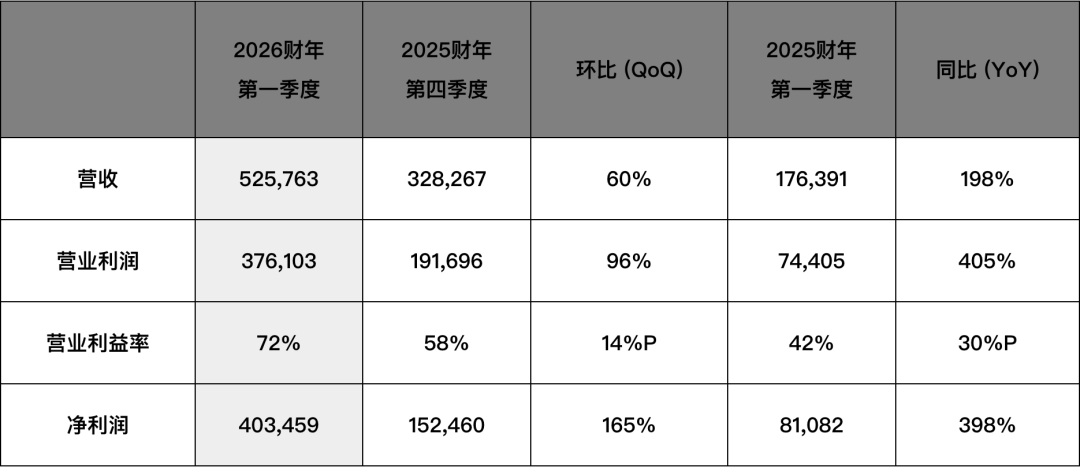
Recently, reports suggest that driven by surging AI-fueled memory demand, SK Hynix, a core memory supplier from South Korea, could see its operating profit ceiling potentially reach 250 trillion won in 2026. Following a 10% profit-sharing rule, the maximum per capita year-end bonus could exceed 3 million RMB.

SK Hynix Performance Data

South Korean media, citing matchmaking agencies, claim that "SK Hynix employees are now unconditionally matched with 'A-grade' partners in the blind date market." Variety shows even joke that SK Hynix's company vests are "stuffed with gold."

Investment bank Macquarie Securities predicts that SK Hynix's operating profit could reach 447 trillion won in 2027. If the profit-sharing rule remains unchanged, per capita bonuses distributed in 2027 could be around 1.29 billion won, nearly 6.1 million RMB.

In its response to *First Finance*, SK Hynix confirmed the authenticity of the 10% profit-sharing rule, while emphasizing that as the 2026 and next year's annual performances are not yet finalized, the bonus scale cannot be predicted, tactfully denying the accuracy of the 6.1 million RMB bonus package.

The high year-end bonus predictions may not be entirely accurate, but a significant disparity in bonuses between Chinese and Korean employees does exist.

"We have removed the bonus cap, but domestic bonuses just don't go up," said a Chinese employee of SK Hynix. "Korean staff have one settlement per year, while in China it's twice a year."

The employee revealed that if Korean staff receive a 3 million RMB bonus, Chinese employees get less than 5% of that, roughly translating to 150,000 RMB. "It's not that every one of us gets 150,000. The bonus is adjusted based on KPI ratings. The higher the rating, the higher the bonus. At best, I've received a little over 100,000."

This employee has been with SK Hynix for over a decade and has a technical background.

In the memory chip industry's super cycle, the expectation of huge year-end bonuses has sparked media reports that memory chip jobs have surpassed doctors and lawyers as the most favored profession by mothers-in-law in South Korea's blind date market.

However, compared to the current fervor, the memory industry downturn was a completely different story.

In fiscal year 2023, during the global semiconductor industry's "winter," SK Hynix's total annual revenue fell approximately 27% to 32.77 trillion won, with a net loss of 9.14 trillion won. "The lowest point was around 2023 and 2024. There was no bonus; it was zero," disclosed the aforementioned Chinese SK Hynix employee.

Regarding the trending topic of "3 million+ and 6 million+ per capita year-end bonuses," multiple industry insiders have raised doubts, emphasizing that the per capita figure is not a good reference.

"It's possible as an average, but definitely not 3 million for everyone. Executives get more, engineers get tens of thousands, and factory workers getting 100,000 RMB is already good," said a semiconductor industry professional. "Take TSMC engineers as an example; it's possible to earn around 1 million RMB a year in total."

"I just look at my income, then look at what's being posted online. The numbers are way too far apart," the Chinese SK Hynix employee explained the difference in year-end bonuses between Chinese and Korean staff: "Their (Korean staff) monthly salaries are high, and bonuses are distributed as a percentage of their 12-month salary."

Currently, SK Hynix mainly has three factories in mainland China, located in Wuxi, Dalian, and Chongqing. The Wuxi factory focuses on DRAM business; the Dalian factory was formed after acquiring Intel's assets and is now Solidigm's NAND factory; and the Chongqing factory is a packaging and testing base. Sales companies providing technical support are also present in Shenzhen, Beijing, and Shanghai.

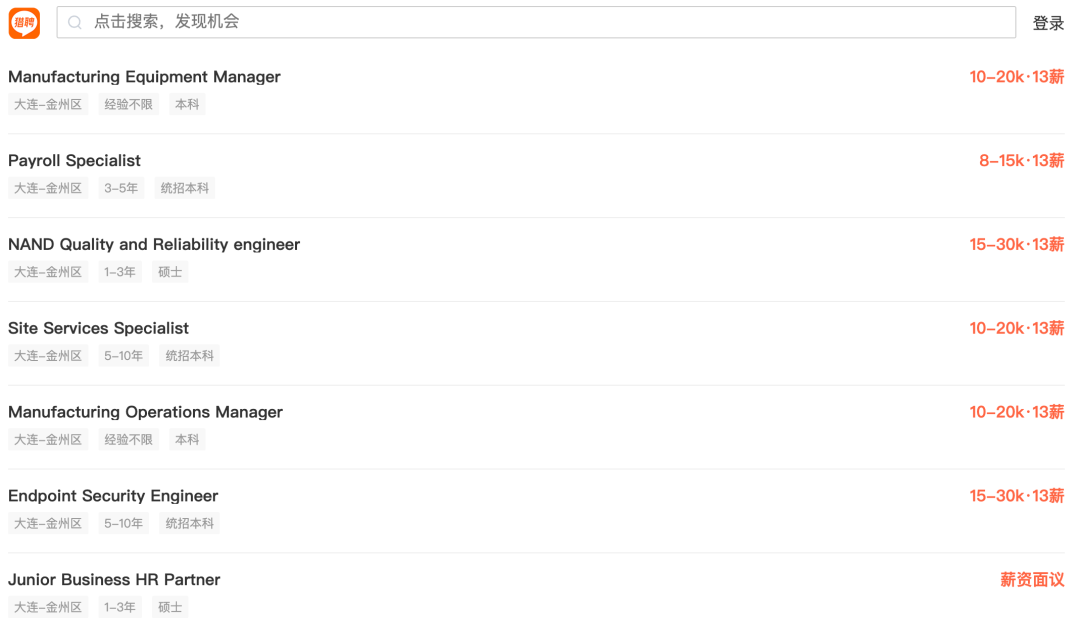
According to recruitment information for the Dalian factory posted on Liepin.com, related engineer positions generally offer monthly salaries in the 10,000 to 30,000 RMB range, promising a 13th-month salary, while senior engineer positions can go up to 35,000 RMB per month.

Besides salary, SK Hynix also provides standard benefits like annual leave for Chinese employees; for instance, support roles like sales don't require overtime work, but stock-based incentives are not offered.

"Management staff have it, but they are all Koreans. Chinese cannot be in management," emphasized the Chinese SK Hynix employee.

Several former employees of Korean companies stated that their firms basically do not offer stock incentives to Chinese employees. In the view of a former Samsung employee, the Chinese entity is more like a sales arm, similar to a national-level agency concept.

"Now there are also mainland Chinese entering middle management. TSMC is the same," said Wu Zihao, former TSMC plant construction expert and CEO of Ronghe Semiconductor Consulting. "It's normal for Korean factories to have more Koreans and prioritize their use. As operations in mainland China continue, local management personnel will also emerge; it's not that absolute."

Judging from industry and corporate forecasts, memory will remain a hot topic for the next 2-3 years, with "marriage jokes" and "work vest jokes" continuing to appear.

At the Q1 earnings call, SK Hynix's CFO indicated that for the next three years, demand represented by HBM will likely continue to outstrip supply, and growth will revolve around B2B demand, a signal also reflected in SK Hynix's official press release.

SK Hynix stated: "Despite the first quarter typically being a seasonally slow period, strong market demand continued, driven by expanding investments in artificial intelligence (AI) infrastructure. By expanding sales of high value-added products such as High Bandwidth Memory (HBM), high-capacity server DRAM modules, and enterprise solid-state drives (eSSD), the company sustained its upward performance momentum."

In summary, these are all typical B2B customer demands.

This implies that if memory makers like SK Hynix do not increase capacity support for consumer-grade products, the previously discussed topic of memory price hikes will continue to impact consumer products, driving a wave of price increases, and "electronic gold" will continue to trouble PC enthusiasts.

Связанные с этим вопросы

QWhat is the rumored maximum year-end bonus for SK Hynix Korean employees in 2027 according to the article?

AThe article states that based on predictions by Macquarie Securities, if SK Hynix's operating profit reaches 447 trillion won in 2027 with the 10% dividend rule unchanged, the per capita bonus could be about 12.9 billion won, which is close to 6.1 million RMB.

QHow does the year-end bonus for Chinese employees of SK Hynix reportedly compare to that of their Korean counterparts?

AAccording to a Chinese employee cited in the article, the bonus for Chinese employees is less than 5% of what Korean employees receive. For example, if Korean employees receive a 3 million RMB bonus, Chinese employees would get less than 150,000 RMB, adjusted based on their KPI ratings.

QWhat are the main reasons given in the article for the disparity in bonuses between Chinese and Korean SK Hynix employees?

AThe article mentions two main structural differences: Korean employees receive their bonus once a year based on 12 months of salary, while Chinese employees receive it twice a year. Additionally, Korean employees typically have higher base salaries, which forms the basis for the bonus calculation.

QWhat was the financial performance of SK Hynix during the semiconductor industry's 'winter period' in the 2023 fiscal year?

AIn the 2023 fiscal year, SK Hynix's total annual revenue decreased by approximately 27% to 32.77 trillion won, and the company reported a net loss of 9.14 trillion won. During this downturn, some employees reportedly received no bonus.

QAccording to the article, what is SK Hynix's outlook for the HBM (High Bandwidth Memory) market in the coming years?

ABased on statements from SK Hynix's CFO in a quarterly earnings meeting, the company believes that for the next 2-3 years, demand for HBM and related products will likely continue to exceed supply. This growth is expected to be driven primarily by business-to-business (to B) demand, such as from AI infrastructure investments.

Похожее

TechFlow Intelligence Bureau: Chip Stocks Lose Trillions in a Single Day, Bitcoin Falls Below $60,000, US-Iran Conflict Escalates

**Daily Tech & Markets Roundup: AI Advances, Market Turmoil, and Geopolitical Tensions** **AI / LLMs**: Anthropic's internal report on AI self-improvement sparked serious discussions about Recursive Self-Improvement (RSI). Meanwhile, debate continues on AI coding tools after Claude was accused of introducing bugs into the rsync codebase. In positive news, DeepSeek V4 Flash impressed in local deployment tests, and GitHub Copilot now supports custom endpoints for local models. A surprising research turn suggests removing chain-of-thought prompting can sometimes improve LLM performance. **Crypto / Web3**: Bitcoin plunged below $60,000, with its RSI hitting levels last seen during the COVID-19 crash, driven by strong U.S. jobs data reviving interest rate hike fears. Discussions highlight Ethereum DeFi's continued lack of a smooth consumer payment layer. **Chips / Hardware**: Chip stocks suffered a massive sell-off, with the Philadelphia Semiconductor Index posting its worst single-day drop in six years, erasing over a trillion dollars in value. Marvell, Micron, AMD, and Intel were among the biggest losers. **Tech Companies**: A leaked Microsoft document revealing goals to make Copilot "addictive" drew criticism. LinkedIn founder Reid Hoffman left Microsoft's board to focus full-time on his AI agent startup, Manus. Google was revealed to be paying SpaceX $920 million monthly for AI training compute. **Markets & Macro**: A blowout U.S. jobs report (172k vs. 80k expected) crushed hopes for near-term rate cuts, sending Treasury yields soaring and triggering a broad market sell-off. CEOs from Kraft, McDonald's, and Whirlpool simultaneously warned U.S. consumers are exhausting their savings. **Geopolitics**: U.S.-Iran tensions escalated with missile/drone interceptions and U.S. strikes on Iranian radar sites, keeping the critical Strait of Hormuz largely closed since late February and posing ongoing oil supply risks. **The Bottom Line**: The strong jobs data acted as a single trigger for correlated sell-offs across equities, crypto, and chips. Underlying the volatility is a stark contradiction between robust employment data and warnings of consumer weakness, alongside geopolitical risks that could reignite inflation, leaving markets to price in a fraught macro outlook with no clear "soft landing" path.

marsbit3 ч. назад

TechFlow Intelligence Bureau: Chip Stocks Lose Trillions in a Single Day, Bitcoin Falls Below $60,000, US-Iran Conflict Escalates

marsbit3 ч. назад

It Took Me a Year to See the Bitter Truth About Agent Payments

After a year building infrastructure for the Agent economy, engaging with major players like Stripe, Visa, and Coinbase, the author shares a sobering analysis of the current state of Agent payments. The core finding is a stark lack of genuine, immediate demand across most envisioned use cases. The article breaks down four key market segments: 1. **Agent-to-Merchant (Consumer Shopping):** For most product categories (e.g., clothing, electronics), conversational AI shopping is a step backwards from visual e-commerce interfaces. While agents excel at understanding needs, they can't replace side-by-side product comparison. Real merchant interest is defensive "Agent Engine Optimization," not driven by current customer demand. Potential exists for high-frequency, low-decision purchases (like food delivery) or navigating complex store UIs, but these require massive B2C distribution channels dominated by giants like Amazon. 2. **Agent-to-API (Developer Services):** Developers already have subscriptions and billing relationships for APIs (compute, data). Prepaid balances solve micro-payment issues for low transaction volumes. A deeper structural problem is that major SaaS vendors' business models rely on enterprise contracts, resisting granular pay-per-call pricing. While protocols like MPP and x402 serve the long tail of niche services, this market is small and developers are historically low-willingness-to-pay. 3. **Agent-to-Agent:** This remains largely theoretical with minimal transaction volume. While it represents a long-term bet on a fundamentally new transaction infrastructure (sub-second, micro-penny to million-dollar, multi-party settlements), it does not constitute a present market. 4. **Agent-to-Finance:** This is the only category with existing, paying demand. Integrating AI into financial workflows (trading, portfolio management) is a natural evolution and enables new capabilities like autonomous rebalancing. However, competition favors established, regulated institutions. The "real problem" is not moving money between agents, but the broader challenge of **coordination**—orchestrating work between agents and humans, verifying outcomes, and settling results. Payment is just one component of settlement, which is itself part of coordination. Companies that solve the coordination layer will subsume payment, not the other way around. While well-funded incumbents build defensively for a long-term future, startups must find where the market is today—which, for the author's team, lies outside these four categories in an area of real, growing, and underserved activity.

marsbit4 ч. назад

It Took Me a Year to See the Bitter Truth About Agent Payments

marsbit4 ч. назад

Торговля

Спот
Фьючерсы

Популярные статьи

Как купить S

Добро пожаловать на HTX.com! Мы сделали приобретение Sonic (S) простым и удобным. Следуйте нашему пошаговому руководству и отправляйтесь в свое крипто-путешествие.Шаг 1: Создайте аккаунт на HTXИспользуйте свой адрес электронной почты или номер телефона, чтобы зарегистрироваться и бесплатно создать аккаунт на HTX. Пройдите удобную регистрацию и откройте для себя весь функционал.Создать аккаунтШаг 2: Перейдите в Купить криптовалюту и выберите свой способ оплатыКредитная/Дебетовая Карта: Используйте свою карту Visa или Mastercard для мгновенной покупки Sonic (S).Баланс: Используйте средства с баланса вашего аккаунта HTX для простой торговли.Третьи Лица: Мы добавили популярные способы оплаты, такие как Google Pay и Apple Pay, для повышения удобства.P2P: Торгуйте напрямую с другими пользователями на HTX.Внебиржевая Торговля (OTC): Мы предлагаем индивидуальные услуги и конкурентоспособные обменные курсы для трейдеров.Шаг 3: Хранение Sonic (S)После приобретения вами Sonic (S) храните их в своем аккаунте на HTX. В качестве альтернативы вы можете отправить их куда-либо с помощью перевода в блокчейне или использовать для торговли с другими криптовалютами.Шаг 4: Торговля Sonic (S)С легкостью торгуйте Sonic (S) на спотовом рынке HTX. Просто зайдите в свой аккаунт, выберите торговую пару, совершайте сделки и следите за ними в режиме реального времени. Мы предлагаем удобный интерфейс как для начинающих, так и для опытных трейдеров.

1.4k просмотров всегоОпубликовано 2025.01.15Обновлено 2026.06.02

Как купить S

Sonic: Обновления под руководством Андре Кронье – новая звезда Layer-1 на фоне спада рынка

Он решает проблемы масштабируемости, совместимости между блокчейнами и стимулов для разработчиков с помощью технологических инноваций.

2.3k просмотров всегоОпубликовано 2025.04.09Обновлено 2025.04.09

Sonic: Обновления под руководством Андре Кронье – новая звезда Layer-1 на фоне спада рынка

HTX Learn: Пройдите обучение по "Sonic" и разделите 1000 USDT

HTX Learn — ваш проводник в мир перспективных проектов, и мы запускаем специальное мероприятие "Учитесь и Зарабатывайте", посвящённое этим проектам. Наше новое направление .

1.8k просмотров всегоОпубликовано 2025.04.10Обновлено 2025.04.10

HTX Learn: Пройдите обучение по "Sonic" и разделите 1000 USDT

Обсуждения

Добро пожаловать в Сообщество HTX. Здесь вы сможете быть в курсе последних новостей о развитии платформы и получить доступ к профессиональной аналитической информации о рынке. Мнения пользователей о цене на S (S) представлены ниже.

活动图片