Bankless Founder Sells Off ETH, Collective Collapse of Ethereum Faith

Odaily星球日报Опубликовано 2026-05-21Обновлено 2026-05-21

Введение

Ethereum faces a "crisis of faith" as David Hoffman, co-founder of the prominent pro-Ethereum media outlet Bankless, announces he has sold all his ETH. This move, coupled with reports of major layoffs at Bankless, signals a potential retreat of Ethereum's staunchest supporters. Hoffman and co-founder Ryan Sean Adams confirm Bankless is entering a "second era," with Adams stepping back and Hoffman exploring new frontiers. Hoffman sharply criticizes the Ethereum Foundation, stating that ETH's poor price performance cannot be separated from its leadership. He has a history of public dissatisfaction, citing the Foundation's failure to drive market growth and its "endless manifestos." His frustration coincides with ETH/BTC hitting multi-month lows and a significant exodus of senior researchers and executives from the Ethereum Foundation, partly attributed to controversial "loyalty oaths." The article contrasts Ethereum's current predicament—with its Layer-2 narrative discredited and ecosystem stagnant—against what should have been a highlight year in 2026 amid tokenization trends. While a previous surge to near $5,000 was driven by corporate buybacks (DAT热潮), ETH has since fallen over 50%. The core question remains: with fading faith and intense competition, what is Ethereum's next solution? Hoffman's divestment symbolizes a growing disconnect between the community and the ecosystem's direction.

Original|Odaily Planet Daily(@OdailyChina)

Author|Wenser(@wenser 2010 )
ETH faces another "crisis of faith." This time, the trigger is Bankless, the crypto media that has long been a cheerleader for Ethereum. Co-founder David Hoffman proactively published an article stating he had "sold his last ETH." Community user @Ox_Lucas also revealed that Bankless recently appeared to have laid off most of its team members. Undoubtedly, "the loyal Ethereum guards are witnessing their moment of exit."

In 2026, as the wave of stock tokenization surges and crypto ETF assets have become standard for institutions, this should have been Ethereum's moment of glory. However, the invalidation of the L2 roadmap, the wave of resignations among foundation leadership, and the reality of ETH's price following declines but not gains have left its survival situation quite awkward.

David Hoffman's sell-off might just be the beginning of "the Ethereum guards' exit."

Co-founder Steps Back, Bankless Enters Its Second Phase

Perhaps newcomers are not very familiar with Bankless. Since its founding in 2020, it has been the "mouthpiece media" for the Ethereum ecosystem. The Bankless DAO, established based on this media, was once the "premier DAO community." But now, Bankless has concluded its "first phase" of development and must usher in its second phase.

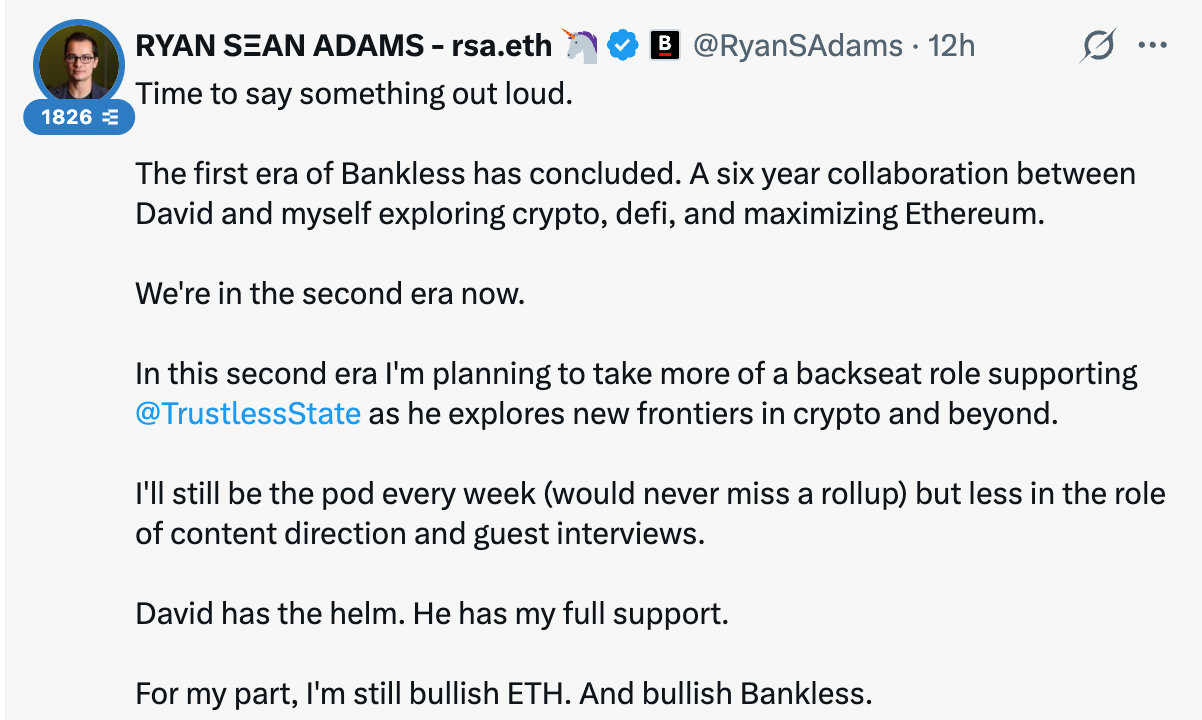
Shortly after David Hoffman's post about selling ETH, the other co-founder, Ryan Sean Adams, also posted, stating: "Time to make it public. The first era of Bankless is over. This marks six years of collaboration between David and me, exploring cryptocurrency, DeFi, and Ethereum maximalism. We are now in the second era.

In this era, I plan to step back from the forefront to support David as he explores new frontiers in crypto and beyond. I will still host the podcast weekly (never missing a recap meeting), but my role in content direction and guest interviews will diminish. David continues to steer the ship, and I fully support him. Personally, I remain bullish on ETH and bullish on Bankless."
Six years after its founding, Bankless has achieved remarkable success: apart from interviews with prominent figures like Vitalik, Chris Dixon, and Hayden Adams, the media has amassed 280,000 subscribers on YouTube, with a newsletter readership of 350,000. Its podcast has received high ratings of 4.7 stars on platforms like Spotify and Apple Podcasts, has been listed among the "Top 10 Best Crypto Podcasts" by multiple media outlets, and is hailed by many as the "ultimate guide to Web3 education."

But now, David Hoffman's discontent is evident, even resorting to "selling off ETH" to express his stance. His criticism is directly aimed at the current Ethereum Foundation.

"When the Most Loyal Ethereum Guard Decides to Sell Off ETH": Bankless Co-founder Blasts Ethereum Foundation

Following David Hoffman's post, the Ethereum community engaged in lively discussion. Some teased him, saying his "routine of periodically leaving the Ethereum ecosystem and returning" is a regular act, calling him a "seasonal barometer." They suggested that when he becomes bullish on ETH again, it might signal a market peak and a time for caution.

Subsequently, David Hoffman responded directly: "I have always supported the Ethereum blockchain network, but the ETH asset is becoming increasingly questionable. Let's not conflate the two."

A community member then pointedly asked: "Is it that you support ETH but doubt the Ethereum Foundation?"

David Hoffman's answer was straightforward: "Unfortunately, you cannot separate ETH's price performance from its leadership." His dissatisfaction with the Ethereum Foundation, the "ecosystem leader," is palpable.

It is worth noting that this is not the first time David Hoffman has expressed dissatisfaction with the Ethereum Foundation:

  • In April of last year, when ETH prices fell below $1,500, he publicly stated, "Ethereum's leadership and culture are driving away users and developers";
  • In October of last year, the departure of Ethereum Foundation researcher Dankrad Feist prompted him to express concern about the brain drain in the Ethereum ecosystem;
  • In March of this year, he directly criticized the Ethereum Foundation in his article "The EF's Endless Manifestos," stating it "does not strive for Ethereum's market expansion."

Now, it seems David Hoffman's attitude towards ETH and the Ethereum Foundation has already transitioned from "frustration at its stagnation and misfortune" to a state of "hopeless despair."

On the other side of the story, naturally, lies ETH and the Ethereum Foundation's own "lack of drive."

According to Coinglass data, the ETH/BTC exchange rate briefly fell to 0.02835 on May 12, marking its lowest level since July 2025, with a cumulative decline of over 35% from the August 2025 high of 0.04324.

Simultaneously, the Ethereum Foundation is experiencing a wave of resignations: On May 19, Ethereum Foundation researchers Carl Beek and Julian Ma officially announced their imminent departure. The former had been with the organization for seven years, while the latter had worked at the Ethereum Foundation for four years, accompanying it through thousands of days and nights.

Prior to this, several executives and researchers from the Ethereum Foundation had already left, including Co-Executive Director Tomasz K. Stańczak, who departed in February of this year, Josh Stark, who left in March, and Protocol team leads Barnabé Monnot, Tim Beiko, and Alex Stokes, who announced their resignations earlier this month. So far this year, at least 8 senior figures at the Ethereum Foundation have resigned.

Absurdly, a primary reason for these departures appears to be the ludicrous requirement for employees to sign loyalty pledges, a factor that is both laughable and infuriating.

Paired with previous incidents where the Ethereum Foundation continued selling ETH regardless of market cycles, and even engaged in direct OTC transactions with DAT treasury company Bitmine, this organization seems to have lost its "last bit of fundamental support." Internal brain drain, external competitive weakness—the future of the Ethereum Foundation appears even bleaker than that of Bankless.

After DAT, What Is Ethereum's Next Solution?

In April of last year, based on interviews from attending an ETH Hangzhou offline event, the author wrote the article "ETH Hangzhou On-site Investigation: Ethereum Has Entered Middle Age, No Hope for Price Highs Within Three Years." At that time, ETH prices were also struggling, and countless people held little hope for its future performance. However, with the DAT frenzy arriving in June and July, buying pressure from listed companies like Bitmine and Sharplink still managed to push ETH's price high to nearly $5,000.

Now, ETH's price has more than halved from its peak. The difference is that when people discuss Ethereum, it is no longer seen as the sole answer for "new financial infrastructure." The L2 roadmap has been thoroughly invalidated, and Hyperliquid has emerged as the new "on-chain infrastructure." What is the next solution awaiting ETH and Ethereum? No one can provide a definitive answer.

Compared to the past when token prices fell but ecosystem development was booming, perhaps the current silence within the Ethereum ecosystem is even more despairing. David Hoffman's sale of ETH may have its own reasons, but his growing distance from the Ethereum ecosystem has become an undeniable fact.

Похожее

Warsh's First Day in Office, Markets Deliver a 'Wake-up Call': Rate Hike Expected This Year

On his first day in office, newly inaugurated Federal Reserve Chairman Warsh received a stark market warning, with expectations now fully pricing in a 25-basis-point interest rate hike this year. The shift was triggered by hawkish remarks from Fed Governor Waller, who stated that inflation is now the key policy "driver" and that the odds of a hike or cut are evenly split. This sent short-term Treasury yields higher. Waller signaled a significant pivot in his stance, citing disappointing inflation and labor data. He suggested removing "easing bias" language from Fed statements and did not rule out future rate increases if inflation fails to recede, though he noted immediate action isn't warranted without signs of unanchored inflation expectations. Chairman Warsh faces immediate pressure at his first FOMC meeting in June. With the preferred inflation gauge at a three-year high, analysts warn that failing to hike could be interpreted as an implicit easing of policy. The geopolitical situation in the Middle East is adding to existing price pressures. The market's expectation for a hike contrasts sharply with earlier forecasts for multiple cuts. While long-term Treasury yields have been contained by lower energy prices recently, analysts note they remain under structural upward pressure. Warsh's swearing-in at the White House highlights political scrutiny over Fed independence. However, the market has made it clear that inflation is the most urgent challenge, leaving the new chairman little time to settle in.

marsbit2 ч. назад

Warsh's First Day in Office, Markets Deliver a 'Wake-up Call': Rate Hike Expected This Year

marsbit2 ч. назад

Has Microsoft Lost Its Way in the AI Race, and Can Copilot Bring It Back on Track?

Microsoft, once seen as an early AI frontrunner due to its investment in OpenAI, is navigating a strategic shift amid increased competition. Its initial reliance on OpenAI’s GPT models has been complicated by OpenAI’s growing ambitions as a direct competitor, rapid advancements from rivals like Claude and Gemini, and the disruptive rise of AI agents, which challenge its traditional SaaS business model. These factors contributed to stock declines and slower-than-expected adoption of its flagship Copilot products. In response, CEO Satya Nadella has taken a hands-on role in product development, signaling the urgency of change. Microsoft is pivoting from a model-centric strategy to a "model-agnostic" enterprise platform approach. It aims to become the foundational layer connecting various AI models—from OpenAI, Anthropic, or its own new "Superintelligence" team—with enterprise workflows, data, security, and cloud services. Recent organizational changes merged consumer and enterprise Copilot teams to accelerate innovation, exemplified by new products like Copilot Tasks and Copilot Cowork. However, this transformation comes at a high cost. Microsoft faces massive capital expenditures, potentially reaching ~$190 billion by 2026, to support AI infrastructure. While its platform strategy shows early signs of traction with growing Azure AI revenue, it must balance startup-like agility with the reliability expected by enterprise clients. The core challenge is no longer being the sole AI winner but defending its position as the essential enterprise software entry point amidst rapid technological commoditization and the shift towards always-on AI agents.

marsbit2 ч. назад

Has Microsoft Lost Its Way in the AI Race, and Can Copilot Bring It Back on Track?

marsbit2 ч. назад

Why Haven't Forex Stablecoins Taken Off?

Why FX Stablecoins Never Took Off: A Path Forward via Synthetic FX Despite the explosive growth of stablecoin-powered digital banking, which has seen ~$6B in VC investment and a 24x surge in crypto card spending in under a year, a major limitation persists: these banks are essentially dollar-only accounts. This leaves 95-99% of global accounts, which are denominated in non-USD currencies, underserved. Attempts to create native foreign currency (FX) stablecoins (like EURC) have largely failed, with total FX stablecoin TVL at ~$600M compared to $400B for USD stablecoins—a 700x gap. These FX tokens face critical challenges: fragile pegs due to low liquidity, limited exchange/FinTech acceptance, poor on/off-ramps, complex regional compliance, and a chicken-and-egg adoption problem. The article argues that the solution lies not in competing with entrenched USD stablecoin networks (USDT/USDC), but in adopting a synthetic FX model inspired by traditional finance. Specifically, it advocates for Mark-to-Market Non-Deliverable Forwards (NDFs)—cash-settled FX derivatives that allow users to maintain underlying USD stablecoin holdings while having their account balance and P&L denominated in a foreign currency. This approach offers key advantages: strong oracle-based pegs, retention of deep USD stablecoin liquidity and yield, superior on/off-ramps, scalability to any currency with a reliable feed, and capital efficiency. It mirrors how modern institutional FX markets operate. Primary use cases for on-chain NDFs include: 1. **Digital Banks/Wallets:** Enabling multi-currency accounts for international users without leaving the USD stablecoin ecosystem, boosting deposits and retention. 2. **FX Carry Trade Vaults:** Offering access to sovereign interest rate differentials (e.g., earning yield on BRL) in a more stable and scalable format than crypto-native products like Ethena. 3. **Global Enterprise Payments:** Allowing merchants to receive payments in local currency equivalents while settling in USD stablecoins, similar to services offered by Stripe for fiat. The conclusion is that synthetic FX, not native FX stablecoins, is the viable path to integrating foreign exchange into the growing stablecoin digital banking landscape, potentially unlocking the next phase of institutional DeFi and multi-trillion-dollar global adoption.

链捕手3 ч. назад

Why Haven't Forex Stablecoins Taken Off?

链捕手3 ч. назад

Торговля

Спот
Фьючерсы

Популярные статьи

Manyu: восходящая мем-звезда на Ethereum, готовая открыть новую эру культуры Shiba

Manyu - это мемтокен на Ethereum, который приносит децентрализованную культурную и развлекательную ценность через вирусное влияние в соцсетях и вовлечённость сообщества.

1.9k просмотров всегоОпубликовано 2025.11.27Обновлено 2025.11.27

Manyu: восходящая мем-звезда на Ethereum, готовая открыть новую эру культуры Shiba

Неделя обучения по популярным токенам 14: Glamsterdam — самое ожидаемое обновление Ethereum в 2026 году

Ordinals/Runes по-прежнему стимулируют доходы от комиссий за блоки и активность разработчиков, рассматриваются как отправная точка «нативной эмиссии активов» в сети.

1.4k просмотров всегоОпубликовано 2026.04.29Обновлено 2026.04.29

Неделя обучения по популярным токенам 14: Glamsterdam — самое ожидаемое обновление Ethereum в 2026 году

Обсуждения

Добро пожаловать в Сообщество HTX. Здесь вы сможете быть в курсе последних новостей о развитии платформы и получить доступ к профессиональной аналитической информации о рынке. Мнения пользователей о цене на ETH (ETH) представлены ниже.

活动图片