Analysts Warn Bitcoin May Face Further Downside After Major Sell‑Off

bitcoinistОпубликовано 2026-02-06Обновлено 2026-02-06

Введение

Bitcoin (BTC) briefly fell to around $60,000, a 17-month low, before recovering to $70,667. Analysts warn that selling pressure from large holders (whales) and significant outflows from spot Bitcoin ETFs are driving the decline. Concerns over a potential "Crypto Winter" are growing, with few signs of a bottom. While some analysts compare the drop to the post-FTX collapse period and warn of further downside, others suggest the market may be nearing "exhaustion" and entering a "peak fear" phase that could precede stabilization. BTC has since rebounded, gaining 10% in 24 hours.

Bitcoin (BTC) has staged a modest rebound after suffering a sharp sell‐off over recent days, but market analysts warn that the underlying pressures driving the decline remain firmly in place.

The world’s largest cryptocurrency plummeted momentarily to around $60,000 on Thursday, its lowest level in around 17 months, before rising modestly to current trade values of $70,667 as of Friday afternoon.

Crypto Winter Fears Grow

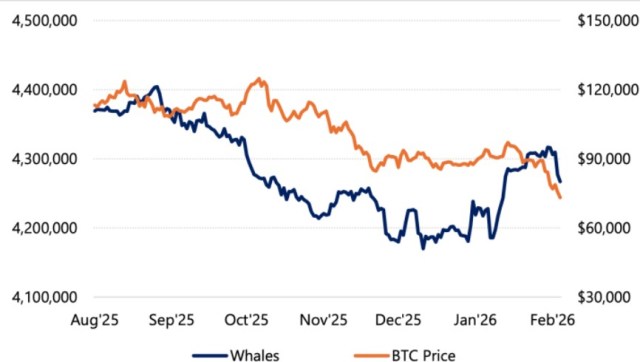
In comments shared with Fortune, Jefferies analyst Andrew Moss, the downturn is being fueled largely by selling from major holders. In a note to clients, Moss said that large Bitcoin investors, commonly referred to as whales, have been offloading their positions into market weakness.

He noted that these holders shifted to net sellers over the weekend after steadily accumulating Bitcoin since early January, suggesting a significant change in market behavior at the top end of ownership.

BTC whale activity during January. Source: Fortune

Selling pressure has also emerged from retail investors who gained exposure to Bitcoin through spot exchange‐traded funds (ETFs). Moss pointed out that net outflows from spot Bitcoin ETFs during the weeks of January 19 and January 26 ranked as the second‐ and third‐largest since those products were launched.

Those withdrawals were followed by another wave of substantial outflows on February 4, adding to downward pressure on prices, which coupled with ETF outflows, has reignited familiar concerns across the crypto market.

Moss said renewed talk of a “Crypto Winter” is spreading, warning that there are few convincing signs that Bitcoin is nearing a bottom. He added that the lack of buying activity from small‐ and medium‐sized holders suggests that dip‐buying sentiment remains weak, a factor that often signals further downside risk.

Analysts Divided On Bitcoin’s Next Move

Other analysts echoed the cautious outlook. Deutsche Bank strategist Henry Allen noted that Bitcoin’s recent drop marked its worst single‐day decline since November 2022.

That period coincided with the collapse of Sam Bankman‐Fried’s FTX exchange, an event that wiped out billions of dollars in customer funds and sent shockwaves through the digital asset industry.

Chevy Cassar, author of the Milk Road newsletter, described the current environment in stark terms, acknowledging that the downturn is painful and warning that conditions could deteriorate further.

Based on historical patterns, Cassar said crypto markets often take anywhere from one month to nearly a year to reach a true bottom after major declines.

Still, not all observers see the current moment as purely negative. Fabian Dori, chief investment officer at Sygnum Bank, said the market may be approaching a point of exhaustion.

Dori said sentiment appears to be entering what he described as “peak fear territory,” a phase that has historically preceded stabilization or recovery in past cycles.

The 1-D chart shows BTC’s recovery slightly above $70,000. Source: BTCUSDT on TradingView.com

At the time of writing, BTC has recovered to its current trading price of $70,667 and has seen a 10% surge within the last 24 hours.

Featured image from OpenArt, chart from TradingView.com

Связанные с этим вопросы

QWhat are the main factors driving Bitcoin's recent decline according to Jefferies analyst Andrew Moss?

AThe downturn is largely fueled by selling from major holders (whales) who shifted to net sellers after accumulating since early January, and significant net outflows from spot Bitcoin ETFs in recent weeks.

QWhat price did Bitcoin briefly drop to on Thursday, and what was its recovery value as of Friday afternoon?

ABitcoin plummeted momentarily to around $60,000 on Thursday, its lowest level in around 17 months, before rising modestly to $70,667 as of Friday afternoon.

QWhat historical event does Deutsche Bank strategist Henry Allen compare Bitcoin's recent drop to?

AHenry Allen noted that Bitcoin's recent drop marked its worst single-day decline since November 2022, a period that coincided with the collapse of Sam Bankman-Fried's FTX exchange.

QAccording to the Milk Road newsletter author Chevy Cassar, how long can it take for crypto markets to reach a true bottom after major declines?

ABased on historical patterns, Chevy Cassar said crypto markets often take anywhere from one month to nearly a year to reach a true bottom after major declines.

QWhat contrasting, more optimistic view does Fabian Dori, CIO of Sygnum Bank, offer on the current market sentiment?

AFabian Dori suggests the market may be approaching a point of exhaustion, with sentiment entering 'peak fear territory,' a phase that has historically preceded stabilization or recovery in past cycles.

Похожее

Institutional Adoption of Prediction Markets Stuck at the Third Stage

Prediction markets are transitioning from niche platforms focused on elections and sports to mainstream financial tools, as highlighted at Kalshi Research's inaugural conference. While sports still dominate trading volume (around 80%), non-sports categories like macroeconomics, politics, and entertainment are growing faster, signaling a shift from entertainment-based trading to information and risk management tools. Institutions, including Wall Street firms, are increasingly using prediction markets for data reference (Stage 1 adoption), with some progressing to system integration (Stage 2). However, full-scale trading (Stage 3) is limited due to the lack of margin trading, requiring full collateral for positions—a barrier for leverage-dependent entities. Kalshi is working with regulators to introduce margin mechanisms. Key insights from participants like Goldman Sachs and CNBC emphasize the value of real-time pricing for events (e.g., Fed decisions, tariffs), providing benchmarks previously unavailable. The path to maturity mirrors historical financial instruments like options, with expectations that prediction markets will become institutional staples within five years. Political leaders, including Trump and Schumer, now cite Kalshi odds, underscoring its growing influence. The platform rewards domain expertise over traditional finance backgrounds, attracting diverse participants from fields like music and poker. Ultimately, prediction markets are evolving into critical infrastructure for pricing uncertainty.

marsbitТолько что

Institutional Adoption of Prediction Markets Stuck at the Third Stage

marsbitТолько что

The First Year of Computing Power Inflation: The Cheaper DeepSeek Gets, the Harder It Is to Stop This Round of Price Hikes

The year 2026 marks the beginning of "computing power inflation." While AI inference costs have dropped by over 80% in 18 months globally, China's three major cloud providers—Alibaba Cloud, Baidu AI Cloud, and Tencent Cloud—simultaneously announced price hikes of 20–30%. This reflects a deeper structural shift driven by Jevons Paradox: as unit costs fall (e.g., via models like DeepSeek-R1), demand explodes, especially with the rise of reasoning models and AI agents that consume 10–50x more tokens per task. Although DeepSeek open-sourced its model weights, it did not release its inference optimization stack, leaving a significant engineering efficiency gap between cloud providers and smaller players. The big three are leveraging this advantage to reposition: Alibaba focuses on high-margin premium clients, Baidu filters out low-value users, and Tencent capitalizes on ecosystem lock-in. Meanwhile, ByteDance’s Volcano Engine adopts a more moderate pricing strategy to capture displaced customers. Unexpectedly, the price surge is pushing large enterprises toward self-built computing solutions once their cloud bills exceed a certain threshold. While cloud providers aim to boost profitability, they risk driving away innovative startups and accelerating competition from GPU leasing and domestic hardware providers like Huawei. The涨价 trend is expected to persist for 2–3 years, fueled by rising token consumption from reasoning models, AI agent adoption, and NVIDIA export restrictions. The inflection point depends on whether domestic chips can match NVIDIA’s efficiency, likely around 2027–2028. Until then, cloud providers will maintain pricing power, and the key for AI companies is to optimize token usage—the real moat in this era.

marsbit1 ч. назад

The First Year of Computing Power Inflation: The Cheaper DeepSeek Gets, the Harder It Is to Stop This Round of Price Hikes

marsbit1 ч. назад

Торговля

Спот
Фьючерсы

Популярные статьи

Тест по Bitcoin Биткоина

HTX Learn: Изучите Bitcoin halving и Заработаете Токены USDT

2.9k просмотров всегоОпубликовано 2024.04.16Обновлено 2024.04.16

Тест по Bitcoin  Биткоина

Что такое $BITCOIN

ЦИФРОВОЕ ЗОЛОТО ($BITCOIN): Комплексный анализ Введение в ЦИФРОВОЕ ЗОЛОТО ($BITCOIN) ЦИФРОВОЕ ЗОЛОТО ($BITCOIN) — это проект на основе блокчейна, работающий в сети Solana, который стремится объединить характеристики традиционных драгоценных металлов с инновациями децентрализованных технологий. Хотя он носит имя Биткойн, часто называемого “цифровым золотом” из-за его восприятия как средства хранения ценности, ЦИФРОВОЕ ЗОЛОТО является отдельным токеном, предназначенным для создания уникальной экосистемы в ландшафте Web3. Его цель — позиционировать себя как жизнеспособный альтернативный цифровой актив, хотя детали его применения и функциональности все еще развиваются. Что такое ЦИФРОВОЕ ЗОЛОТО ($BITCOIN)? ЦИФРОВОЕ ЗОЛОТО ($BITCOIN) — это токен криптовалюты, специально разработанный для использования в блокчейне Solana. В отличие от Биткойна, который выполняет широко признанную роль хранения ценности, этот токен, похоже, сосредоточен на более широких приложениях и характеристиках. Примечательные аспекты включают: Инфраструктура блокчейна: Токен построен на блокчейне Solana, известном своей способностью обрабатывать высокоскоростные и недорогие транзакции. Динамика предложения: ЦИФРОВОЕ ЗОЛОТО имеет максимальное предложение, ограниченное 100 квадриллионами токенов (100P $BITCOIN), хотя детали о его обращающемся предложении в настоящее время не раскрыты. Утилита: Хотя точные функциональные возможности не описаны, есть указания на то, что токен может быть использован для различных приложений, потенциально связанных с децентрализованными приложениями (dApps) или стратегиями токенизации активов. Кто создатель ЦИФРОВОГО ЗОЛОТА ($BITCOIN)? На данный момент личность создателей и команды разработчиков, стоящих за ЦИФРОВЫМ ЗОЛОТОМ ($BITCOIN), остается неизвестной. Эта ситуация типична для многих инновационных проектов в области блокчейна, особенно тех, которые связаны с децентрализованными финансами и феноменом мем-криптовалют. Хотя такая анонимность может способствовать культуре, ориентированной на сообщество, она усиливает опасения по поводу управления и ответственности. Кто инвесторы ЦИФРОВОГО ЗОЛОТА ($BITCOIN)? Доступная информация указывает на то, что у ЦИФРОВОГО ЗОЛОТА ($BITCOIN) нет известных институциональных спонсоров или значительных венчурных капиталовложений. Проект, похоже, функционирует по модели пирингового взаимодействия, сосредоточенной на поддержке и принятии сообществом, а не на традиционных путях финансирования. Его активность и ликвидность в основном сосредоточены на децентрализованных биржах (DEX), таких как PumpSwap, а не на устоявшихся централизованных торговых платформах, что еще больше подчеркивает его подход, ориентированный на grassroots. Как работает ЦИФРОВОЕ ЗОЛОТО ($BITCOIN) Операционные механизмы ЦИФРОВОГО ЗОЛОТА ($BITCOIN) можно подробно описать на основе его дизайна блокчейна и характеристик сети: Механизм консенсуса: Используя уникальный механизм доказательства истории (PoH) Solana в сочетании с моделью доказательства доли (PoS), проект обеспечивает эффективную валидацию транзакций, что способствует высокой производительности сети. Токеномика: Хотя конкретные дефляционные механизмы не были подробно описаны, большое максимальное предложение токенов подразумевает, что оно может быть предназначено для микротранзакций или нишевых случаев использования, которые еще предстоит определить. Интероперабельность: Существует потенциал для интеграции с более широкой экосистемой Solana, включая различные платформы децентрализованных финансов (DeFi). Однако детали относительно конкретных интеграций остаются неуточненными. Хронология ключевых событий Вот хронология, которая подчеркивает значимые вехи, касающиеся ЦИФРОВОГО ЗОЛОТА ($BITCOIN): 2023: Первоначальное развертывание токена происходит в блокчейне Solana, отмеченное его адресом контракта. 2024: ЦИФРОВОЕ ЗОЛОТО приобретает видимость, когда оно становится доступным для торговли на децентрализованных биржах, таких как PumpSwap, позволяя пользователям обменивать его на SOL. 2025: Проект наблюдает спорадическую торговую активность и потенциальный интерес к инициативам, возглавляемым сообществом, хотя на данный момент не зафиксировано никаких значительных партнерств или технических достижений. Критический анализ Сильные стороны Масштабируемость: Основная инфраструктура Solana поддерживает высокие объемы транзакций, что может повысить полезность $BITCOIN в различных сценариях транзакций. Доступность: Потенциально низкая цена торговли за токен может привлечь розничных инвесторов, способствуя более широкому участию благодаря возможностям дробного владения. Риски Отсутствие прозрачности: Отсутствие публично известных спонсоров, разработчиков или процесса аудита может вызвать скептицизм относительно устойчивости и надежности проекта. Волатильность рынка: Торговая активность сильно зависит от спекулятивного поведения, что может привести к значительной волатильности цен и неопределенности для инвесторов. Заключение ЦИФРОВОЕ ЗОЛОТО ($BITCOIN) является интригующим, но неоднозначным проектом в быстро развивающейся экосистеме Solana. Хотя он пытается использовать нарратив “цифрового золота”, его отход от установленной роли Биткойна как средства хранения ценности подчеркивает необходимость более четкого различения его предполагаемой утилиты и структуры управления. Будущее принятие и усвоение, вероятно, будут зависеть от решения текущей непрозрачности и более четкого определения его операционных и экономических стратегий. Примечание: Этот отчет охватывает синтезированную информацию, доступную на октябрь 2023 года, и с тех пор могут произойти события.

99 просмотров всегоОпубликовано 2025.05.13Обновлено 2025.05.13

Что такое $BITCOIN

Fractal Bitcoin: масштабирование Биткоина с помощью рекурсивной системы

Fractal Bitcoin — масштабное Layer-1-решнение, созданное на базе кода Биткоина, позволяющего достигать бесконечного масштабирования с помощью рекурсивного подхода.

2.2k просмотров всегоОпубликовано 2025.06.30Обновлено 2025.06.30

Fractal Bitcoin: масштабирование Биткоина с помощью рекурсивной системы

Обсуждения

Добро пожаловать в Сообщество HTX. Здесь вы сможете быть в курсе последних новостей о развитии платформы и получить доступ к профессиональной аналитической информации о рынке. Мнения пользователей о цене на BTC (BTC) представлены ниже.

活动图片