Analyst Who Predicted The Bitcoin Crash from $82,000 Reveals What’s Next

bitcoinistОпубликовано 2026-06-03Обновлено 2026-06-03

Введение

A crypto analyst known as Tony, who previously predicted Bitcoin's drop from around $82,000, shares his outlook for the leading cryptocurrency. He asserts that Bitcoin is currently in a bear cycle and is likely to decline further, potentially setting new lows this year. Tony points to technical factors like the 200-day moving average and Fibonacci levels as resistance. He outlines a potential scenario where Bitcoin could see a fake breakout above $85,000 to trap retail traders before falling to new lows. His chart analysis suggests possible declines to around $50,000 by July, with a cycle bottom potentially below $40,000. Tony notes that while short-term bounces, possibly from the $67,000 region, could occur, the main trend remains downward. Another analyst, Colin, suggests the $65,000-$66,000 range might offer short-term support for a bounce but reiterates that a retest of $60,000 and lower is still likely, as Bitcoin has not yet seen the typical >70% decline from its peak observed in past bear cycles. Bitcoin is currently trading around $66,300.

Crypto analyst Tony, who predicted the Bitcoin crash from the local top of around $82,000, has revealed what’s next for the leading crypto. He also explained why BTC is likely to set new lows over the coming months before potentially bottoming in this bear cycle.

Analyst Who Predicted The Bitcoin Crash Reveals What’s Next

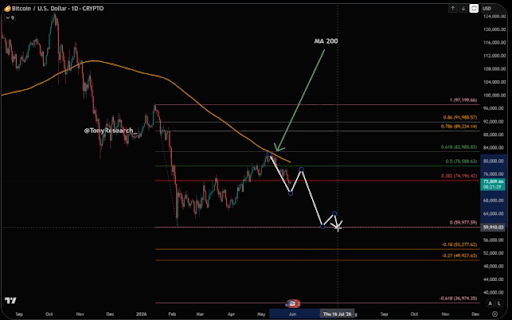
In an X post, Tony stated that Bitcoin crashed from $82,000 for a reason, as the 200 MA has always been an important resistance level during bear markets. He also pointed to the 0.5 and 0.618 Fibonacci levels, where BTC was trading at. As for what’s next, the analyst indicated that Bitcoin is likely to decline further, noting a high probability it will set a new low during the summer months.

He also pointed to an alternative trap scenario where Bitcoin sees a fake breakout above $85,000 to lure retail traders in, followed by the same dump and a break to new lows. Whatever scenario plays out, Tony noted, it will not change the fact that BTC is in a bear cycle and will make new lows this year.

Source: Chart from Tony on X

His accompanying chart showed that Bitcoin could still drop to around $50,000 by July, and also signaled that BTC could decline below $40,000 before it bottoms in this cycle. Meanwhile, in another X post commenting on the current price action, Tony noted that BTC has broken the ascending channel and is trading below the Ichimoku Cloud, a bearish signal.

Tony said that he is expecting a bounce from the $67,000 region into the $74,000 area, followed by a move to make new lows below $60,000. He further remarked that the bear trap is likely over and that the main trend is still down, which is why he expects new lows this year. He added that short-term bounces are possible, but a bull market is unlikely to happen anytime soon.

A Short-Term Bounce Could Occur Around This Region

In an X post, crypto analyst Colin stated that the range between $65,000 and $66,000 appears to be a reasonable support level for a short-term bounce. He noted that the bounce duration could be for weeks or a couple of months. However, the analyst added that BTC retesting $60,000 is still highly likely and that breaking low this year is still a possibility.

Colin stated that the February low of $60,000 is unlikely to be Bitcoin’s bottom in this bear cycle. He explained that BTC has always suffered losses of over 70% in past bear cycles, but the leading crypto has yet to record such a loss in this cycle from its October high of $126,000.

At the time of writing, the Bitcoin price is trading at around $66,300, down over 6% in the last 24 hours, according to data from CoinMarketCap.

BTC trading at $67,211 on the 1D chart | Source: BTCUSDT on Tradingview.com

Связанные с этим вопросы

QAccording to analyst Tony, what is the main reason why Bitcoin crashed from around $82,000?

AAccording to analyst Tony, Bitcoin crashed from around $82,000 because the 200-day Moving Average (200 MA) has always been an important resistance level during bear markets, and it was trading near the 0.5 and 0.618 Fibonacci levels at that time.

QWhat are the two possible scenarios for Bitcoin's price action that Tony describes, and what is the common outcome for both?

AThe two scenarios are: 1) Bitcoin continues to decline further and sets a new low. 2) Bitcoin experiences a fake breakout above $85,000 to lure in retail traders, followed by a dump and a break to new lows. The common outcome for both scenarios is that Bitcoin is in a bear cycle and will make new lows this year.

QBased on Tony's chart analysis, to what price level could Bitcoin potentially drop by July, and what is the possible bottom for this cycle?

ABased on Tony's chart analysis, Bitcoin could drop to around $50,000 by July. The chart also signals that Bitcoin could decline below $40,000 before it bottoms in this cycle.

QWhat key technical levels does analyst Colin identify as a potential support zone for a short-term Bitcoin bounce?

AAnalyst Colin identifies the range between $65,000 and $66,000 as a reasonable support level for a potential short-term bounce.

QWhy does Colin believe the February low of $60,000 is unlikely to be the bottom for Bitcoin in this bear cycle?

AColin believes this because Bitcoin has historically suffered losses of over 70% in past bear cycles. From its October high of $126,000, Bitcoin has not yet recorded such a significant loss in the current cycle, making the $60,000 low unlikely to be the final bottom.

Похожее

Blocked Its Own Treasure, WeChat AI Steps Up

Tencent's stock surged over 10% on June 2nd amid reports that WeChat, with 1.43 billion monthly users, is finalizing tests for a native AI Agent. The reported feature, accessible by swiping right from the main interface, allows users to issue commands in natural language. The AI then decomposes tasks and automatically calls upon relevant Mini Programs within WeChat to complete actions like ordering food, booking tickets, or making payments, creating a closed-loop service execution system. This strategic shift follows the internal conflict and subsequent "blocking" of Tencent's standalone AI app, Yuanbao, by WeChat for violating sharing rules during a 2026 Spring Festival promotion. The incident highlighted a lack of internal consensus and exposed the weakness of competing in the standalone AI assistant arena against rivals like ByteDance's Doubao (345M MAU) and Alibaba's Qianwen. The new WeChat AI Agent aims to leverage WeChat's unique assets—its massive user base, standardized Mini Program APIs, WeChat Pay, and identity system—to move from simple content generation to actual task execution. Analysts note this changes the competitive landscape from model benchmarks to which AI can connect to more real-world services. However, success depends on key variables: the capability of Tencent's underlying Hunyuan model, managing massive inference costs, and redesigning incentives for Mini Program developers whose traffic might be bypassed. The move is seen as an attempt to keep user service intent within WeChat's ecosystem as AI begins to redefine how users access services.

marsbit30 мин. назад

Blocked Its Own Treasure, WeChat AI Steps Up

marsbit30 мин. назад

ByteDance Adopts Arm CPUs, Jensen Huang: So Sad I Didn't Buy Arm

**Summary:** At Computex 2026, Arm CEO Rene Haas announced that ByteDance and Oracle have adopted Arm's self-designed Arm AGI data center CPU. The company expects significant revenue growth from this product, projecting $20 billion in demand for the 2027/2028 fiscal years. Haas noted that restricting AI-capable CPUs from the US to China is nearly impossible due to their widespread applications. Arm's stock has surged dramatically this year, notably rising 16% after NVIDIA's Arm-based Vera CPU and RTX Spark announcements. A highlight was the informal, humorous on-stage conversation between Haas and NVIDIA CEO Jensen Huang. Huang joked about NVIDIA's failed attempt to acquire Arm and playfully lamented selling his Arm shares. Both executives showed a clear sense of camaraderie and shared regret over the missed merger. Key technical topics were discussed: 1. **AI PC Design:** Huang explained NVIDIA's RTX Spark superchip (with a 20-core Arm CPU) is designed for future AI agents that will autonomously run and use tools on PCs, blending local and cloud processing. 2. **Agent vs. OS:** Huang emphasized the operating system remains crucial, as AI agents rely on its APIs and tools to function. 3. **Growth Constraints:** He identified the shift to "useful AI" that generates profitable tokens as a primary driver for immense, almost limitless, computational demand. Haas outlined Arm's strategy across PC and data centers. For PCs, Arm collaborates with partners like NVIDIA and MediaTek, offering its compute subsystem (CSS) for custom SoCs. In data centers, its Arm AGI CPU (built on TSMC's 3nm process) has gained major partners including OpenAI, Meta, and now ByteDance and Oracle. Arm presented a multi-year roadmap for its in-house CPU line. The article concludes that while GPUs dominated the AI training race, the explosion of AI agents is shifting significant focus to CPUs for inference, state management, and tool orchestration. The industry is trending towards vertical integration, with companies like cloud providers designing chips and chip/IP firms offering full solutions, all competing to deliver more efficient computing per watt.

marsbit50 мин. назад

ByteDance Adopts Arm CPUs, Jensen Huang: So Sad I Didn't Buy Arm

marsbit50 мин. назад

New Wall Street Play: Yen Shorts Still Adding, But Japan Stocks Don't Rely on Carry Trade Unwinding

On June 3rd, USD/JPY hit 160.44, its highest level since July 2024, while the Nikkei 225 surged past 68,000 points. Contrary to popular narratives of an imminent "carry trade unwind" akin to August 2024, data reveals a more complex picture. Speculative net short positions in yen futures have actually increased, reaching -114,667 contracts by late May, suggesting traders are doubling down rather than retreating. Meanwhile, Japan's Finance Ministry conducted its largest-ever single-round FX intervention (11.73 trillion yen) in April-May but failed to hold the 160 yen line. The Nikkei's rally is not driven by carry trade dynamics. Foreign investors are aggressively buying Japanese stocks, with net purchases in 2026 running nearly 16 times higher than 2025 levels. This inflow is concentrated in AI and semiconductor-related stocks like SoftBank and Socionext, fueled by positive sector outlooks, rather than being a flight from unwinding yen shorts. Furthermore, the Nikkei has continued climbing despite the Bank of Japan's (BOJ) rate hikes to 0.75%. This disconnect exists because the current equity boom is fueled by AI-driven foreign investment, not reliant on cheap yen funding. However, this relationship remains fragile. Should the BOJ hike rates further (e.g., to 1.0%) while dollar weakness increases carry trade costs, the trajectories of the yen and Japanese stocks could reconverge, potentially triggering volatility.

marsbit54 мин. назад

New Wall Street Play: Yen Shorts Still Adding, But Japan Stocks Don't Rely on Carry Trade Unwinding

marsbit54 мин. назад

Broadcom's Q3 Guidance Misses Expectations by $12 Billion, After-Hours Trading Plummets Over 13%, AI Narrative "Cooling"?

On June 3, Broadcom released record Q2 FY26 results with revenue of $22.19B, up 48% YoY, and AI chip sales of $10.8B, up 143%. Adjusted EPS of $2.44 beat estimates. However, its Q3 AI semiconductor revenue guidance of $16B, while up over 200% YoY, fell roughly $1.2B (7%) short of analyst consensus expectations of $17.2B. This miss, coupled with slightly weaker-than-expected software revenue, triggered a severe market reaction. CEO Hock Tan maintained the FY26 AI revenue outlook of over $100B but did not raise it, disappointing investors who had priced in more robust growth. The stock plummeted over 13% in after-hours trading, erasing roughly $270B in market cap. The sell-off extended to peers like Marvell. A key concern for markets, particularly for Chinese optical module suppliers, was Tan's comment that the contribution of AI networking (e.g., Ethernet switches, optical interconnect chips) to AI revenue, currently near 40%, is expected to normalize to around 30% over time, signaling a potential peak in growth for that segment. Despite the guidance shortfall, Tan reiterated that AI demand remains "insatiable" and reaffirmed the long-term target of exceeding $100B in AI revenue by FY27. The reaction highlights the heightened sensitivity and premium valuation placed on AI-exposed stocks, where anything less than stellar guidance can prompt significant profit-taking. The broader question is whether this represents a cooling AI narrative or a correction in overstretched valuations.

marsbit55 мин. назад

Broadcom's Q3 Guidance Misses Expectations by $12 Billion, After-Hours Trading Plummets Over 13%, AI Narrative "Cooling"?

marsbit55 мин. назад

Торговля

Спот
Фьючерсы

Популярные статьи

Тест по Bitcoin Биткоина

HTX Learn: Изучите Bitcoin halving и Заработаете Токены USDT

3.1k просмотров всегоОпубликовано 2024.04.16Обновлено 2024.04.16

Тест по Bitcoin  Биткоина

Что такое $BITCOIN

ЦИФРОВОЕ ЗОЛОТО ($BITCOIN): Комплексный анализ Введение в ЦИФРОВОЕ ЗОЛОТО ($BITCOIN) ЦИФРОВОЕ ЗОЛОТО ($BITCOIN) — это проект на основе блокчейна, работающий в сети Solana, который стремится объединить характеристики традиционных драгоценных металлов с инновациями децентрализованных технологий. Хотя он носит имя Биткойн, часто называемого “цифровым золотом” из-за его восприятия как средства хранения ценности, ЦИФРОВОЕ ЗОЛОТО является отдельным токеном, предназначенным для создания уникальной экосистемы в ландшафте Web3. Его цель — позиционировать себя как жизнеспособный альтернативный цифровой актив, хотя детали его применения и функциональности все еще развиваются. Что такое ЦИФРОВОЕ ЗОЛОТО ($BITCOIN)? ЦИФРОВОЕ ЗОЛОТО ($BITCOIN) — это токен криптовалюты, специально разработанный для использования в блокчейне Solana. В отличие от Биткойна, который выполняет широко признанную роль хранения ценности, этот токен, похоже, сосредоточен на более широких приложениях и характеристиках. Примечательные аспекты включают: Инфраструктура блокчейна: Токен построен на блокчейне Solana, известном своей способностью обрабатывать высокоскоростные и недорогие транзакции. Динамика предложения: ЦИФРОВОЕ ЗОЛОТО имеет максимальное предложение, ограниченное 100 квадриллионами токенов (100P $BITCOIN), хотя детали о его обращающемся предложении в настоящее время не раскрыты. Утилита: Хотя точные функциональные возможности не описаны, есть указания на то, что токен может быть использован для различных приложений, потенциально связанных с децентрализованными приложениями (dApps) или стратегиями токенизации активов. Кто создатель ЦИФРОВОГО ЗОЛОТА ($BITCOIN)? На данный момент личность создателей и команды разработчиков, стоящих за ЦИФРОВЫМ ЗОЛОТОМ ($BITCOIN), остается неизвестной. Эта ситуация типична для многих инновационных проектов в области блокчейна, особенно тех, которые связаны с децентрализованными финансами и феноменом мем-криптовалют. Хотя такая анонимность может способствовать культуре, ориентированной на сообщество, она усиливает опасения по поводу управления и ответственности. Кто инвесторы ЦИФРОВОГО ЗОЛОТА ($BITCOIN)? Доступная информация указывает на то, что у ЦИФРОВОГО ЗОЛОТА ($BITCOIN) нет известных институциональных спонсоров или значительных венчурных капиталовложений. Проект, похоже, функционирует по модели пирингового взаимодействия, сосредоточенной на поддержке и принятии сообществом, а не на традиционных путях финансирования. Его активность и ликвидность в основном сосредоточены на децентрализованных биржах (DEX), таких как PumpSwap, а не на устоявшихся централизованных торговых платформах, что еще больше подчеркивает его подход, ориентированный на grassroots. Как работает ЦИФРОВОЕ ЗОЛОТО ($BITCOIN) Операционные механизмы ЦИФРОВОГО ЗОЛОТА ($BITCOIN) можно подробно описать на основе его дизайна блокчейна и характеристик сети: Механизм консенсуса: Используя уникальный механизм доказательства истории (PoH) Solana в сочетании с моделью доказательства доли (PoS), проект обеспечивает эффективную валидацию транзакций, что способствует высокой производительности сети. Токеномика: Хотя конкретные дефляционные механизмы не были подробно описаны, большое максимальное предложение токенов подразумевает, что оно может быть предназначено для микротранзакций или нишевых случаев использования, которые еще предстоит определить. Интероперабельность: Существует потенциал для интеграции с более широкой экосистемой Solana, включая различные платформы децентрализованных финансов (DeFi). Однако детали относительно конкретных интеграций остаются неуточненными. Хронология ключевых событий Вот хронология, которая подчеркивает значимые вехи, касающиеся ЦИФРОВОГО ЗОЛОТА ($BITCOIN): 2023: Первоначальное развертывание токена происходит в блокчейне Solana, отмеченное его адресом контракта. 2024: ЦИФРОВОЕ ЗОЛОТО приобретает видимость, когда оно становится доступным для торговли на децентрализованных биржах, таких как PumpSwap, позволяя пользователям обменивать его на SOL. 2025: Проект наблюдает спорадическую торговую активность и потенциальный интерес к инициативам, возглавляемым сообществом, хотя на данный момент не зафиксировано никаких значительных партнерств или технических достижений. Критический анализ Сильные стороны Масштабируемость: Основная инфраструктура Solana поддерживает высокие объемы транзакций, что может повысить полезность $BITCOIN в различных сценариях транзакций. Доступность: Потенциально низкая цена торговли за токен может привлечь розничных инвесторов, способствуя более широкому участию благодаря возможностям дробного владения. Риски Отсутствие прозрачности: Отсутствие публично известных спонсоров, разработчиков или процесса аудита может вызвать скептицизм относительно устойчивости и надежности проекта. Волатильность рынка: Торговая активность сильно зависит от спекулятивного поведения, что может привести к значительной волатильности цен и неопределенности для инвесторов. Заключение ЦИФРОВОЕ ЗОЛОТО ($BITCOIN) является интригующим, но неоднозначным проектом в быстро развивающейся экосистеме Solana. Хотя он пытается использовать нарратив “цифрового золота”, его отход от установленной роли Биткойна как средства хранения ценности подчеркивает необходимость более четкого различения его предполагаемой утилиты и структуры управления. Будущее принятие и усвоение, вероятно, будут зависеть от решения текущей непрозрачности и более четкого определения его операционных и экономических стратегий. Примечание: Этот отчет охватывает синтезированную информацию, доступную на октябрь 2023 года, и с тех пор могут произойти события.

99 просмотров всегоОпубликовано 2025.05.13Обновлено 2025.05.13

Что такое $BITCOIN

Fractal Bitcoin: масштабирование Биткоина с помощью рекурсивной системы

Fractal Bitcoin — масштабное Layer-1-решнение, созданное на базе кода Биткоина, позволяющего достигать бесконечного масштабирования с помощью рекурсивного подхода.

2.3k просмотров всегоОпубликовано 2025.06.30Обновлено 2025.06.30

Fractal Bitcoin: масштабирование Биткоина с помощью рекурсивной системы

Обсуждения

Добро пожаловать в Сообщество HTX. Здесь вы сможете быть в курсе последних новостей о развитии платформы и получить доступ к профессиональной аналитической информации о рынке. Мнения пользователей о цене на BTC (BTC) представлены ниже.

活动图片