AI Claims Erdős's $100 Bounty, Solves in One Page What a 44-Page Top Journal Paper Couldn't

marsbitОпубликовано 2026-07-20Обновлено 2026-07-20

Введение

An AI, in collaboration with a mathematician, has produced a one-page proof for a long-standing Erdős problem (#119), claiming the $100 bounty originally offered by Paul Erdős. The problem concerns the maximum modulus of polynomials with zeros on the unit circle. The new result, generated with the help of GPT-5.6 Sol and posted on the erdosproblems.com forum, is notably simpler than a famous 44-page proof by József Beck published in the Annals of Mathematics in 1991, which addressed a related but distinct part of the problem. Thomas Bloom, a mathematician and the maintainer of the Erdős problems website, stated that the AI's proof uses straightforward harmonic analysis techniques and contains "interesting ideas," suggesting the problem was less inherently difficult than previously believed. This follows other recent AI-assisted proofs, such as for the Cycle Double Cover conjecture. The development has sparked debate within the mathematical community. While some argue AI has hit a wall in pure mathematics, others point to incremental but genuine progress on tough problems, indicating that AI's relentless, non-intuitive exploration can uncover overlooked paths that human mathematicians might dismiss after initial failures. This event highlights a potential shift: some "open" problems may persist not due to sheer difficulty, but due to the limits of human patience in exploring all possible avenues.

A one-page paper has tackled a tough nut that originally required a 44-page paper in a top journal to crack.

In 1991, a 44-page paper was published in the Annals of Mathematics.

The author was József Beck, a name well-known in the combinatorial mathematics community.

He is the proposer of the Beck-Fiala theorem, winner of the 1985 Fulkerson Prize, an invited speaker at the 1986 International Congress of Mathematicians, and one of the founders of discrepancy theory.

The paper was titled "Moduli of polynomials with zeros on the unit circle: a problem of Erdős," solving problem number 119 from Erdős's problem list (Erdős Problems).

Take a sequence of complex numbers on the unit circle as zeros, multiply them into a polynomial. Can the maximum modulus Mn of this polynomial on the unit circle be guaranteed to exceed n to the power of c for infinitely many n?

Beck proved it could. This problem was considered one of the toughest challenges of that era.
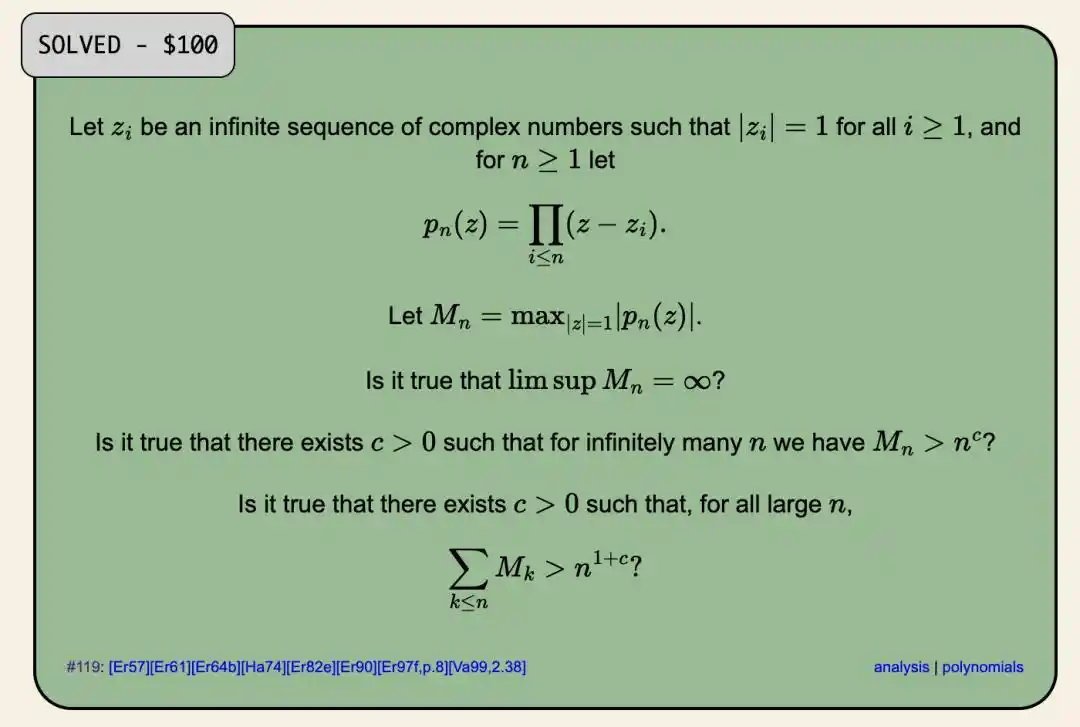
AI has claimed Erdős's bounty. Problem 119 originally asked three questions; the third, with a $100 reward, now has its status changed to SOLVED.

Thirty-five years later, this paper has been surpassed by a single page.

The one saying this is Thomas Bloom.

He is a mathematician, researcher at the University of Manchester, and the creator and maintainer of the website erdosproblems.com.

Over a thousand open problems left by Erdős are listed on this site, making it the primary destination for mathematicians worldwide tracking these problems.

For this reason, every time an AI company claims to have "solved an Erdős problem," it must first pass his scrutiny.

He wrote on X:

So far, GPT-5.6 Sol is the most interesting new model for mathematics I've seen. Every new proof submitted to erdosproblems.com that I've examined in detail has been correct and contained some interesting ideas.
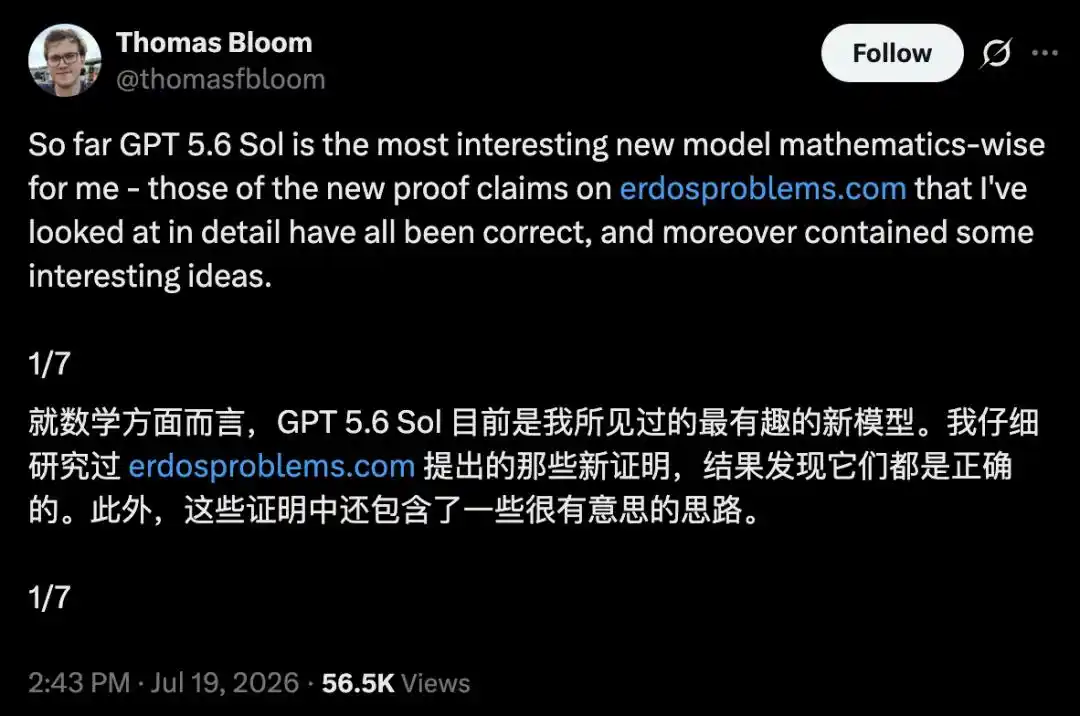
Bloom also emphasized that this wasn't because the AI deployed more complex tools, but rather because we had previously assumed the problem was much harder than it actually is.

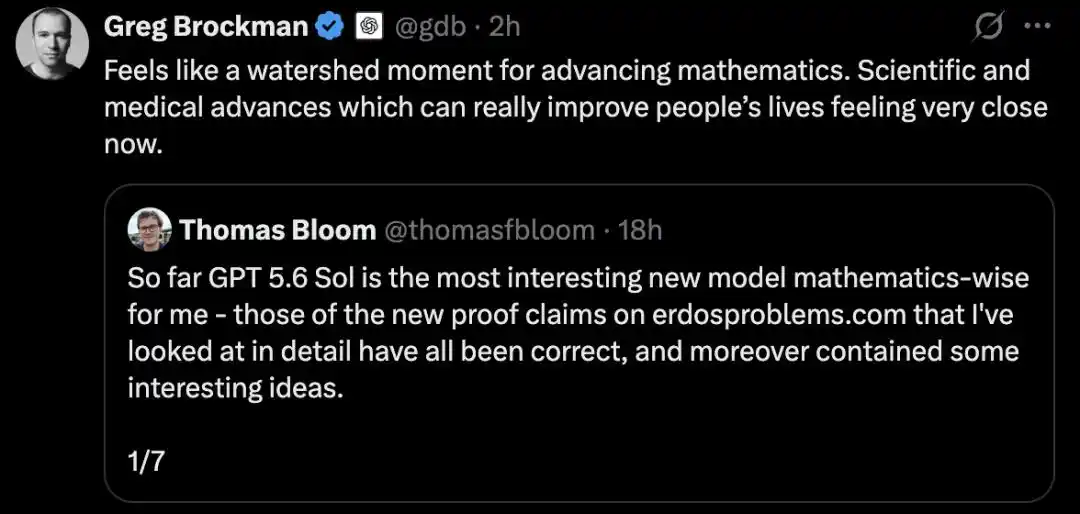
OpenAI President Greg Brockman reposted this tweet, saying:

Feels like a watershed moment for advancing mathematics. Scientific and medical breakthroughs that can truly improve human lives feel very close now.
Erdős's $100 Bounty, Claimed by AI

First, let's clarify the origin and details of this problem.

In 1957, Erdős posed this problem in a paper, asking three questions at once about the moduli of polynomials with zeros on the unit circle.

Over the next four decades, he revisited it in 1961, 1964, 1982, 1990, and 1997.

The first question was solved by Wagner in 1980.

The second question was solved by Beck in 1991, proving that there exists some c>0 such that max_{n≤N} M_n > N^c. This was that 44-page Annals of Mathematics paper.
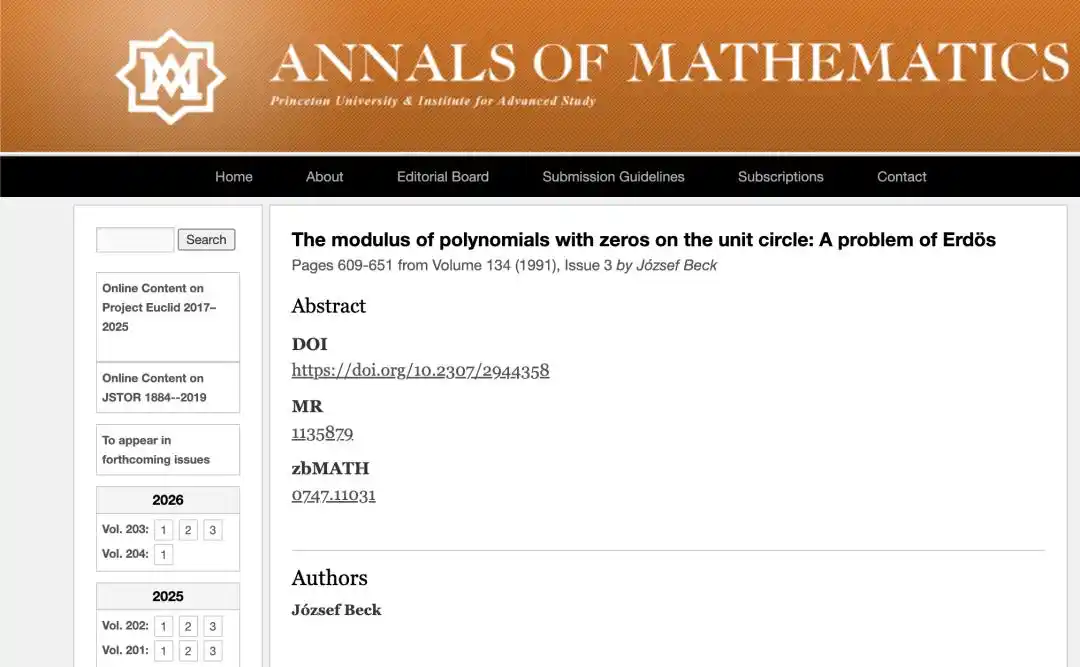
Beck's paper was published in Annals of Mathematics, Volume 134, Issue 3, 1991.

The third question had a $100 bounty personally funded by Erdős, originating from a 1997 article of his.

Now, the bounty has been claimed by GPT-5.6 and a mathematician named Korsky. They solved the question Beck didn't touch using just one page.
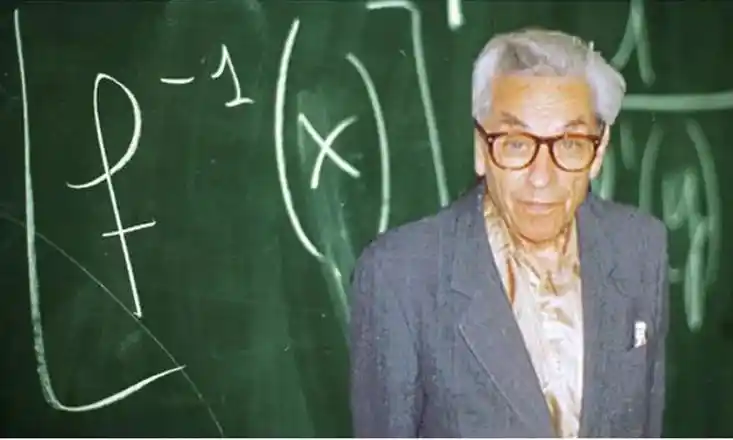
Erdős proposed thousands of problems in his lifetime, offering personal bounties ranging from $25 to $10,000.

Bloom's assessment is: with Korsky's prompting, GPT produced a proof stronger than Beck's 44-page Annals paper using just one page of simple harmonic analysis techniques.

The crucial step, as Bloom later pointed out in the forum, was convolving a non-negative function and shifting it by 1 in time, which suddenly smoothed out the expression, making the previously hard part tractable.

He said this approach of putting operator norms into dual norms and inner products for estimation is one of the most common tricks in analysis.

Not a new tool, but an old tool applied where no one had thought to apply it.
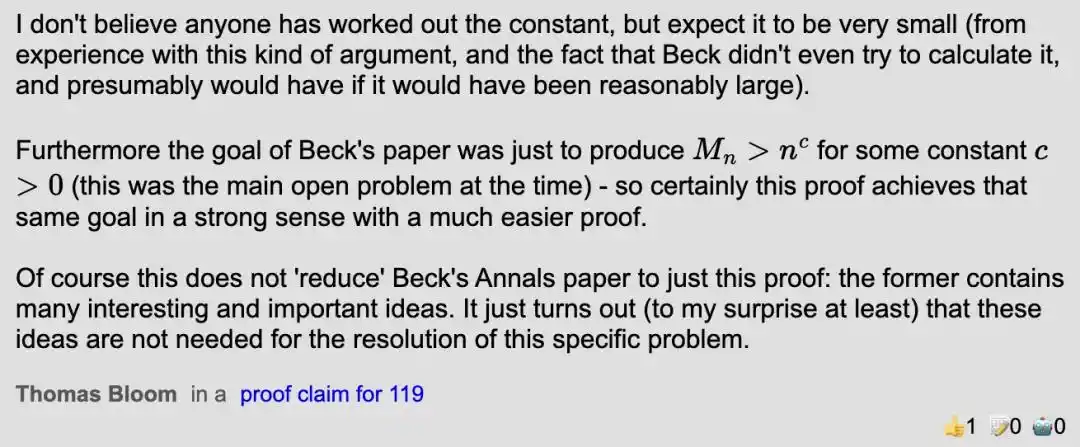
Bloom clarified that Beck's Annals paper contains many important and interesting ideas, just not needed for this specific problem. He added: At least for me, this is quite surprising.

He also mentioned a detail: no one has calculated that constant; it's estimated to be very small. Beck himself didn't calculate it back then, and in his judgment, if the constant were worth mentioning, Beck would have calculated it.

So, this isn't AI overturning a top journal, but rather discovering a detour humans didn't need to take.

For mathematicians, this is more stimulating than "AI solved another problem."

Solving a problem just adds another tool. This time, the tool is correcting the tool user.

A Human Would Shrug and Walk Away; AI Tries the Next One

If this were an isolated case, it would merely be a neat anecdote.

GPT-5.6 Sol Ultra was fully released on July 9th. On July 10th, OpenAI announced that GPT-5.6 Sol Ultra had produced a complete proof of the Cycle Double Cover Conjecture.

This problem was independently proposed by Szekeres in 1973 and Seymour in 1979, remaining open for about fifty years.

The model was allocated 8 hours but used less than 1 hour, employing a method with 64 sub-agents working in parallel. The prompt and proof PDF are fully public.

Bloom was the first to provide a substantive evaluation.

He called it a very beautiful proof, then gave three adjectives:

Short. Elementary. Could have been discovered in the 1980s.

He also pointed out the underlying reason: he speculates there is a small, counterintuitive twist in the key step.

How would a human mathematician approach this problem?

They would first try the most natural approach, check the linear algebra, find it doesn't work, then shrug, think "didn't expect it to be that easy anyway," and walk away.

But AI doesn't get discouraged. It tries small variations until one works.

AI's strength is in not making emotional decisions to cut losses.

Looking back to April this year, GPT-5.4 Pro solved Erdős 1196 in 80 minutes using the von Mangoldt function.

Jared Lichtman from Oxford spent seven years on that problem. He later said that since 1935, everyone working on primitive set problems had become accustomed to the same opening move, which obscured a technical possibility that had been lying in plain sight for a full 90 years.

Tao's evaluation after reading it was even harsher: for decades, humans collectively took the wrong first step.

Human intuition is, of course, not a flaw. On the contrary, it's an efficiency tool: it saves us from a sea of doomed attempts. Without it, no one could reach the frontiers of a discipline in a finite lifetime.

The cost is that occasionally, it also saves the one attempt it shouldn't.

The Person Calling GPT-5.6 Interesting Said Something Else Last Year

Last October, Bloom publicly called out OpenAI.

At the time, OpenAI VP Kevin Weil reposted a post by Mark Sellke, writing: GPT-5 just found solutions to 10 previously unsolved Erdős problems, with progress on another 11, all open for decades.
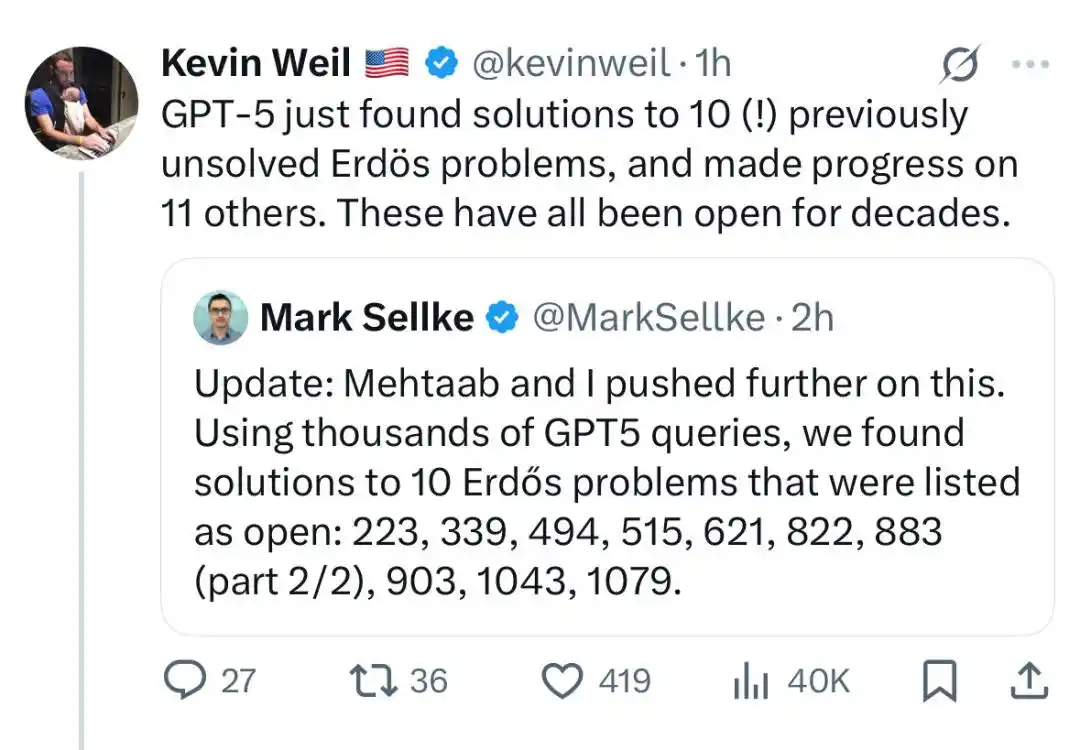
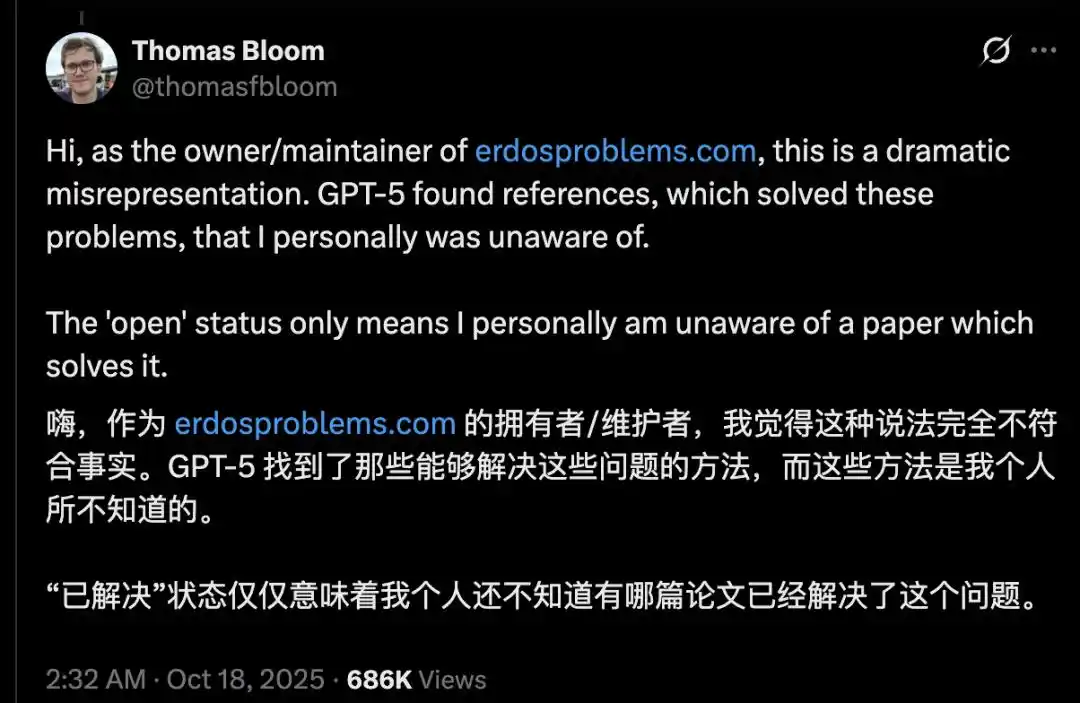
Bloom responded with a sentence to characterize it: Dramatically misleading.

He said that these problems being marked as 'open' on the website only meant he personally wasn't aware of any paper that solved them. What GPT-5 did was dredge up literature he didn't know about.

And finding literature is not the same as constructing a proof.
The following scene is remembered by many.

LeCun chimed in nearby, subtly mocking the fact that his own planted mine exploded. Hassabis was more direct: This is so embarrassing.

Weil deleted the post.

OpenAI researcher Sébastien Bubeck eventually admitted they had only found solutions already existing in the literature.

When OpenAI announced in May this year that they had overturned a 1946 Erdős geometry conjecture, the announcement simultaneously included evaluations from Noga Alon, Melanie Wood, and Thomas Bloom.

Has AI Hit a Wall in Mathematics?

The debate under Bloom's post was also fascinating.

The pessimist faction was represented by user qrdl: "5.6's chain-of-thought output is pitifully little, no progress on problem 677, the CritPT evaluation on the physics side has hardly moved compared to 5.4."

His conclusion: AI has hit a wall in mathematics.
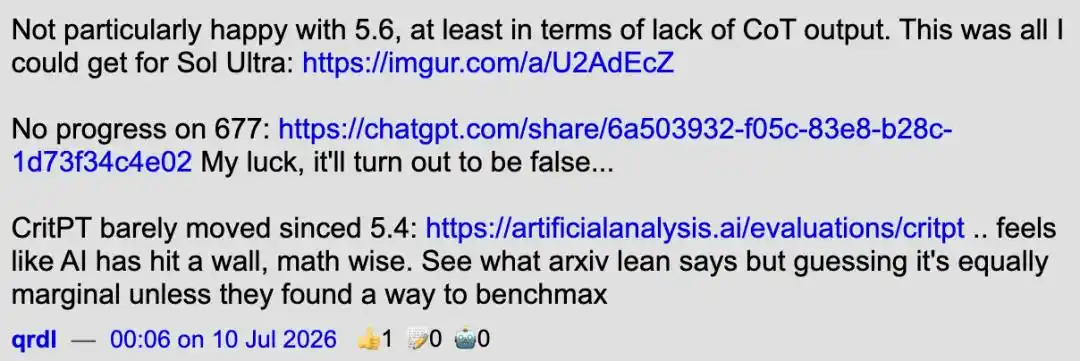
User qrdl posted on the forum, saying CritPT has barely moved since 5.4, and unless they found a way to game the benchmark, results are just about like this.

qrdl's argument wasn't emotional.

He believes large models are essentially static-weight token generators. When doing mathematics, they don't grow new neural connections in real-time like humans. True creative leaps require a flexible brain.

qrdl's feeling is: every time he starts a new session to attack 677, the model repeats the same old failed moves.

The counter-punch came quickly.

Nat Sothanaphan pointed out that CritPT is a physics test, not a mathematics benchmark. Using its curve alone to prove AI has hit a wall in math is cherry-picking favorable data.

His counter-evidence is: 5.6 shows improvements over 5.5 on a large set of evaluations including FrontierMath.

Another faction is the practical faction, represented by a user named old-bielefelder.
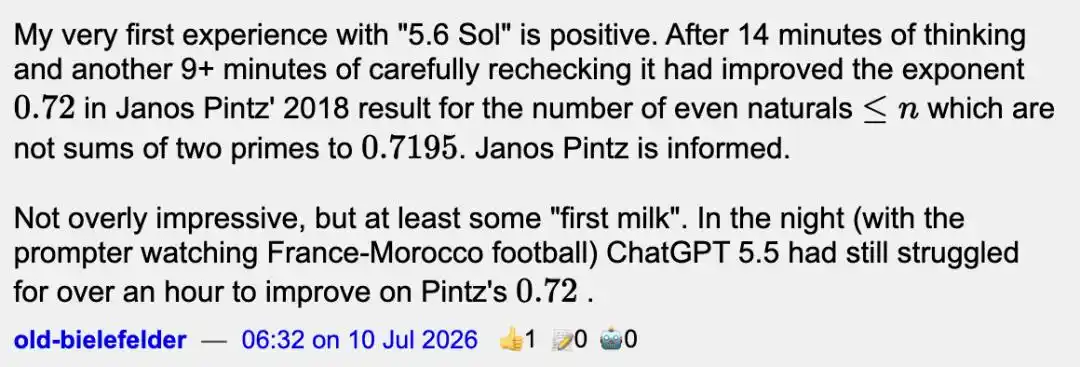
old-bielefelder reported that GPT-5.6 Sol, thinking for 14 minutes and reviewing for over 9 minutes, improved Pintz's 2018 exponent of 0.72 to 0.7195.

Not earth-shattering, but it did move, described by old-bielefelder himself as "the first taste of milk."

As a comparison, the night before, GPT-5.5 spent over an hour on the same problem without budging 0.72.

He then directly notified Pintz of the result.

The third voice also came from Nat Sothanaphan, who borrowed a saying from Bloom: Modern mathematics is a vast cathedral.

Reaching the very forefront of this cathedral itself consumes immense energy, and large models can already do this with superhuman efficiency; recent breakthroughs largely stem from this. Pushing further requires fluid intelligence.

Some say large models lack fluid intelligence; he believes this is wrong.

The steady rise in ARC series evaluations over recent years is evidence, with GPT-5.6 Sol achieving 7.8% at the highest reasoning tier. When this benchmark launched in March this year, the best score was 0.37%, while humans consistently score above 90%.
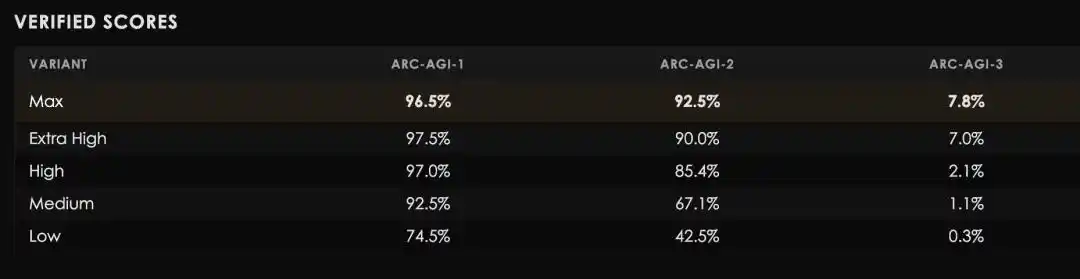
Official verification scores from ARC Prize. GPT-5.6 Sol's performance on ARC-AGI-3 rises steeply with reasoning tiers, from 0.3% at Low tier to 7.8% at Max tier.

His explanation is: the cathedral's foundation is too vast, vast enough to completely overshadow the small but rapidly growing fluid intelligence. So if you just look at the weight of the output, it seems like nothing is happening.

But the day fluid intelligence starts outweighing the foundation, it will suddenly become visible to the naked eye.

After two weeks of debate, what this argument truly brought out was not "Can AI do math?" but how to define the word "difficult."

Among the entries marked "unsolved" in mathematical history, some record the inherent difficulty of the problem, while others merely record the boundaries of human patience.

In the past, these two were mixed together, indistinguishable. Now, they are starting to be separable.

A problem hanging for decades without being claimed might not be because it's incredibly hard, but because no one was willing to try the thirtieth time on that path.

How many more problems are stuck simply because of human patience?

References:

https://annals.math.princeton.edu/1991/134-3/p03

https://www.erdosproblems.com/forum/thread/AI%20Contributions

https://arcprize.org/results/openai-gpt-5-6-sol

This article is from the WeChat public account "新智元" (New Zhiyuan), author: ASI启示录; editor: 元宇

Трендовые криптовалюты

Связанные с этим вопросы

QAccording to the article, what significant mathematical problem did AI solve in a much shorter proof compared to a previous 44-page Annals of Mathematics paper?

AAI solved Erdős problem 119, specifically part of the problem concerning the maximum modulus M_n of polynomials with zeros on the unit circle, providing a one-page proof that surpassed the complexity of József Beck's 44-page proof from 1991.

QWho is Thomas Bloom and what is his role regarding the Erdős problems mentioned in the article?

AThomas Bloom is a mathematician, a researcher at the University of Manchester, and the creator and maintainer of the website erdosproblems.com. He serves as a gatekeeper for verifying new solutions, especially AI-generated ones, to the open problems from Erdős's collection.

QWhat key reason does the article give for why AI was able to find simpler proofs for some long-standing mathematical problems?

AThe article suggests that AI possesses relentless persistence. Unlike human mathematicians who might intuitively dismiss an approach after initial failure, AI continues trying small variations without 'emotional stop-loss,' potentially stumbling upon a valid, simpler path that humans overlooked due to ingrained intuition or patience limits.

QWhat was the controversy involving OpenAI and Thomas Bloom last year, as described in the article?

ALast year, OpenAI claimed GPT-5 had found solutions to 10 previously unsolved Erdős problems. Thomas Bloom called this claim 'dramatically misleading,' clarifying that the problems were marked 'open' only because *he* was unaware of existing solutions, and GPT-5 had merely uncovered existing literature, not created new proofs. This led to OpenAI executives deleting posts and acknowledging the error.

QWhat point does the article make about the nature of 'difficulty' for unsolved mathematical problems in the age of AI?

AThe article argues that the 'difficulty' of long-unsolved problems may now be separated into two components: the intrinsic complexity of the problem and the boundary of human patience. Some problems may have remained unsolved not because they are exceptionally hard, but because no human was willing to try a certain path a thirtieth time, whereas AI lacks such a patience constraint.

Похожее

BONK взлетает на 11%, но медведи наращивают позиции: Эти данные говорят, что ралли – ловушка

Мемкоин Bonk (BONK) продемонстрировал значительный рост более чем на 11% за сутки на фоне восстановления общего настроения рынка и роста внимания в социальных сетях. Однако анализ данных указывает на противоречивую картину. Несмотря на рост, ставки финансирования (Funding Rate) по бессрочным контрактам на BONK стали отрицательными (-0.0009%), что сигнализирует о преобладании коротких позиций и усилении давления продавцов на фьючерсном рынке. Общее настроение также остается негативным. В то же время на спотовом рынке наблюдается противоположная динамика: инвесторы выводят монеты с бирж в частные кошельки для хранения. Чистый отток средств с бирж составил около $880 000, а общий объем накопленных активов оценивается в $4.24 миллиона, что говорит о сохраняющемся интересе покупателей. Таким образом, текущий рост BONK сопровождается наращиванием медвежьих позиций на деривативном рынке, что создает риск для продолжения ралли, в то время как активное накопление на споте может поддержать цену.

ambcrypto26 мин. назад

BONK взлетает на 11%, но медведи наращивают позиции: Эти данные говорят, что ралли – ловушка

ambcrypto26 мин. назад

WEEX TradFi: Один счет в USDT для акций, золота, нефти и мировых рынков

Криптобиржа WEEX анонсировала запуск нового сервиса WEEX TradFi, который позволяет торговать традиционными активами, используя стейблкоин USDT в качестве залога. Через единый счет пользователи получают доступ к золоту, серебру, нефти, токенизированным акциям (таким как TSLA, AAPL) и мировым индексам, объединяя крипто- и традиционные рынки. Сервис устраняет необходимость в отдельном брокерском счете, банковских переводах и работает 24/7, предоставляя гибкость вне стандартных торговых сессий. Он ориентирован на криптотрейдеров, желающих получить доступ к макроэкономическим трендам, не меняя привычный рабочий процесс с USDT. В рамках продвижения продукта WEEX проводит Торговый челлендж TradFi. Участники, как новые, так и существующие пользователи, могут получить бонусы в виде пробных средств USDT за совершение первых сделок, внесение депозита или достижение определенного торгового объема. WEEX, основанная в 2018 году, насчитывает более 6,2 млн пользователей по всему миру и предлагает широкий спектр торговых инструментов, включая фьючерсы с высоким кредитным плечом, а также внедряет AI-инструменты для трейдинга.

TheNewsCrypto30 мин. назад

WEEX TradFi: Один счет в USDT для акций, золота, нефти и мировых рынков

TheNewsCrypto30 мин. назад

Фиксированное предложение + институциональный ажиотаж: после падения на 50% Биткоин повторит «взрывной» сценарий золота 20-летней давности?

Согласно анализу Forbes, несмотря на падение цены биткойна более чем на 50% с пиков 2025 года, эксперты проводят параллели с историей золотых ETF. Аналитик Bloomberg Эрик Балчунас отмечает, что с момента запуска в 2004 году золотые ETF пережили взлеты и долгие периоды консолидации, в итоге значительно увеличив рыночную капитализацию золота. Аналогично, утверждает он, биткойн-ETF, с их фиксированным предложением и зависимостью от спроса, могут повторить этот путь "взрывного" роста, хотя и с высокой волатильностью. Биткойн-ETF, одобренные в 2024 году, быстро привлекли институциональные инвестиции, став одними из самых быстрорастущих фондов. Ключевой фактор будущего роста — устойчивый институциональный спрос, который, по мнению экспертов, смягчает давление продаж. Если биткойн как "цифровое золото" займет даже небольшую долю рыночной капитализации золота (около $28 трлн), это откроет огромный потенциал для роста. Однако, как и в случае с золотом, путь будет отмечен резкими взлетами и болезненными коррекциями, требуя от инвесторов терпения и сосредоточения на долгосрочной перспективе.

marsbit32 мин. назад

Фиксированное предложение + институциональный ажиотаж: после падения на 50% Биткоин повторит «взрывной» сценарий золота 20-летней давности?

marsbit32 мин. назад

Starknet представляет приватную версию биткоина strkBTC, нацелившись на институциональный ончейн финансовый рынок

**Starknet запускает приватную версию биткоина strkBTC, ориентируясь на институциональный ончейн-финансовый рынок** По мере того как ончейн-финансы приближаются к традиционным рынкам, становятся критически важными две проблемы: полная публичная видимость всех финансовых потоков и угроза существующим криптографическим подписям со стороны квантовых вычислений. Биткоин, занимающий более 56% рынка криптовалют, является наиболее ярким примером этих вызовов. Решение Starknet, strkBTC, пытается одновременно решить проблемы видимости и долговечности. strkBTC — это токен ERC-20 в сети Starknet, обеспеченный BTC, заблокированным в сети Bitcoin. Он построен на приватном фреймворке StarkWare STRK20, который позволяет скрывать балансы и совершать конфиденциальные переводы. Пользователи могут работать в публичном режиме (как с обычным ERC-20) или в скрытом режиме, где балансы и транзакции не видны публике. Комплайенс встроен в дизайн: при скрытии средств связанный ключ просмотра передается независимому аудитору (Financial Privacy Inc.), который может предоставить доступ регуляторам по запросу. Вторая часть проблемы — квантовая угроза. Квантовые компьютеры в будущем могут взломать текущие криптографические схемы (например, secp256k1), лежащие в основе Bitcoin и Ethereum. Starknet имеет архитектурное преимущество: его система доказательств STARK основана на хэш-функциях, а не на уязвимой к квантовым атакам эллиптической криптографии. Недавно StarkWare опубликовала дорожную карту по достижению полной квантовой устойчивости (к "Q-day") своего стека, включая миграцию на устойчивые алгоритмы и улучшение поддержки квантово-устойчивых кошельков через нативную абстракцию аккаунтов. Таким образом, strkBTC представляет собой попытку Starknet обеспечить биткоину приватность и готовность к квантовой эре, что является ключевыми требованиями для следующего этапа институционального принятия ончейн-финансов, где необходимы конфиденциальность, комплайенс и долгосрочная безопасность.

marsbit37 мин. назад

Starknet представляет приватную версию биткоина strkBTC, нацелившись на институциональный ончейн финансовый рынок

marsbit37 мин. назад

Strategy привлекла $730 млн за 2 недели и купила 0 биткойнов – рынок спрашивает, почему

Компания Strategy привлекла 730 миллионов долларов за две недели, но не купила ни одного биткойна, увеличив свои денежные резервы до 3,2 миллиарда долларов. Это отступление от привычной стратегии компании, которая годами привлекала капитал для немедленной покупки BTC. Рынок задается вопросом о причинах такого шага. Одна из версий — компания укрепляет баланс и ликвидность, поскольку ее индекс STRC торгуется ниже ключевого уровня в 100 долларов, что ограничивает возможности для привлечения нового капитала через программу ATM для покупки биткойнов. Некоторые инвесторы рассматривают это как стратегическую паузу в ожидании лучших условий, в то время как другие выражают озабоченность в связи с размыванием доли акционеров при отсутствии наращивания стека BTC. Данное решение усиливает неопределенность вокруг будущих действий Strategy в условиях доминирующих настроений избегания риска на рынке.

ambcrypto55 мин. назад

Strategy привлекла $730 млн за 2 недели и купила 0 биткойнов – рынок спрашивает, почему

ambcrypto55 мин. назад

Торговля

Спот

Популярные статьи

Неделя обучения по популярным токенам (2): 2026 может стать годом приложений реального времени, сектор AI продолжает оставаться в тренде

2025 год — год институциональных инвесторов, в будущем он будет доминировать в приложениях реального времени.

1.9k просмотров всегоОпубликовано 2025.12.16Обновлено 2025.12.16

Неделя обучения по популярным токенам (2): 2026 может стать годом приложений реального времени, сектор AI продолжает оставаться в тренде

Обсуждения

Добро пожаловать в Сообщество HTX. Здесь вы сможете быть в курсе последних новостей о развитии платформы и получить доступ к профессиональной аналитической информации о рынке. Мнения пользователей о цене на AI (AI) представлены ниже.

活动图片