After Chasing All Airdrops, the Biggest One Turns Out to Be Yuanbao

比推Опубликовано 2026-02-04Обновлено 2026-02-04

Введение

The article, titled "The Biggest Airdrop for Crypto People is Given by Yuanbao," discusses the recent popularity of Yuanbao's cash red packet campaign in the crypto community. Amid a significant market downturn in late January, where cryptocurrencies like Bitcoin and Ethereum saw sharp declines, many crypto traders turned to claiming small cash rewards from Yuanbao as a form of psychological relief. The author contrasts Web2 and Web3 airdrop models: Yuanbao, backed by Tencent, offers simple, no-cost cash rewards with high certainty, while crypto project airdrops often involve high costs (time, capital, effort) and uncertain returns, sometimes resulting in net losses for users—exemplified by cases like Infinex, where users faced substantial financial setbacks despite long-term participation. The piece argues that crypto airdrops have shifted from rewarding early users to serving as exit strategies for projects, reducing user trust and retention. It concludes that while airdrops can drive user acquisition, long-term retention depends on product-market fit and user experience—areas where Web3 projects can learn from Web2 giants like Tencent.

Author: Golem(@web 3_golem), Odaily Planet Daily

Original Title: The Biggest Airdrop for Crypto People Is Given by Yuanbao


"xxx has sent you a cash red envelope!"

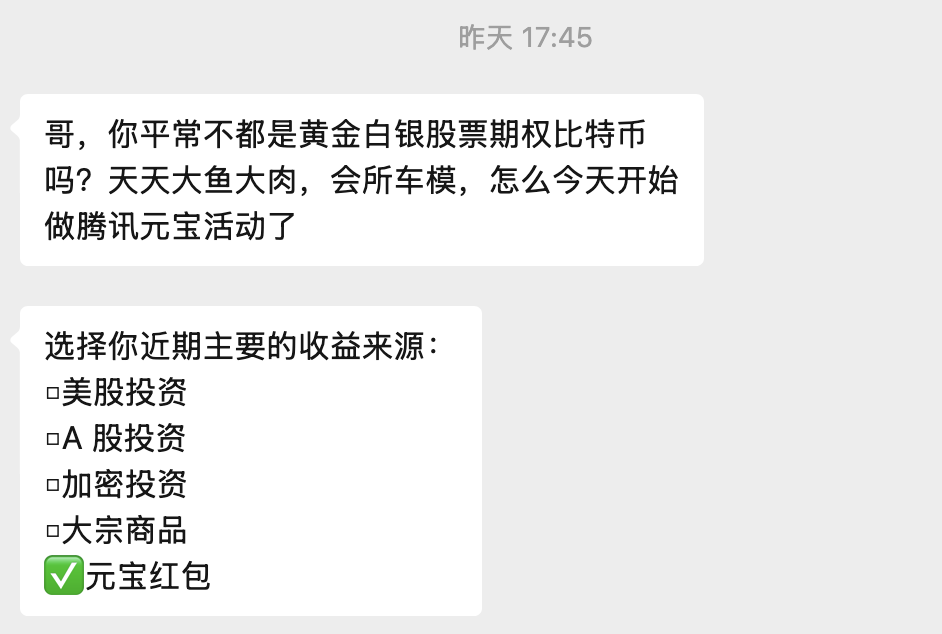
After Yuanbao's cash red envelope activity began on February 1st, many long-dead project/research exchange groups completely transformed into "grab Yuanbao wool" mutual aid groups.

For crypto people, switching from being esteemed crypto traders to wool parties grabbing Yuanbao red envelopes is also a helpless move.

Starting from January 31st, global financial markets plummeted. Precious metals, which had previously surged, quickly crashed. Spot silver nearly erased its yearly gains, and spot gold once fell below $4500. The crypto market wasn't much better. On February 2nd, Bitcoin broke below the $75,000 support level, touching a low of $74,604. ETH fell to a low of $2157.14, and SOL even fell below $100, touching a low of $95.95.

According to Coinglass data, the crypto market's total liquidation amount reached $2.5615 billion on January 31st, setting a record for the highest single-day liquidation volume since the "10.11 crash." Therefore, "too亏损到不想说话 (losing so much I don't want to talk)" became the true psychological state of many crypto people (like the silent Yi Lihua).

For crypto people who just experienced a bloodbath, grabbing Yuanbao red envelopes, though a drop in the bucket for recouping losses, can provide some psychological comfort, temporarily escaping the harsh market reality.

Joke in group chat

Crypto Airdrops: From Swallowing Losses Silently to Passionate Rights Protection

Saying that Yuanbao's cash red envelope is the biggest airdrop for crypto people today is not a gimmick.

The amount Yuanbao can distribute to each user in cash red envelopes is not large, mostly ranging from ten to几十 (a few tens) RMB, but its value lies in its simple interaction and truly zero cost. Users only need to spend a little time recruiting people and step-by-step experiencing product features to get cash red envelopes, with a short task cycle enabling quick returns.

In contrast, project airdrops in the crypto space are first distributed in token form. Profit is truly realized only after the tokens are sold. Although the single received amount seems much larger than Yuanbao's, after deducting time, research, opportunity, wear and tear, and potential costs of being stuck with unsellable tokens, how much is left?

A user who accompanied Infinex for 406 days deeply feels this. On January 31st, the decentralized perpetual contract trading platform Infinex announced TGE and airdrop claims. The project team successfully上岸 (made it ashore), but the community was collectively反撸 (reverse-fleeced).

一千万是只猫 (X:@RXu107) is a typical representative of being reverse-fleeced. On February 1st, he posted that he spent over $11,900 (approx. RMB 82,000) participating in this project (4400 U for NFT, 7500 U for public sale) and作为社区成员深度陪跑了 406天 (accompanied deeply as a community member for 406 days). But on TGE day, not only did he not recover his costs, but his paper loss also exceeded 100,000 RMB (2900 U + 11,284 locked INX tokens).

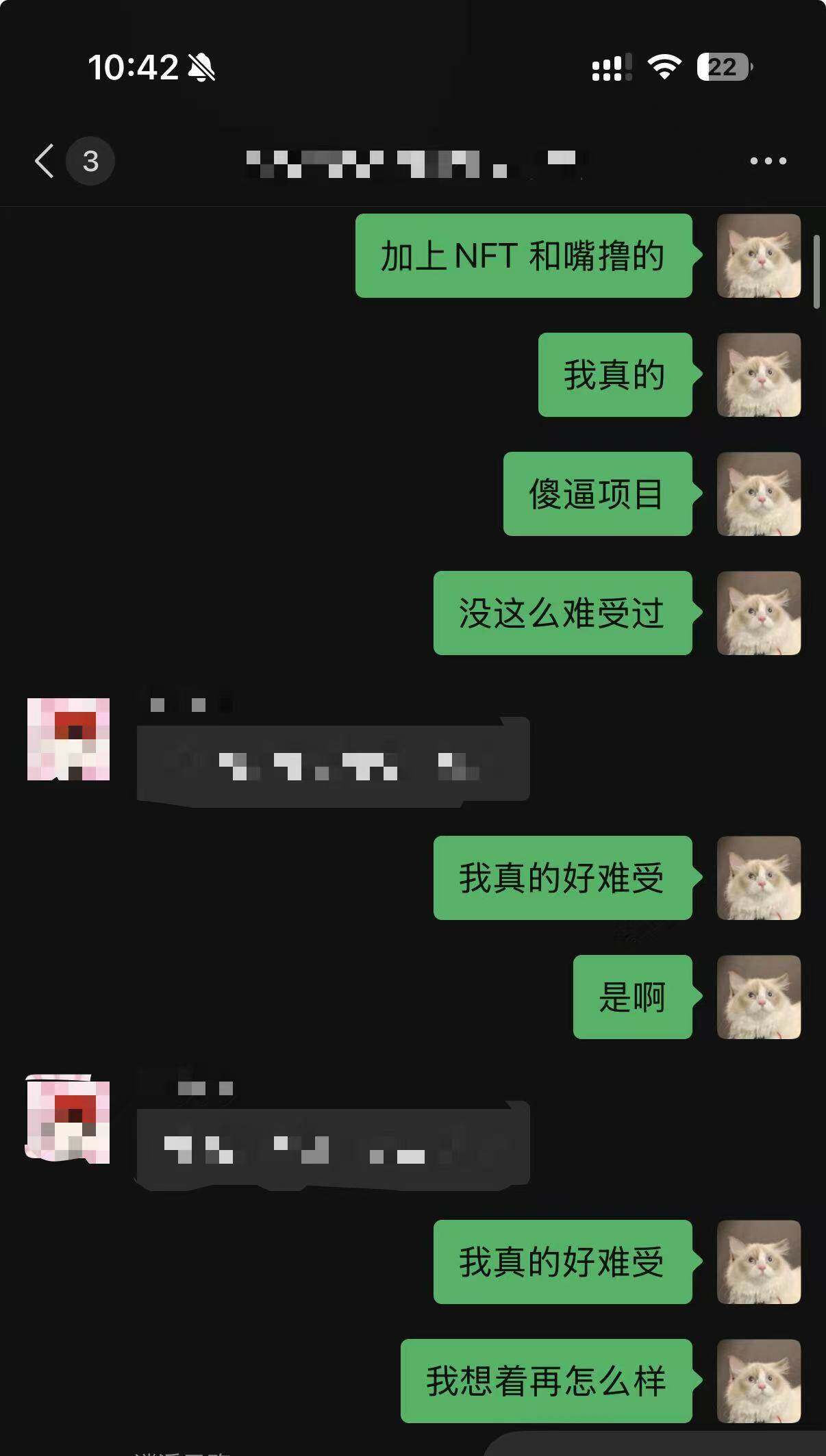
Faced with the reverse-fleece, the blogger had no choice but to repeatedly tell his friends how难受 (awful) he felt.

Blogger reverse-fleeced by Infinex tells friend he feels awful

At Infinex's TGE, the fully diluted valuation was only $150 million. The total投入 (input) for Yuanbao's New Year red envelope activity is approximately $140 million USD. What does this mean? It's equivalent to Tencent directly buying Infinex at its maximum valuation and giving it away for free to the whole nation.

Faced with the pain of being reverse-fleeced and deceived, most people in the community choose the same approach as "一千万是只猫"—swallow the loss silently. But some choose to stand up and confront the project team.

Crypto blogger Ice Frog (X:@Ice_Frog666666) is a typical representative. He started by撸毛 (wool grabbing), but ironically, in 2025, Ice Frog was either engaged in airdrop rights protection or on his way to airdrop rights protection. He is currently still negotiating with the prediction market project Space (Odaily Note: Space raised $20 million publicly, team privately took $13 million) and has even taken legal measures.

Web2 Can Afford to Deliver Airdrops, Web3 Can't Afford to Keep Promises

The most ironic point is that today's "input-reward" imbalance in crypto airdrops is not the "moral decay" of a single project, but the result of a整套行业结构变化 (complete set of industry structural changes).

In 2020, Uniswap opened the era of crypto project airdrops. Since then, there have been constant major airdrop opportunities in the crypto space. Stories of getting a car from an airdrop, swapping an airdrop for a house, or reaching A8 (wealth level) through airdrops attracted batch after batch of people into the wool grabbing track, presenting an aesthetic of "the industry is on the rise."

But by 2025, this changed. Market narratives dried up, primary financing weakened, secondary buying power was insufficient. Airdrops were no longer about sharing the future with early users, but more like mortgaging the future for present data, creating an exit path for the project team itself or换取下一轮融资窗口 (exchanging for the next financing window). Thus, major airdrops disappeared, small airdrops shrank, and "being reverse-fleeced" became the industry norm.

The so-called airdrop is just rewriting the advertising budget into a reward pool, bypassing third parties to directly establish growth relationships with users. Whether it's the 1 billion RMB given by Web2's Yuanbao or the fixed airdrop allocation in Web3 project tokenomics, the essence is this logic.

But the difference is that Web2 giants use cash to buy user certainty, while Web3 offers token returns as a promise that may be fulfilled. This results in the same tactic leading to two different destinies.

The certainty of Yuanbao's cash red envelopes comes from cash flow and约束机制 (binding mechanisms). Tencent's strong cash flow determines that Yuanbao "can pay out." The binding mechanisms under mature laws determine that Yuanbao "cannot renege." Coupled with the "simple and brainless" barrier-free interaction, users naturally understand it as a "welfare."

In contrast, crypto people not only付出 (pay) costs several times higher than Web2 wool grabbing (e.g., capital, time, energy) but also worry about being sybil attacked, token lock-up periods, and ever-changing airdrop rules. The most ironic thing is that the收益 (returns) obtained in the end are not as good as Yuanbao's.

Therefore, today's crypto airdrops have long degenerated from direct growth rewards into promises with constantly deferred fulfillment, or even unfulfilled promises. If this situation does not change in 2026, the user retention rate will be sacrificed along with it.

From User Growth to Retention, Airdrop Utility Can Only Support the First Half at Most

Using airdrops for user growth has always been the most common and direct means in the business world to deal with strong competitors.

Tencent invested 1 billion RMB cash to support Yuanbao because its competitor Doubao is strong enough. By the end of 2025, Doubao was the first AI product in China to exceed 100 million daily active users. The same goes for Web3. In the prediction market track, Polymarket dominates. To grab users, Opinion, predict.fun, and Limitless also use points airdrops for user growth, directly pulling users into the product.

In the short term, airdrops can indeed create a huge user influx entry point. But in the long run, what determines user retention is still product-market fit, user experience, and ecological linkage. In Web3's business history, there are no shortage of project cases that were bustling before the airdrop but became deserted afterwards. Therefore, both Web2 and Web3 face the same "post-airdrop problem": how to retain users.

Ten years ago, Tencent, a company good at imitating first and then surpassing, used "WeChat Red Envelopes" to push WeChat Pay into a national-level入口 (entry point), proving its extreme familiarity with the "user growth → retention → habit" chain. Whether they can create another miracle for Yuanbao in the same way is still debated, but they at least have ample experience in "how to convert airdrops into retention."

To this end, Odaily Planet Daily contacted a certain Yuanbao insider and asked from a product perspective how Web3 project airdrops should be improved. The answer was very practical:

"As one of the internet companies with the largest market capitalization, Web3 projects may not have direct references from Tencent. But the core of user growth methods like airdrops is still to improve retention. This requires a series of联动 (linkages) after the airdrop. For example, PR and marketing need to think about how to further spread the玩法 (gameplay/mechanics). The product side also needs to make more moves to achieve this."

From the perspective of Web3 practitioners,只聊流量玩法终觉浅 (only discussing traffic tactics feels shallow in the end). What product features, beyond the token, can actually retain users is更值得推敲 (more worth scrutinizing).


Twitter:https://twitter.com/BitpushNewsCN

Bitpush TG Exchange Group:https://t.me/BitPushCommunity

Bitpush TG Subscription: https://t.me/bitpush


Original link:https://www.bitpush.news/articles/7608562

Связанные с этим вопросы

QWhat is the main point of the article regarding the comparison between Web2 and Web3 airdrops?

AThe article argues that Web2 airdrops, like Yuanbao's cash red packets, offer small but guaranteed and frictionless rewards, while Web3 airdrops often require significant investment of time, money, and effort, yet yield uncertain returns due to factors like token lock-ups, rule changes, and the risk of being 'sybil attacked' or 'rug pulled', making them less rewarding in practice.

QWhy did the Yuanbao cash red packet campaign become so popular among crypto users in early February?

AIt became popular because it offered a simple, no-cost way to earn small cash rewards during a period of significant market downturn, providing psychological comfort and a temporary escape from heavy trading losses, as the crypto market experienced a major crash with billions liquidated.

QWhat example does the article use to illustrate the problem of being 'rug pulled' in a Web3 airdrop?

AThe article cites the example of a user who spent over $11,900 (including buying an NFT and participating in a public sale) on the Infinex project over 406-day period, only to end up with a significant financial loss at TGE, unable to even recoup their initial investment.

QAccording to the article, what is the fundamental difference in how Web2 and Web3 projects fund their user growth campaigns (airdrops)?

AWeb2 giants like Tencent use their strong cash flow to fund guaranteed cash rewards (like Yuanbao's 1.4 billion USD equivalent campaign), backed by legal constraints ensuring payout. Web3 projects, however, use token rewards which are merely a promise of future value that is often deferred, uncertain, and subject to various risks, making them less reliable.

QWhat key challenge do both Web2 and Web3 projects face after conducting a large airdrop campaign, as mentioned in the article?

ABoth face the challenge of user retention. While airdrops are effective for initial user acquisition and growth, long-term user retention depends on factors like product-market fit, user experience, and ecological utility, not just the initial incentive.

Похожее

South Korean Exchanges 'Battle' Regulators, Challenging the Boundaries of Enforcement and Legislation

South Korea's cryptocurrency industry is engaged in a rare, direct confrontation with regulators. The Financial Intelligence Unit (FIU), the primary anti-money laundering (AML) watchdog, has recently imposed heavy penalties on major exchanges like Upbit and Bithumb for alleged violations involving unregistered overseas VASPs and AML procedures. However, exchanges are now actively challenging these actions in court and through industry associations. In a significant shift, the Seoul Administrative Court ruled in favor of Upbit's operator, Dunamu, overturning part of an FIU-ordered business suspension. The court found the FIU's penalty criteria and justification insufficiently clear. Similarly, the court suspended the enforcement of a six-month business suspension against Bithumb pending a final ruling, citing potential irreversible harm to the exchange. Beyond legal battles, the industry is contesting proposed legislative amendments. The Digital Asset eXchange Alliance (DAXA) strongly opposes a draft rule that would mandate Suspicious Transaction Reports (STRs) for all crypto transfers over 10 million KRW (~$6,800). DAXA argues this "poison pill" clause violates legal principles and would overwhelm the STR system, increasing reports from 63,000 to an estimated 5.45 million annually for major exchanges, thereby crippling effective AML monitoring. This conflict highlights a structural tension in South Korea's crypto governance: comprehensive digital asset laws are still developing, while regulators rely heavily on AML enforcement. The industry's move from passive compliance to active legal and legislative challenges signifies a new phase, pressing for clearer rules and more proportionate enforcement. While short-term disputes may intensify, this clash could ultimately lead to a more mature and sustainable regulatory framework for South Korea's vibrant crypto market.

marsbit54 мин. назад

South Korean Exchanges 'Battle' Regulators, Challenging the Boundaries of Enforcement and Legislation

marsbit54 мин. назад

After 50x Storage Surge, Justin Sun Always Looks to the Next Decade

Sun Yuchen, known for his controversial stunts like a $30 million lunch with Warren Buffett (canceled due to a kidney stone) and eating a $6.2 million duct-taped banana, is often overshadowed by a significant fact: his decade-long track record of spotting major investment trends. In 2016, he famously advised young people to invest in Bitcoin, Nvidia, Tesla, and Tencent instead of buying property. A hypothetical $20,000 investment in Nvidia and Tesla from that list would now be worth over 50 million RMB. His latest major call was on November 6, 2025, predicting a "50x storage opportunity" tied to the AI boom, which materialized with Sandisk's stock surging nearly 50-fold by 2026. Looking ahead, Sun now focuses on the next frontier: Physical AI. He identifies four key areas: 1. **Embodied AI/Robotics**: He sees this reaching its "iPhone moment," with companies like UBTech and Galaxy General leading in commercialization. 2. **Drones**: Viewed as the first commercially viable form of Physical AI, revolutionizing sectors from warfare (e.g., AeroVironment's Switchblade) to logistics. 3. **Spatial Computing**: Beyond VR, it's about AI understanding physical space, a foundational technology for robotics and autonomous systems, exemplified by Apple's Vision Pro. 4. **Space Exploration**: After a 2025 suborbital flight with Blue Origin, Sun advocates for space as the ultimate frontier, discussing blockchain's potential role in space asset management and data transactions. His investment philosophy involves betting on entire, inevitable trends rather than single companies. For robotics, he sees Tesla (the body/manufacturer) and Nvidia (the brain/AI platform) as complementary plays. In defense drones, he highlights companies making tanks obsolete (AeroVironment) and those augmenting fighter jets (Kratos). For space, he participated in Blue Origin's flight and anticipates SpaceX's potential IPO to redefine the sector's valuation. Sun Yuchen's vision frames the next two decades not as a revolution in information flow (like the internet), but in the fundamental operation of the physical world through AI-powered robots, autonomous systems, and spatial intelligence, ultimately extending human and AI activity into space. While many still focus on conventional assets, he continues to look toward the next technological horizon.

marsbit1 ч. назад

After 50x Storage Surge, Justin Sun Always Looks to the Next Decade

marsbit1 ч. назад

The Billionaires Behind the Most Expensive Midterm Election in History

"The Most Expensive Midterm Elections and Their Billionaire Backers" This analysis details the unprecedented scale of spending in the 2026 midterm elections, highlighting the key billionaire donors shaping the political landscape. Jeff Yass, founder of Susquehanna International Group, has contributed over $81 million, ranking third among individual donors behind George Soros ($102.6M) and Elon Musk ($84.8M). Yass is a major donor to Trump's MAGA Inc. and supports school choice and various candidates. Overall, federal committees have raised over $4.7 billion this cycle, with political ad spending projected to reach $10.8 billion. Republican-aligned groups are significantly out-raising their Democratic counterparts. "Dark money" from undisclosed sources continues to grow. The core stakes involve control of Congress and policy direction for Trump's final term. Donors are also motivated by specific issues: Sergey Brin and Chris Larsen are funding opposition to a proposed California wealth tax and supporting crypto-friendly policies. Other top donors include OpenAI's Greg Brockman and his wife Anna ($50M total to MAGA Inc. and an AI-focused PAC), Richard Uihlein ($45.3M to conservative causes), venture capitalists Marc Andreessen and Ben Horowitz (each over $44M to crypto/AI PACs and MAGA Inc.), Miriam Adelson ($42.6M to GOP leadership PACs), Paul Singer ($33.9M), and Diane Hendricks ($25.8M to MAGA Inc.). The article notes that the peak fundraising period is still ahead, with major primaries approaching.

marsbit1 ч. назад

The Billionaires Behind the Most Expensive Midterm Election in History

marsbit1 ч. назад

The Largest IPO in History Is Approaching, Surpassing SpaceX, 28 Years of AI Self-Iteration, Countdown to Intelligence Explosion

"Anthropic Nears Trillion-Dollar IPO, Fueled by Explosive Growth and 2028 'Intelligence Explosion' Warning Anthropic is considering a deal valuing the AI company near $1 trillion, potentially leading to one of the largest IPOs ever and surpassing SpaceX. Its revenue has skyrocketed, with Annual Recurring Revenue (ARR) reaching $45 billion in May 2026—a 500% increase in just five months. This vertical growth curve is attributed to its key products, Claude Code and Cowork, dominating AI coding and enterprise collaboration. Beyond commercial success, co-founder Jack Clark issued a pivotal warning in an interview: there is a greater than 50% chance that by the end of 2028, AI systems will achieve recursive self-improvement—the ability to autonomously build a 'better version' of themselves, initiating an 'intelligence explosion.' This prophecy underpins the company's astronomical valuation, as the market prices in the potential for transformative and disruptive AI. Further signaling its ambition, Anthropic formed a $1.5 billion joint venture with Goldman Sachs and Blackstone, aiming to disrupt traditional consulting firms like McKinsey by deploying Claude AI for complex strategic work. This move tests AI's capacity to replace high-level cognitive labor, a precursor to its predicted autonomous evolution. The narrative presents a dual future: unprecedented economic opportunity alongside significant risks like economic restructuring and security threats. Anthropic's meteoric rise and Clark's 2028 prediction frame the coming years as a countdown to a potential technological singularity."

marsbit2 ч. назад

The Largest IPO in History Is Approaching, Surpassing SpaceX, 28 Years of AI Self-Iteration, Countdown to Intelligence Explosion

marsbit2 ч. назад

Торговля

Спот
Фьючерсы

Популярные статьи

Как купить ONE

Добро пожаловать на HTX.com! Мы сделали приобретение Harmony (ONE) простым и удобным. Следуйте нашему пошаговому руководству и отправляйтесь в свое крипто-путешествие.Шаг 1: Создайте аккаунт на HTXИспользуйте свой адрес электронной почты или номер телефона, чтобы зарегистрироваться и бесплатно создать аккаунт на HTX. Пройдите удобную регистрацию и откройте для себя весь функционал.Создать аккаунтШаг 2: Перейдите в Купить криптовалюту и выберите свой способ оплатыКредитная/Дебетовая Карта: Используйте свою карту Visa или Mastercard для мгновенной покупки Harmony (ONE).Баланс: Используйте средства с баланса вашего аккаунта HTX для простой торговли.Третьи Лица: Мы добавили популярные способы оплаты, такие как Google Pay и Apple Pay, для повышения удобства.P2P: Торгуйте напрямую с другими пользователями на HTX.Внебиржевая Торговля (OTC): Мы предлагаем индивидуальные услуги и конкурентоспособные обменные курсы для трейдеров.Шаг 3: Хранение Harmony (ONE)После приобретения вами Harmony (ONE) храните их в своем аккаунте на HTX. В качестве альтернативы вы можете отправить их куда-либо с помощью перевода в блокчейне или использовать для торговли с другими криптовалютами.Шаг 4: Торговля Harmony (ONE)С легкостью торгуйте Harmony (ONE) на спотовом рынке HTX. Просто зайдите в свой аккаунт, выберите торговую пару, совершайте сделки и следите за ними в режиме реального времени. Мы предлагаем удобный интерфейс как для начинающих, так и для опытных трейдеров.

653 просмотров всегоОпубликовано 2024.04.12Обновлено 2025.06.06

Как купить ONE

Обсуждения

Добро пожаловать в Сообщество HTX. Здесь вы сможете быть в курсе последних новостей о развитии платформы и получить доступ к профессиональной аналитической информации о рынке. Мнения пользователей о цене на ONE (ONE) представлены ниже.

活动图片