A New Crypto Era: SEC-CFTC To Host Joint Regulatory Harmonization Event Next Week

bitcoinistОпубликовано 2026-01-24Обновлено 2026-01-24

Введение

The U.S. Securities and Exchange Commission (SEC) and the Commodity Futures Trading Commission (CFTC) will host a joint public event on January 27 to discuss harmonizing crypto regulations. The event, part of the Trump administration's push to make the U.S. the global crypto leader, aims to clarify jurisdictional boundaries and foster innovation under American law. This follows ongoing efforts between the agencies to improve regulatory coordination, as emphasized in a September roundtable where SEC Chair Atkins declared an end to "regulatory fragmentation." Meanwhile, congressional efforts to pass crypto legislation have stalled, with the Senate Banking Committee delaying its bill after industry criticism, and Coinbase withdrawing support for what it called a "bad bill." The Senate Agriculture Committee has advanced its version of the Clarity Act, focusing on the CFTC's role.

The Securities and Exchange Commission (SEC) and the Commodity Futures Trading Commission (CFTC) have announced a joint event on the future of crypto oversight amid the Trump administration’s push to welcome the sector.

SEC-CFTC Push Joint Crypto Oversight

On Thursday, SEC Chairman Paul Atking and CFTC Chairman Michael Selig announced they will hold an event next week to discuss regulatory harmonization between the two sister agencies.

According to the announcement, the pro-industry chairmen will outline the efforts to work together and cooperate to “deliver on President Trump’s promise to make the United States the crypto capital of the world.”

The event will be hosted on January 27 at the CFTC headquarters and moderated by crypto journalist Eleanor Terret. Additionally, it will be open to the public and livestreamed on both agencies’ websites.

“For too long, market participants have been forced to navigate regulatory boundaries that are unclear in application and misaligned in design, based solely on legacy jurisdictional silos,” said SEC Chair Atkins and CFTC Chair Selig in a joint statement.

“This event will build on our broader harmonization efforts to ensure that innovation takes root on American soil, under American law, and in service of American investors, consumers, and economic leadership,” they added.

Last year, the SEC and CFTC began discussing their options for effectively collaborating on crypto regulations, as a clear framework for digital assets became a top priority for the agencies

As reported by Bitcoinist, the agencies explored reinstating the CFTC-SEC joint advisory committee to develop recommendations on ongoing issues, including efforts in regulatory coordination.

During a September joint roundtable between the two agencies, Atking declared that the era of regulatory fragmentation was ending and the age of harmonized, innovation-friendly crypto oversight was here:

We are at a crossroads. If we follow the path of our predecessors, America risks ceding leadership in the next chapter of financial history. (...) This ends now (...) our two agencies must work in lockstep to transform dual regulation from a source of confusion into a source of strength. Together, we can offer the best of both worlds: the investor protections that have defined U.S. markets, combined with the innovation-friendly approach that will keep us at the frontier of financial technology throughout the 21st century.

The SEC’s Director of the Division of Trading and Markets, Jamie Selway, highlighted the SEC’s efforts to “further harmonize its rules with our sister regulator, the CFTC. In a January 22 speech, He affirmed that the Division will work shoulder-to-shoulder with the CFTC staff to ensure the US’s continued leadership in financial markets, following Atkins’ September directions.

Congress Regulatory Efforts Stall

The SEC and CFTC’s efforts to regulate the crypto market come as the US Congress struggles to establish a framework to oversee the sector. The Senate Banking Committee’s version of the market structure bill, which focuses on the SEC’s oversight, was delayed after multiple market participants criticized the bill’s draft.

Coinbase CEO Brian Armstrong shared his disappointment with the crypto legislation, withdrawing the company’s support last week. “This version would be materially worse than the current status quo. We’d rather have no bill than a bad bill,” he affirmed.

The Senate Agriculture Committee published its version of the CLARITY Act on Thursday, which mainly addresses the CFTC’s role and regulations, scheduling its markup session for January 27.

Eleanor Terret shared that the industry’s reaction has been mostly positive, “with stakeholders noting the bill’s close similarities to the House Agriculture Committee’s version of the Clarity Act.”

However, recent reports have warned that the Banking Committee’s crypto talks may not resume until later February or early March, as focus shifts to advancing affordable housing plans linked to President Trump’s priorities.

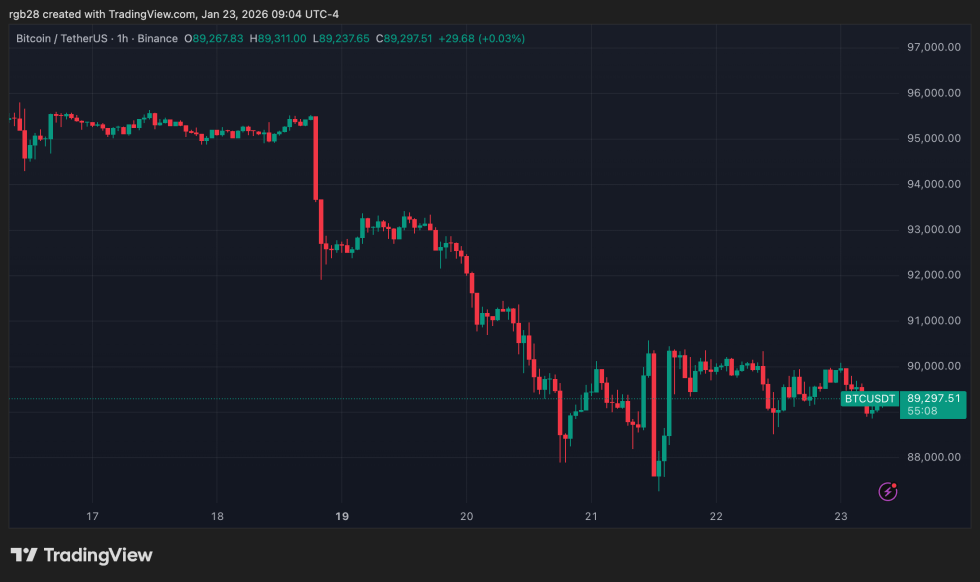
Bitcoin (BTC) trades at $89,297 in the one-week chart. Source: BTCUSDT on TradingView

Связанные с этим вопросы

QWhat is the purpose of the joint event being hosted by the SEC and CFTC next week?

AThe purpose of the joint event is to discuss regulatory harmonization between the SEC and CFTC, outline efforts to cooperate, and deliver on President Trump's promise to make the United States the crypto capital of the world.

QWhere and when will the SEC-CFTC joint event take place, and how can the public access it?

AThe event will be hosted on January 27 at the CFTC headquarters. It will be open to the public and livestreamed on both agencies' websites.

QAccording to the agency chairmen, what problem has forced market participants to navigate unclear regulatory boundaries?

AThe chairmen stated that market participants have been forced to navigate regulatory boundaries that are unclear in application and misaligned in design, based solely on legacy jurisdictional silos.

QWhy did Coinbase CEO Brian Armstrong withdraw support for the Senate Banking Committee's market structure bill?

ABrian Armstrong withdrew support because he believed that version of the bill would be materially worse than the current status quo, stating, 'We'd rather have no bill than a bad bill.'

QWhat recent legislative action did the Senate Agriculture Committee take regarding crypto, and when is its markup session?

AThe Senate Agriculture Committee published its version of the CLARITY Act, which mainly addresses the CFTC's role and regulations, and scheduled its markup session for January 27.

Похожее

Huawei Cloud Rejects Token Price War, Zhou Yuefeng Seeks a New Winning Formula for AI Cloud

At the 2026 Huawei Cloud INSPIRE Creator Conference, CEO Zhou Yuefeng outlined Huawei Cloud's distinct strategy in the competitive AI cloud market. Instead of engaging in price wars based on token volume or Maas revenue—a common focus for rivals like Alibaba Cloud and ByteDance's Volcano Engine—Huawei Cloud is shifting the competition towards real-world productivity gains. Zhou highlighted three core differentiators: a fully domestic computing stack (Ascend, Kunpeng), a focus on government and enterprise clients rather than consumer internet, and a deep commitment to open-source ecosystems. To this end, Huawei Cloud launched a suite of new products under the "Agentic Infra" paradigm, including the AICS Lingqu computing cluster, AMS memory storage, and the ModelArts Next platform. These aim to solve enterprise challenges in deploying AI agents, such as latency, memory, scheduling, and security. The strategy further involves creating specialized industry zones ("AI Dream Factories") for sectors like healthcare and embodied intelligence. For example, a smart medical zone developed with Shanghai Ruijin Hospital aims to democratize expert-level diagnostic capabilities. In essence, Huawei Cloud is positioning itself not as a commodity token provider, but as the foundational infrastructure for industrial AI, leveraging its domestic supply chain and hybrid cloud solutions to serve sectors where productivity, not just scale, is the ultimate measure of value.

marsbit12 мин. назад

Huawei Cloud Rejects Token Price War, Zhou Yuefeng Seeks a New Winning Formula for AI Cloud

marsbit12 мин. назад

70% of the Public Opposes AI, Americans Hope the U.S. Loses the AI War

70% of Americans believe AI development is moving too fast, with growing public resistance evolving from online criticism to real-world protests and violence. This widespread anti-AI sentiment stems from fears of job losses, rising utility costs, environmental damage, threats to democracy, and financial instability. Key incidents illustrate the backlash: Google's former CEO Eric Schmidt was loudly booed at a graduation for promoting AI; AI company ads are vandalized; protests and even violent attacks target AI firms and data centers. Polls show deep public pessimism and strong local opposition to data center construction, often surpassing resistance to nuclear power plants. The core grievances are economic and practical: AI is seen as automating jobs, concentrating wealth, and increasing household electricity and water bills due to massive data center resource demands. Environmentalists also oppose AI's high energy use and carbon emissions. This opposition has turned AI into a major political issue in the US. While the Trump administration prioritizes AI innovation for global competition, bipartisan pushback is growing. Democrats and factions within the MAGA movement are forming temporary alliances to support stricter regulations and local bans on new data centers, pressuring the administration to choose between its tech industry backers and its voter base. The situation highlights a profound national divide over AI's future.

marsbit45 мин. назад

70% of the Public Opposes AI, Americans Hope the U.S. Loses the AI War

marsbit45 мин. назад

Agents Take Over Traffic Distribution Power: What Are Tencent, ByteDance, and Alibaba Competing For?

In the race to dominate the AI era's entry point, China's tech giants—Tencent, ByteDance, and Alibaba—are aggressively deploying AI Agents to control the future of traffic distribution. Alibaba is pursuing a dual-track "closed loop + openness" strategy. Its Qianwen app is evolving into a super-Agent integrated across its ecosystem (Taobao, Alipay, etc.) to handle complex tasks like travel planning. Concurrently, it is opening its platform to external brands (Luckin Coffee, KFC) and has launched a B2B Agent platform, "Wukong," targeting enterprise automation. Its other flagship, Quark, aims to be an "AI super search box" for information and tasks. ByteDance is executing an omnipresent "sprawl strategy." Its Doubao app boasts over 300 million monthly active users and is evolving into a default AI entry point for daily life, with plans for paid versions and e-commerce integration. Its core weapon is the Kouzi platform, a visual "AI assembly factory" for developers to build custom Agents. ByteDance is also pushing hardware integration, collaborating on AI phones and developing smart glasses to embed Doubao everywhere. Tencent is playing its long-held "ultimate card" by quietly embedding an AI Agent directly into WeChat. This Agent, accessible via a swipe, can understand user commands and automatically execute tasks by calling upon WeChat's millions of mini-programs (e.g., finding and ordering coffee). This leverages WeChat's unparalleled 1.4-billion-user ecosystem to position the app as an AI-powered "service operating system," a move that could dramatically reshape the competitive landscape. The core battleground is shifting from competing for "user screen time" to competing to be the "default execution layer" for user intent. The business model is evolving from an "attention economy" to an "intent economy," where the Agent that can most efficiently fulfill a user's need gains control over service access and token flow. This represents a fundamental change in how users connect with digital services, making the fight for the Agent入口 (entry point) a pivotal moment for redefining industry leadership in the AI age.

marsbit2 ч. назад

Agents Take Over Traffic Distribution Power: What Are Tencent, ByteDance, and Alibaba Competing For?

marsbit2 ч. назад

Торговля

Спот
Фьючерсы

Популярные статьи

Как купить ERA

Добро пожаловать на HTX.com! Мы сделали приобретение Caldera (ERA) простым и удобным. Следуйте нашему пошаговому руководству и отправляйтесь в свое крипто-путешествие.Шаг 1: Создайте аккаунт на HTXИспользуйте свой адрес электронной почты или номер телефона, чтобы зарегистрироваться и бесплатно создать аккаунт на HTX. Пройдите удобную регистрацию и откройте для себя весь функционал.Создать аккаунтШаг 2: Перейдите в Купить криптовалюту и выберите свой способ оплатыКредитная/Дебетовая Карта: Используйте свою карту Visa или Mastercard для мгновенной покупки Caldera (ERA).Баланс: Используйте средства с баланса вашего аккаунта HTX для простой торговли.Третьи Лица: Мы добавили популярные способы оплаты, такие как Google Pay и Apple Pay, для повышения удобства.P2P: Торгуйте напрямую с другими пользователями на HTX.Внебиржевая Торговля (OTC): Мы предлагаем индивидуальные услуги и конкурентоспособные обменные курсы для трейдеров.Шаг 3: Хранение Caldera (ERA)После приобретения вами Caldera (ERA) храните их в своем аккаунте на HTX. В качестве альтернативы вы можете отправить их куда-либо с помощью перевода в блокчейне или использовать для торговли с другими криптовалютами.Шаг 4: Торговля Caldera (ERA)С легкостью торгуйте Caldera (ERA) на спотовом рынке HTX. Просто зайдите в свой аккаунт, выберите торговую пару, совершайте сделки и следите за ними в режиме реального времени. Мы предлагаем удобный интерфейс как для начинающих, так и для опытных трейдеров.

728 просмотров всегоОпубликовано 2025.07.17Обновлено 2026.06.02

Как купить ERA

Обсуждения

Добро пожаловать в Сообщество HTX. Здесь вы сможете быть в курсе последних новостей о развитии платформы и получить доступ к профессиональной аналитической информации о рынке. Мнения пользователей о цене на ERA (ERA) представлены ниже.

活动图片