Bitcoin Liquidation Shakeout Leaves Traders Watching $66K Resistance And $61K Support

bitcoinistОпубликовано 2026-06-13Обновлено 2026-06-13

Введение

Bitcoin's recent volatility triggered a major liquidation event, wiping out roughly $980 million in leveraged positions within 24 hours as price swung from ~$64,100 down to $60,700 and back above $63,000. Traders are now watching key technical levels. Major pivot resistance is identified at $66,247, with reclaimed highs near $64,234 and next resistance at $65,890. Critical support zones lie between $63,127-$63,354, then $62,459, with broader downside targets around $59,150-$60,171. Liquidation heatmaps show significant liquidity clusters above ($63.5K-$66K) and below ($58.5K-$61K) spot price, creating a volatile corridor. The market is in a corrective phase; a clean break above resistance is needed for a bullish shift, while failure to hold low-$63K support risks a move toward lower liquidity zones.

TL;DR

  • Bitcoin’s sharp move from the mid-$64,000 area to near $60,700, followed by a rebound above $63,000, triggered a large leverage reset across crypto markets.
  • CryptoReviewing/status/2065076555949216117′′>CryptoReviewing said total crypto liquidations reached about $980 million in less than 24 hours, with liquidity zones now sitting both above and below spot.
  • Trade Nation’s TradingView analysis places Bitcoin’s key pivot resistance at 66,247, with downside supports at 59,150, 56,900, and 54,920.
  • A separate TradingView idea from virDeStatera points to 64,234 as the swept high to reclaim, with 65,890 as the next key resistance.

Bitcoin traders are watching a tight cluster of liquidation zones and technical levels after a sharp two-way move flushed leverage from both sides of the market.

CryptoReviewing, citing a Coinglass liquidation heatmap, said Bitcoin first dropped from $64,100 to $60,700, liquidating roughly $456 million, before rebounding back above $63,000 and triggering another $524 million in liquidations. The analyst described the combined move as roughly $980 million in crypto liquidations in less than 24 hours.
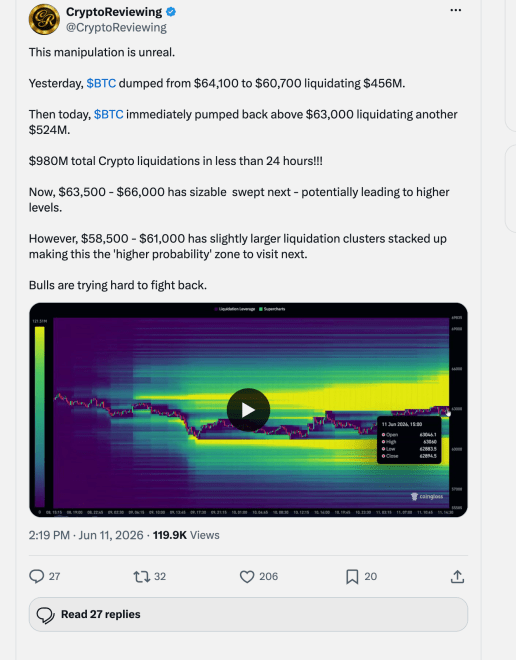
CryptoReviewing highlighted Bitcoin liquidation clusters using Coinglass heatmap data.

The word “manipulation” appeared in the original post, but the cleaner read is that this was a high-leverage market reacting violently around crowded positioning. In that kind of environment, both long and short traders can be forced out quickly as price sweeps liquidity above and below nearby ranges.

Bitcoin Liquidity Zones Sit On Both Sides

The key issue now is where the next liquidity pocket sits. CryptoReviewing pointed to the $63,500 to $66,000 region as a sizable upside zone, while also noting a slightly larger downside cluster around $58,500 to $61,000.

That creates an awkward setup for short-term traders. A push higher could force more short covering if Bitcoin breaks into the upper liquidity zone. But a failure to hold current levels could pull price back toward the lower cluster, where late longs may again be vulnerable.

Liquidation maps are not precise price forecasts. They show where leveraged positions may be concentrated, not where price must go. Still, when volatility is elevated and liquidity is thin, these levels can become magnets because forced liquidations often add fuel to already-moving markets.

Trade Nation Flags 66,247 As Pivot Resistance

A TradingView idea from Trade Nation offered a more traditional support-and-resistance framework for Bitcoin’s current pullback. The analysis described BTC as being in a corrective phase on the four-hour chart and identified 66,247 as the main pivot resistance level.

As long as Bitcoin remains below that level, Trade Nation’s downside scenario highlights 59,150 as near-term support, followed by 56,900 and 54,920. On the upside, a move above 66,247 would shift attention toward 67,950 and then 69,940.

Those levels line up reasonably well with the broader liquidation-map picture. The $59,150 support sits inside the wider $58,500 to $61,000 downside liquidity region, while the 66,247 pivot is close to the upper $63,500 to $66,000 zone identified in the heatmap post.
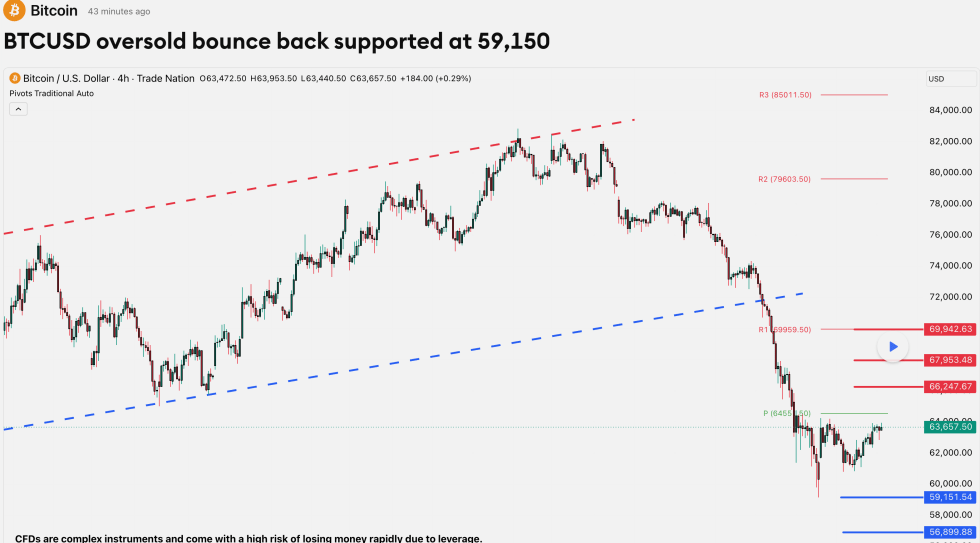
Trade Nation’s TradingView setup marked 66,247 as the main pivot resistance.

Short-Term Traders Watch The Swept High

A separate TradingView idea from virDeStatera focused on Bitcoin’s one-hour structure and argued that a new overnight high had been swept. The analysis placed that swept high at 64,234, with price pulling back toward 63,713 at the time of the post.

The same setup identified 65,890 as key resistance, with intraday support between 63,127 and 63,354. Below that, virDeStatera highlighted 62,459 as key support and 60,171 as a broader thesis line.

The technical language in the original TradingView post included several proprietary indicators, but the practical takeaway is simpler: Bitcoin needs to reclaim the swept 64,234 area with convincing volume before traders can reasonably look toward 65,890 and the broader 66,000 region.

If that reclaim fails, attention likely shifts back toward the lower support stack. The first area to watch would be the 63,127 to 63,354 band, followed by 62,459 and then the wider 60,000 to 61,000 zone flagged by liquidation data.
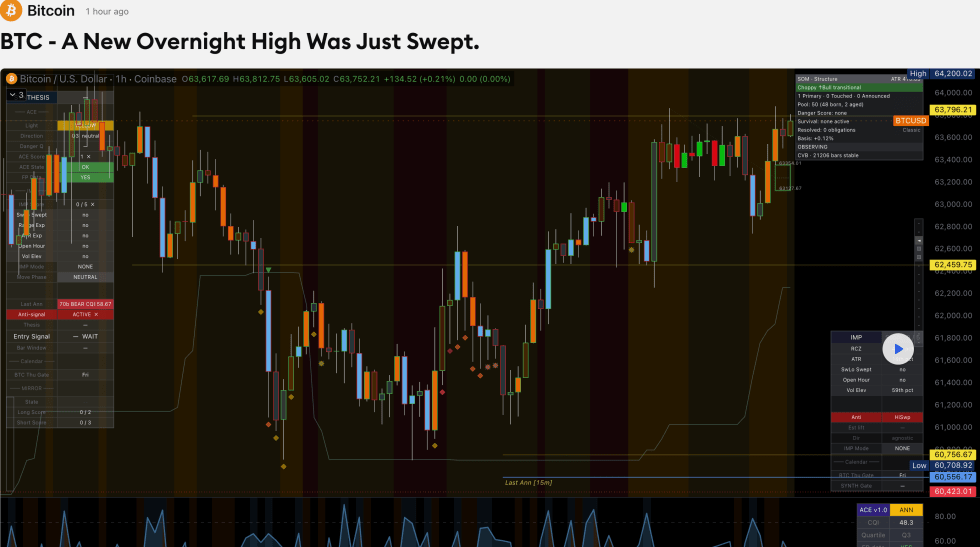
virDeStatera’s TradingView idea focused on the 64,234 swept high and nearby intraday support.

What This Means For Bitcoin Traders

The current setup does not offer a clean one-way signal. Instead, it shows a market sitting between two obvious liquidity pockets after a major leverage reset.

For bulls, reclaiming 64,234 and then pressing toward 65,890 would be the first step toward testing the 66,247 pivot and the upper liquidation zone. For bears, failure to hold above the low-$63,000 area would keep the lower support cluster in play.

That makes risk management more important than prediction. Bitcoin can move quickly when liquidation levels sit close to spot, and the recent $980 million flush shows how fast crowded positioning can unwind.

For now, the clearest map is this: resistance is stacked between roughly 64,234, 65,890, and 66,247, while downside risk builds around 63,127 to 63,354, then 62,459, and finally the broader 59,150 to 60,171 region. Until one side breaks cleanly, Bitcoin remains trapped in a short-term volatility corridor.


Originally shared by CryptoReviewing on X

Связанные с этим вопросы

QWhat was the total estimated value of crypto liquidations triggered by Bitcoin's recent volatile price move, and over what time period did this occur?

AThe total estimated value of crypto liquidations was about $980 million, and this occurred in less than 24 hours.

QAccording to the article, what is the main pivot resistance level for Bitcoin identified in Trade Nation's TradingView analysis?

AThe main pivot resistance level identified by Trade Nation is $66,247.

QWhat are the two broad Bitcoin price ranges identified as liquidity clusters or zones by the analyst CryptoReviewing?

ACryptoReviewing identified an upside liquidity zone from $63,500 to $66,000, and a slightly larger downside liquidity cluster around $58,500 to $61,000.

QIn the shorter-term analysis by virDeStatera, what price level is identified as the 'swept high' that Bitcoin needs to reclaim?

AThe 'swept high' that Bitcoin needs to reclaim is at $64,234.

QBased on the article's conclusion, what is the primary focus for traders in the current Bitcoin market setup, rather than trying to predict direction?

AThe primary focus for traders should be on risk management, as the market is trapped in a short-term volatility corridor between key resistance and support levels.

Похожее

Blockchain Has Finally Started to Sail into the Mainstream After 18 Years

Blockchain Finds Its True Path After 18 Years: Becoming the Financial Backbone for AI Agents and Autonomy This analysis explores a pivotal shift in the blockchain and crypto investment landscape, driven by the dominance of AI. Major venture capital firms, including Variant, Paradigm, Haun Ventures, and YZi Labs, are moving beyond pure "crypto" investment theses. They are expanding their focus to AI, robotics, and frontier tech, signaling that blockchain is no longer seen as a standalone sector but as an underlying infrastructure layer. The core argument is that blockchain's killer application may not be user-facing apps, but rather providing the economic rails for the coming wave of AI agents, autonomous robots, and automated systems. Key capabilities like self-custody wallets, programmable stablecoins for micropayments, on-chain identity, and verifiable smart contracts are positioned as essential for a future where machines conduct economic activity. The recent $1.4 billion investment by Tether (via its venture arm) in German robotics company NEURA Robotics exemplifies this, aiming to embed Tether's wallet tools directly into robots for autonomous transactions. While many "AI + Crypto" projects remain superficial, the article concludes that true value lies where crypto is a necessary component—enabling machine-to-machine payments, agent autonomy, verifiable data provenance, and open financial settlement for the AI era. For crypto venture capital, this convergence with AI represents both an adaptation to shifting capital flows and a potential path to unlocking the large-scale, non-speculative utility the industry has long sought.

marsbit8 мин. назад

Blockchain Has Finally Started to Sail into the Mainstream After 18 Years

marsbit8 мин. назад

Blockchain has finally begun sailing toward the main channel after 18 years

After 18 years of development, blockchain technology is beginning to move from a specialized niche into mainstream adoption, according to a recent industry analysis. The shift is reflected in the changing strategies of major crypto venture capital firms, which are expanding their focus beyond pure "digital ownership" towards broader themes like "autonomy." The report highlights that leading VC firms like Variant, Paradigm, Haun Ventures, and YZi Labs are broadening their investment mandates to include not only crypto but also artificial intelligence (AI), robotics, biotech, and other frontier technologies. This reflects a recognition that the isolated "crypto investment" narrative is losing appeal to limited partners (LPs) as capital and attention increasingly flow toward AI and other high-growth tech sectors. A key emerging thesis is that blockchain's most significant future application may not be as a consumer-facing product, but as the underlying economic and settlement infrastructure for the AI era. As AI agents and autonomous systems become more prevalent, they will require programmable, global, and low-cost payment networks (like stablecoins), verifiable digital identities, and secure wallets to manage transactions and assets on behalf of users. The investment by stablecoin issuer Tether into robotics company NEURA, with plans to integrate its wallet technology, is cited as a prime example of this convergence. However, the article cautions that simply labeling projects as "AI + Crypto" is insufficient. True value lies in integrations where blockchain technology is essential—such as enabling machine-to-machine micropayments, verifiable data provenance for AI, or transparent governance for autonomous organizations—rather than being a superficial marketing add-on. In conclusion, while AI currently dominates the tech narrative and capital flows, it may ultimately create the real-world, high-frequency demand that the crypto industry has long sought. For crypto VCs and projects, the path forward is to position blockchain not as a competing sector, but as a critical foundational layer powering autonomy and economic activity in an AI-driven future.

链捕手14 мин. назад

Blockchain has finally begun sailing toward the main channel after 18 years

链捕手14 мин. назад

Y Combinator Co-founder: How to Make a Billion Dollars?

The Y Combinator co-founder argues that becoming a billionaire by founding a successful startup is not only possible but demonstrably achievable without unfair or unethical practices. He disputes a politician's claim to the contrary, using the example of a founder whose company grew at 93% monthly solely through creating a product users loved and recommended. The core mechanism is exponential growth. A conservative 15% monthly growth rate compounds to a 4384x increase over five years, which can easily lead to billion-dollar valuations and founder wealth. The process depends on two key variables: the growth rate and the duration it can be sustained. A high growth rate stems from a great product that users naturally promote, while a long duration requires a large enough market. For aspiring founders, especially young ones, the simplest path is to build something they and their friends genuinely need. Young people's current needs often predict future mass-market trends. He advises against actively "searching" for ideas, as this tends to filter out unconventional but promising ones. Instead, inspiration should come from working on interesting projects with friends, as many iconic companies (e.g., Apple, Facebook) started this way. Ultimately, building a massively valuable startup is not about exploitation but empathy: deeply understanding a user group and building a product that significantly improves their lives. This, powered by exponential growth in a large market, is the legitimate path to immense wealth creation.

Foresight News16 мин. назад

Y Combinator Co-founder: How to Make a Billion Dollars?

Foresight News16 мин. назад

The 800V Voltage Standard Championed by Nvidia: Which Infrastructure Providers Stand to Benefit?

NVIDIA is actively promoting the 800VDC architecture as a key direction for its next-generation AI factories and high-power racks, particularly for the upcoming Rubin and Kyber platforms. The primary driver is the rapidly increasing power density of AI racks, with designs like GB200/GB300 NVL72 reaching 120-140kW and future systems potentially hitting 180-220kW. At such high power levels, traditional low-voltage power delivery becomes inefficient due to massive current, leading to significant copper use, cable bulk, heat, and power loss. The 800VDC standard aims to increase efficiency by transmitting power at higher voltage and lower current to the rack before stepping it down locally for GPUs. NVIDIA claims this can improve efficiency by up to 5%, reduce total cost of ownership (TCO) by up to 30%, and cut copper usage by approximately 45%. This shift redefines infrastructure roles, pushing power engineering to the forefront alongside GPU performance. Key beneficiaries and ecosystem partners highlighted include: 1. **Power Infrastructure Providers:** Companies like Vertiv, Schneider Electric, Delta Electronics (台达电), and Korean firms LS Electric and HD Hyundai Electric are involved in designing next-gen AI factory power distribution, rack power supplies, and backup systems. 2. **Power Semiconductors:** Suppliers of SiC/GaN devices, such as Infineon and STMicroelectronics, are better suited for high-voltage, high-efficiency conversion in this new architecture. 3. **Connectivity & Structure:** The focus shifts to high-reliability components like busbars, high-voltage connectors, and advanced PCBs that meet stricter insulation and safety requirements. 4. **Liquid Cooling & Rack ODM:** As power and heat density rise, liquid cooling becomes critical. Full-rack system integrators (e.g., Dell, Wiwynn, Wistron) must now demonstrate robust pre-delivery testing capabilities, including burn-in testing under full load, requiring significant power and cooling infrastructure in their factories. The transition is not immediate for all data centers but is targeted at high-density AI factories. NVIDIA’s 800VDC ecosystem is in a preparatory phase, with full-scale production expected to align with the 2027 launch of Kyber rack-scale systems. The investment thesis revolves around which companies can demonstrate proven product integration, customer validation, and reliable delivery of complete, high-power AI rack systems, making power, cooling, and testing capabilities new critical variables in the AI infrastructure value chain alongside GPUs.

marsbit37 мин. назад

The 800V Voltage Standard Championed by Nvidia: Which Infrastructure Providers Stand to Benefit?

marsbit37 мин. назад

Did 'Unlimited Minting' Actually Happen? Zcash Founder Responds to Four Major Market Concerns

The Orchard shielding pool in the privacy cryptocurrency Zcash was recently found to have contained a critical counterfeiting vulnerability that existed for four years. This discovery caused significant market panic and a sharp drop in the price of ZEC, though it has since recovered partially. Zcash founder Zooko Wilcox addressed four key questions raised by the vulnerability. First, while it's unknown if the bug was exploited, he believes it likely was not, citing advanced, targeted discovery methods, a rapid response to freeze the pool, and the typical "smash-and-grab" nature of past crypto exploits. Second, he states that if no exploitation occurred, all legitimate user funds in Orchard are recoverable. However, cautious users moving funds should be aware of privacy trade-offs and other risks involved in transferring to transparent or Sapling pools. Third, users currently cannot independently verify that the total ZEC supply hasn't been inflated due to this bug. However, the proposed "Ironwood" network upgrade will restore this ability by permanently sealing the Orchard pool. This will prevent any counterfeit funds from circulating and allow anyone running a node to cryptographically verify that the supply cap has not been breached. Finally, regarding other undiscovered vulnerabilities, Wilcox notes that intensive ongoing audits by multiple teams, including using advanced AI-assisted tools, have so far found no other counterfeiting bugs. This provides increased, though not absolute, confidence. In conclusion, while assessments suggest the bug was likely unused and funds are safe, the core issue was the loss of user-verifiable supply integrity. The Ironwood upgrade is presented as the solution, aiming to restore trust by allowing users to independently verify Zcash's supply security without relying on third-party assurances.

marsbit38 мин. назад

Did 'Unlimited Minting' Actually Happen? Zcash Founder Responds to Four Major Market Concerns

marsbit38 мин. назад

Торговля

Спот
Фьючерсы

Популярные статьи

Тест по Bitcoin Биткоина

HTX Learn: Изучите Bitcoin halving и Заработаете Токены USDT

3.1k просмотров всегоОпубликовано 2024.04.16Обновлено 2024.04.16

Тест по Bitcoin  Биткоина

Что такое $BITCOIN

ЦИФРОВОЕ ЗОЛОТО ($BITCOIN): Комплексный анализ Введение в ЦИФРОВОЕ ЗОЛОТО ($BITCOIN) ЦИФРОВОЕ ЗОЛОТО ($BITCOIN) — это проект на основе блокчейна, работающий в сети Solana, который стремится объединить характеристики традиционных драгоценных металлов с инновациями децентрализованных технологий. Хотя он носит имя Биткойн, часто называемого “цифровым золотом” из-за его восприятия как средства хранения ценности, ЦИФРОВОЕ ЗОЛОТО является отдельным токеном, предназначенным для создания уникальной экосистемы в ландшафте Web3. Его цель — позиционировать себя как жизнеспособный альтернативный цифровой актив, хотя детали его применения и функциональности все еще развиваются. Что такое ЦИФРОВОЕ ЗОЛОТО ($BITCOIN)? ЦИФРОВОЕ ЗОЛОТО ($BITCOIN) — это токен криптовалюты, специально разработанный для использования в блокчейне Solana. В отличие от Биткойна, который выполняет широко признанную роль хранения ценности, этот токен, похоже, сосредоточен на более широких приложениях и характеристиках. Примечательные аспекты включают: Инфраструктура блокчейна: Токен построен на блокчейне Solana, известном своей способностью обрабатывать высокоскоростные и недорогие транзакции. Динамика предложения: ЦИФРОВОЕ ЗОЛОТО имеет максимальное предложение, ограниченное 100 квадриллионами токенов (100P $BITCOIN), хотя детали о его обращающемся предложении в настоящее время не раскрыты. Утилита: Хотя точные функциональные возможности не описаны, есть указания на то, что токен может быть использован для различных приложений, потенциально связанных с децентрализованными приложениями (dApps) или стратегиями токенизации активов. Кто создатель ЦИФРОВОГО ЗОЛОТА ($BITCOIN)? На данный момент личность создателей и команды разработчиков, стоящих за ЦИФРОВЫМ ЗОЛОТОМ ($BITCOIN), остается неизвестной. Эта ситуация типична для многих инновационных проектов в области блокчейна, особенно тех, которые связаны с децентрализованными финансами и феноменом мем-криптовалют. Хотя такая анонимность может способствовать культуре, ориентированной на сообщество, она усиливает опасения по поводу управления и ответственности. Кто инвесторы ЦИФРОВОГО ЗОЛОТА ($BITCOIN)? Доступная информация указывает на то, что у ЦИФРОВОГО ЗОЛОТА ($BITCOIN) нет известных институциональных спонсоров или значительных венчурных капиталовложений. Проект, похоже, функционирует по модели пирингового взаимодействия, сосредоточенной на поддержке и принятии сообществом, а не на традиционных путях финансирования. Его активность и ликвидность в основном сосредоточены на децентрализованных биржах (DEX), таких как PumpSwap, а не на устоявшихся централизованных торговых платформах, что еще больше подчеркивает его подход, ориентированный на grassroots. Как работает ЦИФРОВОЕ ЗОЛОТО ($BITCOIN) Операционные механизмы ЦИФРОВОГО ЗОЛОТА ($BITCOIN) можно подробно описать на основе его дизайна блокчейна и характеристик сети: Механизм консенсуса: Используя уникальный механизм доказательства истории (PoH) Solana в сочетании с моделью доказательства доли (PoS), проект обеспечивает эффективную валидацию транзакций, что способствует высокой производительности сети. Токеномика: Хотя конкретные дефляционные механизмы не были подробно описаны, большое максимальное предложение токенов подразумевает, что оно может быть предназначено для микротранзакций или нишевых случаев использования, которые еще предстоит определить. Интероперабельность: Существует потенциал для интеграции с более широкой экосистемой Solana, включая различные платформы децентрализованных финансов (DeFi). Однако детали относительно конкретных интеграций остаются неуточненными. Хронология ключевых событий Вот хронология, которая подчеркивает значимые вехи, касающиеся ЦИФРОВОГО ЗОЛОТА ($BITCOIN): 2023: Первоначальное развертывание токена происходит в блокчейне Solana, отмеченное его адресом контракта. 2024: ЦИФРОВОЕ ЗОЛОТО приобретает видимость, когда оно становится доступным для торговли на децентрализованных биржах, таких как PumpSwap, позволяя пользователям обменивать его на SOL. 2025: Проект наблюдает спорадическую торговую активность и потенциальный интерес к инициативам, возглавляемым сообществом, хотя на данный момент не зафиксировано никаких значительных партнерств или технических достижений. Критический анализ Сильные стороны Масштабируемость: Основная инфраструктура Solana поддерживает высокие объемы транзакций, что может повысить полезность $BITCOIN в различных сценариях транзакций. Доступность: Потенциально низкая цена торговли за токен может привлечь розничных инвесторов, способствуя более широкому участию благодаря возможностям дробного владения. Риски Отсутствие прозрачности: Отсутствие публично известных спонсоров, разработчиков или процесса аудита может вызвать скептицизм относительно устойчивости и надежности проекта. Волатильность рынка: Торговая активность сильно зависит от спекулятивного поведения, что может привести к значительной волатильности цен и неопределенности для инвесторов. Заключение ЦИФРОВОЕ ЗОЛОТО ($BITCOIN) является интригующим, но неоднозначным проектом в быстро развивающейся экосистеме Solana. Хотя он пытается использовать нарратив “цифрового золота”, его отход от установленной роли Биткойна как средства хранения ценности подчеркивает необходимость более четкого различения его предполагаемой утилиты и структуры управления. Будущее принятие и усвоение, вероятно, будут зависеть от решения текущей непрозрачности и более четкого определения его операционных и экономических стратегий. Примечание: Этот отчет охватывает синтезированную информацию, доступную на октябрь 2023 года, и с тех пор могут произойти события.

99 просмотров всегоОпубликовано 2025.05.13Обновлено 2025.05.13

Что такое $BITCOIN

Fractal Bitcoin: масштабирование Биткоина с помощью рекурсивной системы

Fractal Bitcoin — масштабное Layer-1-решнение, созданное на базе кода Биткоина, позволяющего достигать бесконечного масштабирования с помощью рекурсивного подхода.

2.3k просмотров всегоОпубликовано 2025.06.30Обновлено 2025.06.30

Fractal Bitcoin: масштабирование Биткоина с помощью рекурсивной системы

Обсуждения

Добро пожаловать в Сообщество HTX. Здесь вы сможете быть в курсе последних новостей о развитии платформы и получить доступ к профессиональной аналитической информации о рынке. Мнения пользователей о цене на BTC (BTC) представлены ниже.

活动图片