Hyperliquid Outperformed Bitcoin By 71% In The Worst Crypto Quarter Since 2018 — Report Reveals Why

bitcoinistОпубликовано 2026-05-08Обновлено 2026-05-08

Введение

In Q1 2026, the worst crypto quarter since 2018, decentralized exchange Hyperliquid outperformed Bitcoin by 71.5 percentage points, generating $215M in gross revenue. While overall market metrics declined, a key structural shift occurred: volume from its HIP-3 feature for real-world asset (RWA) perpetual derivatives surged 175% within the quarter, reaching $68.5B in March. A pivotal moment came on February 28 when, following geopolitical strikes, Hyperliquid's 24/7 oil perpetuals became the de facto global price discovery venue while traditional commodity exchanges were closed. The quarter also saw the landmark licensing of the S&P 500 for perpetual contracts on the platform. Despite excluding U.S. users, Hyperliquid's HYPE token returned +44.8%, supported by substantial buybacks, while the core team voluntarily left approximately $849M in unclaimed tokens. The report concludes Hyperliquid is transitioning from a DeFi narrative to a broader financial infrastructure story.

Decentralized exchange Hyperliquid delivered $215 million in gross revenue during Q1 2026 — crypto’s worst quarter since the 2018 ICO crash — outperformed Bitcoin by 71.5 percentage points, and on one February night, became the de facto global price discovery venue for crude oil while every legacy commodity exchange was closed.

The findings come from a comprehensive 48-page quarterly report published by the Hyperliquid Research Collective (HRC), a joint initiative of Four Pillars and GLC Research, drawing on on-chain data from ASXN, DeFiLlama, and 0xArchive.

The quarter unfolded as Bitcoin fell 26.7% and total crypto market capitalization shed roughly $900 billion. Hyperliquid’s headline metrics declined with the market — holder revenue dropped 33.6% quarter-over-quarter to $149.90 million and perpetual derivatives volume fell 15.6%. Those numbers, the report argues, are not the story.
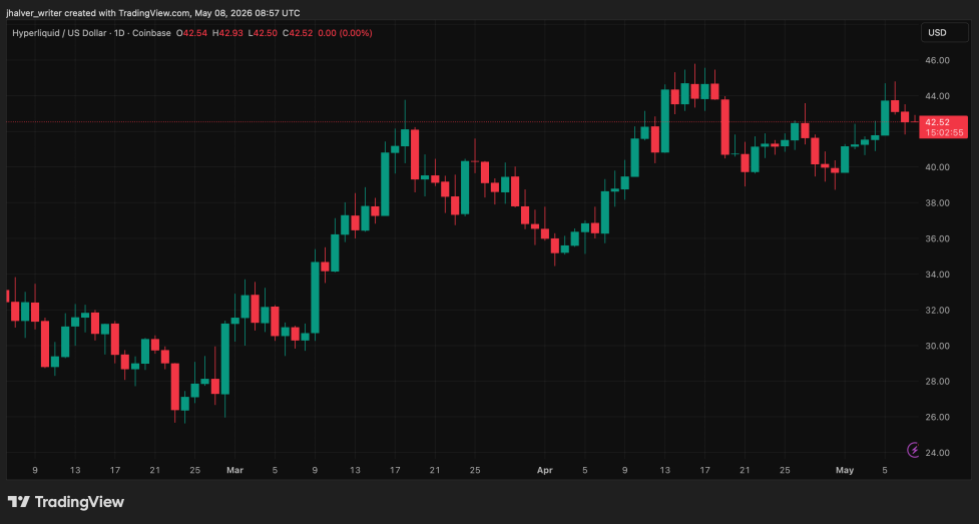
HYPE's price trends to the upside on the daily chart. Source: HYPEUSD on Tradingview

The Night Hyperliquid Became The Oil Market

On February 28, following US-Israeli strikes on Iran, traditional commodity exchanges went dark. Hyperliquid’s 24/7 oil perpetual derivatives markets stayed open. The protocol became what the report describes as the de facto price discovery venue for crude oil while legacy infrastructure sat offline — an event that drew coverage from Bloomberg, the Wall Street Journal, and Fortune within a five-day window, according to the report.

That single session, the HRC notes, said more about Hyperliquid’s institutional trajectory than any quarterly metric.

The Number That Matters: HIP-3

Beneath the headline revenue decline, a structural transformation was underway. Native crypto perpetual derivatives volume fell 32.5% as risk appetite contracted. HIP-3 deployer volume — a protocol feature enabling third parties to deploy real-world asset (RWA) perpetual derivatives on Hyperliquid’s infrastructure — moved in the opposite direction entirely, growing from $24.9 billion in January to $68.5 billion in March, a 175% intra-quarter expansion, per ASXN data cited in the report.

By March, HIP-3 represented 33.6% of total daily perpetual derivatives volume and 28.7% of total platform open interest. Daily unique HIP-3 traders tripled within the quarter, reaching 40,768 on the final day. Silver was the single most traded asset at $40.7 billion in Q1 volume, exceeding crude oil by approximately 2.4x.

The quarter’s institutional landmark arrived on March 18, when S&P Dow Jones Indices officially licensed its S&P 500 benchmark to Trade[XYZ] for perpetual contracts on Hyperliquid — the first officially sanctioned equity index perpetual derivatives product on a decentralized exchange. The contract reached $2 billion in volume within its first two weeks, according to the report.

The Supply Side Signal

On the token side, Hyperliquid’s Assistance Fund purchased approximately 4.94 million HYPE at an average price of $29.90 during Q1 — 18.8% below the quarter-end price of $36.85 — deploying $147.72 million into buybacks. HYPE itself returned +44.8% for the quarter, per CoinGecko data cited in the report.

The report flags an additional signal that it describes as a character disclosure rather than a financial metric. The protocol’s core team claimed just 1.51 million HYPE against a scheduled entitlement of approximately 29.8 million — a 5.1% claim rate, declining each month throughout the quarter. At average Q1 prices, the team voluntarily left approximately $849 million unclaimed.

Four separate ETF filings for HYPE — from Grayscale, VanEck, 21Shares, and Bitwise — were submitted during the quarter, per the report.

The Worst Crypto Quarter Since 2018

The report does not sidestep the primary constraint: US persons cannot access Hyperliquid’s frontend. Every revenue figure, every volume number, and every user count in the report reflects a protocol generating these results without US market participation. The HRC frames every forward valuation of HYPE as, in part, a thesis on whether that regulatory wall eventually comes down.

The Q1 2026 report marks a critical juncture for Hyperliquid’s positioning within the nascent sector. A decentralized exchange that processed live commodity trades while legacy markets were closed, licensed the S&P 500 for on-chain derivatives, and outperformed Bitcoin by 71 percentage points in the worst crypto quarter in eight years is no longer a DeFi story. It is increasingly a financial infrastructure story — and the institutions are beginning to take notice.

On the above, David Schamis, CEO at Hyperliquid Strategies stated the following:

For a year I’ve been saying Hyperliquid is emerging as the most exciting trading venue, period. Q1 settled the argument. One of the worst crypto quarters since 2018 and the protocol still generated more than $200M in revenue, bought back >5M HYPE, brought the S&P 500 onto a decentralized exchange and became the price of oil when legacy markets were closed for the Iran conflict. This isn’ t a future story anymore — it’s all happening now.

Cover image from Grok, BTCUSD chart on Tradingview

Связанные с этим вопросы

QAccording to the Hyperliquid Research Collective report, by what percentage did Hyperliquid's native token HYPE outperform Bitcoin in Q1 2026?

AHyperliquid's native token HYPE outperformed Bitcoin by 71.5 percentage points in Q1 2026. HYPE returned +44.8% for the quarter while Bitcoin fell 26.7%.

QWhat specific event on February 28, 2026, demonstrated Hyperliquid's institutional relevance, as described in the report?

AOn February 28, 2026, following US-Israeli strikes on Iran, traditional commodity exchanges closed. Hyperliquid's 24/7 oil perpetual derivatives markets remained open, becoming the de facto global price discovery venue for crude oil while legacy infrastructure was offline.

QWhat was the key driver (HIP-3 volume) behind Hyperliquid's structural transformation in Q1 2026, and how much did it grow?

AThe key driver was HIP-3 deployer volume, which enables third parties to deploy real-world asset (RWA) perpetual derivatives. It grew from $24.9 billion in January to $68.5 billion in March, a 175% intra-quarter expansion.

QWhat major institutional milestone for decentralized exchanges did Hyperliquid achieve on March 18, 2026?

AOn March 18, 2026, S&P Dow Jones Indices officially licensed its S&P 500 benchmark to Trade[XYZ] for perpetual contracts on Hyperliquid. This was the first officially sanctioned equity index perpetual derivatives product on a decentralized exchange.

QWhat significant constraint does the report highlight regarding Hyperliquid's current operations and revenue generation?

AThe report highlights that US persons cannot access Hyperliquid's frontend. All revenue, volume, and user counts were generated without US market participation, framing forward valuations as partly a thesis on whether this regulatory barrier eventually comes down.

Похожее

Berkshire Hathaway and SoftBank: One Must Die

"Berkshire Hathaway vs. SoftBank: One Must 'Die'" In May 2026, with half-empty seats at its annual meeting, Berkshire Hathaway, under new CEO Greg Abel, faces investor pressure over its massive $397.4 billion cash pile—nearly 40% of its market cap. This hoard, largely in US Treasuries, resulted from 14 consecutive quarters of net equity sales, including massive Apple divestments. Abel inherits Buffett's "nothing looks attractive" stance in an expensive market likened to "a casino next to a church." However, Berkshire's significant underperformance versus the S&P 500 and a future of sustained high valuations could force a historic choice: returning capital via special dividends or breaking up the conglomerate. Berkshire's "death" would be a slow, existential one—the erosion of its value-investing identity post-Buffett. Conversely, SoftBank, led by Masayoshi Son, is in a frantic race against debt. It has pledged a staggering $64.6 billion for a 13% stake in OpenAI, financed by escalating parent-company debt (over ¥16.3 trillion), a historic $40 billion bridge loan, and the fire-sale of assets like Nvidia, T-Mobile, and Alibaba shares. The plan hinges on a successful OpenAI IPO and the $100 billion listing of its Roze AI unit to refinance. Son's high-wire act faces three correlated triggers for potential collapse: an OpenAI IPO delay or stumble, a sharp de-rating of its key liquid asset Arm (trading at 70x forward P/E), or a failure to refinance the massive 2027 bridge loan at increasingly costly rates. The conclusion: One philosophy must "die." In a prolonged bull market, SoftBank could triumph, realizing Son's AI vision, while Berkshire's conservative model fades into irrelevance. In a downturn, SoftBank's leveraged bet could unravel violently, while Berkshire's fortress balance sheet survives. Their fates are inversely tied to the market cycle's turn.

marsbit4 ч. назад

Berkshire Hathaway and SoftBank: One Must Die

marsbit4 ч. назад

Coinbase Q1 Earnings Report: Nearly $4 Billion Loss, Trading Volume Halved. Can AI + RWA Turn Things Around?

Coinbase's Q1 2026 earnings report revealed a net loss of $394 million, largely driven by $482 million in unrealized losses on its crypto asset holdings. Total revenue fell 31% year-over-year to $1.41 billion. Transaction revenue declined 40% to $756 million, reflecting a market-wide slump in crypto trading volumes. Consumer trading was particularly weak, down 48%, though Coinbase's global spot market share rose to a record 8.6%. Key bright spots included institutional trading revenue, which grew 37%, and a surge in derivatives activity following the Deribit acquisition. Subscription and services revenue of $584 million was more resilient, with stablecoin revenue up 11% to $305 million. Adjusted EBITDA remained positive at $303 million. Ahead of earnings, Coinbase announced a 14% workforce reduction (~700 employees) to accelerate its transition to an "AI-native" organizational model. Strategically, the company is pursuing its "Everything Exchange" vision, expanding into derivatives and predictive markets. Its partnership with Circle on USDC remains a core revenue moat, with over 25% of the stablecoin's $80 billion supply held on its platform. The company is actively engaged in shaping stablecoin legislation like the CLARITY Act. Despite significant losses and cyclical pressures, Coinbase is positioning itself as a broader on-chain financial infrastructure provider.

链捕手4 ч. назад

Coinbase Q1 Earnings Report: Nearly $4 Billion Loss, Trading Volume Halved. Can AI + RWA Turn Things Around?

链捕手4 ч. назад

Торговля

Спот
Фьючерсы

Популярные статьи

Тест по Bitcoin Биткоина

HTX Learn: Изучите Bitcoin halving и Заработаете Токены USDT

3.0k просмотров всегоОпубликовано 2024.04.16Обновлено 2024.04.16

Тест по Bitcoin  Биткоина

Что такое $BITCOIN

ЦИФРОВОЕ ЗОЛОТО ($BITCOIN): Комплексный анализ Введение в ЦИФРОВОЕ ЗОЛОТО ($BITCOIN) ЦИФРОВОЕ ЗОЛОТО ($BITCOIN) — это проект на основе блокчейна, работающий в сети Solana, который стремится объединить характеристики традиционных драгоценных металлов с инновациями децентрализованных технологий. Хотя он носит имя Биткойн, часто называемого “цифровым золотом” из-за его восприятия как средства хранения ценности, ЦИФРОВОЕ ЗОЛОТО является отдельным токеном, предназначенным для создания уникальной экосистемы в ландшафте Web3. Его цель — позиционировать себя как жизнеспособный альтернативный цифровой актив, хотя детали его применения и функциональности все еще развиваются. Что такое ЦИФРОВОЕ ЗОЛОТО ($BITCOIN)? ЦИФРОВОЕ ЗОЛОТО ($BITCOIN) — это токен криптовалюты, специально разработанный для использования в блокчейне Solana. В отличие от Биткойна, который выполняет широко признанную роль хранения ценности, этот токен, похоже, сосредоточен на более широких приложениях и характеристиках. Примечательные аспекты включают: Инфраструктура блокчейна: Токен построен на блокчейне Solana, известном своей способностью обрабатывать высокоскоростные и недорогие транзакции. Динамика предложения: ЦИФРОВОЕ ЗОЛОТО имеет максимальное предложение, ограниченное 100 квадриллионами токенов (100P $BITCOIN), хотя детали о его обращающемся предложении в настоящее время не раскрыты. Утилита: Хотя точные функциональные возможности не описаны, есть указания на то, что токен может быть использован для различных приложений, потенциально связанных с децентрализованными приложениями (dApps) или стратегиями токенизации активов. Кто создатель ЦИФРОВОГО ЗОЛОТА ($BITCOIN)? На данный момент личность создателей и команды разработчиков, стоящих за ЦИФРОВЫМ ЗОЛОТОМ ($BITCOIN), остается неизвестной. Эта ситуация типична для многих инновационных проектов в области блокчейна, особенно тех, которые связаны с децентрализованными финансами и феноменом мем-криптовалют. Хотя такая анонимность может способствовать культуре, ориентированной на сообщество, она усиливает опасения по поводу управления и ответственности. Кто инвесторы ЦИФРОВОГО ЗОЛОТА ($BITCOIN)? Доступная информация указывает на то, что у ЦИФРОВОГО ЗОЛОТА ($BITCOIN) нет известных институциональных спонсоров или значительных венчурных капиталовложений. Проект, похоже, функционирует по модели пирингового взаимодействия, сосредоточенной на поддержке и принятии сообществом, а не на традиционных путях финансирования. Его активность и ликвидность в основном сосредоточены на децентрализованных биржах (DEX), таких как PumpSwap, а не на устоявшихся централизованных торговых платформах, что еще больше подчеркивает его подход, ориентированный на grassroots. Как работает ЦИФРОВОЕ ЗОЛОТО ($BITCOIN) Операционные механизмы ЦИФРОВОГО ЗОЛОТА ($BITCOIN) можно подробно описать на основе его дизайна блокчейна и характеристик сети: Механизм консенсуса: Используя уникальный механизм доказательства истории (PoH) Solana в сочетании с моделью доказательства доли (PoS), проект обеспечивает эффективную валидацию транзакций, что способствует высокой производительности сети. Токеномика: Хотя конкретные дефляционные механизмы не были подробно описаны, большое максимальное предложение токенов подразумевает, что оно может быть предназначено для микротранзакций или нишевых случаев использования, которые еще предстоит определить. Интероперабельность: Существует потенциал для интеграции с более широкой экосистемой Solana, включая различные платформы децентрализованных финансов (DeFi). Однако детали относительно конкретных интеграций остаются неуточненными. Хронология ключевых событий Вот хронология, которая подчеркивает значимые вехи, касающиеся ЦИФРОВОГО ЗОЛОТА ($BITCOIN): 2023: Первоначальное развертывание токена происходит в блокчейне Solana, отмеченное его адресом контракта. 2024: ЦИФРОВОЕ ЗОЛОТО приобретает видимость, когда оно становится доступным для торговли на децентрализованных биржах, таких как PumpSwap, позволяя пользователям обменивать его на SOL. 2025: Проект наблюдает спорадическую торговую активность и потенциальный интерес к инициативам, возглавляемым сообществом, хотя на данный момент не зафиксировано никаких значительных партнерств или технических достижений. Критический анализ Сильные стороны Масштабируемость: Основная инфраструктура Solana поддерживает высокие объемы транзакций, что может повысить полезность $BITCOIN в различных сценариях транзакций. Доступность: Потенциально низкая цена торговли за токен может привлечь розничных инвесторов, способствуя более широкому участию благодаря возможностям дробного владения. Риски Отсутствие прозрачности: Отсутствие публично известных спонсоров, разработчиков или процесса аудита может вызвать скептицизм относительно устойчивости и надежности проекта. Волатильность рынка: Торговая активность сильно зависит от спекулятивного поведения, что может привести к значительной волатильности цен и неопределенности для инвесторов. Заключение ЦИФРОВОЕ ЗОЛОТО ($BITCOIN) является интригующим, но неоднозначным проектом в быстро развивающейся экосистеме Solana. Хотя он пытается использовать нарратив “цифрового золота”, его отход от установленной роли Биткойна как средства хранения ценности подчеркивает необходимость более четкого различения его предполагаемой утилиты и структуры управления. Будущее принятие и усвоение, вероятно, будут зависеть от решения текущей непрозрачности и более четкого определения его операционных и экономических стратегий. Примечание: Этот отчет охватывает синтезированную информацию, доступную на октябрь 2023 года, и с тех пор могут произойти события.

99 просмотров всегоОпубликовано 2025.05.13Обновлено 2025.05.13

Что такое $BITCOIN

Fractal Bitcoin: масштабирование Биткоина с помощью рекурсивной системы

Fractal Bitcoin — масштабное Layer-1-решнение, созданное на базе кода Биткоина, позволяющего достигать бесконечного масштабирования с помощью рекурсивного подхода.

2.2k просмотров всегоОпубликовано 2025.06.30Обновлено 2025.06.30

Fractal Bitcoin: масштабирование Биткоина с помощью рекурсивной системы

Обсуждения

Добро пожаловать в Сообщество HTX. Здесь вы сможете быть в курсе последних новостей о развитии платформы и получить доступ к профессиональной аналитической информации о рынке. Мнения пользователей о цене на BTC (BTC) представлены ниже.

活动图片