Bitcoin Miners Are Coming Back—Hashrate Jumps 12.5% From March Lows

bitcoinistОпубликовано 2026-03-31Обновлено 2026-03-31

Введение

On-chain data shows the Bitcoin mining hashrate has increased by 12.5% since its March 19 low of 920.8 EH/s, reaching 1,036.6 EH/s. This recovery suggests miners are returning to the network, contradicting earlier speculation that a shift toward AI and data center businesses was causing a permanent decline. The rebound occurred despite Bitcoin's price consolidation around $67,600 and a recent reversal in ETF flows, with US spot Bitcoin ETFs experiencing $296 million in outflows last week after four consecutive weeks of inflows. The hashrate has not yet fully recovered to its March 1 peak of 1,083.9 EH/s, but the current trajectory indicates a potential full recovery if the trend continues.

On-chain data shows the Bitcoin mining Hashrate has seen a notable jump since the mid-March lows, a sign that miners have been coming back.

Bitcoin Hashrate Has Retraced Much Of The Earlier Decline

The “Hashrate” refers to an indicator that keeps track of the total amount of computing power that miners have connected to the network. It’s measured in terms of hashes per second (H/s), or more practically, in exahashes per second (EH/s). This metric can serve as a proxy for the sentiment among miners; its value going up can imply the chain validators are finding the network profitable to mine on, while its value going down can suggest this cohort is leaving the chain for now

As the chart below from Blockchain.com shows, the 7-day average value of the Bitcoin Hashrate witnessed a drawdown during the first half of March.
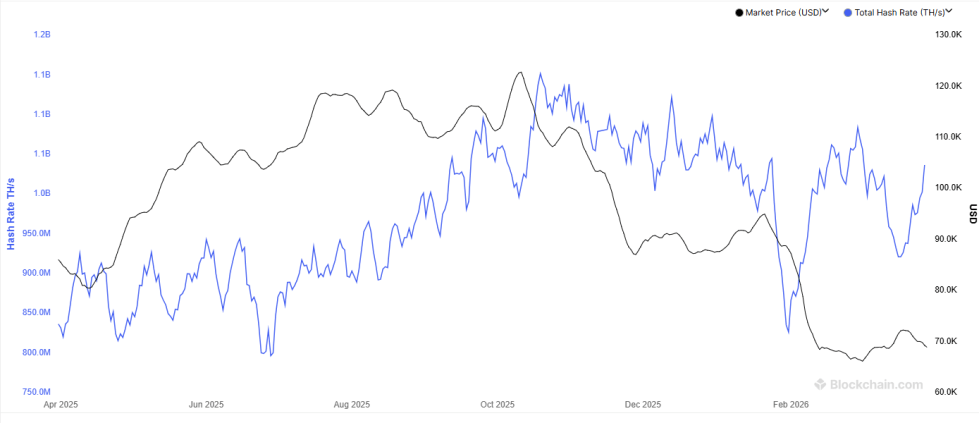
Looks like the value of the metric has shot up in recent days | Source: Blockchain.com

Interestingly, this drop in the metric came alongside a recovery surge in BTC’s spot price. Often, miners tend to follow the cryptocurrency’s value as their revenue directly correlates with it. This time, however, the two showed a divergence.

Some speculated that the decline may be due to a shift that the mining industry has been observing recently, with many big public mining companies choosing to focus on the emerging AI/datacenter business. Since bottoming at 920.8 EH/s on March 19th, however, the Hashrate has made significant recovery, raising doubts about the theory.

Today, the 7-day average value of the Hashrate is sitting at 1,036.6 EH/s, which is about 12.5% up from the low seen earlier in the month. The metric is still not quite back at the 1,083.9 EH/s top from March 1st, but if the recent trajectory continues, it’s possible that a full recovery could happen.

It only remains to be seen, though, how the Hashrate will develop in the near future, considering the consolidation phase that Bitcoin has been stuck in during the war uncertainty and miners making a push toward AI.

In some other news, the Bitcoin spot exchange-traded funds (ETFs) were observing a streak of positive netflows earlier, but the latest week has broken the trend, according to data from SoSoValue.
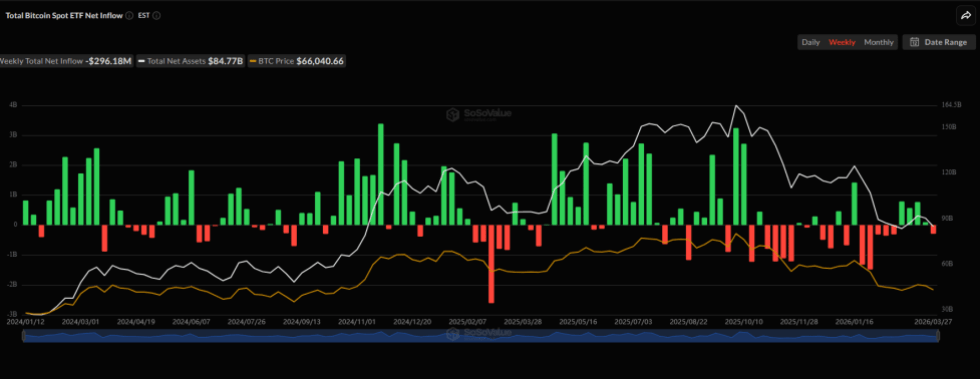
The data for the weekly netflows for US BTC spot ETFs over their history | Source: SoSoValue

As displayed in the above graph, the US Bitcoin spot ETFs saw net inflows for four straight weeks before the latest one, implying demand was pouring into the cryptocurrency via these funds. Last week, however, the trend reversed as over $296 million in capital left the vehicles instead.

BTC Price

At the time of writing, Bitcoin is trading around $67,600, down nearly 5% over the past week.

The trend in the price of the coin over the last five days | Source: BTCUSDT on TradingView


Связанные с этим вопросы

QWhat is the Bitcoin Hashrate and what does it indicate about miner sentiment?

AThe Bitcoin Hashrate is an indicator that tracks the total amount of computing power miners have connected to the network, measured in exahashes per second (EH/s). It serves as a proxy for miner sentiment; an increase suggests miners find the network profitable, while a decrease indicates they may be leaving.

QHow much has the 7-day average Bitcoin Hashrate increased from its March low?

AThe 7-day average Bitcoin Hashrate has increased by 12.5%, rising from a low of 920.8 EH/s on March 19th to 1,036.6 EH/s.

QWhat was the unusual trend observed between Bitcoin's price and hashrate in early March?

AIn early March, the Bitcoin Hashrate experienced a drawdown while the spot price of BTC was simultaneously undergoing a recovery surge. This was a divergence from the typical pattern where miners tend to follow the cryptocurrency's value.

QWhat recent trend was broken for US Bitcoin spot ETFs according to the latest data?

AThe recent streak of four consecutive weeks of positive net inflows for US Bitcoin spot ETFs was broken last week, with over $296 million in capital leaving the funds instead.

QWhat is the current price of Bitcoin and its weekly performance mentioned in the article?

AAt the time of writing, Bitcoin is trading around $67,600, which is down nearly 5% over the past week.

Похожее

Blockchain Games Defeated by Reality, Web3 Doesn't Believe in Dreams

The article "Chain Games Succumb to Reality, Web3 Doesn't Believe in Dreams" discusses the significant downturn in the perceived failure of blockchain gaming. It begins with Solana Foundation President Lily Liu declaring that "blockchain games are dead," a sentiment echoed by Meta's abandonment of its metaverse vision after an $80 billion investment, which shared core concepts with Web3 gaming like virtual worlds and digital asset ownership. Numerous high-profile blockchain games have shut down recently. Examples include "Pirate Nation," which closed after raising $33 million, and others like "Ember Sword," "Nyan Heroes," and "Symbiogenesis," all ceasing operations due to funding shortages or failed token economies. Even well-funded projects like "Wildcard," backed by $46 million from Paradigm, saw their tokens crash shortly after launch. A central issue is misaligned incentives: Web3 games were often funded by investors seeking returns, not players seeking quality gameplay. This led to capital structures driven by speculation rather than sustainable user engagement. Many studios, like Oxalis Games with "Moonfrost," eventually abandoned blockchain elements to release traditional games on platforms like Steam, leaving early investors and NFT holders with losses. Industry reports note a dramatic drop in investment, from peaks of $10 billion in 2022 to just $293 million in 2025, with scams and loss of trust becoming major concerns. Despite the downturn, some industry leaders remain optimistic. They argue for a reset focused on making blockchain invisible to users, prioritizing player retention metrics (like D1, D7, D30 rates) over token prices, using stablecoins for payments to reduce volatility, and leveraging AI to lower development costs. The consensus is that successful games must first meet traditional quality standards, with blockchain providing underlying utility like true asset ownership and open economies—not driving the core experience. The cycle of fundraise, token launch, and collapse may be ending, making way for more sustainable models.

marsbit4 мин. назад

Blockchain Games Defeated by Reality, Web3 Doesn't Believe in Dreams

marsbit4 мин. назад

Торговля

Спот
Фьючерсы

Популярные статьи

Тест по Bitcoin Биткоина

HTX Learn: Изучите Bitcoin halving и Заработаете Токены USDT

2.9k просмотров всегоОпубликовано 2024.04.16Обновлено 2024.04.16

Тест по Bitcoin  Биткоина

Что такое $BITCOIN

ЦИФРОВОЕ ЗОЛОТО ($BITCOIN): Комплексный анализ Введение в ЦИФРОВОЕ ЗОЛОТО ($BITCOIN) ЦИФРОВОЕ ЗОЛОТО ($BITCOIN) — это проект на основе блокчейна, работающий в сети Solana, который стремится объединить характеристики традиционных драгоценных металлов с инновациями децентрализованных технологий. Хотя он носит имя Биткойн, часто называемого “цифровым золотом” из-за его восприятия как средства хранения ценности, ЦИФРОВОЕ ЗОЛОТО является отдельным токеном, предназначенным для создания уникальной экосистемы в ландшафте Web3. Его цель — позиционировать себя как жизнеспособный альтернативный цифровой актив, хотя детали его применения и функциональности все еще развиваются. Что такое ЦИФРОВОЕ ЗОЛОТО ($BITCOIN)? ЦИФРОВОЕ ЗОЛОТО ($BITCOIN) — это токен криптовалюты, специально разработанный для использования в блокчейне Solana. В отличие от Биткойна, который выполняет широко признанную роль хранения ценности, этот токен, похоже, сосредоточен на более широких приложениях и характеристиках. Примечательные аспекты включают: Инфраструктура блокчейна: Токен построен на блокчейне Solana, известном своей способностью обрабатывать высокоскоростные и недорогие транзакции. Динамика предложения: ЦИФРОВОЕ ЗОЛОТО имеет максимальное предложение, ограниченное 100 квадриллионами токенов (100P $BITCOIN), хотя детали о его обращающемся предложении в настоящее время не раскрыты. Утилита: Хотя точные функциональные возможности не описаны, есть указания на то, что токен может быть использован для различных приложений, потенциально связанных с децентрализованными приложениями (dApps) или стратегиями токенизации активов. Кто создатель ЦИФРОВОГО ЗОЛОТА ($BITCOIN)? На данный момент личность создателей и команды разработчиков, стоящих за ЦИФРОВЫМ ЗОЛОТОМ ($BITCOIN), остается неизвестной. Эта ситуация типична для многих инновационных проектов в области блокчейна, особенно тех, которые связаны с децентрализованными финансами и феноменом мем-криптовалют. Хотя такая анонимность может способствовать культуре, ориентированной на сообщество, она усиливает опасения по поводу управления и ответственности. Кто инвесторы ЦИФРОВОГО ЗОЛОТА ($BITCOIN)? Доступная информация указывает на то, что у ЦИФРОВОГО ЗОЛОТА ($BITCOIN) нет известных институциональных спонсоров или значительных венчурных капиталовложений. Проект, похоже, функционирует по модели пирингового взаимодействия, сосредоточенной на поддержке и принятии сообществом, а не на традиционных путях финансирования. Его активность и ликвидность в основном сосредоточены на децентрализованных биржах (DEX), таких как PumpSwap, а не на устоявшихся централизованных торговых платформах, что еще больше подчеркивает его подход, ориентированный на grassroots. Как работает ЦИФРОВОЕ ЗОЛОТО ($BITCOIN) Операционные механизмы ЦИФРОВОГО ЗОЛОТА ($BITCOIN) можно подробно описать на основе его дизайна блокчейна и характеристик сети: Механизм консенсуса: Используя уникальный механизм доказательства истории (PoH) Solana в сочетании с моделью доказательства доли (PoS), проект обеспечивает эффективную валидацию транзакций, что способствует высокой производительности сети. Токеномика: Хотя конкретные дефляционные механизмы не были подробно описаны, большое максимальное предложение токенов подразумевает, что оно может быть предназначено для микротранзакций или нишевых случаев использования, которые еще предстоит определить. Интероперабельность: Существует потенциал для интеграции с более широкой экосистемой Solana, включая различные платформы децентрализованных финансов (DeFi). Однако детали относительно конкретных интеграций остаются неуточненными. Хронология ключевых событий Вот хронология, которая подчеркивает значимые вехи, касающиеся ЦИФРОВОГО ЗОЛОТА ($BITCOIN): 2023: Первоначальное развертывание токена происходит в блокчейне Solana, отмеченное его адресом контракта. 2024: ЦИФРОВОЕ ЗОЛОТО приобретает видимость, когда оно становится доступным для торговли на децентрализованных биржах, таких как PumpSwap, позволяя пользователям обменивать его на SOL. 2025: Проект наблюдает спорадическую торговую активность и потенциальный интерес к инициативам, возглавляемым сообществом, хотя на данный момент не зафиксировано никаких значительных партнерств или технических достижений. Критический анализ Сильные стороны Масштабируемость: Основная инфраструктура Solana поддерживает высокие объемы транзакций, что может повысить полезность $BITCOIN в различных сценариях транзакций. Доступность: Потенциально низкая цена торговли за токен может привлечь розничных инвесторов, способствуя более широкому участию благодаря возможностям дробного владения. Риски Отсутствие прозрачности: Отсутствие публично известных спонсоров, разработчиков или процесса аудита может вызвать скептицизм относительно устойчивости и надежности проекта. Волатильность рынка: Торговая активность сильно зависит от спекулятивного поведения, что может привести к значительной волатильности цен и неопределенности для инвесторов. Заключение ЦИФРОВОЕ ЗОЛОТО ($BITCOIN) является интригующим, но неоднозначным проектом в быстро развивающейся экосистеме Solana. Хотя он пытается использовать нарратив “цифрового золота”, его отход от установленной роли Биткойна как средства хранения ценности подчеркивает необходимость более четкого различения его предполагаемой утилиты и структуры управления. Будущее принятие и усвоение, вероятно, будут зависеть от решения текущей непрозрачности и более четкого определения его операционных и экономических стратегий. Примечание: Этот отчет охватывает синтезированную информацию, доступную на октябрь 2023 года, и с тех пор могут произойти события.

99 просмотров всегоОпубликовано 2025.05.13Обновлено 2025.05.13

Что такое $BITCOIN

Fractal Bitcoin: масштабирование Биткоина с помощью рекурсивной системы

Fractal Bitcoin — масштабное Layer-1-решнение, созданное на базе кода Биткоина, позволяющего достигать бесконечного масштабирования с помощью рекурсивного подхода.

2.1k просмотров всегоОпубликовано 2025.06.30Обновлено 2025.06.30

Fractal Bitcoin: масштабирование Биткоина с помощью рекурсивной системы

Обсуждения

Добро пожаловать в Сообщество HTX. Здесь вы сможете быть в курсе последних новостей о развитии платформы и получить доступ к профессиональной аналитической информации о рынке. Мнения пользователей о цене на BTC (BTC) представлены ниже.

活动图片