Three Scenarios for BTC's Future Direction and a Duel Between Two Strong Forces | Special Invited Analysis

Odaily星球日报Опубликовано 2026-05-12Обновлено 2026-05-12

Введение

**Title: Three Scenarios for BTC's Future Trajectory and a Key Duel | Invited Analysis** The market remains at a critical juncture. Over the past week, Bitcoin (BTC) consolidated broadly between $79,500 and $80,600, validating previous technical analysis. The current focus is on whether this marks the start of a new uptrend or a pause within a larger correction. **BTC Multi-Cycle Analysis & Three Possible Scenarios** BTC's daily chart structure, following its peak at $126,200 in October 2025, presents three primary technical scenarios based on Elliott Wave theory: 1. **Bullish Scenario (End of Correction):** The corrective A-B-C wave from $126,200 ended at the $60,000 low in February 2026. The current price action is the start of a major Wave I uptrend. A subsequent Wave II pullback would not break below $60,000. 2. **Bearish Scenario 1 (Complex Correction):** The correction is unfolding as an A-B-C-D-E pattern. The current move from $60,000 is a D-wave rally. After its completion, a final E-wave decline could potentially breach the $60,000 level. 3. **Bearish Scenario 2 (Larger Correction):** The entire move down from $126,200 to $60,000 was a large A-wave. The current rally is a B-wave correction within a larger A-B-C structure, to be followed by a C-wave decline below $60,000. *Analysis suggests Scenario 2 is less probable due to time disproportions between waves. The battle is effectively between the Bullish Scenario (1) and Bearish Scenario (3).* **Key BTC Levels &...

The market never lies; it simply remains silent.

When prices linger in critical zones, both bulls and bears are waiting for an answer.

Over the past week, Bitcoin completed the wide-range oscillation we previously predicted within the core zone of $79,500 to $80,600. The market's price action has validated the effectiveness of our technical logic. However, validation is merely the starting point; the real game begins this week.

BTC's daily chart correction structure stands at a crossroads with three diverging paths: Is it the starting point of a new rising wave, or a midpoint in a larger-scale correction? Wave analysis can provide a framework, but the market ultimately votes with its price. Regarding HYPE, its seven-wave structure is clearly discernible. Whether it can break through the key level around $45.76 will become the variable most worth watching closely this week.

In this week's article, we will continue to approach from a multi-timeframe perspective, analyzing the structure, judging the direction, and formulating plans. Strategy is ready; discipline is self-held.

Summary of Core Trading Views for This Week:

• Analysis of BTC's Multi-Timeframe Price Structure (Detailed in Part One)
• BTC Market Forecast and Mid-/Short-Term Trading Strategies for This Week. (Detailed in Part Two)
• Analysis of HYPE's Daily Chart Price Structure. (Detailed in Part Three)
• HYPE Market Forecast and Short-Term Trading Strategies for This Week. (Detailed in Part Four)

Market Validation of Last Week's Trading Strategy and Core Views:

• Validation of BTC Market Forecast: In last week's article, we pointed out that we should focus on observing the battle between bulls and bears over the core zone of $79,500 to $80,600 and judged that the market was likely to experience wide-range oscillation there. Current market movements have largely validated our previous view.

One: Analysis of Bitcoin's Multi-Timeframe Price Structure

1. Analysis of BTC's Daily Chart Price Structure: (Three Scenarios for BTC's Subsequent Wave Structure)

Bitcoin _ Daily Candlestick Chart:
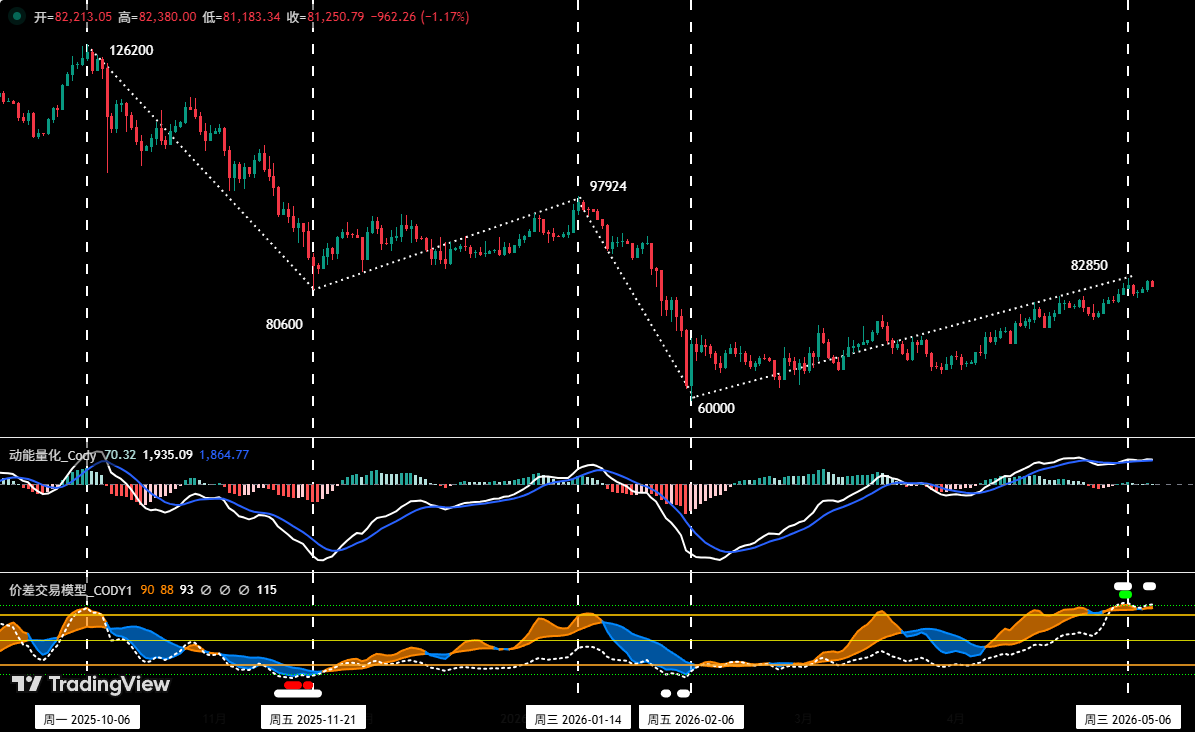
Chart One

As shown in (Chart One), since reaching the high of $126,200 in October 2025, Bitcoin has entered an adjustment cycle lasting about 7 months (216 days). There is significant divergence in the market regarding the subsequent direction. The bearish view argues that the downtrend is not over yet; after the recent rebound concludes, the price will still correct and break below the $60,000 low. The bullish view believes that the adjustment starting from $126,200 ended at $60,000, marking a reversal of the correction trend. The rebound since February is the start of a new upward trend. Next, we will analyze this daily chart correction structure based on Elliott Wave Theory rules and propose three technical scenarios for the subsequent movement for your reference.

1. Scenario One: Adjustment Concluded, New Rising Wave Initiated (Bullish View)

This view holds: The daily-level adjustment starting from the previous high of $126,200 is an A-B-C three-wave structure, with Wave C ending at $60,000. Currently, Major Wave I (the initial rising wave) is underway.

Wave A (Decline): $126,200 (2025-10-06) to $80,600 (2025-11-21), lasting 46 days, maximum decline ~36%.
Wave B (Rebound): $80,600 (2025-11-21) to $97,924 (2026-01-14), lasting 54 days, maximum increase ~21.5%.
Wave C (Decline): $97,924 (2026-01-14) to $60,000 (2026-02-06), lasting 23 days, maximum decline ~38.7%.
• Major Wave I (Initial Rising Wave): $60,000 (2026-02-06) to present, has run for 94 days, maximum increase ~38.1% so far, still ongoing.
• Potential Major Wave II (Correction Wave): The adjustment wave to run after Major Wave I ends. Its low point will not break below $60,000.

2. Scenario Two: Complex Five-Wave Adjustment Structure, Currently in Wave D Rebound (Bearish View One)

This view holds: The daily-level adjustment starting from the previous high of $126,200 may complete as an A-B-C-D-E five-wave structure. Currently, Wave D rebound is underway.

Wave A (Decline): $126,200 (2025-10-06) to $80,600 (2025-11-21), lasting 46 days, maximum decline ~36%.
Wave B (Rebound): $80,600 (2025-11-21) to $97,924 (2026-01-14), lasting 54 days, maximum increase ~21.5%.
Wave C (Decline): $97,924 (2026-01-14) to $60,000 (2026-02-06), lasting 23 days, maximum decline ~38.7%.
• Wave D (Rebound Wave): $60,000 (2026-02-06) to present, has run for 94 days, maximum increase ~38.1% so far, still ongoing.
• Potential Wave E (Decline Wave): The correction wave to run after Wave D rebound ends. Its low point may break below $60,000.

3. Scenario Three: Larger-Level Adjustment Structure (e.g., Weekly), Currently in Wave B Rebound (Bearish View Two)

This view holds: The daily-level adjustment starting from the previous high of $126,200 may be part of a larger-level A-B-C three-wave adjustment structure. Currently, Wave B rebound is underway.

Wave A (Decline): $126,200 (2025-10-06) to $60,000 (2026-02-06), lasting 112 days, maximum decline ~52.5%.
• Wave B (Rebound Wave): $60,000 (2026-02-06) to present, lasting 94 days, maximum increase ~38.1% so far, still ongoing.
• Potential Wave C (Decline Wave): The correction wave to run after Wave B rebound ends. Its low point may break below $60,000.

4. Summary:

• From the perspective of Elliott Wave time rules and pattern harmony, in Scenario Two, Waves B and D are rebound waves of the same degree. However, the current Wave D rebound cycle (94 days) has significantly exceeded the Wave B rebound cycle (54 days). Therefore, due to the excessive extension of Wave D in the time dimension, it disrupts the balance of the wave structure, thereby significantly reducing the probability of this scenario occurring.
• Based on the above analysis, if Scenario Two is excluded, the probability of the market choosing Scenario One (bullish) and Scenario Three (bearish) increases accordingly. As for which of the two has a higher probability, it involves a comprehensive judgment of multiple dimensions, which we will delve into in the next weekly review.

2. In-depth Analysis of BTC's Hourly Chart Structure: (Using the 4-hour chart as the analysis timeframe)

Bitcoin _ 4-hour Candlestick Chart
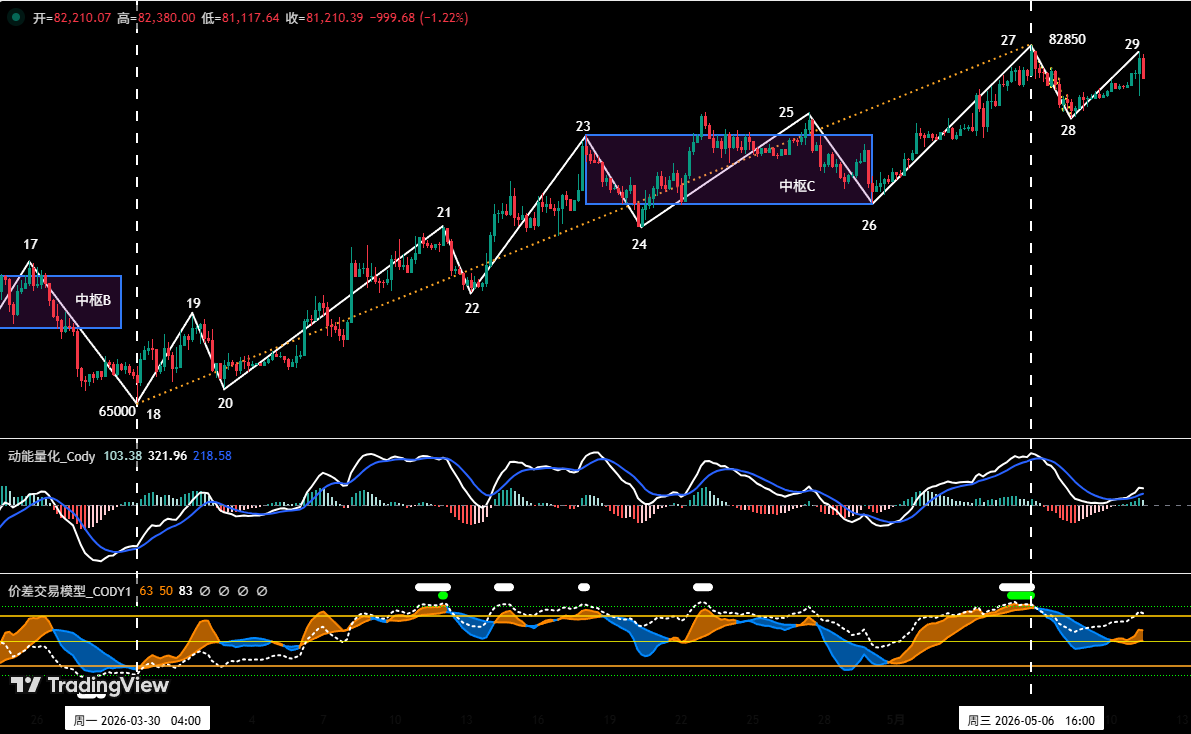
Chart Two

As shown in (Chart Two), the price is currently above central pivot C and is developing segment 28-29.

• If the price effectively holds support above the upper boundary of central pivot C (around $78,500), the high-range wide oscillation pattern will be maintained.
• If the price effectively breaks below the lower boundary of central pivot C (around $75,000), a daily-level correction may initiate.

Two: Bitcoin's Market Forecast and Trading Strategies for This Week

1. BTC Market Forecast for This Week:

Core view this week: The key to this week's movement lies in observing the battle between bulls and bears over the upper and lower boundaries of central pivot C. The gain or loss of this area can serve as an important basis for judging whether the price can continue its rebound or turn downward for adjustment.

2. Core Resistance Levels:

• First Resistance Zone: $83,500~$84,500 region (previous area of concentrated bulls/bears transactions)
• Second Resistance Zone: $89,000~$90,500 region (previous consolidation platform)

3. Core Support Levels:

• First Support Level: $78,500~$79,500 region (near the upper boundary of the central pivot)
• Second Support Level: $73,500~$75,000 region (previous important support level)
• Third Support Level: $69,500~$70,500 region (previous important support level)

4. Trading Strategies for This Week (Excluding Impact of Sudden News)

1. Mid-term Strategy:

Bitcoin _ Daily Candlestick Chart: (Position Monitoring Model)
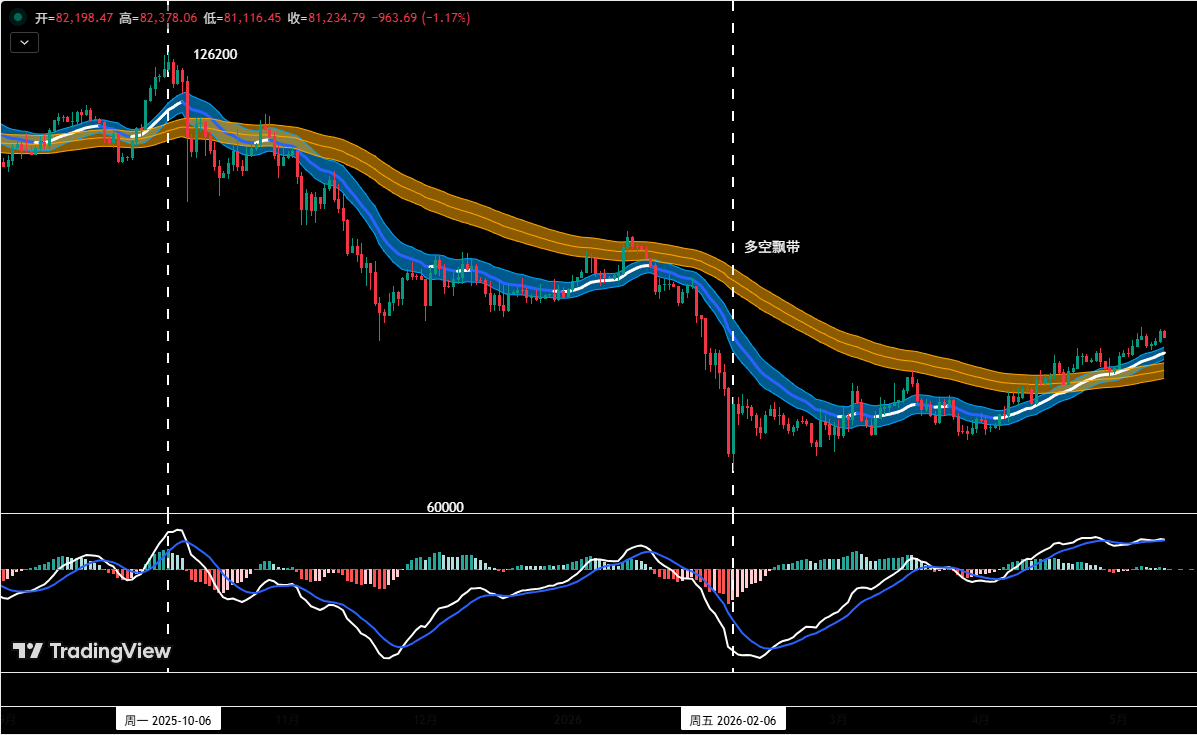
Chart Three

Position Monitoring Model: As shown in (Chart Three), based on trading rules, the market's mid-term direction is not yet clear. This week, the mid-term strategy is to maintain a cash position and wait patiently, avoiding chasing rallies or selling off in panic, until the direction becomes clear before entering positions.

2. Short-term Strategy: Use 30% of capital, set stop-loss points, and look for "price difference" opportunities based on support and resistance levels. (Use 30-minute/60-minute charts as the operation timeframe).

3. In short-term operations, to dynamically respond to the market's complex evolution, we have prepared two specific operation plans in advance, A/B.

Plan A: Effective Holding Above, Go Long on Dips.

• Entry: When the price effectively holds above the $78,500~$79,500 region and combines with bottom signals from the quantitative model, a long position below 20% can be established.
• Risk Control: Initial stop-loss set below $78,500.
• Exit: When rebounding near important resistance levels and combined with model signals, gradually close positions to take profits.

Plan B: Effective Break Below Support, Go Short on Rallies.

• Entry: When the price effectively breaks below the $73,500~$75,000 support region and combines with top signals from the model, a short position below 30% can be established.
• Risk Control: Initial stop-loss set above $76,500.
• Exit: When declining to important support levels and combined with model signals, gradually close positions to take profits.

Three: Analysis of HYPE's Daily Chart Price Structure:

HYPE_ Daily Candlestick Chart
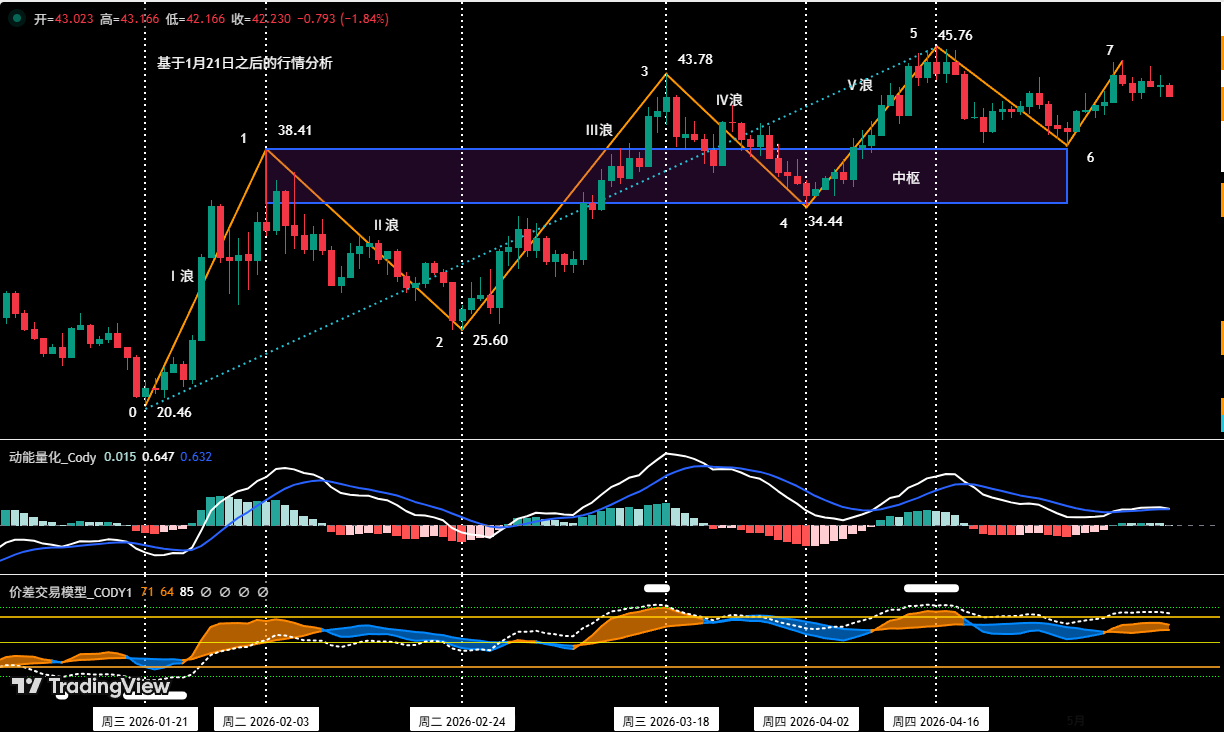
Chart Four

1. As shown in (Chart Four), the uptrend of HYPE starting from the low of $20.46 on January 21 can be divided into a seven-segment structure in the daily chart: 0-1, 1-2, 2-3, 3-4, 4-5, 5-6, 6-7. In the first five segments, prices continuously made new highs, forming a volatile rising structure. In the last two segments, because endpoint 7 ($44.79) is lower than endpoint 5 ($45.76), it is currently viewed as a correction structure.

2. (Chart Four) shows that because the price movements of segments 1-2, 2-3, and 3-4 overlap with each other, they together form an "uptrend central pivot."

Four: HYPE's Market Forecast and Short-Term Trading Strategies for This Week

1. HYPE Market Forecast for This Week:

Core view on HYPE this week:

• Focus on observing whether the price can break through the previous high of $45.76 in subsequent movements. A breakout would indicate the current movement is still within the daily-level uptrend structure.
• Pay attention to the battle between bulls and bears near the upper and lower boundaries of the central pivot.

2. HYPE Short-Term Trading Strategies for This Week:

• This week's short-term operations will be formulated based on the gain or loss of the two key price levels: the upper boundary of the central pivot ($38.41) and the lower boundary of the central pivot ($34.44).
• Long Strategy: If the price retraces to near $38.41, finds support, shows signs of stabilization, and combines with bottom signals triggered by the two major models, consider a light long position. Position size must be controlled below 30%, and stop-loss discipline must be strictly observed.
• Short Strategy: If the price effectively breaks below the support near $34.44 and combines with top signals triggered by the two major models, consider a light short position. Position size must be controlled below 30%, and stop-loss discipline must be strictly observed.

Five: Special Reminders:

1. When opening a position: Immediately set the initial stop-loss level.
2. When profit reaches 1%: Move the stop-loss to the entry cost price (breakeven point) to ensure capital safety.
3. When profit reaches 2%: Move the stop-loss to the level representing a 1% profit.
4. Continuous tracking: Thereafter, for every additional 1% profit in price, move the stop-loss up 1% accordingly, dynamically protecting and locking in profits.

Financial markets change rapidly. All market analysis and trading strategies require dynamic adjustment. All views, analysis models, and operation strategies mentioned in this article originate from personal technical analysis and are solely for personal trading log purposes. They do not constitute any investment advice or basis for operation. Markets involve risks; investing requires caution. Please do not make decisions based solely on this content.


Связанные с этим вопросы

QAccording to the article, what are the three technical wave-based scenarios for BTC's future trend after its correction cycle?

AThe three wave-based scenarios for BTC's future trend are: 1) Adjustment complete, new uptrend initiated (Bullish view - A-B-C correction finished, now in major Wave I up). 2) Complex five-wave correction structure, currently in Wave D rebound (Bearish view one - A-B-C-D-E structure, in Wave D). 3) Larger-degree (e.g., weekly) correction structure, currently in Wave B rebound (Bearish view two - larger A-B-C structure, in Wave B).

QWhy does the article consider the probability of the second scenario (five-wave correction) to be low?

AThe probability of the second scenario (five-wave correction) is considered low because in this scenario, Wave B and Wave D are supposed to be corrective waves of the same degree. However, the current Wave D rebound has lasted 94 days, which significantly exceeds the 54-day duration of the prior Wave B rebound. This excessive extension in the time dimension disrupts the equilibrium of the wave structure, thus greatly reducing its likelihood.

QWhat is the key price zone for judging whether BTC can continue its rebound or start a downward adjustment this week?

AThe key price zone for judging BTC's direction this week is the area defined by the upper and lower rails of 'Central C' on the 4-hour chart. Specifically, observing whether the price effectively holds above the upper rail (around $78,500-$79,500) or breaks below the lower rail (around $75,000) is crucial. Holding above suggests maintaining a wide-range oscillation, while breaking below may initiate a daily-level adjustment.

QWhat is the critical price level for HYPE this week, and what does its breakthrough signify?

AThe critical price level for HYPE this week is the previous high of $45.76. The article states that whether the price can break through this level in subsequent movements is a key focus. A successful breakthrough would indicate that the current price action is still within the daily-level upward structure.

QWhat are the two specific short-term operation plans (A and B) provided for BTC, and what are their respective triggers?

AThe two short-term operation plans for BTC are: Plan A (Effective Holding, Go Long on Dips): Triggered when the price effectively holds above the $78,500-$79,500 area, combined with a bottom signal from the quantitative model. A long position of less than 20% can be established. Plan B (Effective Break of Support, Go Short on Rebound): Triggered when the price effectively breaks below the $73,500-$75,000 support area, combined with a top signal from the model. A short position of less than 30% can be established.

Похожее

NVIDIA Begins Adding Soap to the Bubble

NVIDIA is taking on a dual role: not just as a leading chip supplier, but as a massive capital allocator across the entire AI supply chain. In 2026, the company has committed over $40 billion in investments within five months, targeting everything from optical fiber manufacturing and data center operations to foundational AI model development. This investment spree, described as a systematic "sprinkler" approach, primarily funds companies that are major buyers of NVIDIA's own GPUs. Critics, including analysts from Goldman Sachs, label this a "circular revenue" loop—comparable to a supplier financing a customer to buy more of its products. A prominent example is NVIDIA's investment in OpenAI, which is expected to generate around $13 billion in revenue for NVIDIA, much of which may be reinvested back into OpenAI. While CEO Jensen Huang dismisses the "circular financing" critique as "absurd," arguing the investments are confidence votes in long-term generational shifts, some analysts express discomfort. They note that while investments in critical supply chain components like optics are strategically sound, funding new cloud providers like CoreWeave feels like "pre-paying for your own GPUs." The strategy carries significant risks. If the AI investment cycle turns, the market may question how much demand is genuine versus artificially sustained by NVIDIA's own balance sheet. Despite posting record-breaking earnings—$215.9 billion in annual revenue and $120 billion in net profit for FY2026—NVIDIA's stock fell after its report, signaling that "beating expectations" may no longer be enough to assure investors about the duration of the AI spending boom. The article concludes that while a bubble isn't necessarily a fraud, NVIDIA's actions resemble adding soap to a bubble—making it appear more robust and durable. This creates a complex scenario requiring extreme冷静 from investors to distinguish between real structural growth and financial engineering.

marsbit14 мин. назад

NVIDIA Begins Adding Soap to the Bubble

marsbit14 мин. назад

Short Positions Have Been Squeezed Out: Will the Next Leg of the U.S. Stock AI Rally Continue in Seoul?

"Short Squeeze Exhausted: Will the Next Leg of the AI Rally Continue in Seoul?" A Nomura report suggests the US AI stock rally, which saw the S&P 500 rise ~16.6% in 28 days largely driven by 10 key stocks, may be pausing. The fuel from short covering, CTA fund positioning, and volatility-control strategies is nearing its limit. For the rally to continue, new momentum from retail and sentiment-driven FOMO (Fear Of Missing Out) is needed. South Korea's market provided a potential answer on the very day the report was published. The KOSPI index surged 4.32%, triggering a buy-side circuit breaker, led by massive gains in chip giants SK Hynix (+11.98%) and Samsung. This surge is characterized by retail "hynix FOMO" and overseas funds precisely buying into AI themes via chip-focused ETFs, shifting from broad Korean market ETFs. The Korean rally is a high-beta extension of the US AI capital expenditure story, as major cloud providers plan massive infrastructure spending, directly benefiting memory chip leaders. However, this linkage also implies vulnerability. The sustainability of this next leg depends on whether US tech stocks correct, the trajectory of US inflation (with upcoming CPI data key), and geopolitical tensions around the Strait of Hormuz. Seoul has emerged as the new epicenter of the AI trade, but its fate remains tied to these broader macro and market dynamics.

marsbit19 мин. назад

Short Positions Have Been Squeezed Out: Will the Next Leg of the U.S. Stock AI Rally Continue in Seoul?

marsbit19 мин. назад

Borrowing Money from a Hundred Years Later, Building Incomprehensible AI

Tech giants like Alphabet, Amazon, Meta, and Microsoft are undergoing a radical financial transformation due to AI. Their traditional "light-asset, high-free-cash-flow" model is being dismantled by staggering capital expenditures on AI infrastructure—data centers, GPUs, and power. Combined 2026 guidance exceeds $700 billion, a 4.5x increase from 2022, causing free cash flow to plummet (e.g., Amazon's fell 95%). To fund this, they are borrowing unprecedented sums through long-dated, multi-currency bonds (e.g., Alphabet's 100-year bond). The world's most conservative capital—pensions, insurers—is now funding Silicon Valley's most speculative bet. This shift makes these companies resemble heavy-asset industrials (railroads, utilities) rather than software firms, threatening their premium valuations. Historically, such infrastructure booms (railroads, fiber optics) followed a pattern: genuine technology, overbuilding fueled by competitive frenzy, aggressive debt financing, and a crash triggered by financial conditions—not technology failure. The infrastructure remained, but many original builders and financiers did not survive. The core gamble is a "time arbitrage": using cheap debt today to build scale and lock in customers before AI capabilities commoditize. They are betting that AI revenue will materialize before debt comes due. Their positions vary: Amazon is under immediate cash pressure; Meta's path to monetization is unclear; Alphabet has a robust core business buffer; Microsoft has the shortest path from infrastructure to revenue. The contract is set: the most risk-averse global capital has lent its time to Silicon Valley, awaiting a future that is promised but uncertain.

marsbit1 ч. назад

Borrowing Money from a Hundred Years Later, Building Incomprehensible AI

marsbit1 ч. назад

Торговля

Спот
Фьючерсы

Популярные статьи

Тест по Bitcoin Биткоина

HTX Learn: Изучите Bitcoin halving и Заработаете Токены USDT

3.0k просмотров всегоОпубликовано 2024.04.16Обновлено 2024.04.16

Тест по Bitcoin  Биткоина

Что такое $BITCOIN

ЦИФРОВОЕ ЗОЛОТО ($BITCOIN): Комплексный анализ Введение в ЦИФРОВОЕ ЗОЛОТО ($BITCOIN) ЦИФРОВОЕ ЗОЛОТО ($BITCOIN) — это проект на основе блокчейна, работающий в сети Solana, который стремится объединить характеристики традиционных драгоценных металлов с инновациями децентрализованных технологий. Хотя он носит имя Биткойн, часто называемого “цифровым золотом” из-за его восприятия как средства хранения ценности, ЦИФРОВОЕ ЗОЛОТО является отдельным токеном, предназначенным для создания уникальной экосистемы в ландшафте Web3. Его цель — позиционировать себя как жизнеспособный альтернативный цифровой актив, хотя детали его применения и функциональности все еще развиваются. Что такое ЦИФРОВОЕ ЗОЛОТО ($BITCOIN)? ЦИФРОВОЕ ЗОЛОТО ($BITCOIN) — это токен криптовалюты, специально разработанный для использования в блокчейне Solana. В отличие от Биткойна, который выполняет широко признанную роль хранения ценности, этот токен, похоже, сосредоточен на более широких приложениях и характеристиках. Примечательные аспекты включают: Инфраструктура блокчейна: Токен построен на блокчейне Solana, известном своей способностью обрабатывать высокоскоростные и недорогие транзакции. Динамика предложения: ЦИФРОВОЕ ЗОЛОТО имеет максимальное предложение, ограниченное 100 квадриллионами токенов (100P $BITCOIN), хотя детали о его обращающемся предложении в настоящее время не раскрыты. Утилита: Хотя точные функциональные возможности не описаны, есть указания на то, что токен может быть использован для различных приложений, потенциально связанных с децентрализованными приложениями (dApps) или стратегиями токенизации активов. Кто создатель ЦИФРОВОГО ЗОЛОТА ($BITCOIN)? На данный момент личность создателей и команды разработчиков, стоящих за ЦИФРОВЫМ ЗОЛОТОМ ($BITCOIN), остается неизвестной. Эта ситуация типична для многих инновационных проектов в области блокчейна, особенно тех, которые связаны с децентрализованными финансами и феноменом мем-криптовалют. Хотя такая анонимность может способствовать культуре, ориентированной на сообщество, она усиливает опасения по поводу управления и ответственности. Кто инвесторы ЦИФРОВОГО ЗОЛОТА ($BITCOIN)? Доступная информация указывает на то, что у ЦИФРОВОГО ЗОЛОТА ($BITCOIN) нет известных институциональных спонсоров или значительных венчурных капиталовложений. Проект, похоже, функционирует по модели пирингового взаимодействия, сосредоточенной на поддержке и принятии сообществом, а не на традиционных путях финансирования. Его активность и ликвидность в основном сосредоточены на децентрализованных биржах (DEX), таких как PumpSwap, а не на устоявшихся централизованных торговых платформах, что еще больше подчеркивает его подход, ориентированный на grassroots. Как работает ЦИФРОВОЕ ЗОЛОТО ($BITCOIN) Операционные механизмы ЦИФРОВОГО ЗОЛОТА ($BITCOIN) можно подробно описать на основе его дизайна блокчейна и характеристик сети: Механизм консенсуса: Используя уникальный механизм доказательства истории (PoH) Solana в сочетании с моделью доказательства доли (PoS), проект обеспечивает эффективную валидацию транзакций, что способствует высокой производительности сети. Токеномика: Хотя конкретные дефляционные механизмы не были подробно описаны, большое максимальное предложение токенов подразумевает, что оно может быть предназначено для микротранзакций или нишевых случаев использования, которые еще предстоит определить. Интероперабельность: Существует потенциал для интеграции с более широкой экосистемой Solana, включая различные платформы децентрализованных финансов (DeFi). Однако детали относительно конкретных интеграций остаются неуточненными. Хронология ключевых событий Вот хронология, которая подчеркивает значимые вехи, касающиеся ЦИФРОВОГО ЗОЛОТА ($BITCOIN): 2023: Первоначальное развертывание токена происходит в блокчейне Solana, отмеченное его адресом контракта. 2024: ЦИФРОВОЕ ЗОЛОТО приобретает видимость, когда оно становится доступным для торговли на децентрализованных биржах, таких как PumpSwap, позволяя пользователям обменивать его на SOL. 2025: Проект наблюдает спорадическую торговую активность и потенциальный интерес к инициативам, возглавляемым сообществом, хотя на данный момент не зафиксировано никаких значительных партнерств или технических достижений. Критический анализ Сильные стороны Масштабируемость: Основная инфраструктура Solana поддерживает высокие объемы транзакций, что может повысить полезность $BITCOIN в различных сценариях транзакций. Доступность: Потенциально низкая цена торговли за токен может привлечь розничных инвесторов, способствуя более широкому участию благодаря возможностям дробного владения. Риски Отсутствие прозрачности: Отсутствие публично известных спонсоров, разработчиков или процесса аудита может вызвать скептицизм относительно устойчивости и надежности проекта. Волатильность рынка: Торговая активность сильно зависит от спекулятивного поведения, что может привести к значительной волатильности цен и неопределенности для инвесторов. Заключение ЦИФРОВОЕ ЗОЛОТО ($BITCOIN) является интригующим, но неоднозначным проектом в быстро развивающейся экосистеме Solana. Хотя он пытается использовать нарратив “цифрового золота”, его отход от установленной роли Биткойна как средства хранения ценности подчеркивает необходимость более четкого различения его предполагаемой утилиты и структуры управления. Будущее принятие и усвоение, вероятно, будут зависеть от решения текущей непрозрачности и более четкого определения его операционных и экономических стратегий. Примечание: Этот отчет охватывает синтезированную информацию, доступную на октябрь 2023 года, и с тех пор могут произойти события.

99 просмотров всегоОпубликовано 2025.05.13Обновлено 2025.05.13

Что такое $BITCOIN

Fractal Bitcoin: масштабирование Биткоина с помощью рекурсивной системы

Fractal Bitcoin — масштабное Layer-1-решнение, созданное на базе кода Биткоина, позволяющего достигать бесконечного масштабирования с помощью рекурсивного подхода.

2.2k просмотров всегоОпубликовано 2025.06.30Обновлено 2025.06.30

Fractal Bitcoin: масштабирование Биткоина с помощью рекурсивной системы

Обсуждения

Добро пожаловать в Сообщество HTX. Здесь вы сможете быть в курсе последних новостей о развитии платформы и получить доступ к профессиональной аналитической информации о рынке. Мнения пользователей о цене на BTC (BTC) представлены ниже.

活动图片