Bitcoin Bulls Are Back In Action And They’re Looking To Close This CME Gap

bitcoinistОпубликовано 2026-05-26Обновлено 2026-05-26

Введение

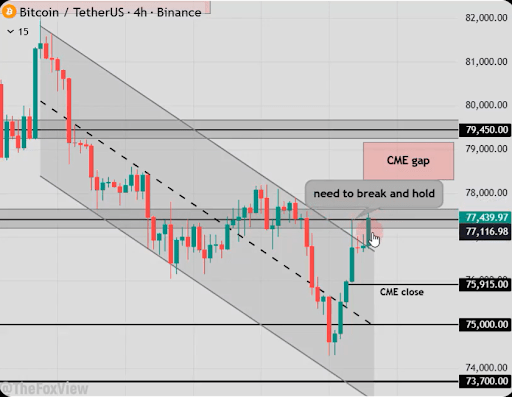
Bitcoin bulls have reignited their push, testing a critical resistance level around $77,400 after breaking out of a descending channel pattern observed on the 4-hour chart. This price has been rejected twice, making a sustained close above it essential for confirming bullish momentum. If successful, the next key target is to fill the upper CME gap around $79,000, with a specific focus on the $79,450 level where significant selling pressure is anticipated. Conversely, a failure to hold above $77,400 could see Bitcoin fall back into the channel, shifting attention to the lower CME gap from the recent Friday close at $75,535. Further support levels lie at $75,000 and $73,700.

Bitcoin bulls mounted a new push over the weekend, clawing their way back to an important technical level around $77,400 that served as a ceiling two times during these rallies. That price level has now become the immediate line between a failed bounce and a stronger move into the upper CME gap.

Bulls Push Out Of The Descending Channel

Bitcoin’s 4-hour chart shows a cryptocurrency still struggling to break through a stubborn resistance area. On Saturday, a bullish surge carried BTC up to $77,439, only for sellers to step in immediately and push the price back down to $74,500. Buying pressure returned with enough force on Sunday again to push the Bitcoin price up to retest the same $77,400 to $77,430 zone.

Notably, this back-and-forth movement is part of a descending channel pattern structure on the 4-hour timeframe. The Sunday bounce has now carried Bitcoin back above the upper area of the channel, and Bitcoin needs to break and hold.
Source: Chart from The Fox on X

At the time of writing, BTC is trading at $77,490, meaning bulls are currently holding above $77,400. That does not mean the bullish case is confirmed yet, as the earlier rejections showed that sellers are still defending this resistance. Therefore, a quick wick above the level would not be enough. Bulls need a convincing close above the zone, followed by enough support to keep the price from falling back inside the channel.

Next Target Is $79,450 CME Gap

According to a crypto analyst on the social media platform X, the next target for Bitcoin bulls is a CME gap around the $79,000 region, with an emphasis on $79,450 as the major level within this gap.

However, there’s a thick resistance band around $79,450. That means filling the gap may not automatically produce a clean continuation, and the Bitcoin price could still meet strong selling pressure there. The first bullish objective is the gap fill, but the larger test would be whether Bitcoin can stay above that region once it gets there.

There is also a clear bearish scenario based on another CME gap. Another rejection at the $77,400 level could push Bitcoin back inside the descending channel and return attention to the recent CME Friday close. According to data from CryptoRank, Bitcoin closed the most recent Friday at $75,535.

CME gaps have a history of being filled more than 90% of the time, and this places emphasis on the current gaps. Below $75,535, the next important price levels are $75,000 and $73,700. Losing $75,000 would diminish the recovery attempt further and could push the BTC price into lower support at $73,700.

BTC trading at $77,564 on the 1D chart | Source: BTCUSDT on Tradingview.com

Связанные с этим вопросы

QWhat is the immediate resistance level that Bitcoin bulls are trying to overcome, according to the article?

AThe immediate resistance level is around $77,400, which has served as a ceiling twice during recent rallies.

QBased on the 4-hour chart analysis, what pattern was Bitcoin struggling within before the Sunday bounce?

ABitcoin was struggling within a descending channel pattern on the 4-hour timeframe before the Sunday bounce carried it back above the upper area of the channel.

QWhat is the next major price target for Bitcoin bulls mentioned in the article?

AThe next major target is a CME gap around $79,000, with a specific emphasis on the $79,450 level within that gap.

QWhat is the bearish scenario described if Bitcoin fails to hold above the $77,400 resistance?

AAnother rejection at $77,400 could push Bitcoin back inside the descending channel, shifting focus to the recent CME Friday close price of $75,535, and potentially lower to $75,000 and $73,700.

QWhat is the general historical behavior of CME gaps, as stated in the article?

ACME gaps have a history of being filled more than 90% of the time.

Похожее

On-chain Analyst: Why Are Most Zcash Transactions Still Traceable?

Title: Why Most Zcash Transactions Remain Traceable Zcash, a privacy-focused cryptocurrency launched in 2016, was designed to offer anonymity by hiding transaction details like sender, receiver, and amount using zero-knowledge proof technology (zk-SNARKs). However, in practice, a significant portion of ZEC transactions are still traceable on-chain. The key reason is Zcash's dual-address system. It features transparent addresses (t-addresses), which work like standard Bitcoin addresses with all data public, and shielded addresses (z-addresses) that encrypt transaction details. There are four transaction types with varying privacy levels: fully transparent (t→t), partially shielded (t→z and z→t), and fully private (z→z). Despite its privacy capabilities, most real-world Zcash activity involves transparent addresses, primarily because major exchanges and institutions use them for regulatory compliance. As a result, blockchain analytics platforms like Arkham can track and attribute a substantial volume of Zcash transactions. Arkham reports it has identified entities behind over $420 billion in ZEC transaction volume. Case studies highlight this traceability: the U.S. government holds seized Zcash from a dark web case, visible via its transparent wallet, and individual traders' profitable moves are trackable from purchase to exchange deposit. In conclusion, Zcash's privacy is not inherent but user-dependent. While purely shielded (z→z) transactions remain cryptographically private, the prevalence of transparent address usage makes much of the network's activity traceable. The actual privacy protection offered depends entirely on how users choose to transact.

marsbit26 мин. назад

On-chain Analyst: Why Are Most Zcash Transactions Still Traceable?

marsbit26 мин. назад

From Power Infrastructure to Token Economy: The 'Seven-Layer Cake' of the AI Industry Chain

From Power Grid to Token Economy: The AI Industry's "Seven-Layer Cake" The AI industry is shifting from a "model-centric" paradigm focused on massive training to a "token-centric" industrial era driven by inference demand. This new phase revolves around the production, distribution, scheduling, and consumption of tokens—the units of computation used by AI agents for every interaction and task. The article proposes a "seven-layer cake" framework for the AI economy: 1. **Power**: The foundational energy source, with competition shifting to securing stable, low-cost electricity. 2. **AIDC (AI Data Centers)**: Large-scale "Token factories." A trend toward smaller, modular, and regionally deployed AI Factories is emerging for efficiency and proximity to users. 3. **GPU**: The core production hardware for tokens. While NVIDIA dominates, competition exists from AMD, ASIC makers, and Chinese chipmakers, with a growing focus on inference efficiency. 4. **LLMs**: The "engines" that generate tokens. The competition is evolving beyond model size to prioritize factors like token cost, inference efficiency, and operational synergy with infrastructure. 5. **Token Distribution**: The "grid" that allocates and rents out compute resources, led by cloud giants and specialized AI-native platforms. 6. **Token Optimization & Intelligent Scheduling**: The critical "brain" layer that intelligently routes tasks (e.g., to local, cloud, or edge models) for optimal cost, latency, and privacy—maximizing the value of each token. 7. **AI Agents & Models**: The end consumers of tokens. The vision involves billions of AI agents working and interacting concurrently, consuming vast amounts of tokens. Currently, the industry faces fragmentation and inefficiencies between these layers. The true "mass adoption era" of AI will begin only when this seven-layer infrastructure is fully integrated and operates as a cohesive, intelligent network—transforming AI from a software tool into a global industrial system spanning energy, hardware, and compute logistics.

marsbit47 мин. назад

From Power Infrastructure to Token Economy: The 'Seven-Layer Cake' of the AI Industry Chain

marsbit47 мин. назад

Semiconductors up 78% annually, software down 12% annually: The 'Liquidity Siphon' is playing out within tech stocks

Semiconductor ETFs like SOXX have surged 78.5% year-to-date, while software ETFs like IGV have dropped 12.5%, creating a record performance gap exceeding 90 percentage points. This reflects a major "liquidity suction" within tech stocks, with capital flooding into semiconductors as software faces selling pressure. Driving the semiconductor boom are staggering capital expenditure plans from hyperscalers like Microsoft, Alphabet, Amazon, and Meta, whose combined 2026 capex is projected near $700 billion. This fuels demand for chips, with companies like SanDisk (up 426%), Intel (up 222%), and Micron (up 154%) leading the S&P 500. In contrast, major software firms like Microsoft, Adobe, and Salesforce are all down over 17% year-to-date. The software sector faces a dual challenge: capital is being redirected to semiconductors, and the rise of AI agents like Claude Code threatens traditional SaaS business models, triggering a narrative of AI displacement. Key unanswered questions remain: How long can hyperscalers sustain their massive capex, given potential free cash flow pressures? And will capital eventually rotate back into the deeply oversold software sector? While some analysts warn of a potential semiconductor bubble akin to the dot-com era, the sector's powerful momentum continues, making market timing exceptionally difficult.

marsbit47 мин. назад

Semiconductors up 78% annually, software down 12% annually: The 'Liquidity Siphon' is playing out within tech stocks

marsbit47 мин. назад

Торговля

Спот
Фьючерсы

Популярные статьи

Тест по Bitcoin Биткоина

HTX Learn: Изучите Bitcoin halving и Заработаете Токены USDT

3.0k просмотров всегоОпубликовано 2024.04.16Обновлено 2024.04.16

Тест по Bitcoin  Биткоина

Что такое $BITCOIN

ЦИФРОВОЕ ЗОЛОТО ($BITCOIN): Комплексный анализ Введение в ЦИФРОВОЕ ЗОЛОТО ($BITCOIN) ЦИФРОВОЕ ЗОЛОТО ($BITCOIN) — это проект на основе блокчейна, работающий в сети Solana, который стремится объединить характеристики традиционных драгоценных металлов с инновациями децентрализованных технологий. Хотя он носит имя Биткойн, часто называемого “цифровым золотом” из-за его восприятия как средства хранения ценности, ЦИФРОВОЕ ЗОЛОТО является отдельным токеном, предназначенным для создания уникальной экосистемы в ландшафте Web3. Его цель — позиционировать себя как жизнеспособный альтернативный цифровой актив, хотя детали его применения и функциональности все еще развиваются. Что такое ЦИФРОВОЕ ЗОЛОТО ($BITCOIN)? ЦИФРОВОЕ ЗОЛОТО ($BITCOIN) — это токен криптовалюты, специально разработанный для использования в блокчейне Solana. В отличие от Биткойна, который выполняет широко признанную роль хранения ценности, этот токен, похоже, сосредоточен на более широких приложениях и характеристиках. Примечательные аспекты включают: Инфраструктура блокчейна: Токен построен на блокчейне Solana, известном своей способностью обрабатывать высокоскоростные и недорогие транзакции. Динамика предложения: ЦИФРОВОЕ ЗОЛОТО имеет максимальное предложение, ограниченное 100 квадриллионами токенов (100P $BITCOIN), хотя детали о его обращающемся предложении в настоящее время не раскрыты. Утилита: Хотя точные функциональные возможности не описаны, есть указания на то, что токен может быть использован для различных приложений, потенциально связанных с децентрализованными приложениями (dApps) или стратегиями токенизации активов. Кто создатель ЦИФРОВОГО ЗОЛОТА ($BITCOIN)? На данный момент личность создателей и команды разработчиков, стоящих за ЦИФРОВЫМ ЗОЛОТОМ ($BITCOIN), остается неизвестной. Эта ситуация типична для многих инновационных проектов в области блокчейна, особенно тех, которые связаны с децентрализованными финансами и феноменом мем-криптовалют. Хотя такая анонимность может способствовать культуре, ориентированной на сообщество, она усиливает опасения по поводу управления и ответственности. Кто инвесторы ЦИФРОВОГО ЗОЛОТА ($BITCOIN)? Доступная информация указывает на то, что у ЦИФРОВОГО ЗОЛОТА ($BITCOIN) нет известных институциональных спонсоров или значительных венчурных капиталовложений. Проект, похоже, функционирует по модели пирингового взаимодействия, сосредоточенной на поддержке и принятии сообществом, а не на традиционных путях финансирования. Его активность и ликвидность в основном сосредоточены на децентрализованных биржах (DEX), таких как PumpSwap, а не на устоявшихся централизованных торговых платформах, что еще больше подчеркивает его подход, ориентированный на grassroots. Как работает ЦИФРОВОЕ ЗОЛОТО ($BITCOIN) Операционные механизмы ЦИФРОВОГО ЗОЛОТА ($BITCOIN) можно подробно описать на основе его дизайна блокчейна и характеристик сети: Механизм консенсуса: Используя уникальный механизм доказательства истории (PoH) Solana в сочетании с моделью доказательства доли (PoS), проект обеспечивает эффективную валидацию транзакций, что способствует высокой производительности сети. Токеномика: Хотя конкретные дефляционные механизмы не были подробно описаны, большое максимальное предложение токенов подразумевает, что оно может быть предназначено для микротранзакций или нишевых случаев использования, которые еще предстоит определить. Интероперабельность: Существует потенциал для интеграции с более широкой экосистемой Solana, включая различные платформы децентрализованных финансов (DeFi). Однако детали относительно конкретных интеграций остаются неуточненными. Хронология ключевых событий Вот хронология, которая подчеркивает значимые вехи, касающиеся ЦИФРОВОГО ЗОЛОТА ($BITCOIN): 2023: Первоначальное развертывание токена происходит в блокчейне Solana, отмеченное его адресом контракта. 2024: ЦИФРОВОЕ ЗОЛОТО приобретает видимость, когда оно становится доступным для торговли на децентрализованных биржах, таких как PumpSwap, позволяя пользователям обменивать его на SOL. 2025: Проект наблюдает спорадическую торговую активность и потенциальный интерес к инициативам, возглавляемым сообществом, хотя на данный момент не зафиксировано никаких значительных партнерств или технических достижений. Критический анализ Сильные стороны Масштабируемость: Основная инфраструктура Solana поддерживает высокие объемы транзакций, что может повысить полезность $BITCOIN в различных сценариях транзакций. Доступность: Потенциально низкая цена торговли за токен может привлечь розничных инвесторов, способствуя более широкому участию благодаря возможностям дробного владения. Риски Отсутствие прозрачности: Отсутствие публично известных спонсоров, разработчиков или процесса аудита может вызвать скептицизм относительно устойчивости и надежности проекта. Волатильность рынка: Торговая активность сильно зависит от спекулятивного поведения, что может привести к значительной волатильности цен и неопределенности для инвесторов. Заключение ЦИФРОВОЕ ЗОЛОТО ($BITCOIN) является интригующим, но неоднозначным проектом в быстро развивающейся экосистеме Solana. Хотя он пытается использовать нарратив “цифрового золота”, его отход от установленной роли Биткойна как средства хранения ценности подчеркивает необходимость более четкого различения его предполагаемой утилиты и структуры управления. Будущее принятие и усвоение, вероятно, будут зависеть от решения текущей непрозрачности и более четкого определения его операционных и экономических стратегий. Примечание: Этот отчет охватывает синтезированную информацию, доступную на октябрь 2023 года, и с тех пор могут произойти события.

99 просмотров всегоОпубликовано 2025.05.13Обновлено 2025.05.13

Что такое $BITCOIN

Fractal Bitcoin: масштабирование Биткоина с помощью рекурсивной системы

Fractal Bitcoin — масштабное Layer-1-решнение, созданное на базе кода Биткоина, позволяющего достигать бесконечного масштабирования с помощью рекурсивного подхода.

2.3k просмотров всегоОпубликовано 2025.06.30Обновлено 2025.06.30

Fractal Bitcoin: масштабирование Биткоина с помощью рекурсивной системы

Обсуждения

Добро пожаловать в Сообщество HTX. Здесь вы сможете быть в курсе последних новостей о развитии платформы и получить доступ к профессиональной аналитической информации о рынке. Мнения пользователей о цене на BTC (BTC) представлены ниже.

活动图片