95% of Bitcoin Mined, the Last One Won't Be Until the 22nd Century

比推Опубликовано 2026-03-10Обновлено 2026-03-10

Введение

Bitcoin has now mined 20 million coins, representing 95.2% of its total capped supply of 21 million. The remaining 1 million BTC will be gradually mined over approximately the next 114 years, with the final coin expected around the year 2140. Since the genesis block was created in 2009, Bitcoin has grown from a niche experiment into a major crypto asset, reaching a market cap surpassing $2.5 trillion and a price of $126,000 by 2025. Key milestones include rapid early growth in transaction volume and network activity, followed by expanded adoption around bull markets such as in 2017. Bitcoin’s emission rate decreases through halving events, which occur every 210,000 blocks (roughly every four years). The current block reward is 3.125 BTC, and it will continue to diminish until all coins are mined. This controlled supply model reinforces Bitcoin’s scarcity and supports its narrative as digital gold. In the future, miners will rely increasingly on transaction fees rather than block rewards.

Author: Ma He, Foresight News

Original Title: Only 1 Million Bitcoin Left Unmined, the Last One Not Until the 22nd Century?


At approximately 9:00 PM on March 10, the 20 millionth Bitcoin was mined. This means that 95.2% of the total supply of 21 million BTC has been mined, leaving only 1 million to be mined over the next 114 years.

On January 3, 2009, Satoshi Nakamoto mined the Genesis Block (Block 0) of the Bitcoin network, marking the official launch of the Bitcoin blockchain. Seventeen years have passed since then.

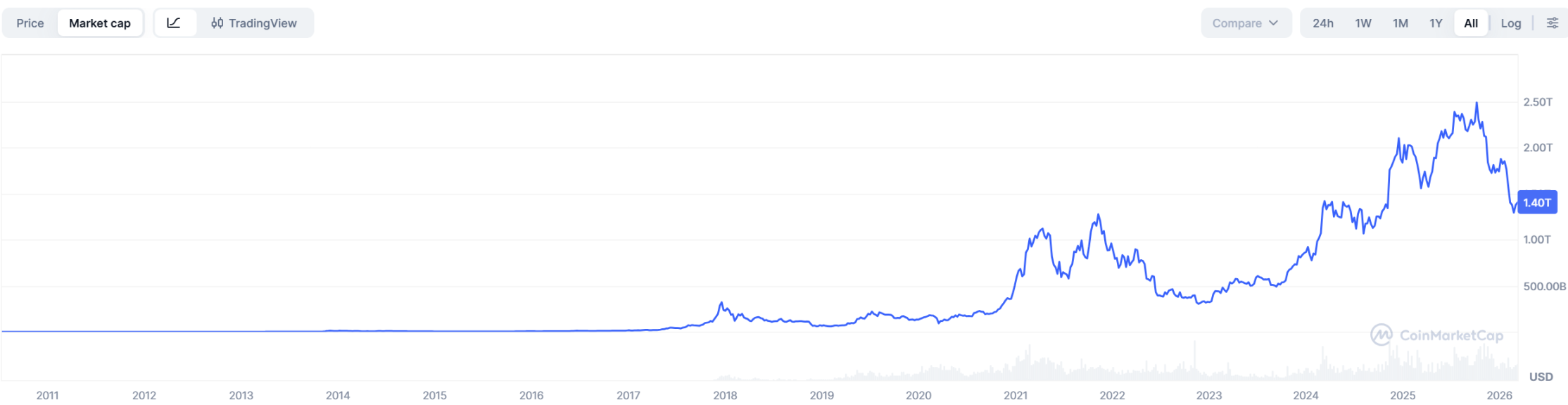
Over this long journey, BTC has risen from $0.06 to $126,000 in 2025, growing from a geek's toy into a massive crypto asset once valued at over $2.5 trillion, demonstrating its robust vitality to the world.
Beyond the staggering returns, there are still some noteworthy data points in BTC's development history.

The chart's horizontal axis spans from 2010 to 2026, with each bar corresponding to a specific metric, annotated with the number of days required from left to right. The shortest is "Transfer volume exceeding 20 million BTC," taking only 729 days, roughly corresponding to early 2011. At that time, Bitcoin was still in its early stages with low prices, but significant liquidity accumulation was already evident on-chain.
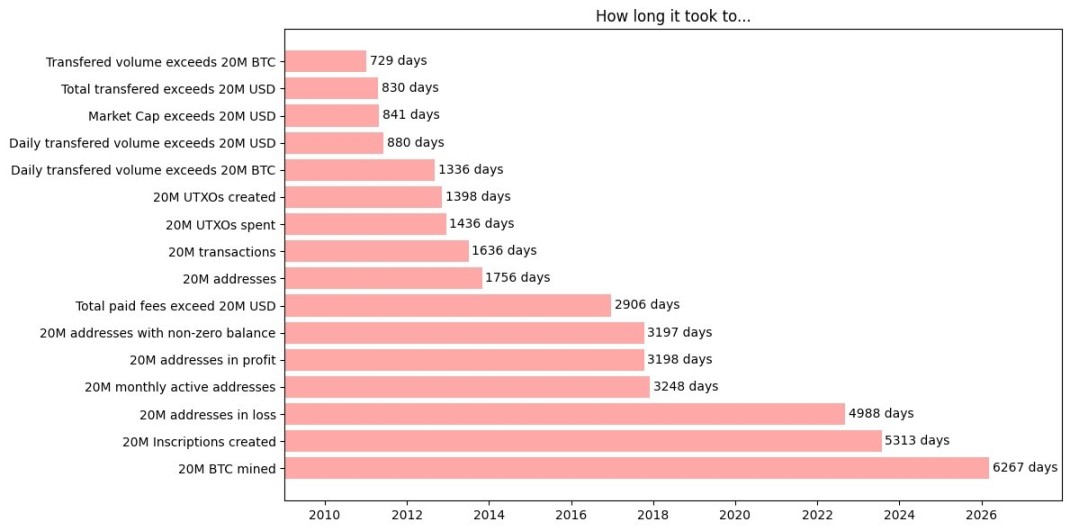
Subsequently, it took 830 days for the total BTC transfer value to exceed $20 million, 841 days for the market cap to surpass $20 million, and 880 days for the daily transfer volume to exceed $20 million. These early metrics marked Bitcoin's transition from an experimental protocol to an asset form with actual value.

As time progressed, the time required for on-chain activity metrics gradually extended. It took 1336 days for the daily transfer volume to exceed 20 million BTC, 1398 days to create 20 million UTXOs, 1436 days to spend 20 million UTXOs, 1636 days for Bitcoin to accumulate 20 million transactions, and approximately 1756 days to have 20 million addresses.

Most of this data clusters around 2013 to 2014, shortly after Bitcoin's first halving in November 2012 (block reward reduced from 50 BTC to 25 BTC), when the network ecosystem began to expand substantially.

It took 2906 days, nearly 8 years, for the total BTC payment fees to exceed $20 million, reflecting the extremely low transaction fees in the early days, which only accumulated significantly as network demand increased and congestion worsened. Bitcoin reached 20 million non-zero balance addresses, 20 million addresses in profit, and 20 million monthly active addresses in 3197 days, 3198 days, and 3248 days respectively, roughly corresponding to the 2017 bull market. During this period, Bitcoin gradually entered the public eye, and the number of holding addresses grew significantly.

The longest bar corresponds to "20 million BTC mined," taking 6267 days, about 17 years and 2 months.

Bitcoin has a total supply cap of 21 million coins, issued through block rewards, halving every 210,000 blocks (approximately every 4 years). The initial reward was 50 BTC per block, halved to 25 BTC, then to 6.25 BTC per block in the 2020 halving, totaling approximately 19,687,500 coins; the fourth halving in April 2024 reduced it to 3.125 BTC per block. We are currently in this cycle. Each halving cuts the new coin issuance rate in half, enhancing the scarcity of the asset and creating a linkage with price cycles.

The estimated time to mine the remaining approximately 1 million BTC, based on the current block reward and halving schedule, is about 114 years. The current reward is 3.125 BTC per block, with about 164,000 new coins added annually; after the 2028 halving, it will drop to 1.5625 BTC per block, continuing to decrease thereafter. In the final stages, issuance will proceed slowly in satoshis until completion around 2140.

This is the core logic of Bitcoin's design: rapid distribution in the early stages to establish a foundation, and an extremely slow rate in the later stages to strengthen its "digital gold" attributes. Miners' future income will rely more on transaction fees to maintain network security.

The 20 million milestone is not the end but the start of a new phase. As the remaining supply is slowly released, Bitcoin's digital gold narrative will be further strengthened.


Twitter:https://twitter.com/BitpushNewsCN

Bitpush TG Discussion Group:https://t.me/BitPushCommunity

Bitpush TG Subscription: https://t.me/bitpush

Original link:https://www.bitpush.news/articles/7618395

Связанные с этим вопросы

QWhat percentage of the total Bitcoin supply has been mined so far, and how many are left?

A95.2% of the total Bitcoin supply has been mined, leaving approximately 1 million BTC left to be mined.

QWhen was the genesis block of Bitcoin mined, and what was the starting price of Bitcoin?

AThe genesis block of Bitcoin was mined on January 3, 2009, and the starting price of Bitcoin was $0.06.

QHow long did it take to mine the first 20 million Bitcoins, and when is the last Bitcoin expected to be mined?

AIt took 6,267 days (approximately 17 years and 2 months) to mine the first 20 million Bitcoins. The last Bitcoin is expected to be mined around the year 2140.

QWhat is the current block reward for mining Bitcoin, and how often does the halving event occur?

AThe current block reward for mining Bitcoin is 3.125 BTC per block. The halving event occurs approximately every 210,000 blocks, which is roughly every 4 years.

QHow will miners' income be sustained in the future as block rewards continue to decrease?

AMiners' future income will rely more on transaction fees to maintain network security, as block rewards continue to decrease through halving events.

Похожее

AI Giants Enter the Dark Forest

In the AI industry's "dark forest," major players like Anthropic, OpenAI, and DeepSeek are strategically withholding their most advanced models to avoid becoming targets in a high-stakes competitive landscape. Anthropic released Claude Opus 4.7 but admitted it underperforms compared to their unreleased model Mythos, citing safety concerns. They delayed addressing user complaints about performance regression until OpenAI’s GPT-5.5 launch, highlighting a tactic of controlled disclosure aligned with competitors’ moves. OpenAI’s GPT-5.5, though a full retrain since GPT-4.5, was seen as incremental rather than revolutionary. Leaks revealed internal models like Glacier and Heisenberg, indicating significant unreleased capabilities. OpenAI acknowledges a "capability overhang," where real model power exceeds what users experience, often due to infrastructure-driven throttling. DeepSeek launched V4 Preview, a cost-efficient model, but its full potential (V4 Pro Max) awaits Huawei’s Ascend 950 super-nodes量产 in late 2026. Their strategy focuses on affordability and scalability, aiming to democratize AI access globally, a move noted even by NVIDIA’s CEO as a disruptive threat. Together, these actions reflect a broader trend: leading AI labs are deliberately pacing releases, hiding strengths, and aligning disclosures with competitive dynamics—each avoiding the risk of exposure in a forest where first movers become targets.

marsbit52 мин. назад

AI Giants Enter the Dark Forest

marsbit52 мин. назад

Naval Steps Into the Arena: A Historic Collision Between Ordinary People and Venture Capital

Naval Ravikant, co-founder of AngelList and a prominent Silicon Valley thinker, has taken a hands-on role as the chairman of the investment committee at USVC—a new SEC-registered fund allowing non-accredited investors to access high-growth private tech companies with a minimum investment of $500. The fund’s initial portfolio includes leading AI firms like OpenAI, Anthropic, xAI, and others. This move represents a significant shift in democratizing access to venture capital, a space traditionally dominated by institutional investors and high-net-worth individuals. USVC aims to let ordinary investors participate in the high-alpha, pre-IPO growth phase of tech companies—a stage where much of the value creation now occurs before public listings. However, the fund is not without complexities. It offers limited liquidity, with potential quarterly redemptions capped at 5%, and charges an all-in fee of 2.5% in its first year. While this is higher than traditional ETFs, it is positioned as a more accessible alternative to conventional VC fee structures. Ultimately, USVC symbolizes a broader movement toward financial inclusion in high-stakes tech investing—not through crypto or Web3 mechanisms, but via regulated, retail-friendly investment vehicles. It offers a ticket to early-stage innovation, though risks typical of venture capital remain.

marsbit53 мин. назад

Naval Steps Into the Arena: A Historic Collision Between Ordinary People and Venture Capital

marsbit53 мин. назад

Торговля

Спот
Фьючерсы

Популярные статьи

Тест по Bitcoin Биткоина

HTX Learn: Изучите Bitcoin halving и Заработаете Токены USDT

3.0k просмотров всегоОпубликовано 2024.04.16Обновлено 2024.04.16

Тест по Bitcoin  Биткоина

Что такое $BITCOIN

ЦИФРОВОЕ ЗОЛОТО ($BITCOIN): Комплексный анализ Введение в ЦИФРОВОЕ ЗОЛОТО ($BITCOIN) ЦИФРОВОЕ ЗОЛОТО ($BITCOIN) — это проект на основе блокчейна, работающий в сети Solana, который стремится объединить характеристики традиционных драгоценных металлов с инновациями децентрализованных технологий. Хотя он носит имя Биткойн, часто называемого “цифровым золотом” из-за его восприятия как средства хранения ценности, ЦИФРОВОЕ ЗОЛОТО является отдельным токеном, предназначенным для создания уникальной экосистемы в ландшафте Web3. Его цель — позиционировать себя как жизнеспособный альтернативный цифровой актив, хотя детали его применения и функциональности все еще развиваются. Что такое ЦИФРОВОЕ ЗОЛОТО ($BITCOIN)? ЦИФРОВОЕ ЗОЛОТО ($BITCOIN) — это токен криптовалюты, специально разработанный для использования в блокчейне Solana. В отличие от Биткойна, который выполняет широко признанную роль хранения ценности, этот токен, похоже, сосредоточен на более широких приложениях и характеристиках. Примечательные аспекты включают: Инфраструктура блокчейна: Токен построен на блокчейне Solana, известном своей способностью обрабатывать высокоскоростные и недорогие транзакции. Динамика предложения: ЦИФРОВОЕ ЗОЛОТО имеет максимальное предложение, ограниченное 100 квадриллионами токенов (100P $BITCOIN), хотя детали о его обращающемся предложении в настоящее время не раскрыты. Утилита: Хотя точные функциональные возможности не описаны, есть указания на то, что токен может быть использован для различных приложений, потенциально связанных с децентрализованными приложениями (dApps) или стратегиями токенизации активов. Кто создатель ЦИФРОВОГО ЗОЛОТА ($BITCOIN)? На данный момент личность создателей и команды разработчиков, стоящих за ЦИФРОВЫМ ЗОЛОТОМ ($BITCOIN), остается неизвестной. Эта ситуация типична для многих инновационных проектов в области блокчейна, особенно тех, которые связаны с децентрализованными финансами и феноменом мем-криптовалют. Хотя такая анонимность может способствовать культуре, ориентированной на сообщество, она усиливает опасения по поводу управления и ответственности. Кто инвесторы ЦИФРОВОГО ЗОЛОТА ($BITCOIN)? Доступная информация указывает на то, что у ЦИФРОВОГО ЗОЛОТА ($BITCOIN) нет известных институциональных спонсоров или значительных венчурных капиталовложений. Проект, похоже, функционирует по модели пирингового взаимодействия, сосредоточенной на поддержке и принятии сообществом, а не на традиционных путях финансирования. Его активность и ликвидность в основном сосредоточены на децентрализованных биржах (DEX), таких как PumpSwap, а не на устоявшихся централизованных торговых платформах, что еще больше подчеркивает его подход, ориентированный на grassroots. Как работает ЦИФРОВОЕ ЗОЛОТО ($BITCOIN) Операционные механизмы ЦИФРОВОГО ЗОЛОТА ($BITCOIN) можно подробно описать на основе его дизайна блокчейна и характеристик сети: Механизм консенсуса: Используя уникальный механизм доказательства истории (PoH) Solana в сочетании с моделью доказательства доли (PoS), проект обеспечивает эффективную валидацию транзакций, что способствует высокой производительности сети. Токеномика: Хотя конкретные дефляционные механизмы не были подробно описаны, большое максимальное предложение токенов подразумевает, что оно может быть предназначено для микротранзакций или нишевых случаев использования, которые еще предстоит определить. Интероперабельность: Существует потенциал для интеграции с более широкой экосистемой Solana, включая различные платформы децентрализованных финансов (DeFi). Однако детали относительно конкретных интеграций остаются неуточненными. Хронология ключевых событий Вот хронология, которая подчеркивает значимые вехи, касающиеся ЦИФРОВОГО ЗОЛОТА ($BITCOIN): 2023: Первоначальное развертывание токена происходит в блокчейне Solana, отмеченное его адресом контракта. 2024: ЦИФРОВОЕ ЗОЛОТО приобретает видимость, когда оно становится доступным для торговли на децентрализованных биржах, таких как PumpSwap, позволяя пользователям обменивать его на SOL. 2025: Проект наблюдает спорадическую торговую активность и потенциальный интерес к инициативам, возглавляемым сообществом, хотя на данный момент не зафиксировано никаких значительных партнерств или технических достижений. Критический анализ Сильные стороны Масштабируемость: Основная инфраструктура Solana поддерживает высокие объемы транзакций, что может повысить полезность $BITCOIN в различных сценариях транзакций. Доступность: Потенциально низкая цена торговли за токен может привлечь розничных инвесторов, способствуя более широкому участию благодаря возможностям дробного владения. Риски Отсутствие прозрачности: Отсутствие публично известных спонсоров, разработчиков или процесса аудита может вызвать скептицизм относительно устойчивости и надежности проекта. Волатильность рынка: Торговая активность сильно зависит от спекулятивного поведения, что может привести к значительной волатильности цен и неопределенности для инвесторов. Заключение ЦИФРОВОЕ ЗОЛОТО ($BITCOIN) является интригующим, но неоднозначным проектом в быстро развивающейся экосистеме Solana. Хотя он пытается использовать нарратив “цифрового золота”, его отход от установленной роли Биткойна как средства хранения ценности подчеркивает необходимость более четкого различения его предполагаемой утилиты и структуры управления. Будущее принятие и усвоение, вероятно, будут зависеть от решения текущей непрозрачности и более четкого определения его операционных и экономических стратегий. Примечание: Этот отчет охватывает синтезированную информацию, доступную на октябрь 2023 года, и с тех пор могут произойти события.

99 просмотров всегоОпубликовано 2025.05.13Обновлено 2025.05.13

Что такое $BITCOIN

Fractal Bitcoin: масштабирование Биткоина с помощью рекурсивной системы

Fractal Bitcoin — масштабное Layer-1-решнение, созданное на базе кода Биткоина, позволяющего достигать бесконечного масштабирования с помощью рекурсивного подхода.

2.2k просмотров всегоОпубликовано 2025.06.30Обновлено 2025.06.30

Fractal Bitcoin: масштабирование Биткоина с помощью рекурсивной системы

Обсуждения

Добро пожаловать в Сообщество HTX. Здесь вы сможете быть в курсе последних новостей о развитии платформы и получить доступ к профессиональной аналитической информации о рынке. Мнения пользователей о цене на BTC (BTC) представлены ниже.

活动图片