Abstract:On November 4,as the Federal Reserve FOMC announced the launch of Taper after the meeting, the turning point of global liquidity growth has arrived. Taper means a diminishing marginal dollar liquidity,it may affect the price of Bitcoin. In addition, under normal circumstances, after the end of Taper, interest rate hikes will follow. Faced persistent inflation concerns, voices for accelerating Taper has become increasingly loud, which will have a bearing on bitcoin.
Author:William Lee, Huobi Research
Among the big names in the crypto community in 2021, a Twitter user named PlanB may be the most watched. This Dutch investor named PlanB created a Bitcoin price model based on S2F (Stock to Flow) and successfully predicted the Bitcoin price in the first three quarters of this year, stunned the market. Unfortunately, PlanB's model is likely to fail for the first time -it predicted bitcoin would reach at least 98,000 US dollars by the end of November. However, recent bitcoin price has fallen all the way to 57,000 US dollars, which is far from the predetermined target.
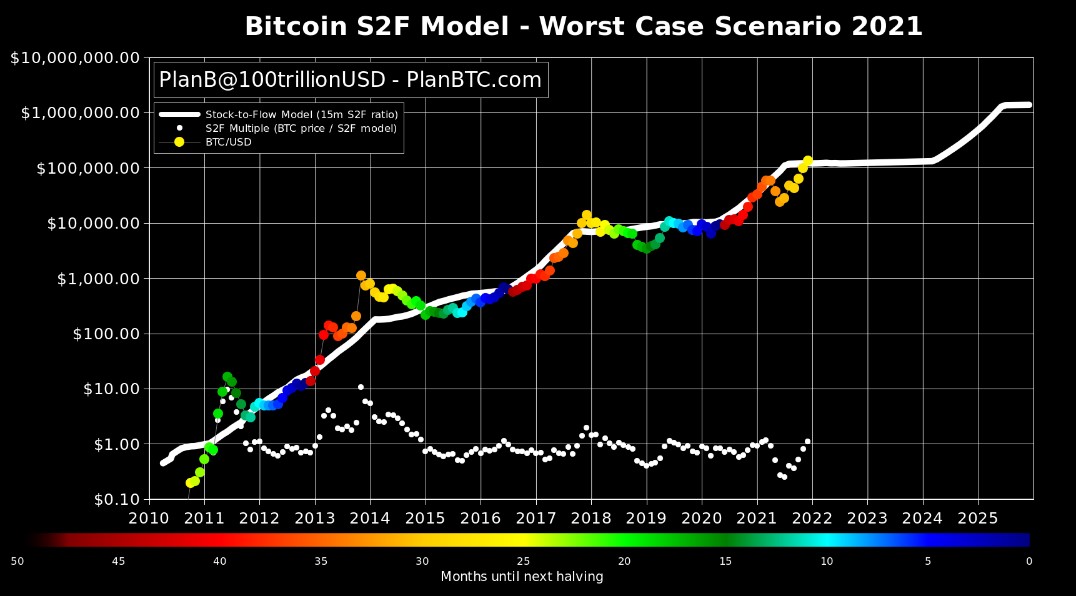
Figure 1. PlanB's Bitcoin S2F model
Sources:Tiwtter,Huobi Research
Why does the "victorious" Bitcoin S2F model suddenly fail? Because PlanB only considered the monthly SF ratio of Bitcoin and historical Bitcoin price data when constructing the model, but ignored the impact of external macro changes on the market.
As we all know, the background of the bitcoin price rise is the spread of COVID-19 around the world and the extremely loose monetary policies implemented by central banks to rescue the market. Due to the tremendous liquidity released by central banks to the market, many risky assets, including Bitcoin, have surged in the past year. However, on the 3rd of this month, as the Federal Reserve FOMC announced the launch of Taper after the meeting, the turning point of global liquidity growth has arrived.
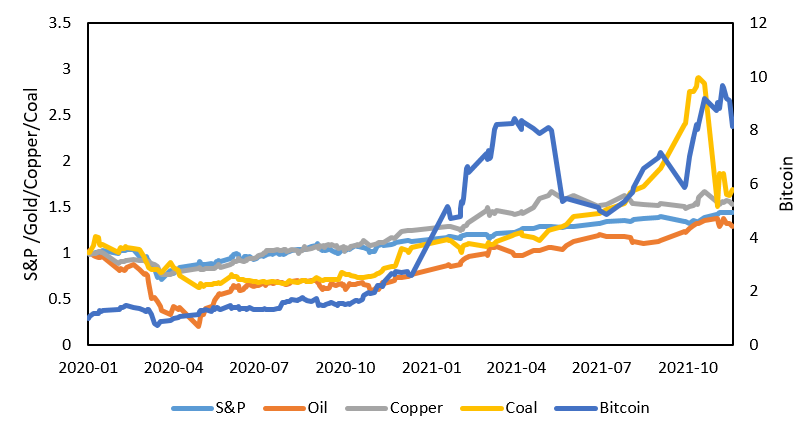
Figure 2. Changes in the prices of major global assets since 2020 (current price/initial price)
Sources:Wind,Huobi Research
So, what is Taper? Why should we pay attention to Taper?
When it comes to Taper, we must first understand what quantitative easing is. When the Federal Reserve launched quantitative easing in March last year, we discussed the difference between "interest rate cuts" and "quantitative easing"-cutting interest rates means lowering the "price of funds" and injecting liquidity into the market by controlling the borrowing costs of the market; and "quantitative easing" is to increase the "quantity of funds" and inject liquidity into banks through the continuous purchase of a large number of bonds, forcing banks to lend out even under conditions of zero interest rates, thereby increasing market liquidity. Therefore, quantitative easing is an unconventional policy that is forced to be implemented when interest rates cannot be lowered. The two main types of bonds purchased during the quantitative easing are Treasury and MBS. The more they purchase, the larger the Fed assets is.
We know that the original meaning of Taper is "gradual contraction". In the context of central bank monetary policy, "Taper" means "gradual reduction in quantitative easing." Therefore, Taper does not mean the end of quantitative easing ,or let alone tightening liquidity, rather, it means a gradual reduction in the scale of bond purchases in quantitative easing.
According to the minutes of this FOMC meeting, the Fed opened Taper in November, which signifies an increase in its holding by at least US$70 billion in US Treasury bonds and $35 billion in institution MBS this month, followed by a shrink of $10 billion in Treasury purchases and $5 billion MBS each month. A simple calculation, if you buy 15 billion dollars less each month, the total amount of $120 billion in assets purchased per month will be exhausted in 8 months. That is to say, putting an end in bond purchasing and quantitative easing in next June.
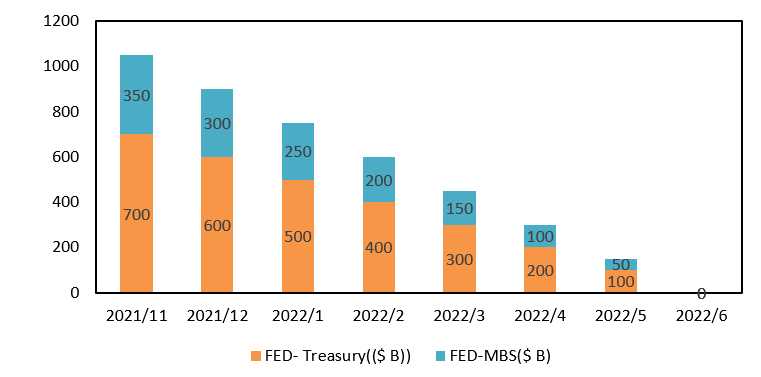
Figure 3. Forecast of the Fed's bond purchases during the Taper period
Sources: Huobi Reseach
So why should we pay attention to Taper? We know that Taper means a diminishing marginal dollar liquidity. While it does not change the expansion, or contraction, of liquidity itself, it may change the destination of fund flow or the degree of asset mismatch. Especially for Bitcoin, an extraordinarily risky asset, its sensitivity to changes in liquidity of dollars will be theoretically higher. (As we observed during March last year, due to the shortage of market liquidity, Bitcoin price dropped by nearly 50% in one day). Here we can recall the price trend of Bitcoin during the Fed's last round of Taper implementation.
As shown in the figure below, since the 2008 financial crisis, after nearly five years of quantitative easing, the Federal Reserve began to kick off the normalization of monetary policy to the market in 2013, and officially launched Taper. At that time, the overall process of Taper can be divided into 2 stages: 1) the price release stage from May 2013 to December 2013, and 2)the formal implementation stage from December 2013. The asset purchase scale was reduced from $85 billion to $75 billion per month. Since then, the scale of debt purchases has continued to decline until it completely withdrew from QE in October 2014. In order to eliminate the influence of quarterly factors on the Fed's balance sheet, we reflect the impact of Taper by calculating the year-on-year change in the size of the Fed's assets (note that Taper represents the deceleration of QE). From the figure below, we can clearly see that around the time when the Federal Reserve officially announced the launch of Taper in December, it was at the peak of Bitcoin's bull market in 2013. During the previous round of Taper, Bitcoin was trapped in a bear market.
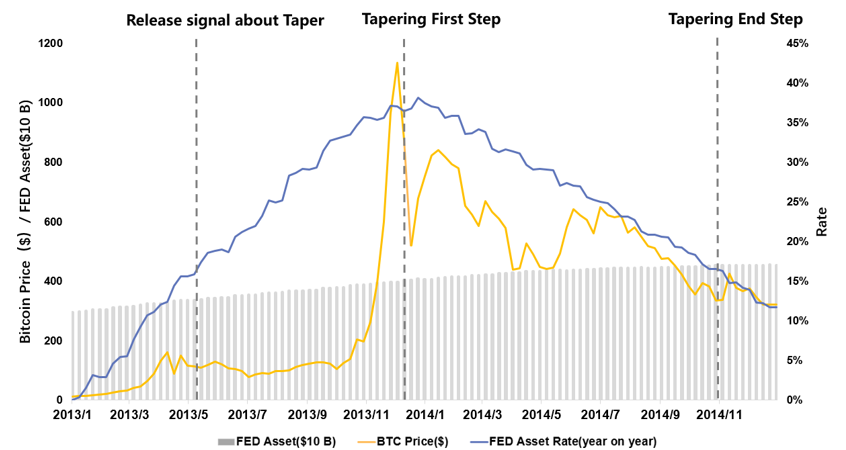
Figure 4. Bitcoin price movements during the last Round of Federal Reserve Taper Taper periods (2013-2014)
Sources: Wind,Huobi Reseach
So, what impact will this round of Taper have on the cryptocurrency market?
There are two special features: First, the starting point of this round is higher, but the speed of reduction is faster; Second, at the end of this round, the Fed's asset scale will be significantly higher than previous round. This has two implications: First, the market liquidity growth rate will slow down significantly, which means that it is difficult for various asset prices to rise wildly; Second, even if Taper ends, there will still be sufficient liquidity in the market. It is more likely that asset prices will continue to remain high.
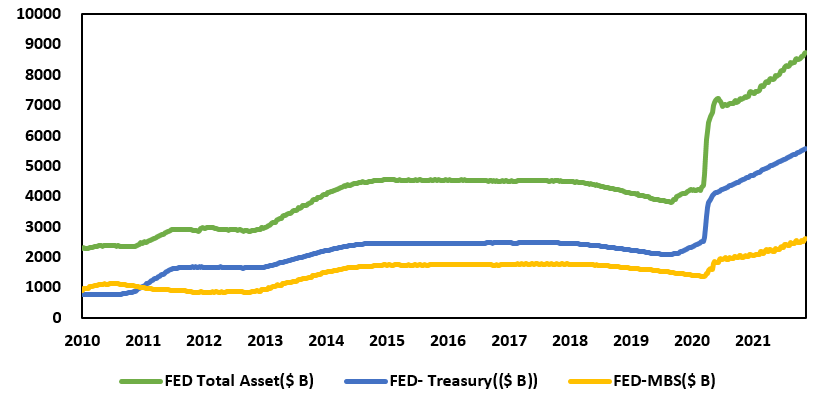
Figure 5. Changes in the size of FED assets
Sources:Wind,Huobi Research
However, story continues. According to regular operation of the Fed's monetary policy, after the end of Taper, interest rate hikes will follow, which means that liquidity will shrink, bringing about a huge impact on various risk assets.
First of all, we need to understand the Fed's monetary policy decision-making framework. According to the Federal Reserve Act, the goal of Federal Reserve monetary policy is to "maintain the growth of money and credit supply that echoes the long-term economic growth, so as to effectively 1) maximize employment, 2) price stability, and 3) moderate long-term economic growth." In order to achieve the above monetary policy goals, the Taylor Rule proposed by John B. Taylor in 1993 played an important role. The expression of Taylor's Rule is as follows:

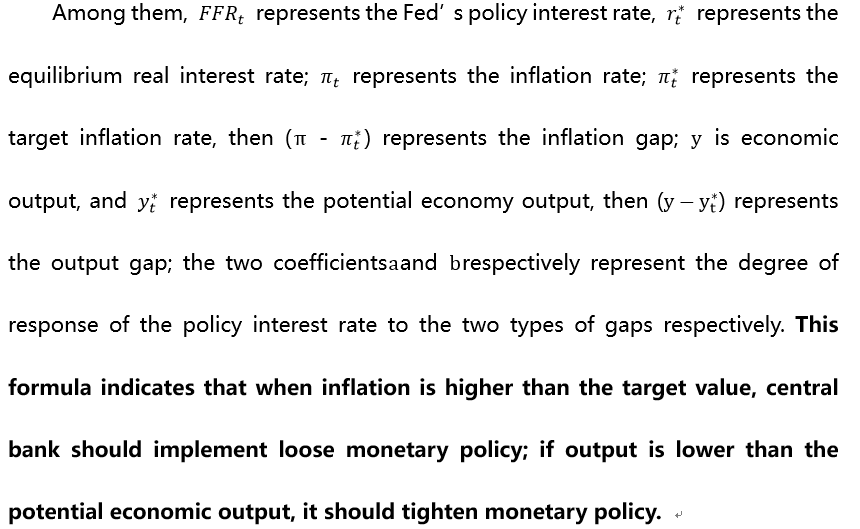
After 2014, based on the previous Taylor Rule, the Federal Reserve developed an optimal control policy so that the target interest rate of federal funds can minimize the deviation of the unemployment rate and inflation rate from the target; the latest monetary policy framework still does not diverge from the core logic of Taylor Rule.
Specifically, since 2012, the Federal Reserve has maintained a relatively stable long-term goal for eight years: consistently implementing the target of achieving 2% inflation in the long run, and reducing the expectation of long-term natural unemployment rate year by year responding to the constant restructure and adjustment of the labor market.
On August 27, 2020, the Federal Reserve introduced a new monetary policy framework in the "Long-term Goals and Monetary Policy Strategy Statement", which made major adjustments to specific targets for inflation and employment. For the first time, the Fed put forward the concept of an average inflation rate, that is, while emphasizing the long-term inflation expectations of 2%, it allows for a period of time to achieve an inflation rate moderately higher than 2%, which means the Fed’s tolerance for temporary high inflation improved. This is why, since the beginning of this year, inflation of the United States has set new highs frequently, but the Fed has not changed monetary policy; because inside of the Fed is still arguing whether inflation is "temporary" or not.
Figure 6. Changes in U.S. CPI since 2020
Sources:Wind,Huobi Research
However, since the summer of this year, inflation of the United States has remained above 4%. Confronted persistent inflation concerns, the Fed officially initiated Taper on November 4 , and announcing an end of QE by the end of next year. However, data released by the U.S. Department of Labor on November 10 illustrated that the CPI rose 6.2% year-on-year in October, reaching a 31-year high, which further aggravated the market’s concerns about inflation, voices for accelerating Taper has become increasingly loud. On November 19, a number of senior Federal Reserve officials hinted that they might speed up the Taper process. Speeding up Taper means speeding up the withdrawal of QE, which means that the turning point of liquidity will be advanced. Therefore, under the influence of market expectations, it is difficult for various high-risk assets, represented by Bitcoin, to continue to rise in the future, and even the possibility of further decline cannot be ruled out.