Understanding Stablecoin Peg Deviations: What Actually Happens When a Digital Dollar Loses Its Link to the US Dollar

cryptonews.ruОпубликовано 2026-08-23Обновлено 2026-08-23

Введение

Stablecoin peg breakdowns occur because the code doesn't enforce a $1 value; it's an economic promise. Arbitrage by large traders (buying at a discount, redeeming for $1) maintains the peg. However, direct redemption is limited to large, verified clients, making general market confidence the true first line of defense. Four historical cases show different causes: USDT's 2018 drop was a trust issue; USDC's 2023 dip was a bank failure; xUSD's 2025 crash was due to risky yield strategies and a counterparty loss; and TerraUSD's 2022 collapse resulted from a flawed algorithmic design that triggered a death spiral. In 2026, a market-wide decline (total supply dropped ~$14.6B) is driven by new US regulations banning yield, reducing the arbitrage capital cushion that absorbs shocks. Market concentration remains high, with USDT and USDC comprising ~83% of the market, meaning any issue with either poses systemic risk. To interpret future de-pegs: identify the cause (reserve-backed coins tend to recover; algorithmic or yield-based models may not); monitor redemption processing, not just price; and watch for contagion to other protocols and assets, as seen with DAI during the USDC incident.

Nothing in a stablecoin's code keeps its price fixed at $1, meaning the peg is simply an economic promise where the issuer states each token can be exchanged for one real dollar, and arbitrage does the rest. If $USDT trades at $0.99, professional traders buy it at a discount and redeem it with Tether for $1.00, pocketing the difference and pushing the market price up.

Conversely, if it trades above $1, they mint new tokens for exactly $1 and sell them. The market price remains pegged only because this "redemption machine" is believed to work.

In practice, access to this "redemption machine" is limited. For instance, Tether requires clients to pass verification and have a minimum of $100,000 for direct redemptions, while Circle (the issuer of $USDC) operates through institutional accounts. Everyone else (be it a retail holder, a DeFi protocol, or an offshore exchange) relies on a chain of arbitrageurs who have both the access and the courage to keep buying tokens at a discount during panic.

It is this structure that causes a peg deviation to appear on exchange screens even in cases where the issuer never misses a redemption, i.e., the first line of defense for the peg is the trust of other people, not the reserves themselves.
Four Cases of Peg Deviation, Four Different Reasons

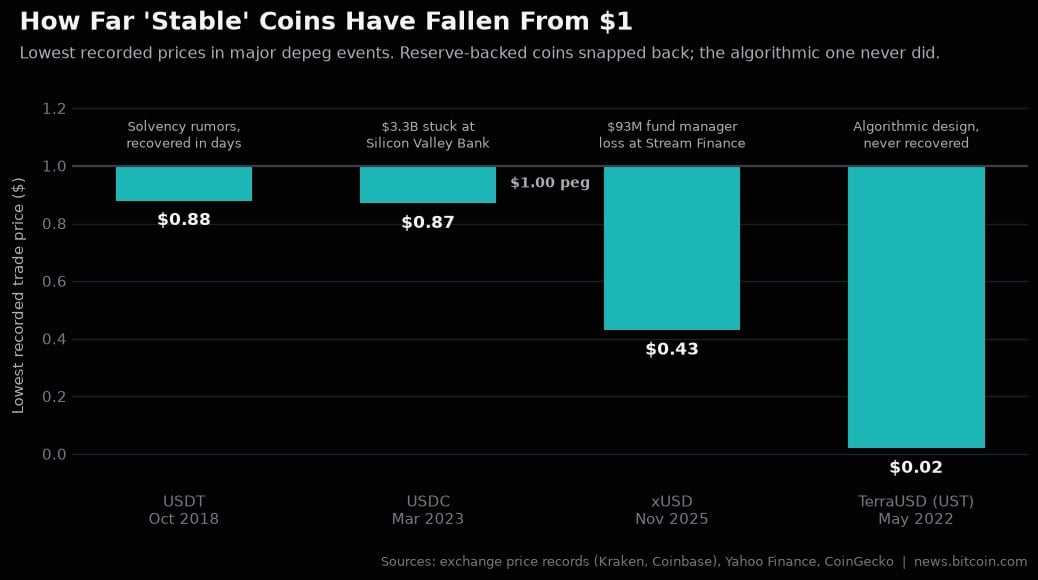
The panic around $USDT in October 2018 was a trust issue: rumors about the solvency of Tether and its associated exchange Bitfinex led to $USDT dropping to around $0.88 on some platforms. Ultimately, the reserves covered the redemptions, and the peg was restored within days.

The deviation of $USDC in March 2023 was more of a banking issue, as Circle disclosed that $3.3 billion of its reserves were held in the failed Silicon Valley Bank, causing the token's price to fall to $0.87 before US regulators guaranteed the bank's deposits. It is worth noting that this incident led to a broader market decline in decentralized finance (DeFi): $DAI, largely backed by $USDC, dropped to around $0.89.

The collapse of xUSD in November 2025 was a counterparty issue and serves as the most recent reminder that yield-bearing stablecoins carry risks not present with the giants. xUSD from Stream Finance was not backed dollar-for-dollar in a bank account, as the company employed leveraged strategies through third-party fund managers to generate yield for holders.

When one of these managers reported a $93 million loss, Stream froze withdrawals, and the price of xUSD plummeted from $1 to a low of $0.24 within hours (with $160 million in user deposits frozen at the same time).

Last but not least, the collapse of terraUSD (UST) in May 2022 was caused by a structural issue, and this token has never recovered. UST maintained its peg not through reserves but via an algorithmic "seesaw" mechanism relative to its "sister" token $LUNA (burning $1 of $LUNA to mint one UST and vice versa).

When mass withdrawals knocked UST off its $1 peg, holders rushed to convert it to $LUNA and sell, leading to hyperinflation of $LUNA's supply and the disappearance of the very asset meant to back the peg. UST fell below $0.10 within a week and trades around $0.02 today. The combined value of both tokens evaporated by roughly $40 billion, and the crash dragged down hedge funds, lenders, and ultimately, the fragile empire of the FTX exchange.

2026: A Decline, Then Stabilization at a Certain Level

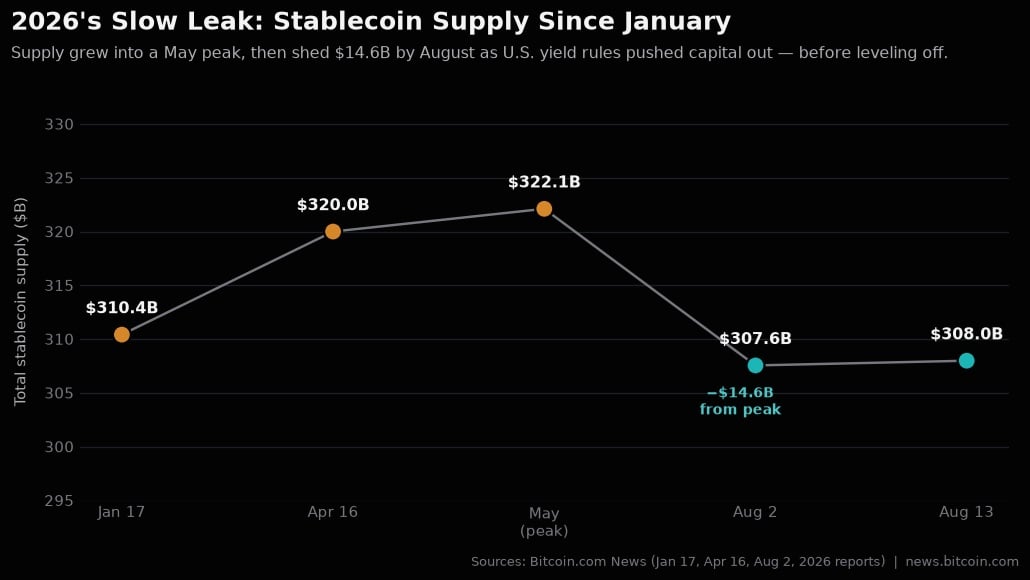
Tensions this year so far do not resemble an "instant crash" but rather a slow leak driven by regulatory measures. After new US federal stablecoin rules deprived digital dollars of the ability to pay interest, yield-seeking capital began to exit. The stablecoin market volume was $310 billion at the start of 2026, grew to about $320 billion by mid-April, and peaked at $322.1 billion in mid-May.

After that, the trend reversed sharply: by early August, the total stablecoin supply had contracted by $14.56 billion—the sharpest contraction since the Terra crash. Over the same period, the volume of $USDT shrank from about $189 billion to $183.2 billion (it had increased by $5 billion earlier this year while competitors saw a $4.2 billion contraction). The volume of $USDC, meanwhile, fell from a March peak near $80 billion to about $72.1 billion.
The decline was not limited to these two giants: in early July, the market volume contracted by $1.9 billion, with Sky Dollar's USDS showing the sharpest weekly drop, although PayPal's PYUSD and Ripple's RLUSD continued to grow.

A supply contraction does not directly cause a peg deviation, but it reduces the buffer of arbitrage capital that absorbs shocks, and it is this buffer that gets tested when the next crisis hits.

Why Concentration Raises the Stakes

Furthermore, this buffer is unevenly distributed, as $USDT and $USDC still account for roughly 83% of the entire $307.6 billion stablecoin market, meaning the redemption mechanism that keeps this entire category at $1 runs through the balance sheets and banking relationships of two companies.
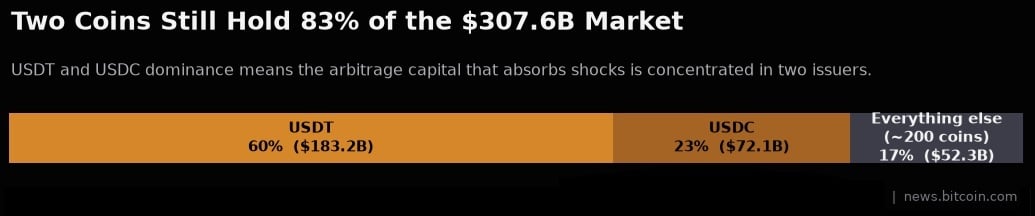
This concentration means that while these two coins dominate trading, which is generally a stabilizing factor, it also leads to disruptions for either issuer (such as a bank failure like the one Circle experienced in 2023, regulatory action, or a dispute over reserves) causing massive, unpredictable damage.

How to Interpret the Next Peg Deviation

First, it is crucial to identify the underlying cause, as reserve-backed coins (knocked off peg due to panic or bank failures) almost always restore their peg quickly once enough tokens are redeemed. However, models based on a native token (like TerraUSD) or an opaque yield strategy are incapable of this.

Second, investors should monitor redemption dynamics, not just price, as a coin trading at $0.97 (with the issuer processing withdrawal requests normally) is simply selling at a discount, not entering a "death spiral."

Third, it is critical to watch where "contagion" spreads: after all, fluctuations in $USDC led to a revaluation of $DAI within hours, the Terra crash affected companies that never dealt with UST, and the xUSD collapse triggered a chain reaction among DeFi lenders holding it as collateral.

end-content

Трендовые криптовалюты

Связанные с этим вопросы

QWhat is the primary mechanism that keeps a stablecoin's price at $1, according to the article?

AThe primary mechanism is an economic promise where the issuer states that each token can be redeemed for one real dollar, with arbitrage doing the rest to keep the market price near $1.

QWhat were the four main causes of de-pegging events mentioned for USDT (2018), USDC (2023), xUSD (2025), and TerraUSD (2022)?

AUSDT (2018): A confidence/trust issue. USDC (2023): A banking issue (exposure to a failing bank). xUSD (2025): A counterparty/yield-related issue. TerraUSD (2022): A structural/algorithmic issue with its 'seesaw' mechanism.

QWhat is the current trend in the stablecoin market in 2026 according to the article, and what is cited as the main driver?

AIn 2026, the market is experiencing a slow decline/contraction, not a sudden crash. The main driver cited is new U.S. federal regulations that prevent stablecoins from paying interest, causing yield-seeking capital to leave.

QWhy does market concentration in USDT and USDC increase systemic risk, even though it generally stabilizes trading?

ABecause it means the redemption mechanism that maintains the $1 peg for the entire category depends on the balance sheets and banking relationships of just two companies. A shock to one (like a bank failure, regulatory action, or reserve dispute) can cause widespread, unpredictable damage.

QWhat are three key factors an investor should monitor when a stablecoin de-pegs, based on the article's conclusion?

A1. The root cause (e.g., reserve-backed vs. algorithmic). 2. The dynamics of redemptions (not just the price). 3. The spread of 'contagion' to other platforms, tokens, or DeFi protocols.

Похожее

Основатель Strategy Майкл Сэйлор дал понять, что компания может снова начать покупать биткоины (BTC)! Вот подробности

Сооснователь MicroStrategy Майкл Сэйлор намекнул на возможность возобновления компанией покупок биткоина (BTC), опубликовав в социальных сетях сообщение «Мы вернулись» с соответствующим символом. Это вызвало оживлённые обсуждения на рынке, так как аналогичные формулировки ранее использовались перед объявлениями о приобретениях. MicroStrategy, являющаяся одним из крупнейших институциональных держателей биткоина, активно отслеживается инвесторами. Её крупные покупки рассматриваются как индикатор институционального спроса и могут влиять на рыночные настроения. Хотя прямое подтверждение о новой сделке и её объёмах отсутствует, участники рынка ожидают официального заявления от компании. Продолжение стратегии накопления BTC может further увеличить долю актива в балансе MicroStrategy, остающегося чувствительным к колебаниям цены криптовалюты.

cryptonews.ru18 мин. назад

Основатель Strategy Майкл Сэйлор дал понять, что компания может снова начать покупать биткоины (BTC)! Вот подробности

cryptonews.ru18 мин. назад

Интерпретация исследовательского отчета Nomura: Хок-дебют Уорша делает акцент на цели по инфляции, данные за август могут удержать ФРС от изменений

В своем первом выступлении на симпозиуме в Джексон-Хоул новый председатель ФРС Уорш занял более жесткую позицию, чем ожидалось, сделав акцент на важности достижения целевого показателя инфляции. Он указал, что если инфляция не будет снижаться достаточными темпами, может потребоваться ужесточение политики, однако прямых намеков на скорое повышение процентных ставок не последовало. В еженедельном отчете Nomura от 28 августа отмечается, что ожидаемый рост базового индекса PCE в августе примерно на 0,2% в месячном выражении должен позволить ФРС сохранить ставки на текущем уровне. Ключевыми данными для решения ФРС в сентябре станут отчет по занятости за август (прогноз: +60 тыс. новых рабочих мест вне сельского хозяйства) и данные по инфляции. Nomura ожидает, что ФРС сохранит ставки неизменными на неопределенный срок, однако риски смещены в сторону ужесточения. Несмотря на то, что большинство чиновников довольны выжидательной позицией, неопределенность в отношении дальнейшего пути монетарной политики значительно возросла после выступления Уорша. Основные риски для инфляции связаны с бумом инвестиций в ИИ и возможными сбоями в цепочках поставок.

marsbit51 мин. назад

Интерпретация исследовательского отчета Nomura: Хок-дебют Уорша делает акцент на цели по инфляции, данные за август могут удержать ФРС от изменений

marsbit51 мин. назад

a16z раскрывает данные о криптоэнтузиазме в Аргентине: покупка монет — это покупка долларов, полностью трансформировавшиеся привычки использования стейблкоинов

Авторы a16z crypto на основе данных исследуют криптоэнтузиазм в Аргентине. В стране один из самых высоких уровней внедрения криптовалют в Латинской Америке, причем каждый пятый аргентинец использует криптоактивы. Основной движущей силой является историческое недоверие к национальной валюте (песо) из-за гиперинфляции и прошлых экономических кризисов, что укрепило привычку сберегать в долларах США. Криптодоллары (стейблкоины, в основном USDC) стали ключевым инструментом для аргентинцев, позволяя обходить валютный контроль и сохранять сбережения. Данные от компании Deel показывают, что доля подрядчиков, получающих зарплату в USDC, росла вместе с инфляцией. Даже после отмены большинства валютных ограничений в 2025 году и снижения инфляции использование стейблкоинов не сократилось, а стабилизировалось. Более 94% торговых пар с песо на криптобиржах приходится на стейблкоины, что является самым высоким показателем среди всех отслеживаемых валют. Хотя цена криптодоллара ранее значительно превышала официальный курс, после либерализации рынка разница сократилась до нескольких процентов. Вывод: для аргентинцев стейблкоины трансформировались из средства защиты от инфляции в устоявшуюся финансовую привычку, сохраняя свою актуальность даже после смягчения экономического кризиса.

marsbit1 ч. назад

a16z раскрывает данные о криптоэнтузиазме в Аргентине: покупка монет — это покупка долларов, полностью трансформировавшиеся привычки использования стейблкоинов

marsbit1 ч. назад

Спустя 10 недель простоя, Strategy снова готова к режиму 'скупки'?

После 10-недельного перерыва в покупках Bitcoin компания Strategy, судя по всему, готовится возобновить свою скупку криптовалюты. Об этом свидетельствует сообщение Майкла Сэйлора, а также несколько ключевых изменений в финансовом положении компании. Во-первых, Strategy устранила дисбаланс между своими денежными резервами ($66,9 млрд) и долгом по конвертируемым векселям ($67,1 млрд), сократив чистый леверидж до 0,1%. Во-вторых, цена её привилегированных акций STRC приблизилась к целевой отметке в $100, что снижает потребность в затратных операциях по поддержке их курса. Ранее именно эти операции требовали продажи Bitcoin. Сообщение Сэйлора в соцсетях было расценено как сигнал, хотя и не является официальным заявлением. Стратегия компании будет подтверждена в еженедельном отчёте, который должен быть опубликован 31 августа.

marsbit1 ч. назад

Спустя 10 недель простоя, Strategy снова готова к режиму 'скупки'?

marsbit1 ч. назад

Торговля

Спот

Популярные статьи

Как купить LINK

Добро пожаловать на HTX.com! Мы сделали приобретение ChainLink (LINK) простым и удобным. Следуйте нашему пошаговому руководству и отправляйтесь в свое крипто-путешествие.Шаг 1: Создайте аккаунт на HTXИспользуйте свой адрес электронной почты или номер телефона, чтобы зарегистрироваться и бесплатно создать аккаунт на HTX. Пройдите удобную регистрацию и откройте для себя весь функционал.Создать аккаунтШаг 2: Перейдите в Купить криптовалюту и выберите свой способ оплатыКредитная/Дебетовая Карта: Используйте свою карту Visa или Mastercard для мгновенной покупки ChainLink (LINK).Баланс: Используйте средства с баланса вашего аккаунта HTX для простой торговли.Третьи Лица: Мы добавили популярные способы оплаты, такие как Google Pay и Apple Pay, для повышения удобства.P2P: Торгуйте напрямую с другими пользователями на HTX.Внебиржевая Торговля (OTC): Мы предлагаем индивидуальные услуги и конкурентоспособные обменные курсы для трейдеров.Шаг 3: Хранение ChainLink (LINK)После приобретения вами ChainLink (LINK) храните их в своем аккаунте на HTX. В качестве альтернативы вы можете отправить их куда-либо с помощью перевода в блокчейне или использовать для торговли с другими криптовалютами.Шаг 4: Торговля ChainLink (LINK)С легкостью торгуйте ChainLink (LINK) на спотовом рынке HTX. Просто зайдите в свой аккаунт, выберите торговую пару, совершайте сделки и следите за ними в режиме реального времени. Мы предлагаем удобный интерфейс как для начинающих, так и для опытных трейдеров.

2.1k просмотров всегоОпубликовано 2024.03.29Обновлено 2026.06.02

Как купить LINK

Неделя обучения по популярным токенам, выпуск 22: Micron ускоряет внутреннее расширение в США; традиционные институты настроены оптимистично в отношении LINK в долгосрочной перспективе

Standard Chartered установил целевую цену LINK на 2030 год в размере $200 (на основе ожиданий роста рынка токенизации).

1.1k просмотров всегоОпубликовано 2026.08.19Обновлено 2026.08.19

Неделя обучения по популярным токенам, выпуск 22: Micron ускоряет внутреннее расширение в США; традиционные институты настроены оптимистично в отношении LINK в долгосрочной перспективе

Обсуждения

Добро пожаловать в Сообщество HTX. Здесь вы сможете быть в курсе последних новостей о развитии платформы и получить доступ к профессиональной аналитической информации о рынке. Мнения пользователей о цене на LINK (LINK) представлены ниже.

活动图片