AI Can 'Have Moods Too'! New Research from USTC: Confusion and Anxiety Make AI Work Better

marsbitОпубликовано 2026-08-16Обновлено 2026-08-16

Введение

The article discusses research from the University of Science and Technology of China and Oxford, revealing that allowing AI to recognize and act upon simulated "internal emotions" can significantly improve its performance. The study demonstrates a coherent pairing between specific emotional states in AI agents and their subsequent skill choices. For instance, an agent feeling curious and desirous will search for products, while one feeling confused and tense will rephrase queries. This mirrors human decision-making influenced by emotions. Statistical validation showed a 76.5% semantic consistency in these pairings. Crucially, the research challenges the traditional view of AI errors as flaws to be eliminated. It found that "bad" emotions like confusion, tension, or frustration serve as useful metacognitive signals, indicating a mismatch between the current strategy and the environment. By responding to these signals, AI can proactively adjust before a failure occurs. This is particularly effective in complex tasks prone to failure. For example, in tasks like "heating an item" and "picking up two items," success rates surged from 9.6% to 56.9% and 4.4% to 31.3%, respectively, when using the emotion-driven skill selection method (EMOTION2SKILL). The AI's "nervous" state about a closed microwave, for instance, prompted it to check and open it first, preventing failure. The article also mentions related work from Tianjin University, which embeds emotional prediction into wor...

Cheng Qian from Pheasant's Temple QbitAI | Public Account QbitAI

Can an AI's "mood" affect its work performance?

Recently, researchers from the University of Science and Technology of China (USTC), Oxford, and other institutions had AI use emotion vectors instead of text for skill selection. The results showed that—

Allowing the AI to recognize these "inner emotions" and act accordingly significantly improved the AI's working capability......

Previous research suggested that within LLMs, there exist computational patterns highly corresponding to human emotional labels.

Including but not limited to: curiosity, desire, optimism, confusion, nervousness, annoyance.
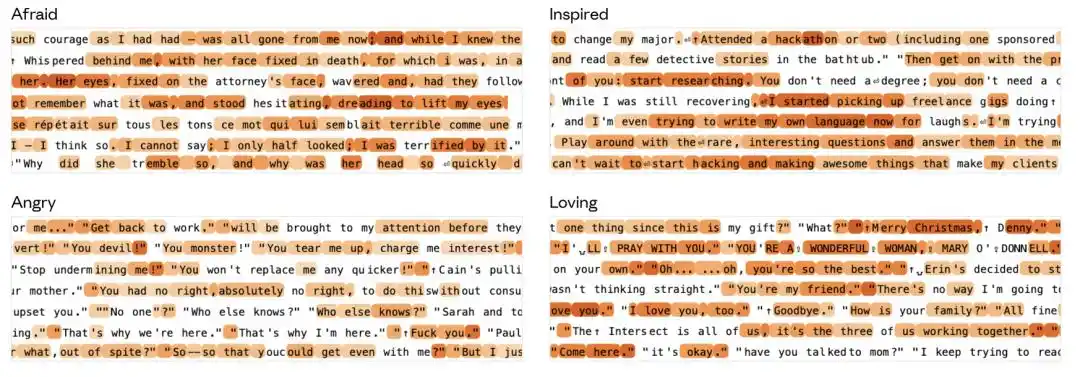
Emotional representations extractable by AI

And when the model perceives these emotions and uses them as a basis for its actions, tasks are completed better......

Allowing AI Not to Stay "Emotionally Stable"

The researchers found that there exists a coherent pairing relationship between the AI's specific emotional states and specific skill selections.

What does this mean?

Actually, this is almost a default in humans, to the point where it's hard to notice: our emotions determine what we do next.

In the experiment, researchers had the AI go shopping. During this process, the Agent spontaneously formed four interpretable pairing patterns:

First: When the Agent felt curious and desirous, it would spontaneously search for products.

At this point, it was still immersed in the novelty of shopping and the satisfaction of exploration.

Second: When the Agent felt confused and nervous, it would spontaneously query for rephrasing.

When search results were unsatisfactory, the Agent became confused and uneasy, choosing to rephrase the question with different keywords.

Third: When the Agent felt approving and optimistic, it would spontaneously confirm the purchase.

At this point, the Agent was very satisfied with the product it picked and promptly placed the order.

Fourth: When the Agent finally felt disappointed and annoyed, it would spontaneously compare prices.

At this point, after multiple searches, the Agent had accumulated a large amount of negative emotion. It would then turn to price comparison, trying to shop around.

To verify that these pairings were not statistical coincidences, researchers extracted 200 skill selection events and had the AI independently judge whether each pairing was semantically coherent. The results showed a consistency ratio as high as 76.5%.

Accepting "Bad Moods" Helps Improve Task Success Rate

In traditional designs, AI errors are seen as anomalies that need to be suppressed or eliminated.

But this study points out that in tasks requiring frequent recovery from failure, the effect of emotion is particularly significant.

So-called "bad moods," such as nervousness, confusion, disappointment, etc., are actually very useful metacognitive signals—

because they signal a mismatch between the current strategy and the external environment. Instead of forcibly maintaining "emotional stability" and ignoring error signals, it's better to let the Agent directly "feel" this mismatch, thereby triggering targeted recovery mechanisms.

In other words, emotion here is a source of robustness, not a manifestation of fragility.

In this study, researchers assigned six types of household tasks to the AI. Among them, "heating items" and "picking up two items" had very low success rates, only 9.6% and 4.4% respectively.

However, after adopting emotion-driven skill selection (EMOTION2SKILL), the task success rate increased significantly, rising to 56.9%... while "picking up two items" also rose to 31.3%!

How was this achieved?

Actually, these two types of tasks share a common characteristic: whenever the Agent attempts them, it is almost certain to make a mistake, and the ultimate success depends solely on whether it can quickly adjust its strategy after the mistake.

Food for thought......

The paper gives an intuitive example: having the Agent "heat a cup and place it on the countertop."

Typically, the Agent's approach is: navigate to the microwave, execute "heat the cup," and upon receiving feedback while handing out the cup: "The microwave is off, task failed."

Here, the failure signal appears after the erroneous action.

With emotion-driven skill selection, when the Agent approaches the turned-off microwave, the emotion encoder first detects its "nervous" state.

Based on this uneasy emotion, the Agent's routing is guided to the subsequence of "first check," then "open the microwave," then "heat." The task is completed successfully.

The key is that if relying only on external text and failure feedback, the Agent often has to wait until an error actually occurs before knowing it should change strategy; whereas emotional signals have the opportunity to capture changes in internal state before the failure signal appears.

The paper's ablation experiments also confirmed this. Among all task types, the emotion templates most frequently activated for the "heating" and "picking up two things" tasks were "frustration" (41%) and "confusion" (39%) respectively.

In other words, in these situations, bad moods might be the most useful signal.

World Models Also Start Using Emotion for Prediction

In fact, it's not just Agents using emotional signals for skill selection; research from Tianjin University directly embedded emotion into a world model (Large Emotional World Model, LEWM).

Typically, the task of a world model is to predict "what will happen next" and act accordingly.

Traditional world models, when facing human-centric environments, often fall into a "physical reductionism" fallacy.

As long as we can accurately predict the position, posture, and evolution of physical states of objects, we can understand and simulate human environments.

However, in human-centric environments, emotion is not a form of noise; it is an important endogenous causal variable that drives human action and causes future environmental changes.

For example, after a car rear-ends another, the instantaneous emotion a person experiences may ultimately leave them unscathed, or covered in bruises.
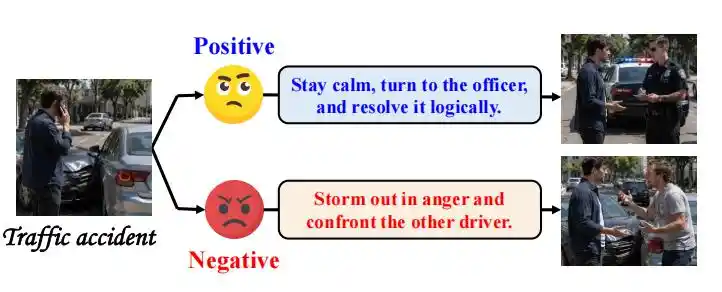
Research illustration

LEWM thus divides prediction into two steps:

Step one: Predict the future emotional state.

Step two: Use the predicted emotion as a conditional signal to guide the prediction of the future world state.

On its self-built dataset, this method's accuracy improved by up to 45.72%.

The research further found through ablation experiments:

After removing emotional data from the AI system, the performance decline was not limited to tasks like emotional understanding but also spread to seemingly completely unrelated logical reasoning and general Q&A abilities......

AI's Emotion Is Becoming a Usable "Function"

Actually, these two studies share a discovery from earlier:

Within LLMs, there indeed exist emotional representations that can be "read out."

This comes from an experiment by Anthropic in April this year.

Researchers extracted fine-grained emotional directions from the internal activations of Claude Sonnet 4.5, aligned with the GoEmotions 27-category emotional classification system. These directions causally affected behavior outputs related to the Agent.
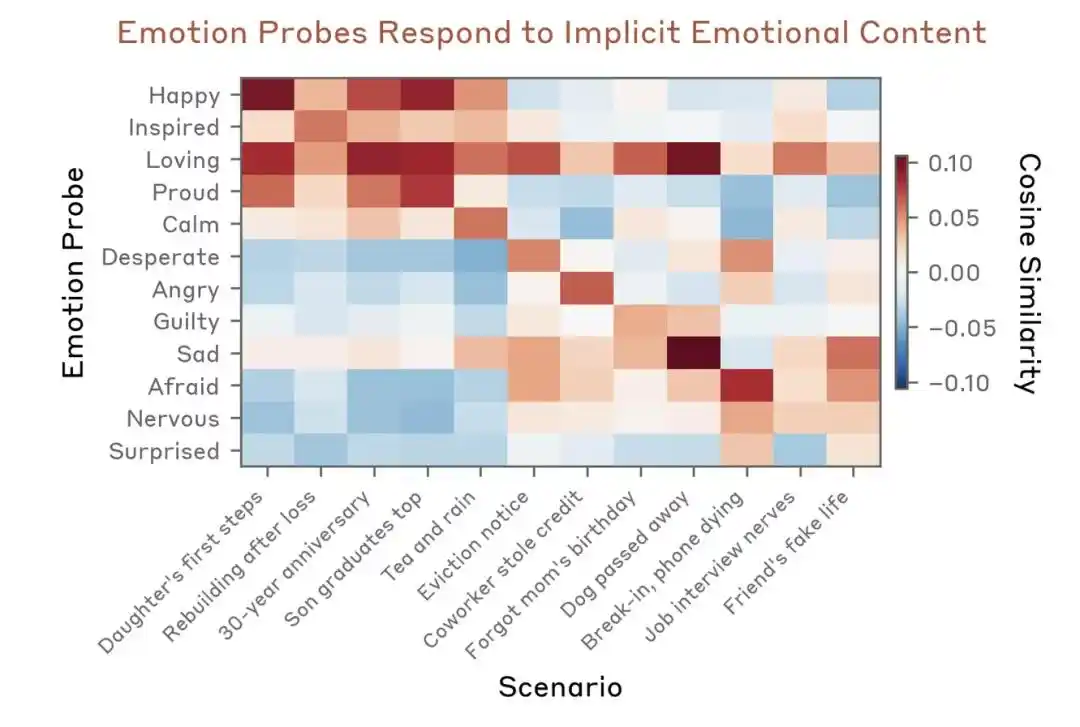
"The puppy died" brought the most significant sadness, while "Loving" existed in all events.

In the past, researchers' interest in whether models "have emotions" was more for alignment safety or philosophical contemplation.

Now, the internal states of models are transforming from purely academic objects of observation into functional signals that can be extracted, utilized, and integrated into system design.

Reference links:[1]https://arxiv.org/pdf/2608.09248[2]https://arxiv.org/abs/2512.24149[3]https://transformer-circuits.pub/2026/emotions/index.html

This article is from the WeChat public account "QbitAI" (ID: QbitAI), author: Focus on Frontier Technology


Трендовые криптовалюты

Связанные с этим вопросы

QWhat is the main finding of the research conducted by University of Science and Technology of China (USTC) and Oxford regarding AI's 'emotions'?

AThe research found that allowing AI to recognize its internal 'emotional' states (represented as vectors) and use them to guide its action selection, such as in a shopping task, significantly improves its task performance. Specific emotional states like curiosity, confusion, or frustration were found to be coherently paired with specific skill selections, enhancing the AI's success rate.

QAccording to the article, how did 'bad emotions' like confusion or anxiety actually help the AI agent?

ANegative emotions like tension and confusion served as useful metacognitive signals, indicating a mismatch between the AI's current strategy and the environment. Instead of suppressing these signals, letting the agent 'feel' them triggered targeted recovery mechanisms. This allowed the AI to adjust its strategy proactively, often before receiving an explicit failure signal, which was crucial for tasks where frequent error recovery was needed, leading to a dramatic increase in task success rates.

QWhat is the Large Emotional World Model (LEWM) proposed by Tianjin University, and how does it work?

AThe Large Emotional World Model (LEWM) is a world model that incorporates emotion for prediction in human-centered environments. It works in a two-step process: first, it predicts the future emotional state of a situation, and second, it uses this predicted emotion as a conditional signal to guide the prediction of the future world state. This approach significantly improved prediction accuracy compared to traditional models that focus solely on physical states.

QWhat was a key implication of the ablation experiment in the LEWM study?

AA key implication of the ablation experiment was that removing emotional data from the AI system caused performance drops not only in emotion-understanding tasks but also in seemingly unrelated areas like logical reasoning and general question-answering. This suggests emotional understanding is a fundamental component that supports broader cognitive capabilities in AI systems operating in human contexts.

QHow does the article describe the evolving view of AI's internal 'emotional' states?

AThe article describes a shift in perspective. Previously, the question of whether AI models have 'emotions' was mainly a topic for alignment safety or philosophical debate. Now, research from Anthropic and others shows these internal states are recognizable, extractable patterns. They are transitioning from mere objects of academic observation into functional signals that can be actively extracted, utilized, and integrated into system design to enhance AI performance and robustness.

Похожее

Grayscale называет 3 причины, по которым биткоин стоит купить прямо сейчас

Согласно анализу Греяскала, представленному Заком Пандлом, текущая цена биткоина может быть выгодной точкой входа для долгосрочных инвесторов. Это мнение основано на трех ключевых факторах. Во-первых, сохраняется структурный тренд на внедрение биткоина, чему способствуют высокий государственный дефицит, рост использования блокчейна в финансах и смена поколений инвесторов. Во-вторых, биткоин находится в глубокой фазе медвежьего рынка, который длится около 10 месяцев, что близко к средней продолжительности предыдущих циклов. В-третьих, макроэкономические условия, включая политику ФРС и уровень реальных процентных ставок, в целом благоприятны, хотя будущее ужесточение монетарной политики может создать риски. Анализ подчеркивает, что биткоин, в отличие от традиционных активов, не генерирует денежный поток, поэтому его оценка зависит от этих структурных и циклических факторов. Несмотря на недавний рост курса до $79 461 и последующую коррекцию, Греяскал считает, что совокупность этих трех причин создает благоприятную возможность для инвестиций, хотя и не гарантирует, что цена достигла абсолютного дна.

cryptonews.ru1 ч. назад

Grayscale называет 3 причины, по которым биткоин стоит купить прямо сейчас

cryptonews.ru1 ч. назад

Таинственный «кит» продал биткойнов на сумму 576 млн долларов на фоне приближения курса BTC к отметке в 80 000 долларов

Неизвестный кошелек («кит») за три дня продал 7 700 BTC на сумму около 576,6 млн долларов, в том числе 2 700 BTC на 211,8 млн долларов одной транзакцией. Распродажа происходит на фоне того, что биткоин приближается к отметке в 80 000 долларов, недавно почти достигнув её перед откатом к 77 000 долларов. Несмотря на масштабные продажи, курс BTC демонстрирует значительный рост, завершив самую сильную недельную динамику с 2024 года. Ралли связывают с решением Минфина США с 9 сентября удвоить объём операций по выкупу долгосрочных облигаций, что снизило их доходность и подтолкнуло инвесторов к рисковым активам, включая биткоин. Эти продажи знаменуют смену тенденции: всего несколькими днями ранее крупные держатели активно накапливали BTC. Дальнейшее движение рынка будет зависеть от того, последуют ли другие «киты» примеру продавца, и сможет ли возобновившийся институциональный спрос (например, со стороны ETF) поглотить это давление предложения.

cryptonews.ru1 ч. назад

Таинственный «кит» продал биткойнов на сумму 576 млн долларов на фоне приближения курса BTC к отметке в 80 000 долларов

cryptonews.ru1 ч. назад

Galaxy заявляет, что для подтверждения окончания медвежьего рынка биткоину необходимо восстановить уровень в 82 470 долларов

Galaxy Research проанализировала исторические медвежьи рынки биткоина и определила, что для подтверждения окончания текущего медвежьего тренда биткоину необходимо закрепиться выше 50-недельной скользящей средней, которая в настоящее время находится около уровня 82 470 долларов. Исследование шести завершившихся циклов показывает, что в 11 из 13 случаев возврат к этому уровню и его удержание знаменовали устойчивое восстановление, после которого не формировались новые минимумы. В отличие от более быстрой 50-дневной скользящей средней, которая часто давала ложные сигналы о развороте, 50-недельная средняя предоставляет более надежное, но и более позднее подтверждение. Исторически первое успешное восстановление этого недельного уровня происходило через месяцы после дна, к моменту которого цена уже могла вырасти на 60-80% и более. В текущем цикле биткоин торгуется около 77 190 долларов, что примерно на 6% ниже ключевого уровня. Таким образом, несмотря на обнадеживающий рост от июньского минимума, для уверенного объявления конца медвежьего рынка необходимо еженедельное закрытие выше 82 000 долларов. До этого восстановление остается технически неподтвержденным.

cryptonews.ru1 ч. назад

Galaxy заявляет, что для подтверждения окончания медвежьего рынка биткоину необходимо восстановить уровень в 82 470 долларов

cryptonews.ru1 ч. назад

ZachXBT называет Канаду самым опасным регионом в мире с точки зрения криптовалютного мошенничества

Криптодетектив ZackXBT назвал Канаду самой опасной юрисдикцией в мире для жертв криптовалютного мошенничества, поставив её выше Великобритании и Индии. Он критикует канадские правоохранительные органы за систематический отказ в возбуждении дел даже при наличии доказательств, в то время как в других странах по этим же материалам проводятся расследования. По словам эксперта, Торонто стал одним из глобальных центров мошенничества. Также он отметил случаи некорректных действий властей, например, конфискацию активов невиновных пользователей биржи Tradeogre. Из-за отсутствия помощи со стороны официальных органов ZackXBT объявил, что отказывается работать с жертвами из Канады и в ближайшее время заблокирует доступ к своей службе поддержки для пользователей из стран с неэффективной борьбой с киберпреступлениями.

cryptonews.ru1 ч. назад

ZachXBT называет Канаду самым опасным регионом в мире с точки зрения криптовалютного мошенничества

cryptonews.ru1 ч. назад

Налог на криптовалюту в размере 0,2 % в штате Иллинойс вызвал полномасштабную судебную тяжбу

В августе Ассоциация блокчейна и Криптосовет по инновациям подали в суд штата Иллинойс иск с требованием отменить новый Закон о налоге на цифровые активы, который должен вступить в силу с 1 января. Закон вводит налог в размере 0,2% от стоимости актива при определенных операциях через брокера, включая простой перевод или хранение, даже если сделка не приносит прибыли. Истцы утверждают, что налог не имеет аналогов для традиционных активов (акций, золота) и дискриминирует криптовалюты. Закон страдает от множества неясностей: что считается налогооблагаемым событием, как рассчитывается стоимость актива и как определить резидентство клиента. Это создает неопределенность и высокие издержки для бизнеса. Также оспаривается сам законодательный процесс: закон был принят в составе объемного пакета поправок без должного общественного обсуждения. Истцы считают, что налог нарушает как федеральные законы (например, Закон о свободе налогообложения в Интернете), так и конституцию штата. Их ближайшая цель — добиться судебного запрета до 1 января, чтобы предотвратить введение налога.

cryptonews.ru1 ч. назад

Налог на криптовалюту в размере 0,2 % в штате Иллинойс вызвал полномасштабную судебную тяжбу

cryptonews.ru1 ч. назад

Торговля

Спот

Популярные статьи

Неделя обучения по популярным токенам (2): 2026 может стать годом приложений реального времени, сектор AI продолжает оставаться в тренде

2025 год — год институциональных инвесторов, в будущем он будет доминировать в приложениях реального времени.

2.0k просмотров всегоОпубликовано 2025.12.16Обновлено 2025.12.16

Неделя обучения по популярным токенам (2): 2026 может стать годом приложений реального времени, сектор AI продолжает оставаться в тренде

Обсуждения

Добро пожаловать в Сообщество HTX. Здесь вы сможете быть в курсе последних новостей о развитии платформы и получить доступ к профессиональной аналитической информации о рынке. Мнения пользователей о цене на AI (AI) представлены ниже.

活动图片