Mining Artificial Intelligence: Why Bitcoin Miners Are Changing Their Business Model

cryptonews.ruОпубликовано 2026-08-15Обновлено 2026-08-15

Введение

"Bitcoin miners pivot to AI: Economic pressures and new opportunities drive business model shift." Major publicly-traded US bitcoin mining companies are shifting their business model away from solely cryptocurrency mining. They are repurposing their infrastructure for artificial intelligence (AI) and high-performance computing (HPC). This move is driven by rising mining costs and declining profitability following the 2024 halving and a 2025 BTC price drop. According to a CoinShares report, the average cost to mine one BTC exceeded its market price in late 2025, making operations unprofitable for many. Companies like IREN, HUT 8, and TerraWulf are now leveraging their existing data centers, power access, and cooling systems to provide infrastructure for AI firms. This transition is facilitated by multi-billion dollar contracts with tech giants; for example, HUT 8 secured a $7 billion deal, and IREN partnered with Microsoft for $9.7 billion. While this pivot requires replacing specialized ASIC mining hardware with GPUs suitable for AI computations, it offers a more stable and potentially lucrative revenue stream. The shift has temporarily reduced Bitcoin's hash rate, but a recovery is expected. Most mining companies' stock prices have risen significantly since the announcement of their AI ventures. Analysts predict that AI-related income could soon constitute the majority of these firms' revenue, fundamentally changing their core business from cryptocurrency mining to AI inf...

Many large public American (and not only) mining companies are moving away from the model involving almost exclusively cryptocurrency mining. They have repurposed their activities towards developing infrastructure for artificial intelligence-based developments and high-performance computing (HPC). The largest players are IREN (formerly Iris Energy), HUT 8, TerraWulf, Riot Platforms, Bitdeer, and Cipher Digital.

The Rising Cost of Mining

Any business, including mining, must first and foremost be profitable. Certain difficulties with profitability have emerged in the Bitcoin mining market following the 2024 halving and the decline in the value of $BTC in late 2025.

According to a report from investment company CoinShares, mining the largest cryptocurrency by market capitalization was unprofitable for public American companies in the last quarter of last year. The average cost to mine 1 $BTC was $79,995, while the market price was around $70,000. For TerraWulf, mining one coin at a certain point even cost $385,000. In other words, revenue did not cover expenses at all.

No less telling data is shown by the Bitcoin Hash Price Index, which indicates the expected daily revenue for a miner from one petahash per second of computing power. As of August this year, the indicator is near its historically low values around $32. This is almost half of what it was a year earlier, more than ten times lower than the peak in 2021, and more than a hundred times lower than the 2017 peak. In short, the same amount of power brings less revenue to miners each year.
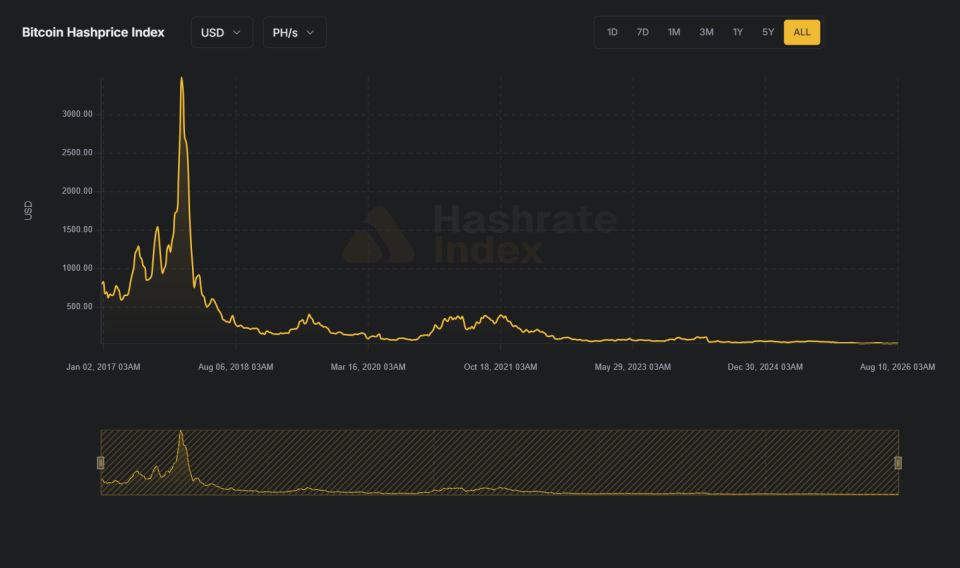
Source: hashrateindex.com

It turns out that large mining companies have faced realities where the economic feasibility of cryptocurrency mining has been called into question. Of course, the metrics above do not allow us to claim that Bitcoin mining suddenly became completely unprofitable everywhere. It's worth considering that miners in different countries and regions incur different costs: electricity and ASIC device prices vary, as do associated expenses like taxes, rent, and salaries for maintenance personnel. Equipment does not stand still and evolves, requiring timely replacement. Mining $BTC becomes less profitable for players unable to efficiently cover such costs.

However, there are other reasons for the shift to artificial intelligence.

Capital Availability

Let's clarify immediately: miners who previously mined Bitcoin do not themselves become AI operators. They merely provide their infrastructure to meet the needs of companies directly involved in artificial intelligence.

For providing their data centers, miners will receive very good money, which they did not have access to before. For example, HUT 8 signed a $7 billion deal to lease out its capacity, including the River Bend farm in Louisiana. The technical partners in the deal are the firm Anthropic, creator of the Claude neural network, and the cloud platform Fluidstack, with funding provided by tech giant Google and banks J.P. Morgan and Goldman Sachs.

IREN struck a deal with the world's largest software developer, Microsoft, for $9.7 billion. Microsoft thereby gains access to AI systems based on Nvidia GB-300 chips in Texas. And IREN will additionally purchase graphics processing units (GPUs) worth $5.8 billion from Dell Technologies, which is expected to bring in another $1.9 billion in annual revenue.

Economic Feasibility

Companies that have been exclusively mining cryptocurrency for years already have a certain infrastructure: specialized buildings, access to electricity, cooling systems. It's easier to repurpose a hypothetical data center from mining needs to AI needs than to build everything from scratch for the same Microsoft or Google. It's quite possible that fintech companies will someday switch to their own infrastructure, but that's not happening yet.

Speaking about converting mining farms for AI needs, it's necessary to understand that this doesn't happen in 100% of cases. New specialized data campuses will appear somewhere. Nevertheless, even here miners have it easier, as they know the specifics of data centers and have experience in organizational, operational-financial, and management issues. In other words, it is sometimes more profitable for large capital to delegate such matters to specialized companies.

Among the examples of infrastructure repurposing is the Bitdeer campus in the Norwegian municipality of Tydal.

ASIC Nuances

Modern large-scale cryptocurrency mining occurs primarily using highly specialized ASICs—equipment designed specifically for mining. Generally, an ASIC (Application Specific Integrated Circuit) is a special-purpose integrated circuit designed to solve one specific task. Such microchips can be implemented not only in mining but also in other fields where there is a need to minimize the cost of producing such equipment for specific needs.

ASIC miners themselves are different, which is related to the hashing algorithms used by specific coins. For example, Bitcoin uses the SHA-256 hashing algorithm, while Litecoin uses Scrypt. Manufacturers of such devices offer different and most often non-interchangeable units.

For instance, the manufacturer Bitmain releases the Antminer S21 model for the SHA-256 algorithm, the Antminer L9 for the Scrypt algorithm, and the Antminer D9—already for the X11 hashing algorithm. To explain in the simplest terms, an ASIC miner is a computing device from which everything unnecessary has been removed, increasing efficiency in mining cryptocurrencies and thereby reducing production costs.

On the other hand, advanced AI computations also require their own special technical capabilities. Moreover, even the efficiency of individual computations using graphics processing units (GPUs) varies depending on the manufacturer and specific model because their architectures differ fundamentally.

In other words, it's not enough to simply take down the "Mining" sign and hang up a new one—"Artificial Intelligence"—from a facility where coin mining previously took place and the corresponding ASICs stood. The equipment used will have to be replaced.

But did the reorientation of major American miners deal a decisive blow to Bitcoin?

What Happened to the Hashrate

The $BTC hashrate has definitely been influenced by miners moving into AI. From October 2025 to January 2026, the seven-day moving average of the hashrate fell by 28%, dropping from 1.15 EH/s to 0.83 EH/s. However, such dynamics shouldn't be too surprising, considering that American mining companies account for up to 40% of Bitcoin's total hashrate.
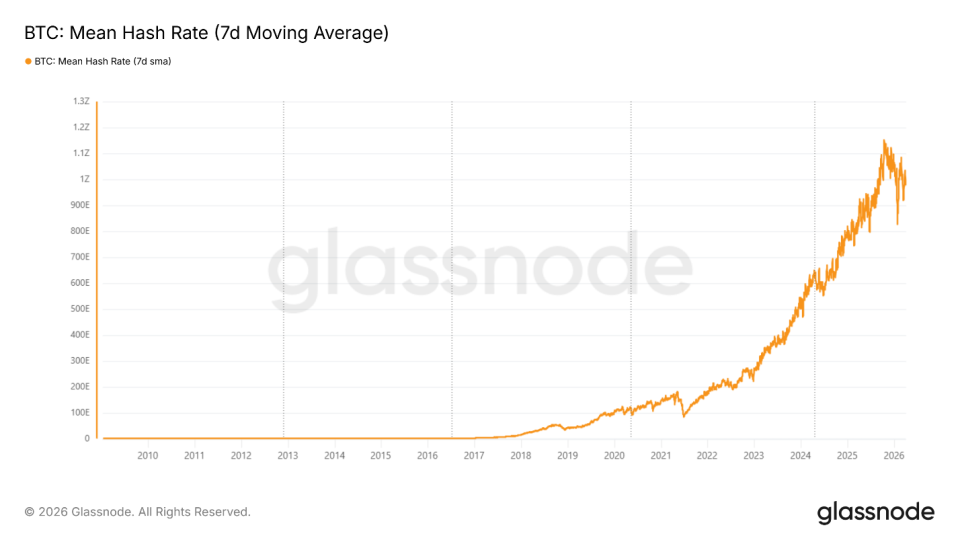
Source: studio.glassnode.com

By August 2026, some recovery in hashrate is already being observed. Its value fluctuates around 0.9 EH/s. Furthermore, according to CoinShares forecasts, the 1.8 EH/s mark should be broken by the end of the year, and by the end of 2027—2 EH/s.

It's worth remembering that reorienting towards AI does not mean miners are completely abandoning mining. In most cases, they are merely scaling back financial investments in this direction against the backdrop of expectations of greater profits from AI.

And how many bitcoins could miners potentially have mined if they hadn't reoriented to AI?

The Number of Missed Bitcoins

Actually, it's hardly possible to answer this question.

  • First, how to calculate it all? If miners had not started working on AI infrastructure, they would not have secured large contracts. Accordingly, this money cannot be factored into the potential expansion of the monetary base for mining. Similarly, the credit funds actively attracted by mining companies. From this angle—it seems the companies themselves may have earned even more than they could have without AI computing.

  • Second, the question: who missed out and how much? If we refer, for example, to Riot Platforms' report for the first quarter (data for the second quarter is not yet available), this company mined 1,473 $BTC. This is only 57 coins less than during the same period in 2025 (a 3.7% decrease). The change is more in the nature of a statistical error than a structural shift. Additionally, miners, without ceasing mining, are able to abandon further expansion in the field of mining and develop the AI direction as a short-term, highly profitable venture.

It is also worth considering here: if hypothetical IREN, TerraWulf, or HUT 8 did not mine $BTC, it means that only their balance sheets were not replenished. Bitcoin is still being mined as before, it's just that new coins went not to these companies' wallets but to other miners. The block reward remains fixed with predictable reduction during halvings and only the amount of network transaction fees changes. Moreover, if some major players suddenly switch off their power, it will become slightly easier for other participants to mine the cryptocurrency during the next network difficulty recalculation. In other words, these "bitcoins not mined by others" will still be mined somewhere in the world.

Miner Revenue

Amidst current economic/geopolitical instability, unfortunately, it's not yet possible to talk about exact figures. There are only forecast values. CoinShares believes that revenue from AI for mining companies will reach 70%, while at the beginning of the year it accounted for only 30%. In other words, the growth will be twofold. Essentially, if mining was the main activity for companies before, now it will become auxiliary. On the other hand, this doesn't mean mining will be abandoned for sure. Priorities will likely just be reassessed.

And how have such large-scale changes affected the stocks of cryptocurrency mining organizations?

Stocks and the Transition to AI

In most cases, the impact has been positive. Since the beginning of the year, the shares of five companies have shown price increases: IREN — 5.69%, Terra Wulf — 45.92%, MARA Holdings — 9.49%, Riot Platforms — 57.72%, Cipher Digital — 14.76%. The exception is Bitdeer, whose securities fell by 4.73%.

However, certain investor concerns regarding the transition to AI remain.

  • First, it's still unclear how successful this entire venture will be in the future. Will miners really be able to generate profits that cover all current and future costs?

  • Second, the transition from mining to developing infrastructure for artificial intelligence has forced a number of organizations to borrow huge sums. For TerraWulf — it's $5.7 billion, for IREN — $3.7 billion. Such a significant scale of debt load growth cannot but worry shareholders.

Conclusion

Large mining companies are transitioning from exclusively mining cryptocurrency to earning from AI due to economic feasibility and the availability of necessary infrastructure/management models. According to some forecasts, by the end of the year, the majority of their income will come from payments from AI operators, not from mining. The Bitcoin hashrate, after such companies reoriented their business, declined insignificantly and briefly but is already recovering. The stocks of most public miners are demonstrating price growth against the backdrop of business repurposing.

This material and the information in it are not individual or any other recommendation. The opinion of the editorial staff may not coincide with the opinions of analytical portals and experts.



end-content

Трендовые криптовалюты

Связанные с этим вопросы

QWhy are major Bitcoin mining companies shifting their business model away from pure cryptocurrency mining?

AThey are shifting due to the decreasing profitability of Bitcoin mining after events like the 2024 halving and the 2025 price drop, and the emergence of more lucrative opportunities in providing infrastructure for artificial intelligence (AI) and high-performance computing (HPC) for companies like Microsoft and Google.

QWhat are the key financial challenges that made Bitcoin mining less profitable for public US companies, according to the article?

AAccording to a CoinShares report, the average cost to mine one Bitcoin in the last quarter of the past year was $79,995, while the market price was around $70,000, making it unprofitable. Companies like TerraWulf even faced costs as high as $385,000 per coin at one point.

QHow do Bitcoin mining companies benefit from providing infrastructure for AI development?

AThey secure large, lucrative contracts by leasing their data centers and expertise. For example, HUT 8 secured a $7 billion deal, and IREN secured a $9.7 billion deal with Microsoft, providing them with revenue streams that were previously unavailable from mining alone.

QWhat was the impact on Bitcoin's hashrate when major miners began transitioning to AI, and what is the forecast?

ABitcoin's seven-day moving average hashrate dropped by 28%, from 1.15 EH/s to 0.83 EH/s between October 2025 and January 2026. However, it has since recovered to around 0.9 EH/s by August 2026. Forecasts predict it will reach 1.8 EH/s by the end of 2026 and 2 EH/s by the end of 2027.

QHow has the stock performance of major mining companies been affected by their pivot towards AI infrastructure?

AThe stock performance has been largely positive. Since the beginning of the year, shares of IREN, TerraWulf, MARA Holdings, Riot Platforms, and Cipher Digital have increased by 5.69%, 45.92%, 9.49%, 57.72%, and 14.76% respectively. Only Bitdeer's stock decreased by 4.73%.

Похожее

Pax Silica против WAICO: США хотят запретить Европе использовать китайский искусственный интеллект

США готовы потребовать от европейских и других партнеров отказаться от китайских проектов в сфере искусственного интеллекта под угрозой исключения из американской инициативы Pax Silica, сообщает Reuters со ссылкой на проект документа Госдепа. Страны-участницы альянса, включая многих европейцев, должны выбрать одну сторону: либо Pax Silica, либо конкурирующую структуру, подразумевая китайскую Всемирную организацию сотрудничества в области ИИ (WAICO). Этот ультиматум ставит государства, особенно европейские, перед сложным выбором между интеграцией в западную технологическую экосистему и сотрудничеством с альтернативными форматами, что может ограничить их возможности для диверсификации. Формирование двух противостоящих блоков — Pax Silica под руководством США и WAICO во главе с Китаем — ведет к фрагментации глобального технологического пространства. Это вынуждает страны и компании выбирать сторону, что приведет к росту издержек, снижению эффективности и созданию несовместимых стандартов. Решение партнеров определит конфигурацию мировой цифровой экономики на десятилетия вперед, смещая приоритеты с экономической эффективности на технологический суверенитет.

cryptonews.ru3 ч. назад

Pax Silica против WAICO: США хотят запретить Европе использовать китайский искусственный интеллект

cryptonews.ru3 ч. назад

Ставка Пола Тюдора Джонса на биткоин-ETF компании Blackrock достигла 22,9 млн долларов

Хедж-фонд Пола Тюдора Джонса Tudor Investment Corp увеличил свою позицию в биткоин-ETF Blackrock iShares Bitcoin Trust (IBIT). По данным отчета 13F на 30 июня, фонд владеет 688 529 акциями IBIT на сумму $22,9 млн, что на 18,9% больше, чем в предыдущем квартале. Хотя эта доля незначительна для фонда с активами в $106 млрд, она отражает растущий тренд среди традиционных управляющих активами использовать спотовые биткоин-ETF для доступа к криптовалюте. Джонс, давний сторонник биткоина как средства защиты от инфляции, последовательно наращивает инвестиции в BTC, перейдя от фьючерсов к регулируемым ETF. Его позиция, впервые раскрытая в 2020 году, эволюционировала в постоянную статью портфеля. Доминирующий ETF Blackrock привлекает институциональных инвесторов, занимая около 49% рынка спотовых биткоин-ETF США. Устойчивость этой стратегии станет яснее после публикации отчетов за третий квартал в ноябре.

cryptonews.ru5 ч. назад

Ставка Пола Тюдора Джонса на биткоин-ETF компании Blackrock достигла 22,9 млн долларов

cryptonews.ru5 ч. назад

Роберт Кийосаки рассказал о прогнозе своего наставника относительно появления биткоина и ИИ

Американский предприниматель и автор книги «Богатый папа, бедный папа» Роберт Кийосаки рассказал о влиянии футуриста Ричарда Бакминстера Фуллера на своё мировоззрение. Он связал давние прогнозы своего наставника с появлением биткоина и развитием искусственного интеллекта, назвав Фуллера «дружелюбным гением», предвидевшим эти изменения. В публикации Кийосаки также поделился размышлениями о жизненном предназначении, вспомнив переломную встречу с Фуллером. Он процитировал его слова о том, что истинное предназначение человека заключается в максимальной пользе для других. Параллельно предприниматель подтвердил свою веру в цифровые активы. Он регулярно заявляет о покупках биткоина во время паники на рынке и считает криптовалюты защитой от проблем традиционной финансовой системы. Ранее Кийосаки прогнозировал масштабный обвал рынков и называл биткоин, Ethereum, золото и серебро ключевыми активами для подготовленных инвесторов, ожидая от них значительного роста в будущем.

cryptonews.ru5 ч. назад

Роберт Кийосаки рассказал о прогнозе своего наставника относительно появления биткоина и ИИ

cryptonews.ru5 ч. назад

Глава Etherealize назвал закрытые блокчейны Уолл-стрит «гонкой ко дну»

Сооснователь и генеральный директор Etherealize Вивек Раман раскритиковал растущий интерес Уолл-стрит к закрытым блокчейнам с ограниченным доступом. Он заявил, что консорциумные сети дробят ликвидность и создают изолированные системы, от которых изначально должна была избавить технология блокчейна. Раман назвал эту тенденцию «гонкой ко дну», подрывающей ключевые преимущества — совместимость и концентрацию ликвидности. Etherealize продвигает Ethereum в качестве открытого базового слоя для институциональных игроков. Раман настаивает, что приватность и контроль доступа логичнее реализовывать на уровне приложений или вторых слоёв (L2) поверх публичной инфраструктуры, а не создавать отдельные закрытые сети. Он сравнил Ethereum с протоколом HTTP, а дополнительные приватные уровни — с HTTPS. В качестве примеров новых закрытых решений он привёл Canton Network от Digital Asset, проект Arc от Circle и Tempo от Stripe, назвав их «консорциумными цепочками 2.0». Раман напомнил о более ранних инициативах, таких как R3 и Hyperledger, которые так и не получили широкого развития. Он подчеркнул убеждённость своей компании в необходимости глобальной открытой permissionless-инфраструктуры в качестве основы. Ранее, в июне, он также отмечал, что традиционные финансовые организации начали внедрять решения на базе Ethereum в реальные бизнес-процессы.

cryptonews.ru5 ч. назад

Глава Etherealize назвал закрытые блокчейны Уолл-стрит «гонкой ко дну»

cryptonews.ru5 ч. назад

Основатель DeFiLlama опустошил собственный кошелек, чтобы заставить Apple удалить фейковое приложение

Анонимный основатель аналитического сайта DeFiLlama, 0xngmi, был вынужден позволить мошенническому приложению украсть свои средства, чтобы доказать Apple факт мошенничества и добиться удаления поддельного приложения из App Store. Несмотря на многомесячные жалобы компании на нарушение товарных знаков и выдачу себя за другое лицо через официальные каналы, Apple не предпринимала действий. Только после того, как основатель пополнил кошелек, установил приложение-клон и подтвердил кражу средств, компания удалила приложение через несколько дней. Поддельное приложение было простой копией, созданной для кражи сид-фраз пользователей. Мошенники использовали для верификации данные несуществующего мелкого бизнеса. Этот инцидент заставил DeFiLlama отложить запуск официального приложения. Проблема поддельных приложений распространена: аналогичные случаи фиксировались с Hyperliquid и Uniswap, где пользователи теряли крупные суммы из-за клонов и мошеннической рекламы в Google и магазинах приложений.

cryptonews.ru5 ч. назад

Основатель DeFiLlama опустошил собственный кошелек, чтобы заставить Apple удалить фейковое приложение

cryptonews.ru5 ч. назад

Торговля

Спот

Популярные статьи

Тест по Bitcoin Биткоина

HTX Learn: Изучите Bitcoin halving и Заработаете Токены USDT

3.3k просмотров всегоОпубликовано 2024.04.16Обновлено 2024.04.16

Тест по Bitcoin  Биткоина

Что такое $BITCOIN

ЦИФРОВОЕ ЗОЛОТО ($BITCOIN): Комплексный анализ Введение в ЦИФРОВОЕ ЗОЛОТО ($BITCOIN) ЦИФРОВОЕ ЗОЛОТО ($BITCOIN) — это проект на основе блокчейна, работающий в сети Solana, который стремится объединить характеристики традиционных драгоценных металлов с инновациями децентрализованных технологий. Хотя он носит имя Биткойн, часто называемого “цифровым золотом” из-за его восприятия как средства хранения ценности, ЦИФРОВОЕ ЗОЛОТО является отдельным токеном, предназначенным для создания уникальной экосистемы в ландшафте Web3. Его цель — позиционировать себя как жизнеспособный альтернативный цифровой актив, хотя детали его применения и функциональности все еще развиваются. Что такое ЦИФРОВОЕ ЗОЛОТО ($BITCOIN)? ЦИФРОВОЕ ЗОЛОТО ($BITCOIN) — это токен криптовалюты, специально разработанный для использования в блокчейне Solana. В отличие от Биткойна, который выполняет широко признанную роль хранения ценности, этот токен, похоже, сосредоточен на более широких приложениях и характеристиках. Примечательные аспекты включают: Инфраструктура блокчейна: Токен построен на блокчейне Solana, известном своей способностью обрабатывать высокоскоростные и недорогие транзакции. Динамика предложения: ЦИФРОВОЕ ЗОЛОТО имеет максимальное предложение, ограниченное 100 квадриллионами токенов (100P $BITCOIN), хотя детали о его обращающемся предложении в настоящее время не раскрыты. Утилита: Хотя точные функциональные возможности не описаны, есть указания на то, что токен может быть использован для различных приложений, потенциально связанных с децентрализованными приложениями (dApps) или стратегиями токенизации активов. Кто создатель ЦИФРОВОГО ЗОЛОТА ($BITCOIN)? На данный момент личность создателей и команды разработчиков, стоящих за ЦИФРОВЫМ ЗОЛОТОМ ($BITCOIN), остается неизвестной. Эта ситуация типична для многих инновационных проектов в области блокчейна, особенно тех, которые связаны с децентрализованными финансами и феноменом мем-криптовалют. Хотя такая анонимность может способствовать культуре, ориентированной на сообщество, она усиливает опасения по поводу управления и ответственности. Кто инвесторы ЦИФРОВОГО ЗОЛОТА ($BITCOIN)? Доступная информация указывает на то, что у ЦИФРОВОГО ЗОЛОТА ($BITCOIN) нет известных институциональных спонсоров или значительных венчурных капиталовложений. Проект, похоже, функционирует по модели пирингового взаимодействия, сосредоточенной на поддержке и принятии сообществом, а не на традиционных путях финансирования. Его активность и ликвидность в основном сосредоточены на децентрализованных биржах (DEX), таких как PumpSwap, а не на устоявшихся централизованных торговых платформах, что еще больше подчеркивает его подход, ориентированный на grassroots. Как работает ЦИФРОВОЕ ЗОЛОТО ($BITCOIN) Операционные механизмы ЦИФРОВОГО ЗОЛОТА ($BITCOIN) можно подробно описать на основе его дизайна блокчейна и характеристик сети: Механизм консенсуса: Используя уникальный механизм доказательства истории (PoH) Solana в сочетании с моделью доказательства доли (PoS), проект обеспечивает эффективную валидацию транзакций, что способствует высокой производительности сети. Токеномика: Хотя конкретные дефляционные механизмы не были подробно описаны, большое максимальное предложение токенов подразумевает, что оно может быть предназначено для микротранзакций или нишевых случаев использования, которые еще предстоит определить. Интероперабельность: Существует потенциал для интеграции с более широкой экосистемой Solana, включая различные платформы децентрализованных финансов (DeFi). Однако детали относительно конкретных интеграций остаются неуточненными. Хронология ключевых событий Вот хронология, которая подчеркивает значимые вехи, касающиеся ЦИФРОВОГО ЗОЛОТА ($BITCOIN): 2023: Первоначальное развертывание токена происходит в блокчейне Solana, отмеченное его адресом контракта. 2024: ЦИФРОВОЕ ЗОЛОТО приобретает видимость, когда оно становится доступным для торговли на децентрализованных биржах, таких как PumpSwap, позволяя пользователям обменивать его на SOL. 2025: Проект наблюдает спорадическую торговую активность и потенциальный интерес к инициативам, возглавляемым сообществом, хотя на данный момент не зафиксировано никаких значительных партнерств или технических достижений. Критический анализ Сильные стороны Масштабируемость: Основная инфраструктура Solana поддерживает высокие объемы транзакций, что может повысить полезность $BITCOIN в различных сценариях транзакций. Доступность: Потенциально низкая цена торговли за токен может привлечь розничных инвесторов, способствуя более широкому участию благодаря возможностям дробного владения. Риски Отсутствие прозрачности: Отсутствие публично известных спонсоров, разработчиков или процесса аудита может вызвать скептицизм относительно устойчивости и надежности проекта. Волатильность рынка: Торговая активность сильно зависит от спекулятивного поведения, что может привести к значительной волатильности цен и неопределенности для инвесторов. Заключение ЦИФРОВОЕ ЗОЛОТО ($BITCOIN) является интригующим, но неоднозначным проектом в быстро развивающейся экосистеме Solana. Хотя он пытается использовать нарратив “цифрового золота”, его отход от установленной роли Биткойна как средства хранения ценности подчеркивает необходимость более четкого различения его предполагаемой утилиты и структуры управления. Будущее принятие и усвоение, вероятно, будут зависеть от решения текущей непрозрачности и более четкого определения его операционных и экономических стратегий. Примечание: Этот отчет охватывает синтезированную информацию, доступную на октябрь 2023 года, и с тех пор могут произойти события.

468 просмотров всегоОпубликовано 2025.05.13Обновлено 2025.05.13

Что такое $BITCOIN

Fractal Bitcoin: масштабирование Биткоина с помощью рекурсивной системы

Fractal Bitcoin — масштабное Layer-1-решнение, созданное на базе кода Биткоина, позволяющего достигать бесконечного масштабирования с помощью рекурсивного подхода.

2.5k просмотров всегоОпубликовано 2025.06.30Обновлено 2025.06.30

Fractal Bitcoin: масштабирование Биткоина с помощью рекурсивной системы

Обсуждения

Добро пожаловать в Сообщество HTX. Здесь вы сможете быть в курсе последних новостей о развитии платформы и получить доступ к профессиональной аналитической информации о рынке. Мнения пользователей о цене на BTC (BTC) представлены ниже.

活动图片