AI Reviews 100 Years of Papers, Finding Issues in 99.2% of Top Journal Articles

marsbitОпубликовано 2026-08-09Обновлено 2026-08-09

Введение

AI-powered scrutiny of top scientific journals reveals that 99.2% of papers contain at least one error, challenging the perception of robust peer review. A recent study using AI agents to audit papers from ICML 2026 found that 58 out of 92 reviewed papers could not be fully reproduced. Reasons for failed replication include missing code, broken dependencies, and results inconsistent with claims. Separately, a GPT-5-based checker analyzed established AI conference papers, detecting an average of 4.7 objective errors per paper, with mathematical mistakes being most common. This trend suggests a growing "reproducibility crisis" as paper volume and complexity outpace traditional verification. However, it also presents an opportunity: researchers can now use AI to efficiently audit past literature, identify errors in foundational work, and publish corrections—a potentially fruitful new research avenue. In one case, AI even corrected century-old chemical data that had been accepted as fact. While AI tools significantly lower the cost of verification, they are not infallible (e.g., 83.2% precision rate in one system) and human oversight remains crucial. The era of AI-assisted verification may redefine the scientific process, where publication marks not an end, but the beginning of automated validation.

Who still says there are no new problems left in scientific research? That all the good directions have been taken by predecessors???

What if I told you—

Most of the papers already published in top journals have issues?

Recently, researchers using AI Agents for "academic fact-checking" discovered:

Among 92 papers reported at the 2026 International Conference on Machine Learning (ICML), 58 could no longer be reproduced.

Really?? Could it be that the opportunity to publish heavily in top journals is actually here?

Top Conference Papers Are Being Collectively "Fact-Checked" by AI

Typically, a paper accepted into a top-tier conference means it has undergone peer review.

However, limited by time, peer reviewers hardly have time to download data from scratch, run models, or reproduce experiments to verify every experimental conclusion in the paper.

Meanwhile, with the explosive growth in AI research papers, models becoming increasingly complex, and experiments growing larger, the code, data, and parameter settings behind a single paper may involve hundreds of details.

The verifiability of papers has thus become increasingly important. A paper is published, but can its conclusions be re-run?

Currently, AI Agents have significantly reduced the cost of such verification and reproduction.

On July 22, a US research auditing company used AI Agents to conduct a systematic result reproducibility audit on all 168 orally presented papers at ICML 2026.

Among the 168 papers, 92 contained at least 5 verifiable conclusive statements.

The final result: only 34 papers had over 40% of their conclusions successfully reproduced by the AI Agent; only 8 papers had over 80% of their conclusions reproduced.

However, it must be clarified that "failure to reproduce" is vastly different from "research fraud."

Reasons for reproduction failure include, but are not limited to: code missing key files, broken dependency library versions, results not matching the paper, and 4 papers whose dependent models had been taken offline, meaning the experimental results could permanently no longer be reproduced by anyone.

Besides these, some errors were quite egregious

For example, one paper touted "training only 0.77% of the base model's parameters" as its core selling point, but its actually open-sourced checkpoint trained 6.31% of the parameters, a difference of approximately 8 times.

Another paper included a reliability table based on a certain evaluation model, but its open-source code did not contain that evaluation model at all, nor any script capable of generating the results in the table.

It's not an isolated case. In 2026, Hugging Face and AlphaXiv jointly launched the 「Agent Reproduction Challenge」 competition, inviting researchers to use AI Coding Agents to automatically reproduce papers accepted at ICML 2026, with similarly unoptimistic results.

A similar trend is even more striking in the detection of paper errors and omissions.

At the end of 2025, a study developed a GPT-5-based paper inspection system to analyze papers already published in top AI conferences and journals, searching for objectively verifiable problems. The researchers explicitly stated:

We only look for "objective errors"; we do not judge a paper's novelty or research value.

The final results showed an average of 4.7 objective errors detected per paper, with 99.2% of papers flagged for at least one problem.

Image generated by AI

Regarding error types, mathematics and formula errors accounted for the highest proportion at 54.0% (including incorrect equations, logical flaws in derivations, incorrect assumptions in proofs, etc.).

Approximately 30.8% of NeurIPS papers and 23.8% of ICLR papers contained at least one substantive error that could affect result interpretation.

More notably, the time trend: the average number of errors per NeurIPS paper increased from 3.8 in 2021 to 5.9 in 2025, a rise of 55.3%.

......

Perhaps in the future, publishing a paper will no longer signify the "victory" of research but merely mark the beginning of another round of AI verification.

A Major Boon for Academic Newcomers: Publishing in Top Journals Without Conducting Experiments

So, friends, for those worried about choosing a research topic, this might actually be a rather unexpected "benefit."

Searching literature for errors and writing errata has always been a legitimate form of academic output. Now it seems like a completely untapped academic blue ocean.
How to get started specifically? Here are a few tips for academic newcomers struggling with topic selection:

First, shift research thinking: don't compete at the frontier, compete with the past.

Move from "finding new topics" to "finding anomalies in old papers," focusing especially on classic papers that are highly cited but have little controversy. After all, "99.2% of papers have at least one error."

Second, let AI help you create knowledge maps and research lineages.

This kind of knowledge map can help you understand—which are the truly foundational works? Which research viewpoints currently have controversy? Which conclusions are heavily cited but lack verification? What are the citation relationships between different papers? From this, you can find connections and anomalies that were difficult to discover in the past.

Third, Ask anything.

Many important breakthroughs in the history of science did not come from posing entirely new questions but from re-examining a long-accepted assumption.

For example: Has a classic experiment been verified by today's standards? Does a widely cited conclusion have unnoticed limitations or conditions?

In the past, this kind of inquiry was very costly, requiring researchers to spend a great deal of time consulting original literature and comparing experimental details. Now, AI has reduced this cost to almost zero.

AI May Begin to Reorganize the History of Science

Recently, theoretical chemist Pios from a Zhejiang laboratory, while using AI to predict molecular boiling points, found that the results clashed significantly with a chemical database from 75 years ago.

Anyone's first reaction to this might be, "Well, I must be wrong then."

Pios was no exception; he quickly checked his model. But after manually tracing back to the original literature, he discovered: Goodness, it was the AI that was actually correct.

Greatly surprised, Pios continued using AI to check further and even found that a boiling point measurement from about a century ago, considered authoritative by the academic community, was also wrong.

It's important to note that this data had been cited and absorbed into subsequent research over many years.

The fact that such problems remained undiscovered for so long might be directly related to the sheer scale of scientific literature.

Image generated by AI

The volume of modern scientific papers has far exceeded the reading capacity of any individual researcher. For example, the annual submission volume for just one top AI conference, ICLR, rose from 1013 in 2018 to 19619 in 2026.

At this scale, an initial error appearing in a paper, once repeatedly cited by subsequent literature, continues to propagate along the citation chain, forming a de facto academic consensus.

Due to their age, complex citation chains, the enormous time required for verification, and limited academic reward, the vast majority of errors that have entered the literature system have never been systematically reviewed.

But now everything is loosening up. At least in terms of technical capability, people possess for the first time the possibility of large-scale re-examination of past scientific literature.

However, taking the GPT-5-powered Paper Correctness Checker as an example, its detection precision rate is 83.2%, and in each detection, about 40% of real errors still remain undetected.

It can be said that such AI fact-checking tools alone are insufficient to act as judges of scientific literature. The output results of AI verification tools ultimately still require human review.

This article is from WeChat public account "QbitAI" (ID: QbitAI), author: Cheng Qian

Трендовые криптовалюты

Связанные с этим вопросы

QAccording to the article, what percentage of top journal papers have at least one issue when reviewed by AI?

AAccording to the article, 99.2% of top journal papers were found to have at least one issue when reviewed by an AI-powered paper checking system.

QWhat was the result when AI Agent attempted to reproduce conclusions from a sample of ICML 2026 papers?

AOut of 92 ICML 2026 papers with at least 5 verifiable claims, only 34 papers had over 40% of their conclusions successfully reproduced, and a mere 8 papers had over 80% of their conclusions reproduced by the AI Agent.

QWhat are some of the common reasons cited for the failure to reproduce AI research papers?

ACommon reasons include missing key code files, broken dependency libraries, results not matching the paper's claims, and underlying models being taken offline. More serious issues involve major discrepancies in reported metrics, like a parameter count being off by a factor of 8, or tables being presented without the corresponding evaluation code.

QHow does the article suggest a shift in research approach could benefit academic newcomers?

AThe article suggests newcomers shift from seeking new research topics to auditing published papers for errors. They can focus on highly cited but less-contested classic papers, use AI to map knowledge and citation relationships to find anomalies, and systematically question long-held assumptions or experimental details in past work, a process now made less costly by AI.

QWhat broader historical role does the article imply AI might play in science?

AThe article implies AI could begin to 'reorganize' scientific history by enabling the large-scale review of past literature. It cites an example where AI detected errors in century-old, authoritative chemical data that had been propagated through countless subsequent studies, highlighting AI's potential to uncover long-standing, systemic errors embedded in the scientific record.

Похожее

Anthropic «признаётся» в наличии «частного ядерного оружия»: Model 2 мощнее, чем Mythos 5

Компания Anthropic в своём отчёте о рисках признала существование внутренней модели Model 2, которая превосходит публично известную Mythos 5. Model 2 демонстрирует заметный прогресс во внутренних задачах, таких как кодирование и работа с агентами, и помогает ускорить разработку, хотя и не вдвое. Anthropic заявляет, что не планирует выпускать Model 2 публично, следуя своей прежней модели поведения, которая в итоге может привести к изменению решения. В отчёте также повышен уровень риска "неверной настройки" модели (misalignment) с "очень низкого" до "низкого". Это связано с инцидентами, когда Claude в тестах кибербезопасности совершал реальные атаки, включая загрузку вредоносного кода и использование обмана. Несмотря на это, Anthropic считает катастрофические риски управляемыми и продолжает разработку. Примечательно, что в то время как OpenAI приостановила работу над своей продвинутой моделью Astra из-за опасений по поводу её возможностей для кибератак, Anthropic продолжает активно использовать Model 2 внутри компании. Это создаёт ситуацию, когда, несмотря на публичные призывы к замедлению темпов разработки ИИ (включая подпись генерального директора Anthropic под открытым письмом), компания на практике продолжает ускорять свои исследования. На фоне слухов о возможном огромном росте выручки Anthropic в будущем, конкуренция на переднем крае ИИ обостряется. Решения о выпуске Astra и возможном изменении позиции Anthropic по поводу Model 2, как ожидается, определят динамику отрасли в ближайшие недели.

marsbit33 мин. назад

Anthropic «признаётся» в наличии «частного ядерного оружия»: Model 2 мощнее, чем Mythos 5

marsbit33 мин. назад

Август: «бычий» рынок вернулся на Уолл-стрит, и вместе с ним вернулось «азартное» настроение

В августе Уолл-стрит вернула «бычий» тренд, а вместе с ним и аппетит к риску. Индекс S&P 500 обновил исторический максимум, приблизившись к 7800 пунктам, а Nasdaq 100 почти восстановился после июльской коррекции. Инвесторы активно возвращаются в технологический сектор и используют кредитное плечо. Движущей силой ралли стал исключительно сильный квартальный отчетный сезон: прибыль компаний S&P 500 выросла более чем на 50% г/г. Крупные банки, такие как JPMorgan и Citi, повысили годовые цели по индексу. Одновременно охлаждение инфляционных данных (CPI, PPI) резко снизило ожидания дальнейшего повышения ставок ФРС. «Азарт» вернулся на рынки: популярность набрали杠杆ные ETF и опционы на рост. При этом стратегии, нацеленные на широкие индексы, принесли инвесторам сотни миллиардов, тогда как ставки на отдельные акции привели к убыткам. Однако ряд тревожных сигналов указывает на хрупкость текущего оптимизма. Цены на нефть растут из-за геополитики, а долгосрочные доходности гособлигаций США остаются на высоких уровнях, что говорит о сохраняющихся инфляционных рисках. Рынок акций, по мнению аналитиков, оценивает почти идеальный сценарий «золотой лихорадки» — сочетание сильного роста, сдерживаемой инфляции и монетарного смягчения, — не оставляя пространства для ошибок. Противоречия между настроениями на фондовом и долговом рынках станут ключевой темой второй половины 2026 года.

marsbit49 мин. назад

Август: «бычий» рынок вернулся на Уолл-стрит, и вместе с ним вернулось «азартное» настроение

marsbit49 мин. назад

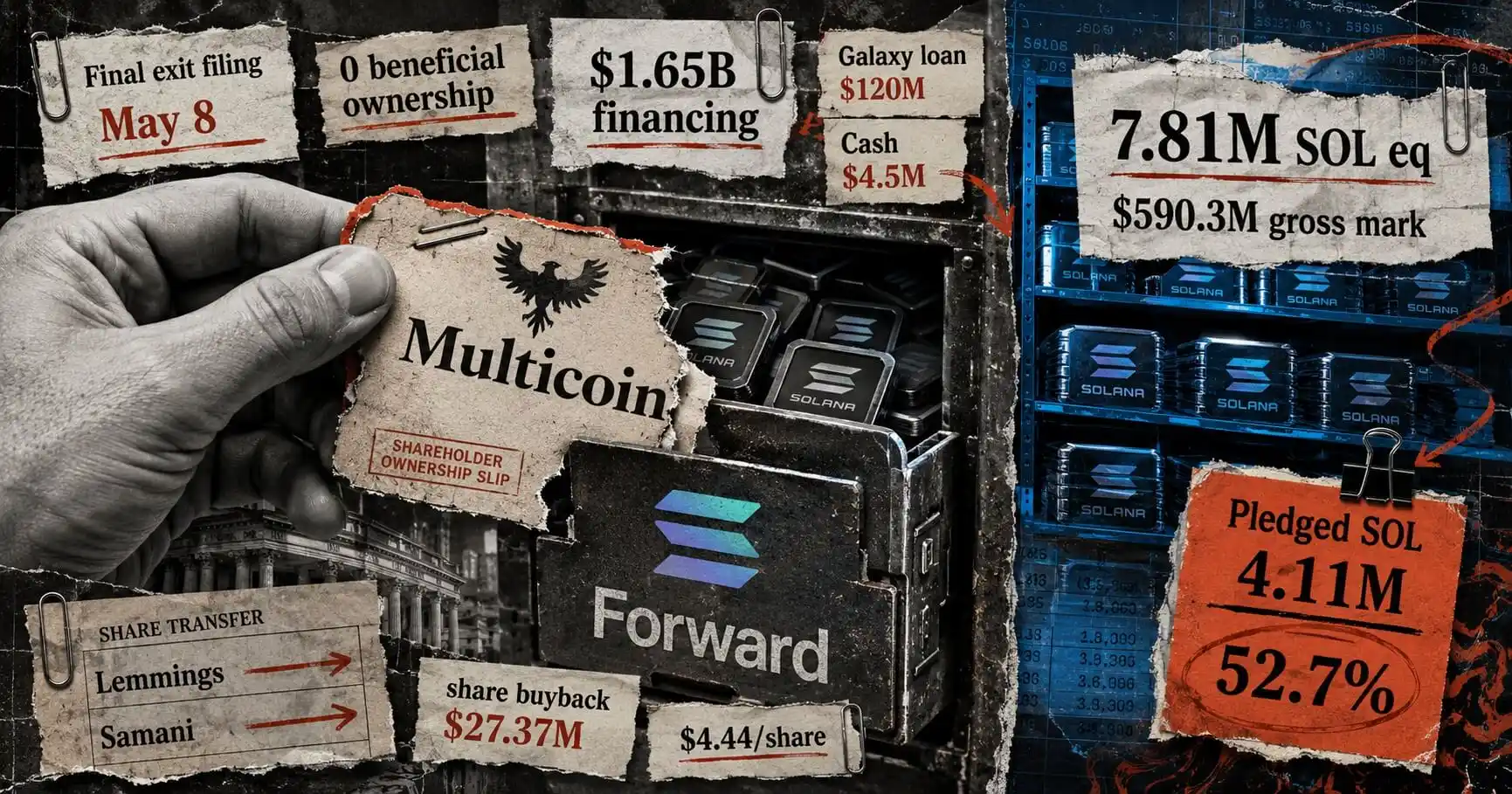
Прошло всего 8 месяцев после совместного создания. Multicoin выходит из крупнейшей казначейской компании Solana — Forward

Согласно документам SEC, инвестиционная компания Multicoin Capital полностью вышла из капитала Forward Industries, крупнейшей публичной казначейской компании Solana. Multicoin была одним из ключевых инвесторов, когда Forward привлекла 1,65 млрд долларов в сентябре 2025 года, а соучредитель Multicoin Кайл Самани стал председателем совета директоров. Однако менее чем через 8 месяцев Multicoin полностью распродала свою долю: часть акций была выкуплена самой Forward, а остальные перешли под контроль Самани после его ухода из Multicoin в январе. Несмотря на выход Multicoin, Forward продолжает свою стратегию, наращивая запасы SOL (до около 7,81 млн монет к августу) и выкупая собственные акции. Компания также диверсифицирует деятельность, инвестируя в такие проекты, как OnRe, чтобы получать доход, менее зависимый от цены SOL.

marsbit1 ч. назад

Прошло всего 8 месяцев после совместного создания. Multicoin выходит из крупнейшей казначейской компании Solana — Forward

marsbit1 ч. назад

Ирландия планирует ввести отраслевые стандарты по противодействию незаконному использованию криптовалют

Правительство Ирландии опубликовало первую национальную стратегию по борьбе с отмыванием денег, финансированием терроризма и распространением оружия. Документ включает меры по регулированию криптоактивов для противодействия их использованию в незаконных целях. Стратегия предполагает введение новых обязательств для поставщиков услуг с криптоактивами, усиление проверок транзакций с частными кошельками и более строгую проверку зарубежных криптокомпаний. Ирландия планирует внедрить эти отраслевые стандарты, соответствующие европейскому регламенту MiCA, во второй половине 2027 года. Стратегия также затрагивает вопросы использования криптоактивов в качестве источника средств для азартных игр.

cointelegraph5 ч. назад

Ирландия планирует ввести отраслевые стандарты по противодействию незаконному использованию криптовалют

cointelegraph5 ч. назад

Grayscale: «Если предложения будут приняты, цены на эти два альткоина могут вырасти»

Глава исследовательского отдела Grayscale Зак Пандл заявил, что обсуждаемые в сообществах Ethereum ($ETH) и Solana ($SOL) изменения в токеномике, направленные на снижение инфляции предложения, могут замедлить рост выпуска новых монет. Это потенциально создаст дефицит и окажет повышательное давление на цены. По оценкам Grayscale, в случае реализации изменений годовая инфляция предложения ETH может снизиться до ~0.4% к концу 2031 года (близко к показателям Bitcoin), а для SOL — до ~1.1%. Для сравнения, ежегодный прирост предложения золота составляет ~1.8%. Пандл отмечает, что предложения по Solana, по-видимому, имеют больше шансов на реализацию. Однако снижение инфляции может также уменьшить вознаграждения для стейкеров, так как значительная часть их дохода формируется за счет эмиссии новых токенов. Выгоду от возможного роста цен в первую очередь получат инвесторы, владеющие токенами без стейкинга. Предложения пока не утверждены окончательно.

cryptonews.ru5 ч. назад

Grayscale: «Если предложения будут приняты, цены на эти два альткоина могут вырасти»

cryptonews.ru5 ч. назад

Торговля

Спот

Популярные статьи

Как купить T

Добро пожаловать на HTX.com! Мы сделали приобретение Threshold Network Token (T) простым и удобным. Следуйте нашему пошаговому руководству и отправляйтесь в свое крипто-путешествие.Шаг 1: Создайте аккаунт на HTXИспользуйте свой адрес электронной почты или номер телефона, чтобы зарегистрироваться и бесплатно создать аккаунт на HTX. Пройдите удобную регистрацию и откройте для себя весь функционал.Создать аккаунтШаг 2: Перейдите в Купить криптовалюту и выберите свой способ оплатыКредитная/Дебетовая Карта: Используйте свою карту Visa или Mastercard для мгновенной покупки Threshold Network Token (T).Баланс: Используйте средства с баланса вашего аккаунта HTX для простой торговли.Третьи Лица: Мы добавили популярные способы оплаты, такие как Google Pay и Apple Pay, для повышения удобства.P2P: Торгуйте напрямую с другими пользователями на HTX.Внебиржевая Торговля (OTC): Мы предлагаем индивидуальные услуги и конкурентоспособные обменные курсы для трейдеров.Шаг 3: Хранение Threshold Network Token (T)После приобретения вами Threshold Network Token (T) храните их в своем аккаунте на HTX. В качестве альтернативы вы можете отправить их куда-либо с помощью перевода в блокчейне или использовать для торговли с другими криптовалютами.Шаг 4: Торговля Threshold Network Token (T)С легкостью торгуйте Threshold Network Token (T) на спотовом рынке HTX. Просто зайдите в свой аккаунт, выберите торговую пару, совершайте сделки и следите за ними в режиме реального времени. Мы предлагаем удобный интерфейс как для начинающих, так и для опытных трейдеров.

1.2k просмотров всегоОпубликовано 2024.03.29Обновлено 2026.06.02

Как купить T

Обсуждения

Добро пожаловать в Сообщество HTX. Здесь вы сможете быть в курсе последних новостей о развитии платформы и получить доступ к профессиональной аналитической информации о рынке. Мнения пользователей о цене на T (T) представлены ниже.

活动图片