Qualcomm: AI Hype Subsides, When Will Smartphones Emerge from the Gloom?

marsbitОпубликовано 2026-08-03Обновлено 2026-08-03

Введение

Qualcomm reported its Q3 FY2026 results (ending June 2026), with revenue of $9.95B, down 4% YoY but above expectations. Gross margin declined to 53.1%, pressured by rising costs across manufacturing and memory. Key business segments showed mixed performance: Handset revenue fell 19.6% YoY to $5.09B, dragged by an 11% decline in non-Apple Android shipments and weaker high-end mix. Conversely, Automotive revenue surged 61% to $1.59B, and IoT grew 9% to $1.83B. Core operating profit dropped 41% YoY due to margin compression and higher expenses. Management's Q4 FY2026 guidance projects revenue of $9.7B-$10.5B, in line with consensus, but Non-GAAP EPS guidance of $2.05-$2.25 fell short of expectations. Amidst persistent weakness in its core handset market, Qualcomm is pursuing growth in AI, focusing on Edge AI (smartphones, PCs, automotive) and Data Center AI. Its data center strategy includes four pillars: AI accelerators (e.g., AI200), commercial CPUs (Dragonfly C1000), custom silicon, and connectivity solutions. While these initiatives initially boosted its stock, concerns over AI capital expenditure sustainability have since erased those gains. The company targets $5B in data center revenue for FY2027 and $15B for FY2029. The report concludes that with the traditional handset business still under pressure, the data center opportunity is currently viewed as a longer-term option, and a more conservative valuation based on core operations may be warranted until AI contributio...

Qualcomm (QCOM.O) released its fiscal year 2026 third-quarter earnings report (ending June 2026) after the U.S. market closed on the morning of July 30, 2026, Beijing time. Key points are as follows:

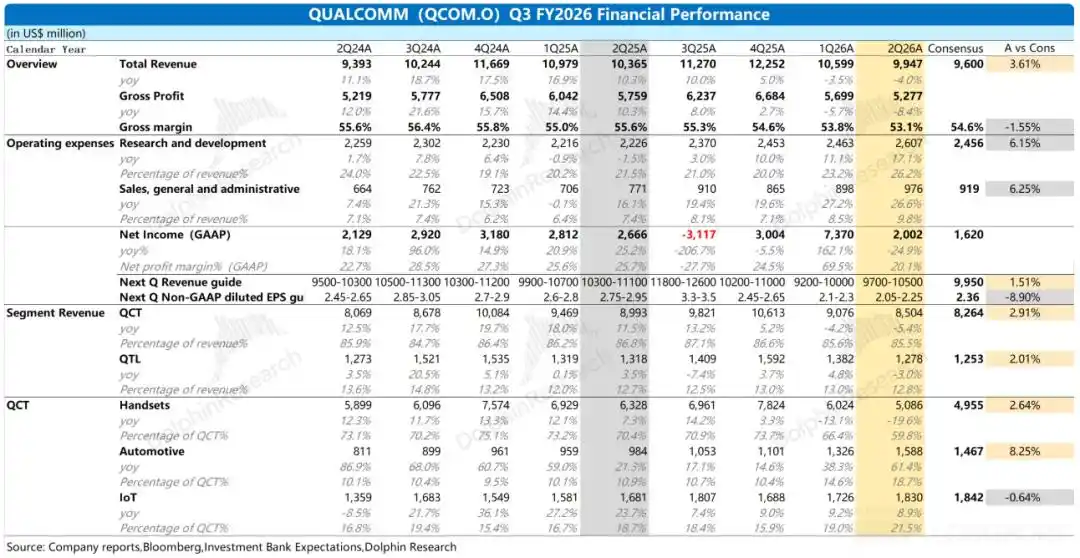
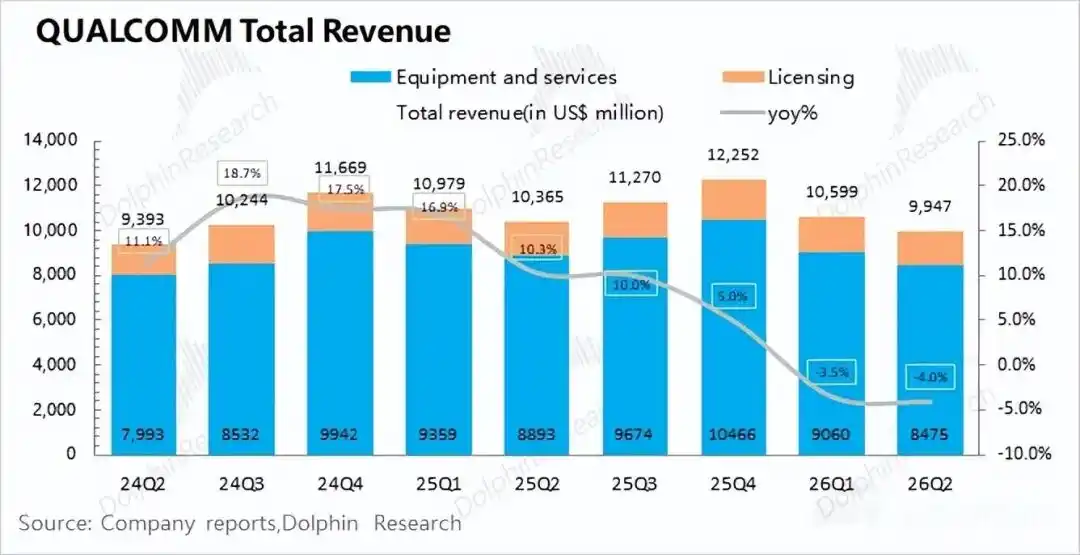
1. Core Data: Qualcomm's revenue for this quarter was $9.95 billion, down 4% year-over-year, better than market expectations ($9.6 billion). Despite significant growth in the automotive business, revenue was still dragged down by the decline in the handset business.

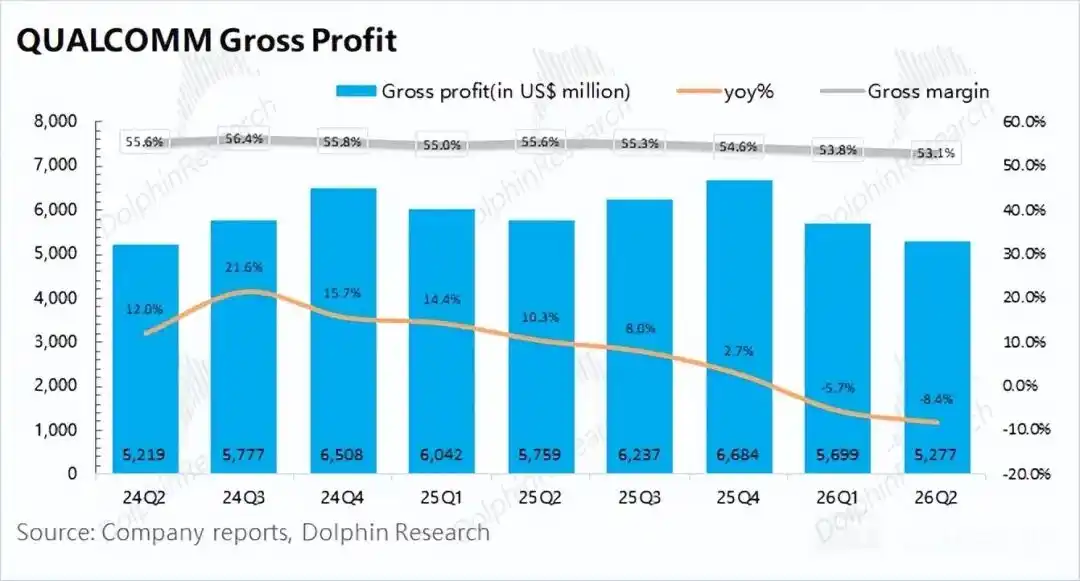
The company's gross margin for this quarter was 53.1%, down 2.5 percentage points year-over-year, below market expectations (54.6%). Increases in costs across wafer fabrication, packaging, testing, advanced packaging, memory, and other materials put significant pressure on the company's gross margin.

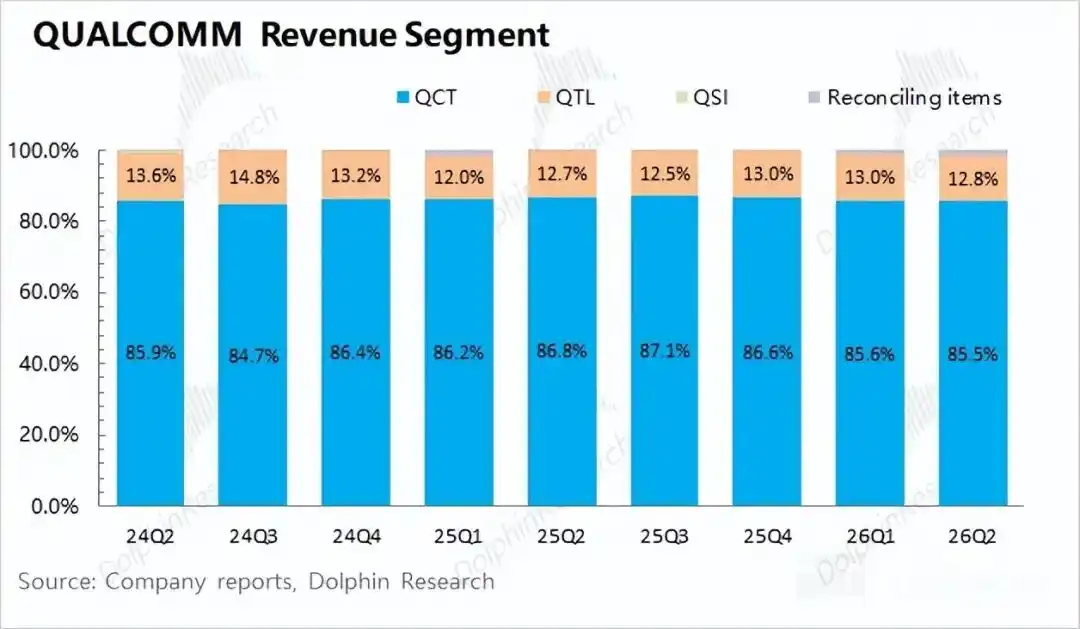
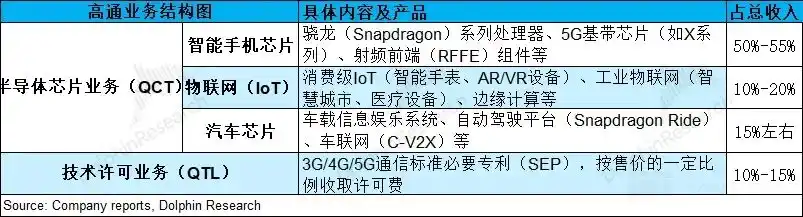
2. Business Segment Details: $Qualcomm's (QCOM.US) business is primarily divided into the Semiconductor Chip business (QCT) and the Technology Licensing business (QTL), with the Semiconductor Chip business being the largest revenue source, accounting for over 80%.

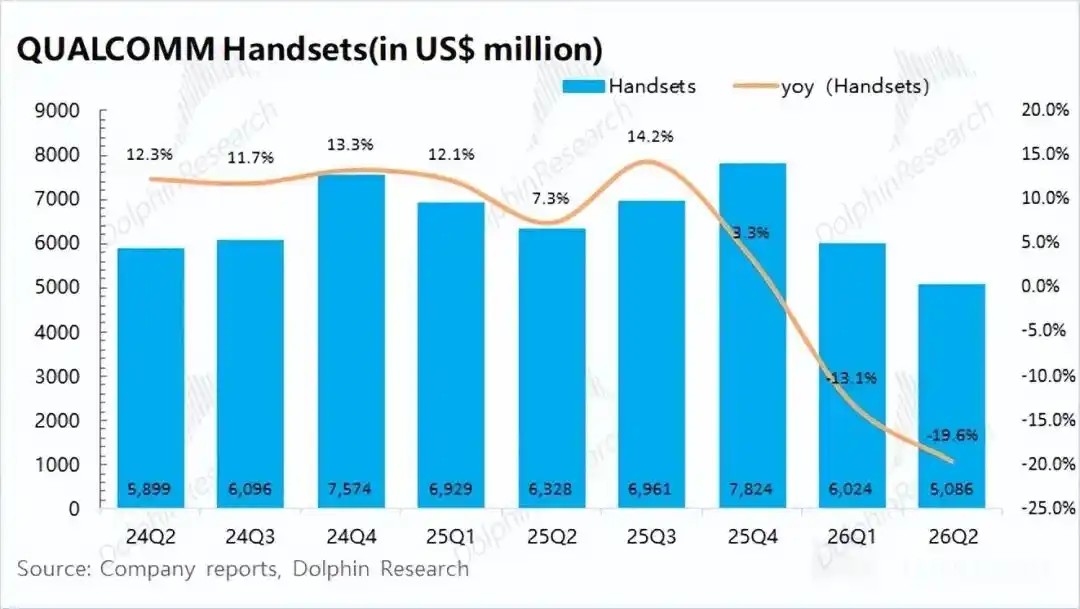
Within the Semiconductor Chip business: 1. Handset business this quarter was $5.09 billion, down 19.6% year-over-year. The decline in the company's handset business was mainly influenced by two factors: Firstly, industry-wide factors, as handset shipments (excluding Apple) fell 11% this quarter; secondly, a weakening internal mix towards premium models, with handset manufacturers tending to use previous-generation platforms to reduce costs.

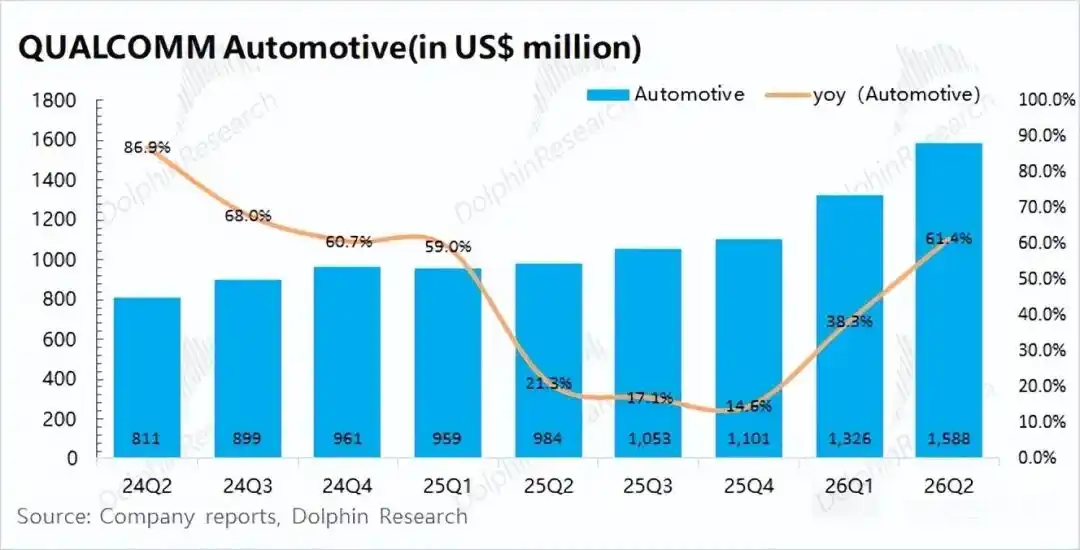
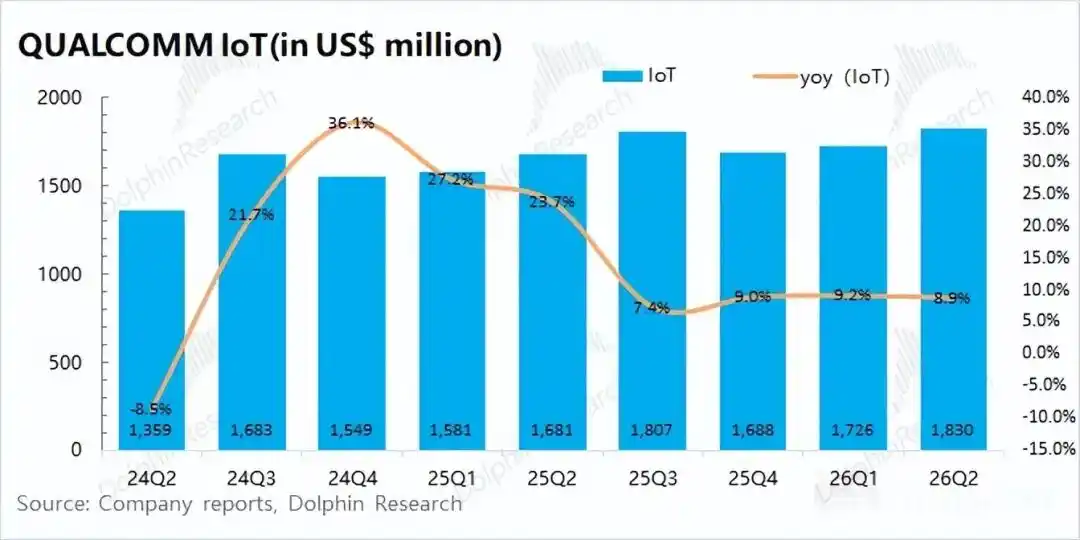
2. Automotive business this quarter was $1.59 billion, up 61% year-over-year, driven by shipments of the fourth-generation Snapdragon Digital Chassis. The company's fifth-generation Snapdragon Digital Chassis will ramp up production in September, with significantly higher value per vehicle. 3. IoT business this quarter was $1.83 billion, up 9% year-over-year, with growth driven by consumer and industrial product demand.

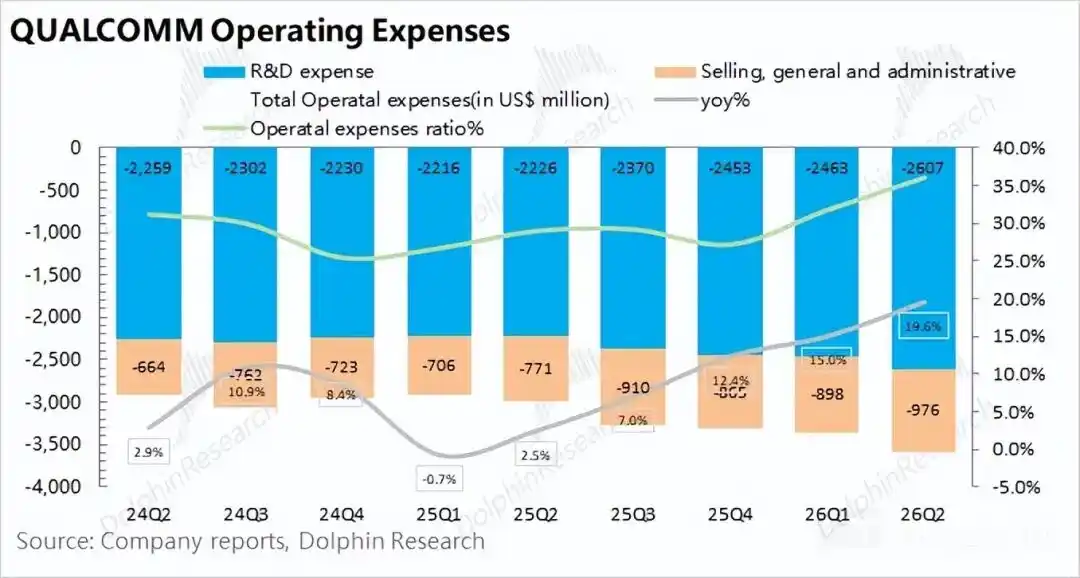
3. Operating Expenses: The company's core operating expenses increased to approximately $3.6 billion, with R&D expenses rising to $2.6 billion this quarter and SG&A expenses amounting to $980 million for the quarter.

The company reported net income of $2.0 billion for the quarter, following the release of a valuation allowance for deferred tax assets (approximately $5.7 billion) in the previous quarter. From an operational perspective, core operating profit for the quarter was $1.63 billion, down 41% year-over-year, primarily due to lower gross margin and increased expenses.

4. Next Quarter Guidance: Qualcomm expects fiscal Q4 2026 revenue of $9.7-$10.5 billion, in line with market expectations ($9.95 billion).; The company expects Non-GAAP EPS for the next quarter to be $2.05-$2.25, below market expectations ($2.36).
Dolphin Research's Overall View: Memory Weighs on Handsets, Data Center "Promises" Await Fulfillment

Qualcomm's earnings report this time remains tepid. While revenue met market expectations, it continues to show a declining trend. Gross margin continues to fall, primarily due to factors like memory price increases and weak demand, leading to higher costs.

Looking at the guidance for the next quarter, the company expects revenue of $9.7-$10.5 billion, showing no clear signs of recovery; while Non-GAAP EPS is expected to be $2.05-$2.25, below market expectations ($2.36). Demand in end markets like handsets remains weak, and factors like memory price increases will continue to pressure the company's costs.
While its traditional core business is sluggish, the company is actively seeking breakthroughs in the data center domain. It plans to focus on four areas: custom chips, commercial CPUs, AI accelerators, and connectivity products. This initially pushed the company's stock price above $250. As market concerns grew about the sustainability of AI Capex, the stock price fell back below $160, essentially erasing the gains brought by data center prospects.

Beyond this earnings report, the market is focusing on the following aspects of Qualcomm:

1) Traditional Domains: The Core Business, Bearing the Pressure of Memory

The handset business is Qualcomm's largest segment, accounting for over half of its business. Its weak performance amidst the overall sluggish handset market puts significant pressure on the company's results. Global handset shipments this quarter remained at 290 million units, down 6% year-over-year.

The handset market mainly consists of Apple and Android. Looking in detail, Apple's handset shipments grew nearly 20% year-over-year this quarter. Shipments for the rest of the Android camp fell approximately 11% year-over-year, directly impacting Qualcomm's handset business performance this quarter.
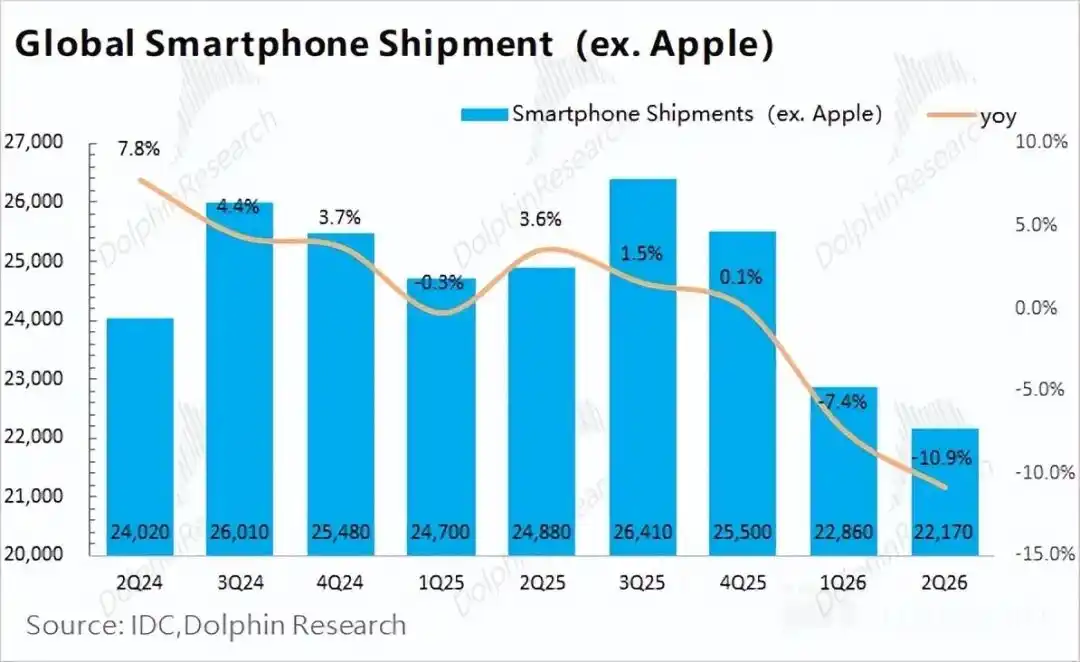
The company expects next quarter's handset business to be around $5.2 billion, down about 25% year-over-year, with Android sequential growth partially offset by declining Apple product revenue (seasonal uptick in the second half, the traditional peak season).

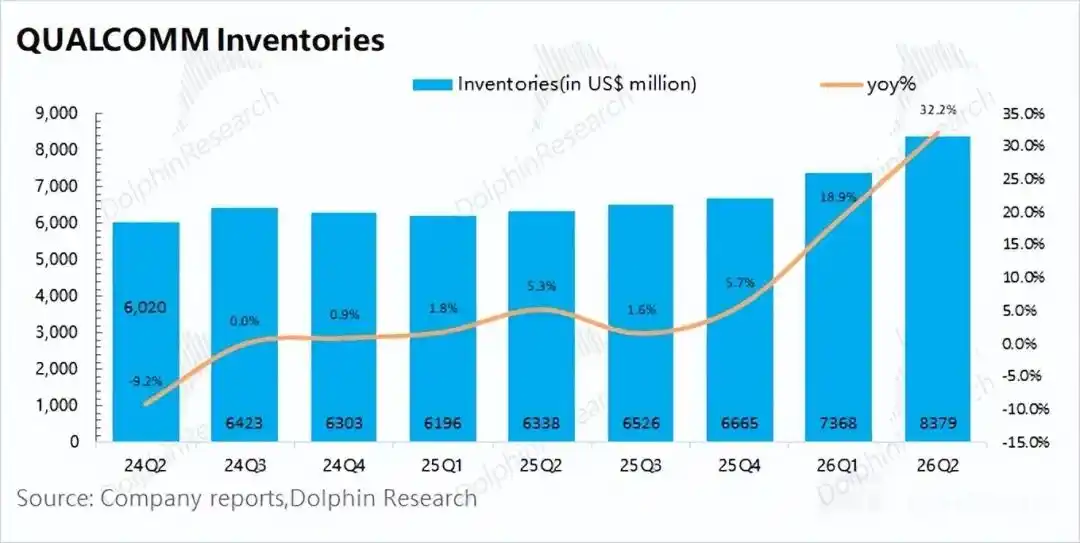
The recent pace of memory price increases has started to slow. As seen in OPPO and VIVO rejecting price hikes from memory suppliers, the "skyrocketing memory" has caused market discontent. If the memory cycle turns downward subsequently, pressure on the company's traditional core business may ease.

2) AI Domain: On-Device AI and Data Center, Potential Growth Markets

While traditional markets are weak, the company is also actively laying out in the AI field, hoping for new breakthroughs.

a) On-Device AI: The company views on-device AI as a core part of its Physical AI strategy, covering all end devices like smartphones, PCs, cars, XR, robots, and industrial IoT, areas where the company already has a presence.

The two main areas: 1. The potential replacement cycle driven by AI Phones, as AI Agents become the "new interface" for smartphones; 2. In the AI PC domain, the company has launched the Snapdragon C platform (for Windows laptops), with core advantages in: Oryon CPU, low-power AI inference, heterogeneous computing (CPU+GPU+NPU collaboration, supporting on-device AI Agent operation).

b) AI Data Center: Qualcomm ultimately couldn't resist entering the main AI arena, which is also the company's most notable strategic plan in the AI field.

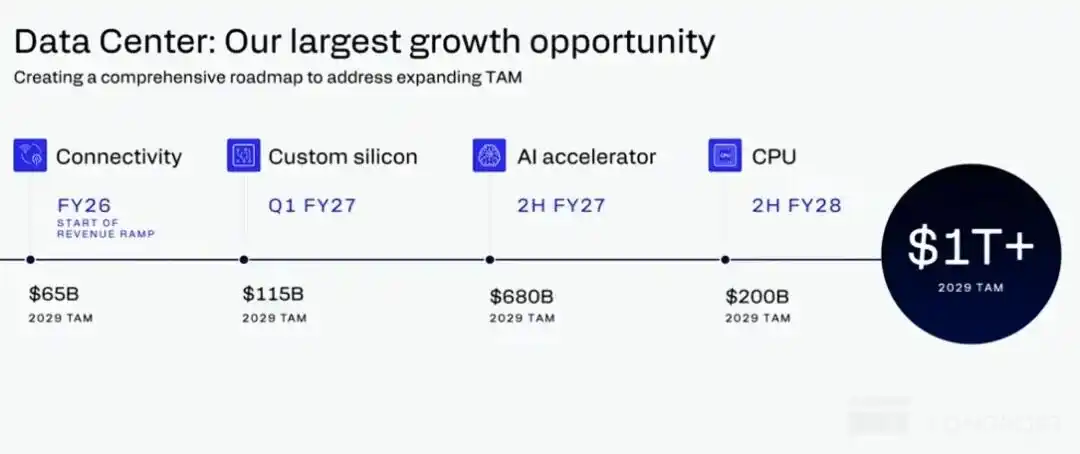
At its investor day on June 24, 2026, Qualcomm disclosed that its AI data center strategy will cover four product lines:

1. AI Accelerators (HBC): Microsoft confirmed a multi-generation partnership.

Qualcomm's core differentiated technology, using LPDDR5X (vs. HBM) to enable Processing Near Memory, optimized for memory-capacity-intensive AI inference workloads.

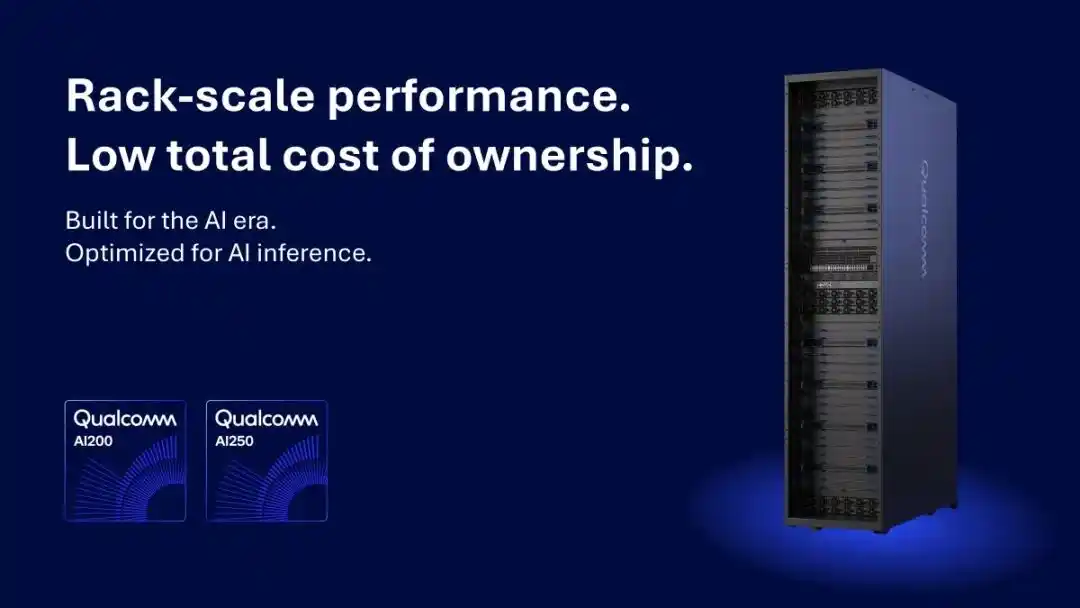
AI200 is currently ramping production; the next-gen AI250 is expected to sample in 2027. Subsequent AI300 will be based on UALink and ESUN for Scale-up network interconnection, with effective bandwidth 54 times that of AI200.
2. Commercial CPU (Dragonfly C1000): Meta confirmed a multi-generation partnership.

This is primarily based on Qualcomm's Oryon CPU architecture from smartphones and PCs, extended to the data center. Positioned as an "Agentic CPU," specifically for CPU-intensive workloads like agent orchestration, multi-step reasoning, and tool invocation.

3. Custom Silicon Business: Confirmed 2 hyperscale customers (each contributing $1 billion+ in FY2027)

This is based on capabilities acquired from Alphawave Semi (SerDes, Die-to-Die, PCIe/CXL, HBM PHY) and Ventana (Veyron V2 RISC-V CPU), primarily providing custom AI chip (XPU) design services to hyperscale customers.

4. Connectivity Business: Secured first hyperscale customer.

Based on Alphawave IP, offering products like 800G/1.6T optical modules, AOCs, AECs. The company currently has 800G LR2 modules, 800G optical modules/AOCs/AECs in production; 1.6T optical modules/AOCs/AECs expected in 2026-2027.
Previously, driven by AI hype, the company's move into the AI data center field once pushed its stock price above $250. Now, with concerns over AI Capex, the stock has fallen back to around $160, erasing the growth expectations from data centers.

Although the company estimates the AI data center business market opportunity at $1 trillion, its data center business currently doesn't contribute significant revenue. Looking back at the traditional business, with weak end markets like handsets, the company's current P/E multiple is actually relatively high.

As for the data center business, while management has set a $15 billion revenue target for FY2029, the focus should currently be on nearer-term performance. Based on the company's FY2027 data center revenue target of $5 billion, this could contribute about $1.2 billion in operating profit (referencing the company's OPM).

In the current fragile market environment, it's more prudent to look for Qualcomm's relatively safe bottom range. From a traditional business perspective, a further decline in the stock price is safer. Of course, this essentially treats the data center business as "an option."

If the company's FY2027 targets are met, they will inject valuation expectations for the data center segment.

Below are relevant charts from Dolphin Research regarding this Qualcomm earnings report:
This article is from the WeChat public account "Dolphin Investment Research" (ID: haituntouyan), author: Dolphin Research


Трендовые криптовалюты

Связанные с этим вопросы

QAccording to the article, what were the key financial highlights of Qualcomm's Q3 2026 earnings report?

AIn its Q3 2026 earnings report, Qualcomm's revenue was $9.95 billion, a 4% year-over-year (YoY) decline but surpassing market expectations of $9.6 billion. The company's gross margin was 53.1%, a decrease of 2.5 percentage points YoY, which fell below market expectations of 54.6%. Net profit reached $2 billion.

QWhat were the main factors causing the decline in Qualcomm's mobile phone business revenue in Q3 2026?

AThe decline in Qualcomm's mobile phone business revenue, which fell 19.6% YoY to $5.09 billion, was primarily attributed to two factors: first, a broader industry downturn where smartphone shipments (excluding Apple) declined by 11% in the quarter; second, a weakening structure within the high-end smartphone market, where manufacturers tended to use previous-generation platforms to reduce costs.

QWhat are the four key product lines in Qualcomm's AI data center strategy as mentioned in the article?

AQualcomm's AI data center strategy comprises four key product lines: 1) AI Accelerators (HBC), with Microsoft as a confirmed multi-generation partner; 2) Commercial CPUs (Dragonfly C1000), with Meta as a confirmed multi-generation partner; 3) Custom Silicon, with two confirmed hyperscale customers expected to contribute over $1 billion each in fiscal year 2027; and 4) Connectivity Business, which has secured its first hyperscale customer.

QWhat is the outlook for Qualcomm's mobile phone business in the next quarter (Q4 2026) according to the article?

AFor the next quarter (Q4 2026), Qualcomm expects its mobile phone business revenue to be approximately $5.2 billion, representing a year-over-year decline of around 25%. The article notes that this forecast includes some seasonal recovery in Android phone shipments, which is partly offset by a decline in revenue from Apple's products.

QHow does the article characterize the market's current view of Qualcomm's AI data center business, and what is the company's related financial target?

AThe article characterizes the market's current view of Qualcomm's AI data center business as cautious, describing it as a "piece of 'optionality'" given its lack of significant current revenue contribution. Amid concerns about AI capital expenditure sustainability, the stock price surge driven by this business has largely been erased. However, the article mentions that management has set a target of $15 billion in revenue from the data center business by fiscal year 2029, with a nearer-term goal of $5 billion for fiscal year 2027.

Похожее

Уязвимость Coldcard привела к краже $89 млн и вызвала самую масштабную миграцию средств в блокчейне после краха FTX

Уязвимость в аппаратном кошельке Coldcard привела к краже 1367,05 BTC (около 89 млн долларов) с 4585 адресов. Инцидент, связанный с ошибкой в генерации сид-фраз в определенной прошивке, вызвал массовую миграцию средств пользователей на новые безопасные адреса. Это привело к аномальному всплеску активности в сети Биткоин, исказив ключевые ончейн-индикаторы, такие как активность долгосрочных держателей и объем мелких транзакций. Активность и рыночные настроения достигли уровня, сравнимого с периодом после краха FTX. Расследование столкнулось с трудностями из-за ограничений коммерческих ИИ-моделей (например, в США), которые блокируют анализ вредоносных данных даже для целей защиты. Следователи были вынуждены использовать открытые модели, такие как китайский GLM 5.2, для отслеживания украденных средств. Этот случай высветил проблему асимметрии: злоумышленники используют неограниченные ИИ-инструменты, в то время как защитники сталкиваются с барьерами коммерческих систем безопасности, что критично в сфере криптовалют, где скорость отслеживания средств крайне важна.

marsbit14 мин. назад

Уязвимость Coldcard привела к краже $89 млн и вызвала самую масштабную миграцию средств в блокчейне после краха FTX

marsbit14 мин. назад

Заработок в миллион на электриках: Meta спешно открывает собственное ПТУ

Новый этап конкуренции в сфере искусственного интеллекта столкнулся с неожиданным препятствием — острой нехваткой квалифицированных технических специалистов, особенно электриков и строителей, для возведения сверхмощных центров обработки данных. В США, согласно прогнозам, к 2030 году для инфраструктуры ИИ потребуется дополнительно 130 000 электриков и 240 000 строителей, однако ежегодно остается незаполненными около 80 000 вакансий электриков. Компании, такие как OpenAI (проект "Stargate" стоимостью $160 млрд), Meta и Microsoft, сталкиваются с огромными убытками из-за задержек строительства. Например, задержка ввода центра мощностью 60 МВт может обернуться потерей $14,2 млн в месяц. Причина спроса — беспрецедентная сложность строительства ИИ-центров. Они потребляют колоссальную энергию (сотни мегаватт), требуют уникальных систем электроснабжения и охлаждения (жидкостное или иммерсионное), что делает работу высококвалифицированных монтажников, сантехников и инженеров незаменимой. Для решения проблемы кадрового голода ИИ-гиганты начали масштабные программы обучения. Meta инвестировала $115 млн в создание собственной школы строителей с бесплатным обучением и стипендией, а OpenAI сотрудничает с профсоюзами. Активная вербовка ведется даже среди старшеклассников. Потребление энергии ИИ-центрами растет экспоненциально, опережая общий рост энергопотребления в 16 раз и увеличивая счета за электричество для потребителей. Однако строительство таких объектов носит проектный характер: для возведения центра "Stargate" требуется 6400 рабочих, а для его обслуживания — всего 100-1000. Это создает риск перенасыщения рынка труда после завершения строительного бума, что может привести к падению зарплат в отрасли.

marsbit1 ч. назад

Заработок в миллион на электриках: Meta спешно открывает собственное ПТУ

marsbit1 ч. назад

OpenAI больше не зарабатывает на самых дорогих моделях

В статье говорится о том, что OpenAI скорректировала цены на свои модели ИИ. Флагманская модель GPT-5.6Luna подешевела на 80%, а Terra — на 20%. Но главное не в этом, а в смене стратегии. OpenAI впервые рекомендует клиентам использовать не самую мощную и дорогую модель для всех задач, а подбирать модель под конкретную задачу. Например, для сложного планирования можно использовать Sol, а для рутинного выполнения — более дешевую Luna. Аналогичные шаги предприняла и Anthropic, выпустив более доступную модель Claude Opus 5. Это говорит о том, что индустрия переходит от гонки за "самым умным" ИИ к созданию "массовых" решений. Флагманские модели остаются для демонстрации технологического лидерства, а основную прибыль приносят более дешевые и эффективные модели для повседневного использования. OpenAI также отмечает, что снижение цен стало возможным благодаря тому, что сами модели ИИ теперь участвуют в оптимизации своего собственного кода и процессов, создавая цикл ускоренного снижения затрат. Ключевая мысль: бизнес-модель смещается от продажи "интеллекта" к продаже "потребления" (API-вызовов). Цель — стать неотъемлемой частью бизнес-процессов, как электричество, делая миграцию на другую платформу слишком дорогой. Будущее ИИ — не в громких флагманских релизах, а в повсеместной и невидимой интеграции.

marsbit1 ч. назад

OpenAI больше не зарабатывает на самых дорогих моделях

marsbit1 ч. назад

Предполагаемая 4-я волна атак на Coldcard уносит 389 биткоинов: Галактики Торн

Пользователям аппаратных кошельков Coldcard угрожает новая волна скоординированных краж биткойнов, произошедшая всего через несколько дней после первой атаки в четверг. Алекс Торн, глава исследований Galaxy, сообщил в понедельник о 218 транзакциях, затронувших 462 потенциальных адреса жертв, в результате чего было перемещено около 388,9 BTC. Торн отметил, что активность составляла в среднем 13,8 переводов на блок, что примерно в 45 раз выше обычного уровня. Большинство средств переводились на новые уникальные адреса, а не в один центральный кошелек. Часть средств уже была перемещена на адреса второго уровня. Исследователь заявил, что эти транзакции, вероятно, направлены против пользователей Coldcard, так как соответствуют характеру уязвимых неделимых выходов транзакций (UTXO) кошелька. В мемпуле также находятся ожидающие подтверждения похожие транзакции. Пострадавшие пользователи, контролирующие ключи, могут попытаться опередить злоумышленников, отправив конфликтующую транзакцию с более высокой комиссией для перевода средств на безопасный кошелек. Данные инциденты связаны с ранее необнаруженным недостатком в прошивке Coldcard, из-за которого некоторые устройства генерировали сиды кошельков с меньшей энтропией. По последним оценкам, затронуто более 1100 кошельков, а сумма украденных средств достигла 90 миллионов долларов.

cointelegraph1 ч. назад

Предполагаемая 4-я волна атак на Coldcard уносит 389 биткоинов: Галактики Торн

cointelegraph1 ч. назад

Обязательно ли ФРС повысит ставки в сентябре? Как это повлияет на криптовалюты и фондовый рынок?

За последнюю неделю рыночные ожидания повышения ставки ФРС в сентябре резко выросли с менее чем 50% до более чем 80%, что оказало давление на криптовалюты и связанные с ними акции. Ключевой причиной стал рост цен на нефть из-за эскалации геополитической напряженности вокруг Ормузского пролива, что усилило опасения по поводу инфляции. На июльском заседании ФРС сохранила ставку, но расклад голосов 9-3 в пользу сохранения показал усиление позиций сторонников ужесточения политики. Следующим важным ориентиром станут данные по инфляции (CPI) за июль, публикация которых 12 августа может существенно скорректировать ожидания. Для крипторынка, в частности для Bitcoin, усиление ожиданий повышения ставок создает краткосрочное давление, поскольку активы, не приносящие доход, становятся менее привлекательными. Однако исторически Bitcoin демонстрировал устойчивость, когда траектория повышения ставок уже была учтена рынком. Решающим фактором часто является не сам факт повышения, а изменение ожиданий относительно будущего цикла монетарной политики. Акции компаний, связанных с криптоиндустрией, такие как Coinbase и MicroStrategy, обычно демонстрируют более высокую волатильность в ответ на изменение ожиданий по ставкам. Для рынка акций в целом, особенно для технологического сектора с высокими оценками, рост стоимости заимствований может увеличить давление на мультипликаторы. Это совпадает с сезоном отчетности, когда инвесторы начали более пристально оценивать, приводят ли высокие капитальные затраты компаний на ИИ к реальному росту выручки и денежных потоков. Если ФРС повысит ставки в сентябре, толерантность рынка к "историям роста" за счет "сжигания денег" может снизиться, что усилит волатильность.

marsbit1 ч. назад

Обязательно ли ФРС повысит ставки в сентябре? Как это повлияет на криптовалюты и фондовый рынок?

marsbit1 ч. назад

Торговля

Спот

Популярные статьи

Как купить HYPE

Добро пожаловать на HTX.com! Мы сделали приобретение Hyperliquid (HYPE) простым и удобным. Следуйте нашему пошаговому руководству и отправляйтесь в свое крипто-путешествие.Шаг 1: Создайте аккаунт на HTXИспользуйте свой адрес электронной почты или номер телефона, чтобы зарегистрироваться и бесплатно создать аккаунт на HTX. Пройдите удобную регистрацию и откройте для себя весь функционал.Создать аккаунтШаг 2: Перейдите в Купить криптовалюту и выберите свой способ оплатыКредитная/Дебетовая Карта: Используйте свою карту Visa или Mastercard для мгновенной покупки Hyperliquid (HYPE).Баланс: Используйте средства с баланса вашего аккаунта HTX для простой торговли.Третьи Лица: Мы добавили популярные способы оплаты, такие как Google Pay и Apple Pay, для повышения удобства.P2P: Торгуйте напрямую с другими пользователями на HTX.Внебиржевая Торговля (OTC): Мы предлагаем индивидуальные услуги и конкурентоспособные обменные курсы для трейдеров.Шаг 3: Хранение Hyperliquid (HYPE)После приобретения вами Hyperliquid (HYPE) храните их в своем аккаунте на HTX. В качестве альтернативы вы можете отправить их куда-либо с помощью перевода в блокчейне или использовать для торговли с другими криптовалютами.Шаг 4: Торговля Hyperliquid (HYPE)С легкостью торгуйте Hyperliquid (HYPE) на спотовом рынке HTX. Просто зайдите в свой аккаунт, выберите торговую пару, совершайте сделки и следите за ними в режиме реального времени. Мы предлагаем удобный интерфейс как для начинающих, так и для опытных трейдеров.

722 просмотров всегоОпубликовано 2024.12.11Обновлено 2026.06.02

Как купить HYPE

Обсуждения

Добро пожаловать в Сообщество HTX. Здесь вы сможете быть в курсе последних новостей о развитии платформы и получить доступ к профессиональной аналитической информации о рынке. Мнения пользователей о цене на HYPE (HYPE) представлены ниже.

活动图片